Rigid Body Mechanics
遊んで学ぼう
問題に答えてエネルギーを集めたら、釣りや探検を楽しもう。アカウント不要。
レッスンノート
Torque & Couples
- A moment is the turning effect of a force around a pivot: Moment = Force × perpendicular distance from the pivot (N m).
- For a non-perpendicular force, resolve the force or use τ = Fr sin θ, where θ is the angle between the force and the line from the pivot.
- A couple is a pair of equal and opposite coplanar forces that produce rotation only; the forces are equal in magnitude, opposite in direction, and perpendicular to the distance between them.
- The moment of a couple is Force × perpendicular distance between the lines of action; it does not depend on a pivot.
- A couple produces zero resultant force (no linear acceleration) but a net torque causing angular acceleration.
- For a couple on a wheel of radius r, the net torque is τ = 2Fr sin θ; when θ = 90°, τ = 2Fr.
- Torque is maximum when the force is applied perpendicular to the lever arm (θ = 90°); at θ = 0° or 180°, torque is zero.
Rotational Equilibrium
- A body is in rotational equilibrium if the resultant torque acting on it is zero; it remains at rest or rotates with constant angular velocity.
- The condition for rotational equilibrium is: sum of clockwise torques = sum of anticlockwise torques (principle of moments).
- A resultant (unbalanced) torque causes angular acceleration; the direction of angular acceleration is the same as the net torque direction.
- When solving equilibrium problems, you can take torques about any point; choose a point that simplifies the calculation (e.g. where unknown forces act).
- For a beam balanced on a pivot, the weight acts at the centre of mass; torques are calculated using τ = Fr for perpendicular forces.
Angular Displacement, Velocity & Acceleration
- Angular displacement Δθ is the change in angle through which a body rotates, measured in radians.
- Linear displacement is related to angular displacement by s = rΔθ.
- Angular velocity ω is the rate of change of angular displacement: ω = Δθ / Δt, measured in rad s⁻¹.
- Linear speed is related to angular speed by v = rω; also ω = 2πf = 2π/T and v = 2πfr.
- Angular acceleration α is the rate of change of angular velocity: α = Δω / Δt, measured in rad s⁻².
- Linear acceleration is related to angular acceleration by a = rα.
- Graphs: angular displacement is the area under the angular velocity–time graph; angular velocity is the gradient of the angular displacement–time graph and the area under the angular acceleration–time graph; angular acceleration is the gradient of the angular velocity–time graph.
Angular Acceleration Formula (Rotational Kinematics)
- The linear kinematic equations can be rewritten for uniform angular acceleration:
- ωf = ωi + αt
- Δθ = ωi t + ½ αt²
- ωf² = ωi² + 2αΔθ
- Δθ = (ωi + ωf) t / 2
- These equations are used when angular acceleration is constant; identify the known and unknown quantities to select the appropriate equation.
- When converting from RPM to rad s⁻¹, use ω = 2π × (RPM / 60).
Moment of Inertia
- Moment of inertia I is the resistance of a body to a change in rotational motion; it depends on the mass distribution about the axis of rotation.
- Moment of inertia is measured in kg m².
- For a point mass, I = mr², where r is the distance from the axis of rotation.
- The total moment of inertia of a system is the sum of the moments of inertia of its parts: Itotal = Σ mr².
- The moment of inertia of a rigid body depends on its shape, density, and orientation relative to the axis of rotation.
- Common moments of inertia (given in exams): solid cylinder/disc I = ½MR², solid sphere I = ⅖mr², hollow sphere I = ⅔mr², thin rod about centre I = 1/12 mL².
- You are not expected to memorise moments of inertia of different shapes; they will be provided where needed.
Newton’s Second Law for Rotation
- Newton’s second law for rotation: τ = Iα, where τ is torque (N m), I is moment of inertia (kg m²), and α is angular acceleration (rad s⁻²).
- This is the rotational analogue of F = ma.
- Torque is the rotational equivalent of force; moment of inertia is the rotational equivalent of mass.
- For a point mass, I = mr² and α = a/r, leading to τ = Iα.
- In problems with a hanging mass and pulley, apply F = ma to the linear motion and τ = Iα to the rotation, linking linear and angular acceleration by a = rα.
Angular Momentum
- Angular momentum L is the rotational equivalent of linear momentum: L = Iω, measured in kg m² rad s⁻¹ (or kg m² s⁻¹).
- For a point mass, L = mvr, where r is the perpendicular distance from the axis of rotation.
- Conservation of angular momentum: the total angular momentum of a system remains constant unless acted upon by a net resultant torque.
- For a constant total angular momentum: Iiωi = Ifωf.
- Examples: an ice skater spinning faster when arms are pulled in (I decreases, ω increases); a diver tucking; a collapsing star increasing its rotation rate.
- Objects travelling in straight lines can have angular momentum about a point not on their line of motion.
Conservation of momentum
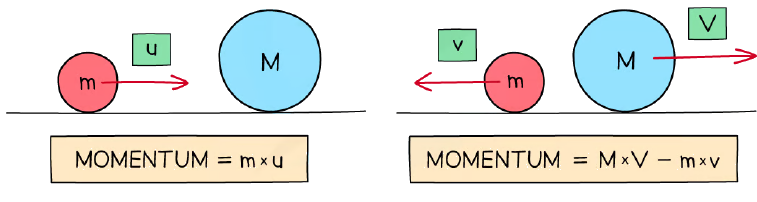
Angular Impulse
- Angular impulse is the change in angular momentum produced by a torque acting over a time interval: ΔL = τΔt.
- Angular impulse is measured in kg m² s⁻¹ or N m s.
- The equation requires a constant resultant torque; if torque varies, use an average value.
- A small torque acting for a long time can produce the same angular impulse as a large torque acting for a short time.
- On a torque–time graph, the area under the graph equals the angular impulse or change in angular momentum.
- For a changing torque, ΔL = I(ωf − ωi) can be used with the area under the graph.
Rotational Kinetic Energy
- A rotating body has rotational kinetic energy: Ek = ½Iω² (or Ek = L² / 2I).
- For an object rolling without slipping, total kinetic energy is the sum of translational and rotational kinetic energy: Ektotal = ½mv² + ½Iω².
- Rolling without slipping requires friction; the point of contact has zero velocity, the centre of mass has velocity v = ωr, and the top point has velocity 2v.
- When an object rolls down a slope, gravitational potential energy is converted into both translational and rotational kinetic energy: mgΔh = ½mv² + ½Iω².
- Using v = ωr and the moment of inertia, the total kinetic energy can be expressed in terms of ω or v; for a solid sphere, mgΔh = 7/10 mω²r².
- If an object slides (slips) without rolling, there is no rotational kinetic energy and angular velocity is zero.
スライド
練習問題
無料プレビュー — 61問中8問。すべて見るには登録を。
1.Which of the following best defines the moment of a force about a pivot?
Easy- AThe product of the force and the perpendicular distance from the pivot to the line of action of the force
- BThe product of the force and the distance from the pivot to the point of application of the force
- CThe force divided by the perpendicular distance from the pivot
- DThe product of the force and the time for which it acts
2.Which pair of forces acts as a couple?
Easy- ATwo forces equal in magnitude, opposite in direction, and perpendicular to the distance between them
- BTwo forces equal in magnitude and in the same direction, separated by a distance
- CTwo forces of different magnitudes acting in opposite directions
- DTwo forces equal in magnitude and opposite in direction, but not perpendicular to the distance between them
3.A force of 50 N is applied at an angle of 30° to a spanner of length 0.20 m. What is the torque produced?
Medium- A5.0 N m
- B8.7 N m
- C10 N m
- D0.50 N m
4.A uniform beam is pivoted at its centre. Two forces act on it: a 10 N force downwards at 0.30 m to the left of the pivot, and a 15 N force downwards at 0.20 m to the right of the pivot. What is the resultant torque on the beam?
Medium- A0 N m, the beam is in rotational equilibrium
- B1.0 N m clockwise
- C1.0 N m anticlockwise
- D6.0 N m clockwise
5.A solid cylinder of mass 2.0 kg and radius 0.50 m rotates about its central axis. What is its moment of inertia? (I = ½MR²)
Medium- A0.25 kg m²
- B0.50 kg m²
- C1.0 kg m²
- D0.125 kg m²
6.A star of mass M and radius R rotates with angular velocity ω. It collapses to a sphere of radius R/4 without losing mass. What is its new angular velocity? (Assume it remains a uniform sphere.)
Hard- A16ω
- B4ω
- Cω/4
- Dω/16
7.Which of the following statements about a couple are correct? (Select all that apply.)
Medium- AThe resultant force of a couple is zero.
- BA couple produces a net torque.
- CThe moment of a couple depends on the choice of pivot.
- DA couple causes angular acceleration.
- EThe forces in a couple must act along the same line of action.
8.Which of the following are units of angular momentum? (Select all that apply.)
Medium- Akg m² s⁻¹
- BN m s
- Ckg m s⁻¹
- DJ s
- Ekg m² s⁻²