Kinematics
遊んで学ぼう
問題に答えてエネルギーを集めたら、釣りや探検を楽しもう。アカウント不要。
教育者の方へ: Kinematics(Physics、SL)向けのすぐ使えるレッスンスライド, 復習ノート — レッスンで使うか、学習者がライブゲームとして遊ぶインタラクティブなクラス活動としてトピックを実施できます。
レッスンノート
Distance & Displacement
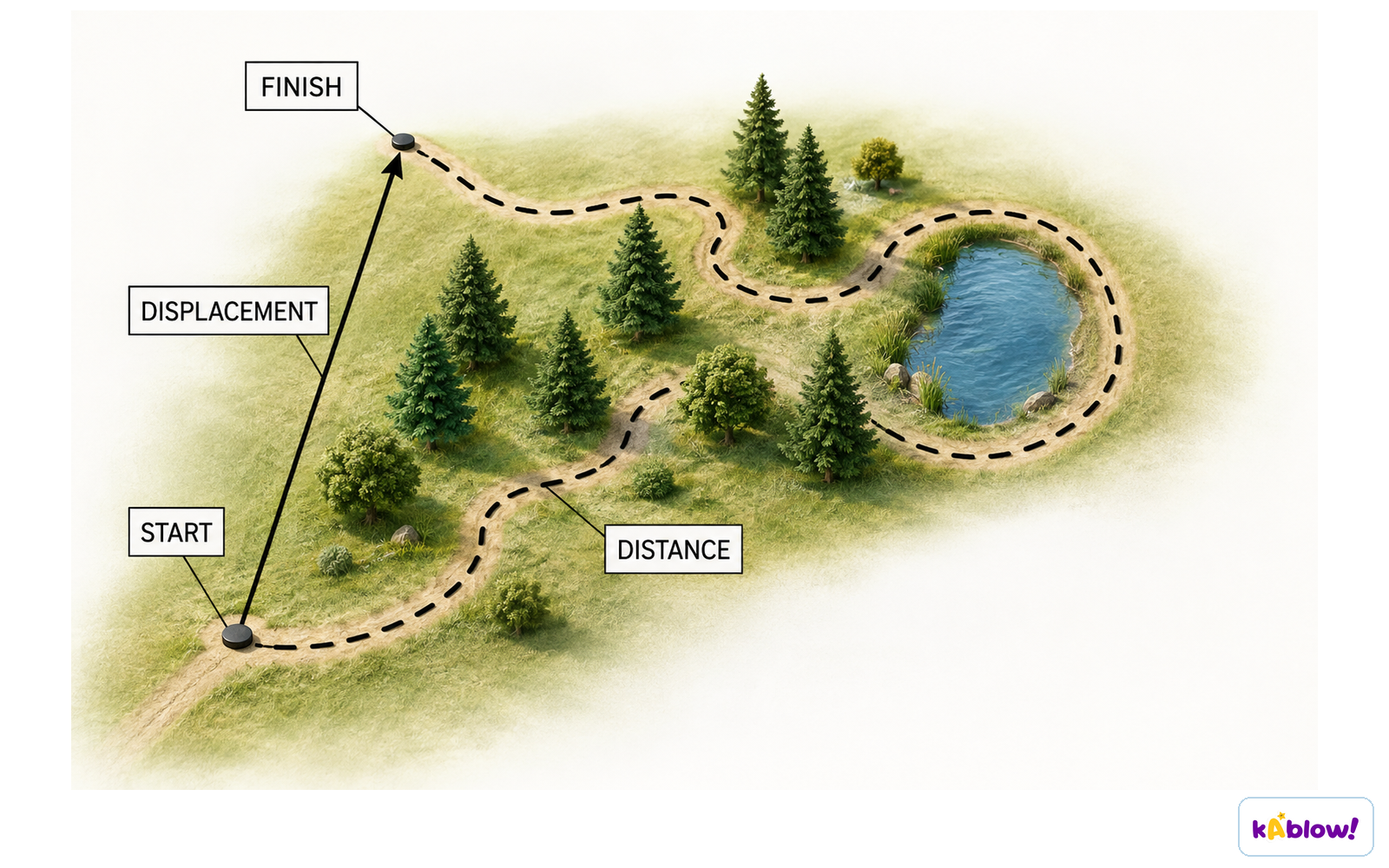
- Distance is a measure of how far an object travels, and it is a scalar quantity (direction is not important).
- Displacement is a measure of how far something is from its starting position, along with its direction; it is a vector quantity.
- Displacement describes the change in position and includes both magnitude and direction.
- For a journey that returns to the starting point, the total distance is non-zero but the displacement is zero.
- When travelling to school, the distance includes all the twists and turns of the roads, while the displacement is the straight-line distance from home to school.
Distance vs displacement
Speed & Velocity
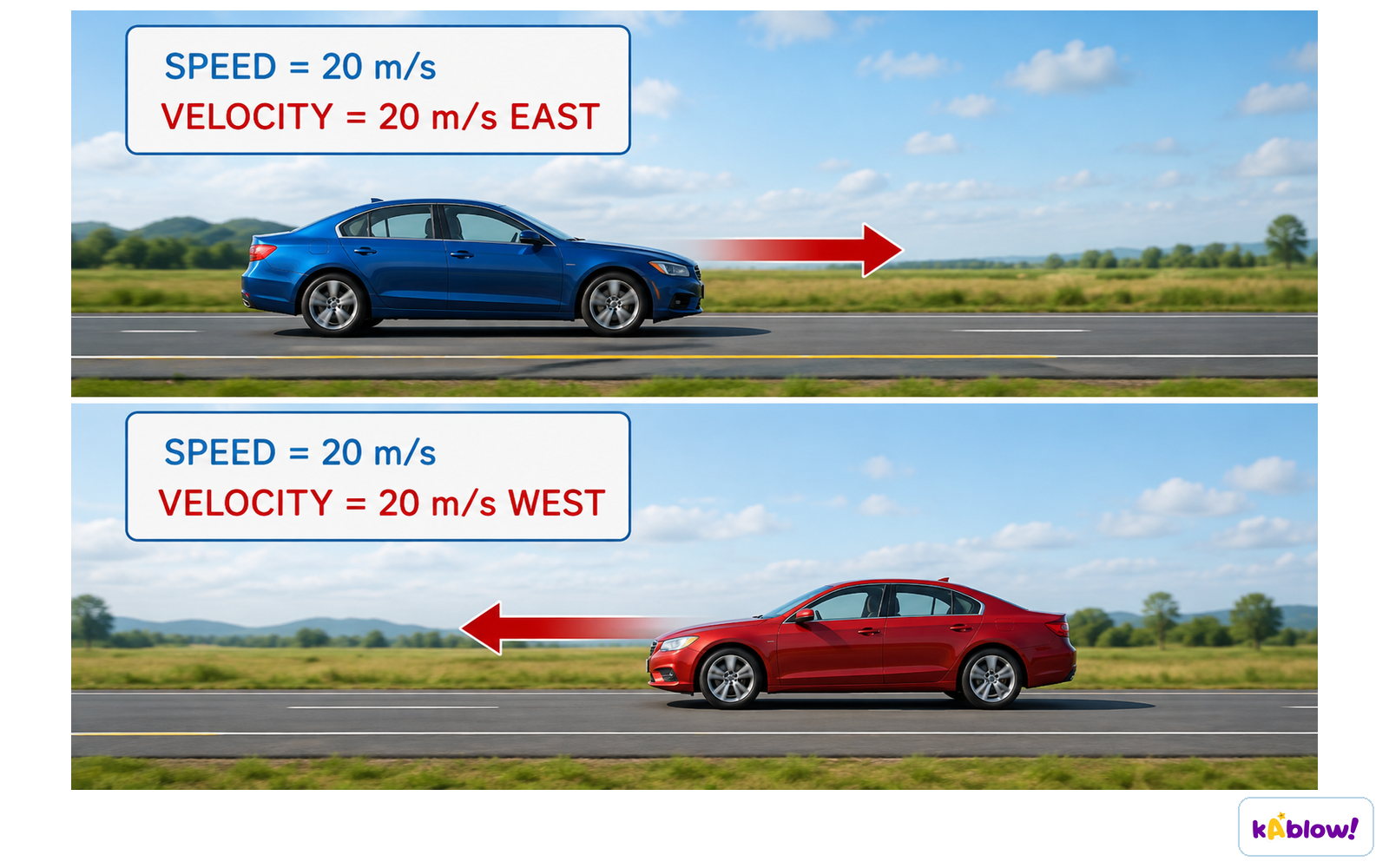
- Speed is the distance travelled per second; it is a scalar quantity.
- Average speed = total distance ÷ time taken.
- Velocity is the rate of change of displacement; it is a vector quantity.
- Velocity is speed in a given direction, so it can be positive or negative.
- Instantaneous speed (or velocity) is the speed (or velocity) at a particular moment in time.
- On a displacement–time graph, the gradient gives velocity; for a curved line, draw a tangent at the required time and calculate its gradient.
- Average velocity = total displacement ÷ total time taken.
- If acceleration is constant, average velocity can also be calculated as (u + v)/2.
Comparing speed and velocity
Acceleration
- Acceleration is defined as the rate of change of velocity.
- Acceleration is a vector quantity measured in metres per second squared (m s⁻²).
- Average acceleration = change in velocity ÷ time taken, or a = Δv/Δt.
- Change in velocity = final velocity − initial velocity, or Δv = v − u.
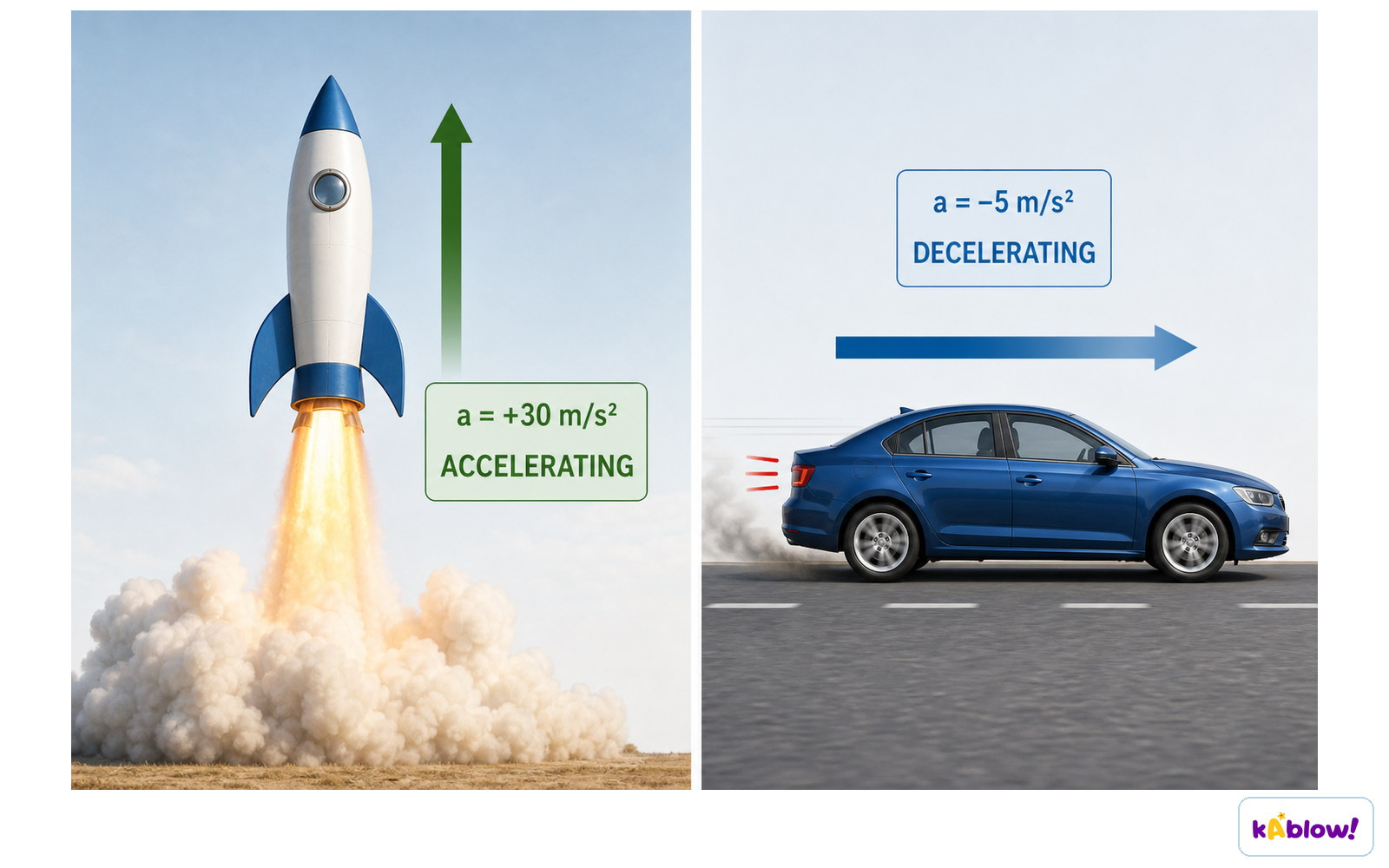
- If an object is speeding up, acceleration is positive; if slowing down, acceleration is negative (deceleration).
- Acceleration can also be negative if the object is accelerating in the negative direction.
- Instantaneous acceleration is the acceleration at a particular point in time; it is shown by a curved line on a velocity–time graph.
Illustration of positive and negative acceleration with a rocket and a car.
Kinematic Equations
- The kinematic equations (SUVAT equations) describe motion with constant (uniform) acceleration.
- The five variables are: s = displacement, u = initial velocity, v = final velocity, a = acceleration, t = time interval.
- The four equations are: v = u + at; s = ut + ½at²; v² = u² + 2as; s = (u + v)t / 2.
- These equations are given in the data booklet, so you do not need to memorise them.
- 'Starts from rest' means u = 0 and t = 0.
- 'Falling due to gravity' means a = g = 9.8 m s⁻²; choose a positive direction and keep it consistent.
- To solve problems: list known and unknown quantities, choose the equation containing those quantities, convert units to SI, then substitute and solve.
Motion Graphs
- On a displacement–time graph: slope equals velocity; a straight diagonal line represents constant velocity; a curved line represents acceleration.
- On a displacement–time graph, a positive slope means motion in the positive direction, a negative slope means motion in the negative direction, and a zero slope means the object is at rest.
- On a velocity–time graph: slope equals acceleration; a straight diagonal line represents uniform acceleration; a curved line represents non-uniform acceleration.
- On a velocity–time graph, the area under the curve equals the change in displacement.
- On an acceleration–time graph: the area under the curve equals the change in velocity; a horizontal line represents constant acceleration.
- For a bouncing ball, acceleration due to gravity is always directed downwards; at the highest point the velocity is momentarily zero and changes direction.
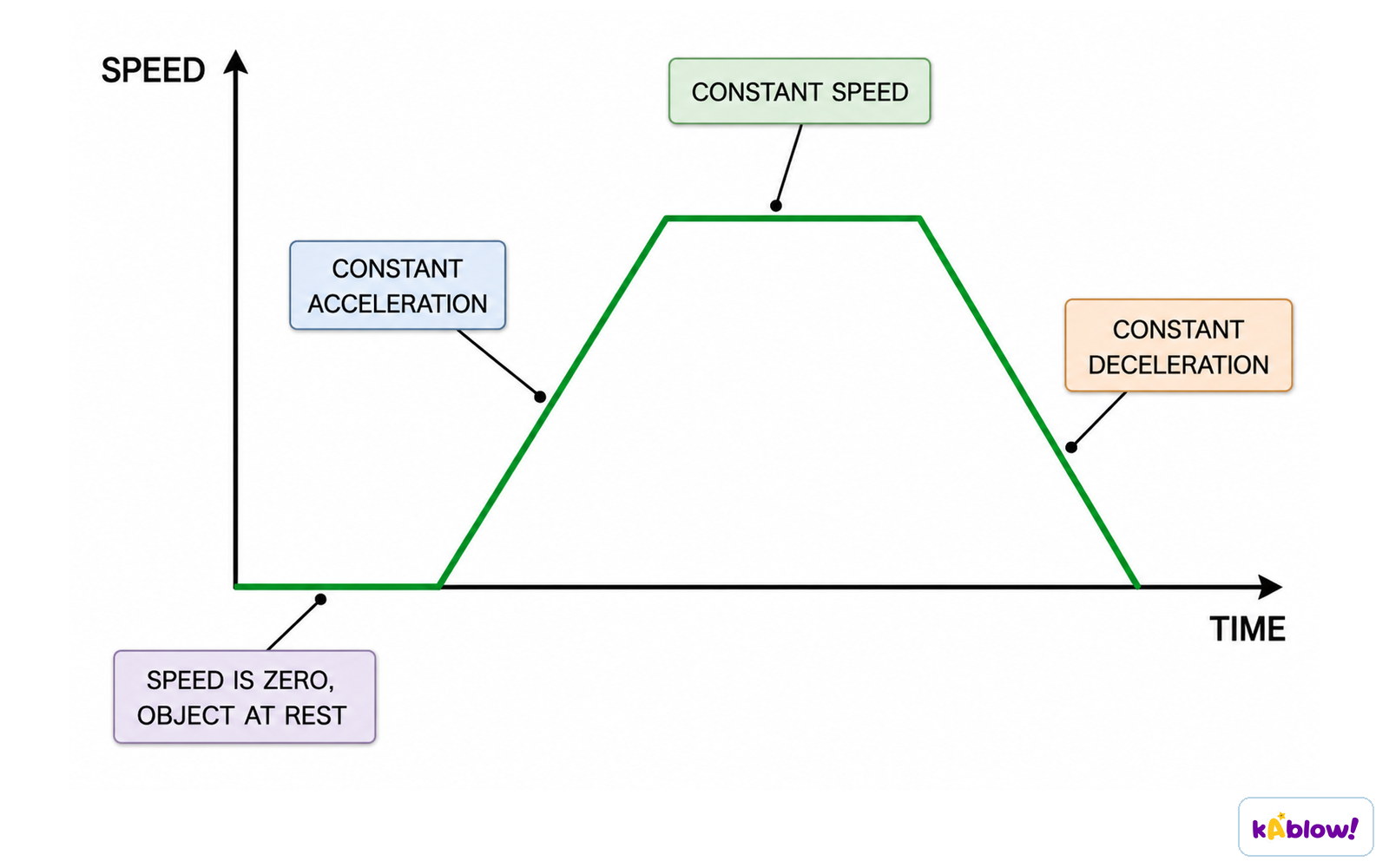
Motion on a speed–time graph
Projectile Motion
- A projectile is a particle moving freely under gravity in a two-dimensional plane, with negligible fluid resistance and constant g.
- The horizontal and vertical components of motion are independent of each other and must be analysed separately using the SUVAT equations.
- Horizontal motion: velocity is constant, acceleration is zero.
- Vertical motion: acceleration is g (9.8 m s⁻²), acting downwards.
- If a projectile is launched with speed u at angle θ to the horizontal, its initial horizontal component is u cosθ and its initial vertical component is u sinθ.
- Time of flight is the total time in the air; for level ground, the time to maximum height is half the total time.
- Maximum height is reached when the vertical velocity component is zero.
- Range is the horizontal distance travelled by the projectile.
Fluid Resistance
- Fluid resistance refers to the resistive forces (viscous drag) acting on an object moving through a gas or liquid.
- Viscous drag is a type of friction that always acts in the opposite direction to motion and increases with the object's speed.
- Lift is an upward force perpendicular to the fluid flow, often arising from Newton's Third Law.
- In projectile motion, air resistance decreases the horizontal velocity, range, maximum height and time of flight.
- With air resistance, the trajectory is no longer a parabola; it is steeper on the way down than on the way up.
- For sports like long jump or javelin, an optimum angle is used to maximise range against air resistance.
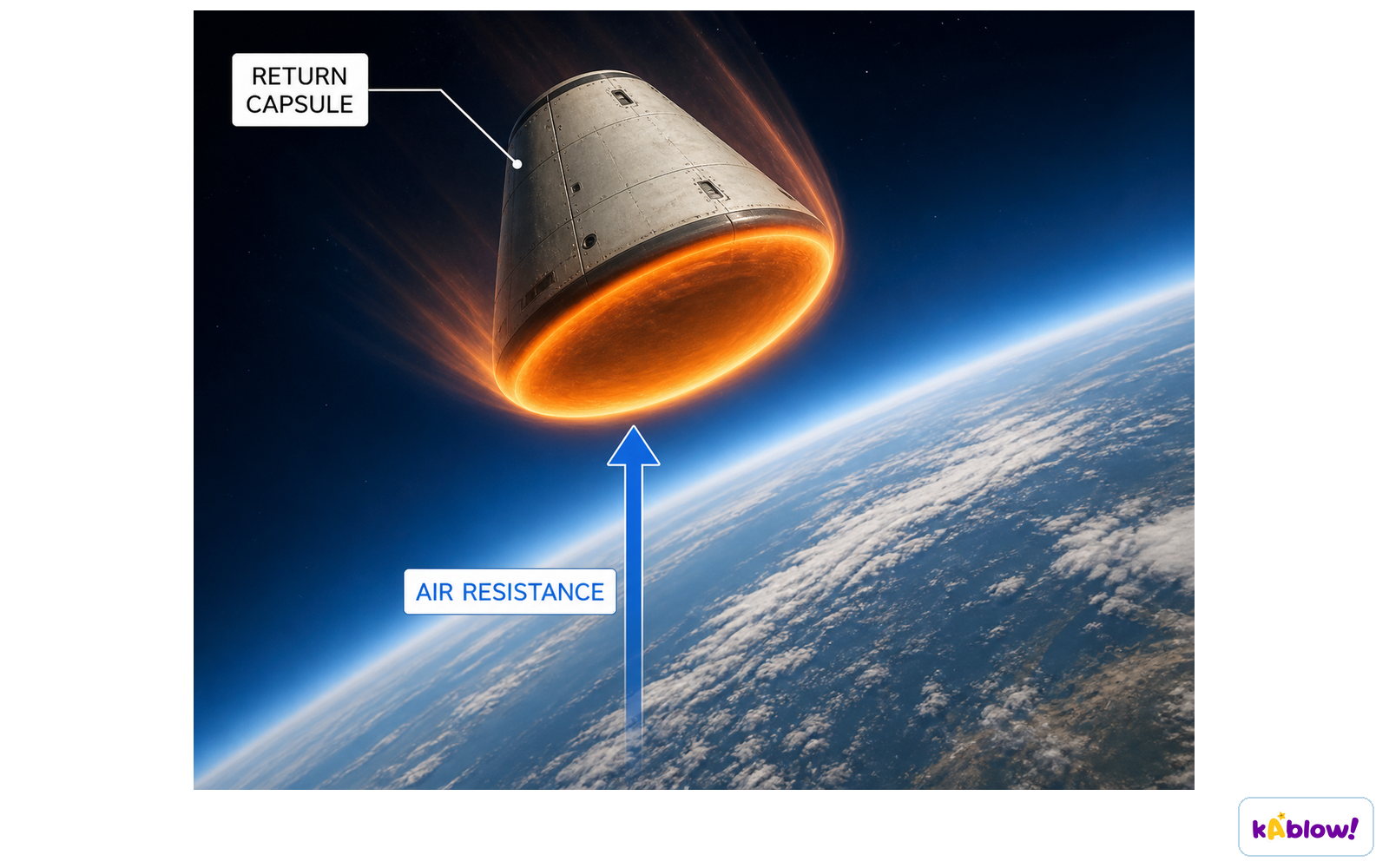
Air resistance is a type of drag: it opposes motion through a fluid and heats the object.
Terminal Speed
- For a body falling in a vacuum, the only force is weight, so acceleration is g.
- As a body falls through a fluid, viscous drag increases with speed, reducing the resultant force and therefore the acceleration.
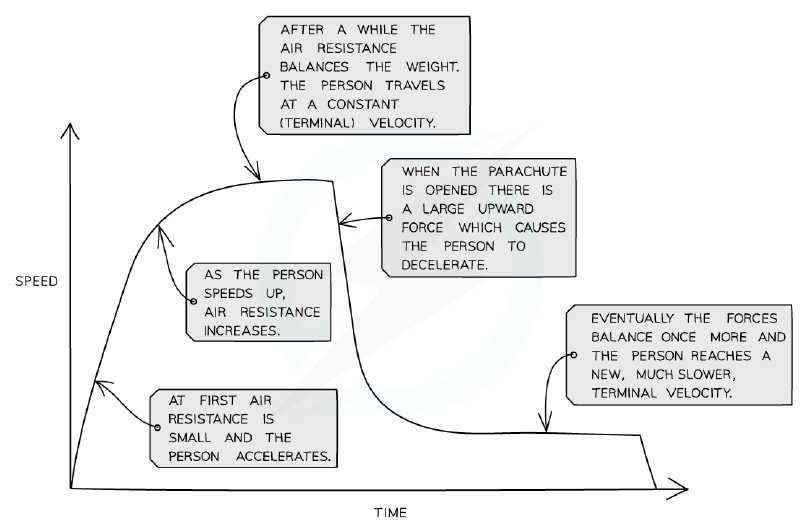
- Terminal velocity is reached when the viscous drag force equals the weight, so the resultant force is zero and the body falls at a constant velocity.
- On a velocity–time graph for a skydiver, the gradient (acceleration) decreases until it becomes zero at terminal velocity.
- A heavier skydiver reaches a higher terminal velocity and reaches it faster than a lighter skydiver with the same surface area.
- After a parachute is deployed, the skydiver decelerates to a lower terminal velocity; they do not move upwards.
A speed-time graph for a skydiver: air resistance builds as speed increases until it balances weight and a constant (terminal) velocity is reached.
スライド
練習問題
無料プレビュー — 62問中8問。すべて見るには登録を。
1.What is the definition of acceleration?
Easy- AThe rate of change of velocity
- BThe rate of change of displacement
- CThe length between two points
- DThe length between two points in a certain direction
2.Which of the following correctly describes distance and displacement?
Easy- ADistance is a scalar and displacement is a vector
- BDistance is a vector and displacement is a scalar
- CBoth distance and displacement are scalars
- DBoth distance and displacement are vectors
3.A sprint walker completes a 200 m race in 40 s. What is their average speed during the race?
Easy- A5 m s⁻¹
- B6 m s⁻¹
- C7 m s⁻¹
- D8 m s⁻¹
4.Velocity is a vector quantity.
EasyTrue or false?
5.What does the gradient of a displacement-time graph represent?
Easy- AVelocity
- BDistance
- CSpeed
- DAcceleration
6.A velocity-time graph is shown for an object. Which property of the graph represents the total displacement of the object?
Easy- AThe total area between the line and the axis
- BThe gradient of the line
- CThe y-intercept
- DThe x-intercept
7.A car accelerates from rest to a speed of 40 m s⁻¹ in 5 seconds. What is the car's acceleration?
Medium- A8 m s⁻²
- B5 m s⁻²
- C20 m s⁻²
- D35 m s⁻²
8.Which of the following quantities are vectors? (Select all that apply.)
Medium- ADisplacement
- BVelocity
- CAcceleration
- DDistance
- ESpeed
過去問
このトピックの過去問練習は近日公開。
近日公開