Scalars & Vectors
遊んで学ぼう
問題に答えてエネルギーを集めたら、釣りや探検を楽しもう。アカウント不要。
教育者の方へ: Scalars & Vectors(Physics、SL)向けのすぐ使えるレッスンスライド, 復習ノート — レッスンで使うか、学習者がライブゲームとして遊ぶインタラクティブなクラス活動としてトピックを実施できます。
レッスンノート
Scalar & Vector Quantities
- A scalar is a quantity that has only a magnitude (size).
- A vector is a quantity that has both a magnitude and a direction.
- Distance is a scalar because it describes how far an object has travelled overall, but not the direction.
- Displacement is a vector because it describes how far an object is from its starting point and in what direction.
- Example: A hiker's displacement is the straight-line distance from start to finish, while the distance walked is the total path length.
- To decide if a quantity is a vector, ask: can it have a minus sign? For example, negative displacement is possible, but negative energy is not.
Representing Vectors
- Vectors are represented by an arrow.
- The arrowhead indicates the direction of the vector.
- The length of the arrow represents the magnitude of the vector.
- Component vectors are sometimes drawn with a dotted line and a subscript indicating horizontal or vertical, e.g. Fx for the horizontal component and Fy for the vertical component of force F.
Combining Vectors
- Vectors can be combined by adding or subtracting them to produce the resultant vector (also called the 'net' vector).
- Triangle method: Step 1: link the vectors head-to-tail. Step 2: the resultant vector is formed by connecting the tail of the first vector to the head of the second vector.
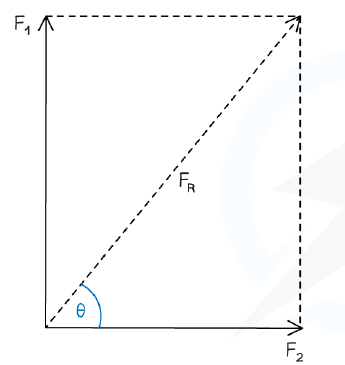
- Parallelogram method: Step 1: link the vectors tail-to-tail. Step 2: complete the parallelogram. Step 3: the resultant vector is the diagonal of the parallelogram.
Vector Multiplication
- The product of a scalar and a vector is always a vector.
- Example: mass (scalar) × acceleration (vector) = force (vector): F = m × a.
- Example: mass (scalar) × velocity (vector) = momentum (vector): p = m × v.
Resolving Vectors
- Resolving a vector is the opposite of adding vectors: a single resultant vector is represented by two vectors that together have the same effect.
- The two parts are called components.
- For a force vector of magnitude F at an angle θ to the horizontal: horizontal component Fx = F cos θ, vertical component Fy = F sin θ.
- The magnitude of the resultant vector is found using Pythagoras' Theorem.
- The direction of the resultant vector is found from the angle it makes with the horizontal or vertical, using trigonometry (sine, cosine, or tangent).
- Tip: cos θ is always the adjacent side of the right-angled triangle (making a 'cos sandwich').
Forces as Vectors
- Forces are vectors and are often represented by free-body force diagrams.
- Rules for drawing a free-body diagram: draw a point at the centre of mass; draw the body free from contact; draw forces as vectors with length proportional to magnitude; draw the tail from the centre of mass and use the tip to indicate direction.
- Common forces on objects: weight, normal reaction force, tension (from cords and strings), and friction.
- Use conventional symbols: w or mg for weight; N or R for normal reaction force.
Vector diagram of two perpendicular forces resolved into a resultant force
Forces on an Inclined Plane
- An inclined plane is a flat surface tilted at an angle θ.
- The weight vector (W = mg) always acts vertically downwards.
- On an inclined plane, weight can be split into components: perpendicular to the slope W = mg cos θ, parallel to the slope W = mg sin θ.
- The normal (or reaction) force R is always perpendicular to the surface.
- If there is no friction, the parallel component of weight, mg sin θ, causes the object to move down the slope.
- If the object is not moving perpendicular to the slope, the normal force is R = mg cos θ.
Equilibrium
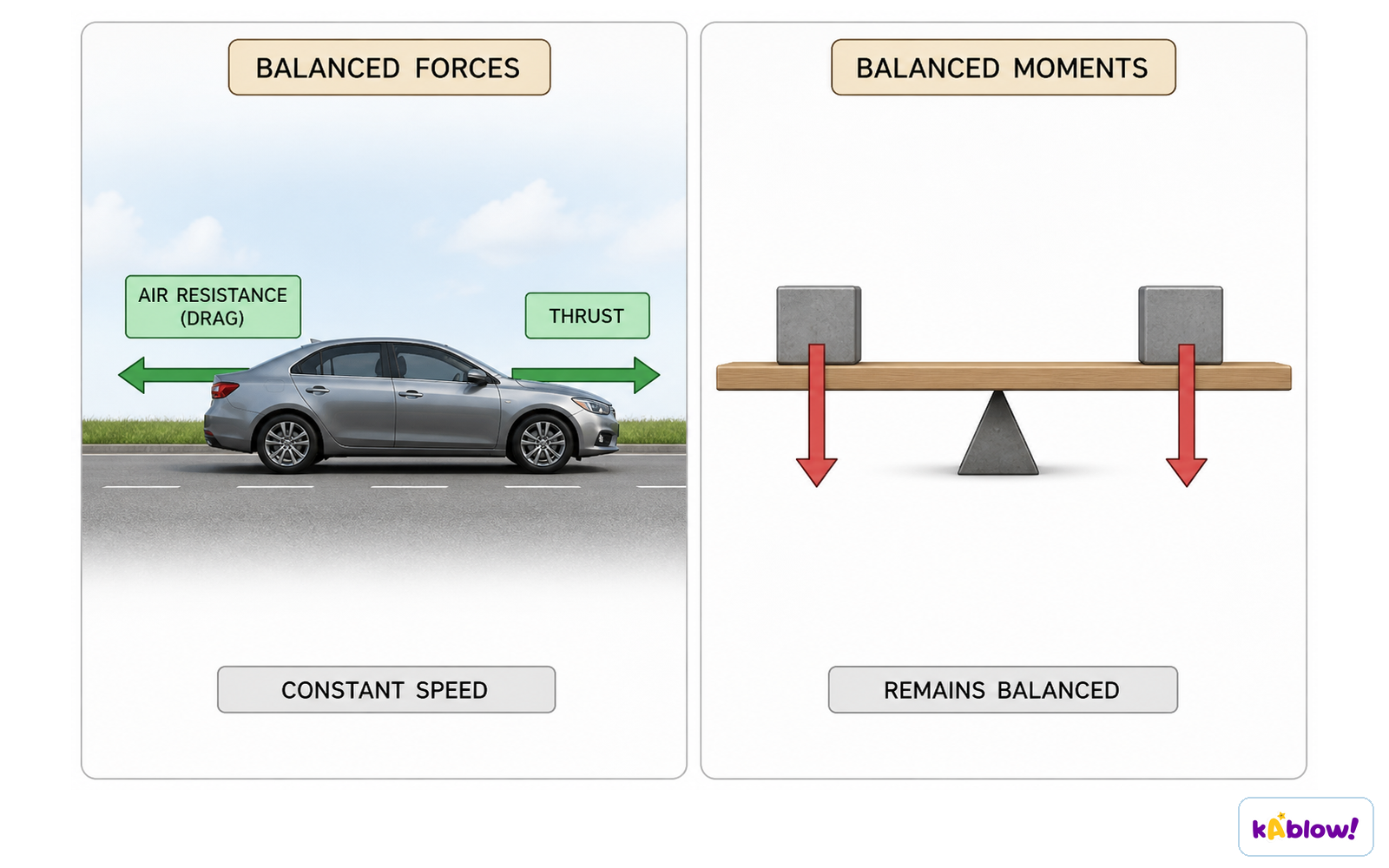
- Forces are in equilibrium if an object is either at rest or moving at constant velocity.
- In equilibrium, coplanar forces are represented by closed vector triangles.
- The vectors, when joined together, form a closed path.
- Three forces on an object in equilibrium form a closed vector triangle.
Systems in equilibrium
Scale Diagrams
- Use calculation if the vectors are perpendicular; use a scale drawing if the vectors are not perpendicular.
- Scale drawing involves drawing lengths and angles accurately using a sharp pencil, ruler, and protractor.
- Steps: link vectors head-to-tail; draw the resultant using the triangle or parallelogram method; measure the length of the resultant with a ruler; measure the angle (from North if it is a bearing) with a protractor.
- A scale may be given, such as 1 cm = 1 km.
- The final answer must be converted back to the units needed, e.g. for a scale of 1 cm = 2 km, a 5 cm length represents 10 km.
- Scale diagram questions typically involve vector triangles that do not contain a right angle.
スライド
練習問題
無料プレビュー — 62問中8問。すべて見るには登録を。
1.Which of the following is a scalar quantity?
Easy- ADisplacement
- BVelocity
- CDistance
- DForce
2.Which of the following is a vector quantity?
Easy- AMass
- BTime
- CDisplacement
- DSpeed
3.A scalar quantity has both magnitude and direction.
EasyTrue or false?
4.Which of the following correctly describes the difference between distance and displacement?
Easy- ADistance is a vector; displacement is a scalar.
- BDistance is a scalar; displacement is a vector.
- CBoth are scalars.
- DBoth are vectors.
5.A vector is represented by an arrow. What does the length of the arrow represent?
Easy- AThe direction of the vector
- BThe magnitude of the vector
- CThe unit of the vector
- DThe component of the vector
6.Which of the following is NOT a scalar quantity?
Medium- AEnergy
- BMass
- CVelocity
- DTemperature
7.The product of a scalar and a vector is always a vector.
EasyTrue or false?
8.Which of the following gives the correct horizontal and vertical components of a force F at an angle θ to the horizontal?
Medium- AHorizontal = F sin θ, vertical = F cos θ
- BHorizontal = F cos θ, vertical = F sin θ
- CHorizontal = F tan θ, vertical = F cos θ
- DHorizontal = F sin θ, vertical = F tan θ
過去問
このトピックの過去問練習は近日公開。
近日公開