Coordination, Response & Homeostasis
遊んで学ぼう
問題に答えてエネルギーを集めたら、釣りや探検を楽しもう。アカウント不要。
教育者の方へ: Coordination, Response & Homeostasis(Biology、CIE)向けのすぐ使えるレッスンスライド, 復習ノート — レッスンで使うか、学習者がライブゲームとして遊ぶインタラクティブなクラス活動としてトピックを実施できます。
レッスンノート
Mammalian Nervous System
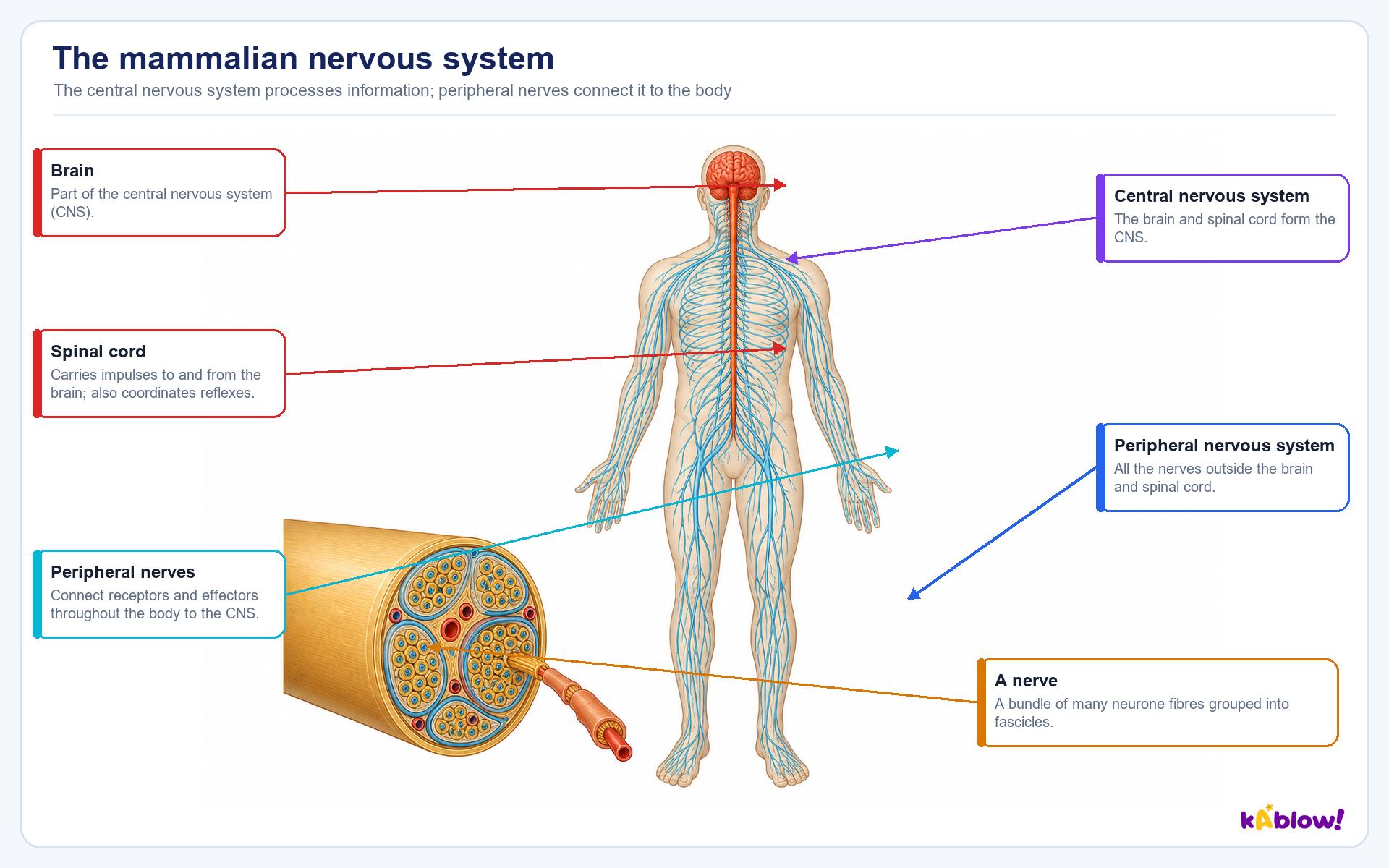
- The nervous system consists of the central nervous system (CNS) (brain & spinal cord) and the peripheral nervous system (PNS) (all nerves).
- It allows us to sense surroundings, respond, and coordinate body functions.
- Information travels as nerve impulses – electrical signals along neurones.
- A bundle of neurones is called a nerve.
A nerve is a bundle of neurones
Types of Neurones
- Sensory neurones carry impulses from sense organs to the CNS.
- Relay neurones (intermediate) connect sensory and motor neurones inside the CNS.
- Motor neurones carry impulses from the CNS to effectors (muscles or glands).
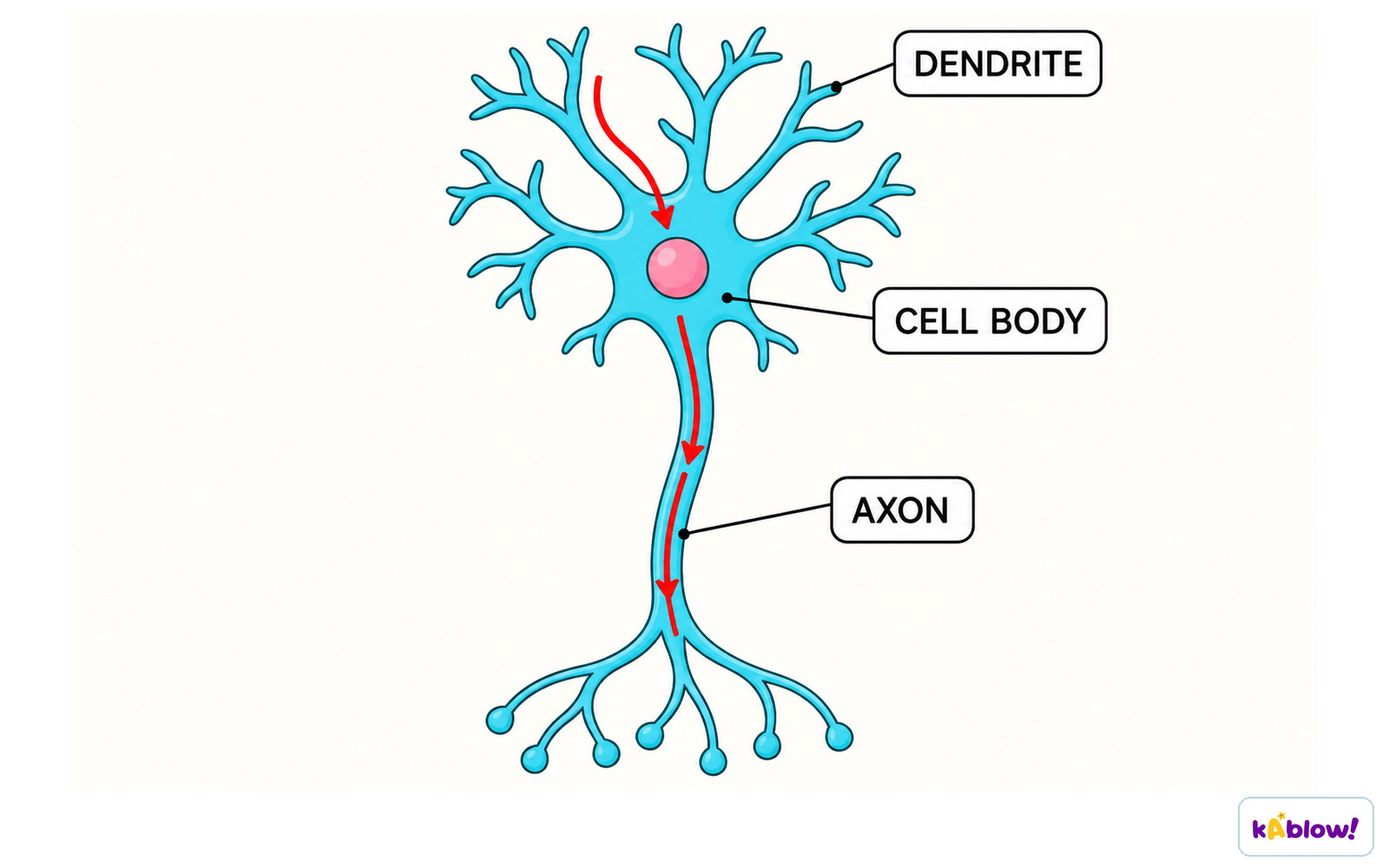
- Neurones have a long axon insulated by a fatty sheath with nodes – impulses jump between nodes for speed.
- Dendrites on the cell body connect to many other neurones.
Structure of a neurone showing dendrite, cell body and axon
The Reflex Arc
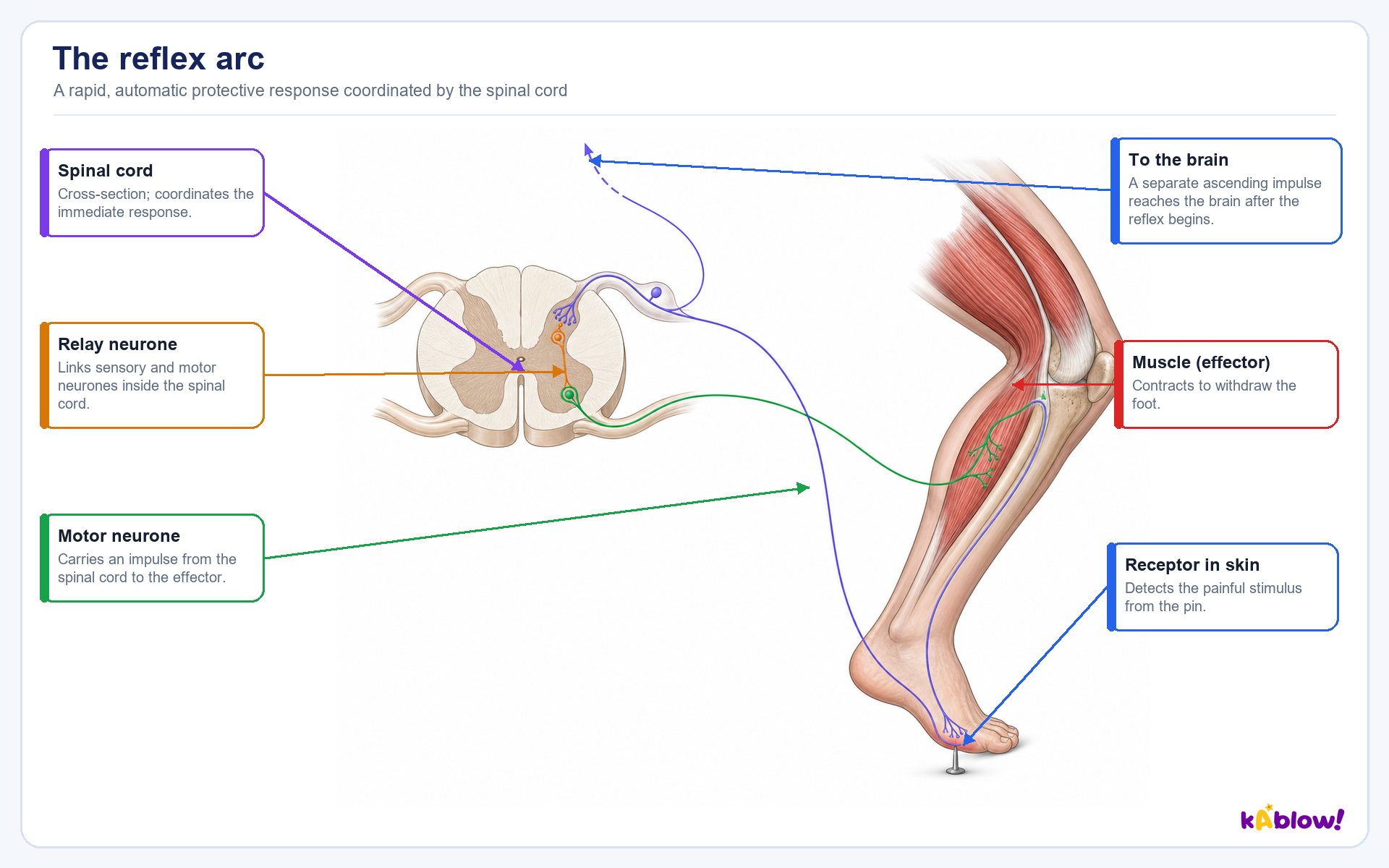
- A reflex is an automatic, rapid, involuntary response to a stimulus.
- It does not involve the brain as coordinator – only the spinal cord.
- Pathway: stimulus → receptor → sensory neurone → relay neurone → motor neurone → effector → response.
- Reflexes are protective and minimise damage (e.g., pulling hand from heat).
The reflex arc pathway
The Synapse (Extended)
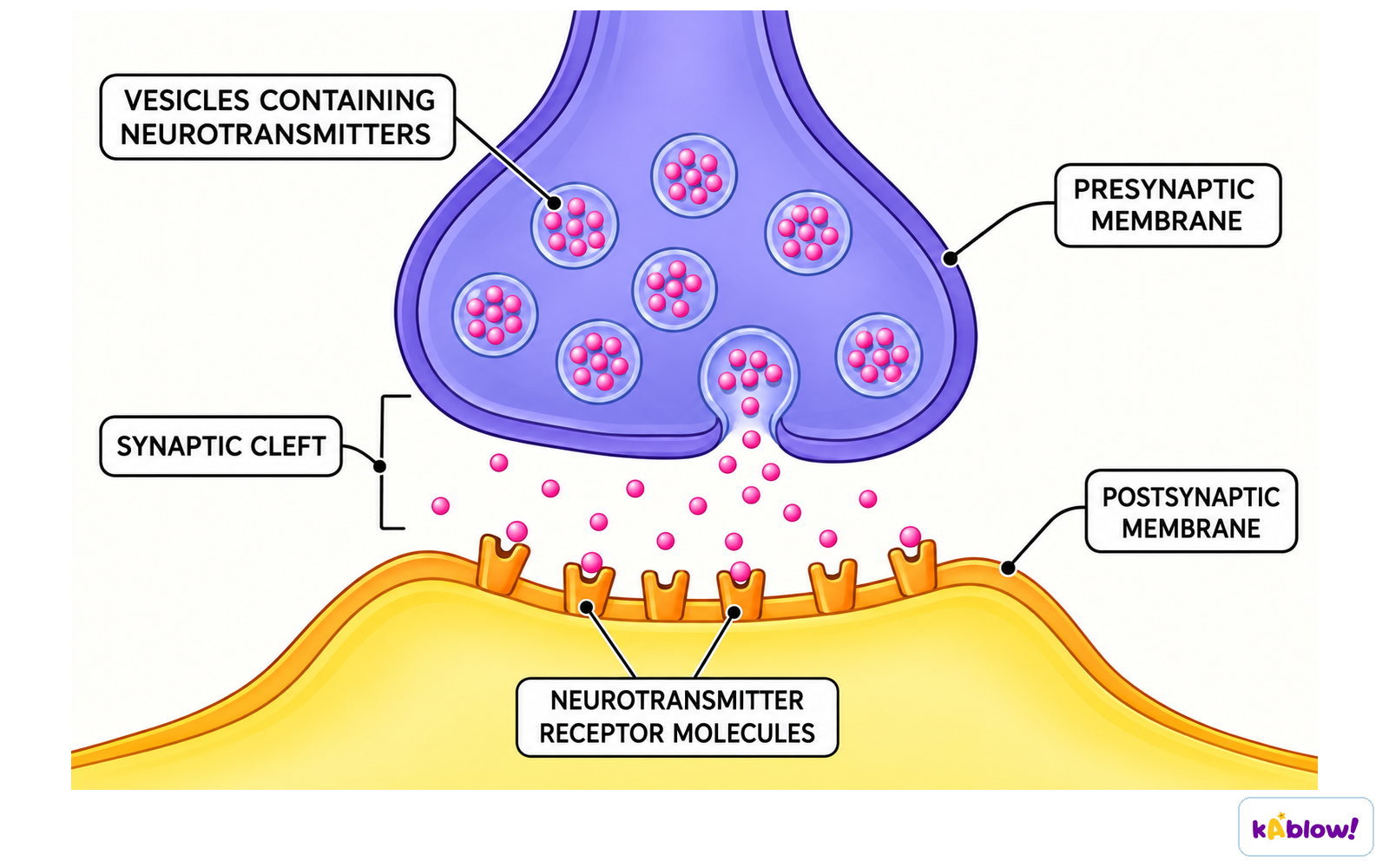
- A synapse is the junction between two neurones where they do not touch.
- The electrical impulse triggers release of neurotransmitters from vesicles in the presynaptic neurone.
- Neurotransmitters diffuse across the synaptic cleft and bind to receptors on the postsynaptic membrane.
- This stimulates a new electrical impulse in the second neurone.
- Neurotransmitters are then destroyed to prevent repeated stimulation.
- Synapses ensure one-way transmission and are sites where drugs (e.g., heroin) can act.
Structure of a synapse
Sense Organs & The Eye
- Sense organs contain receptors that detect specific stimuli and generate impulses.
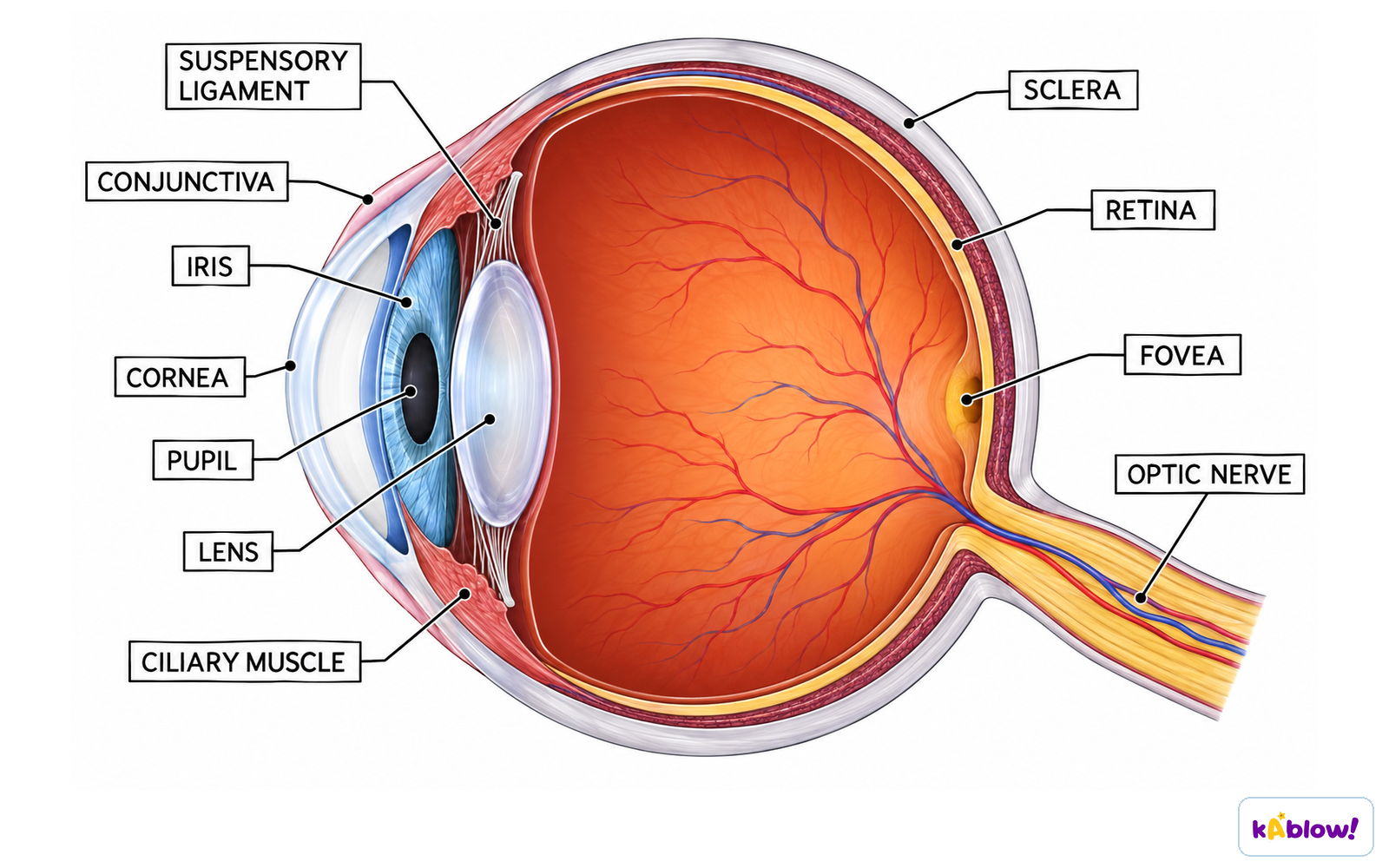
- The eye is a sense organ with light-sensitive receptors.
- Key structures: cornea (refracts light), iris (controls pupil size), lens (focuses light), retina (contains rods & cones), optic nerve (carries impulses to brain).
- Pupil reflex: In dim light, radial muscles contract, circular muscles relax → pupil dilates. In bright light, opposite occurs.
- Accommodation: For near objects, ciliary muscles contract, suspensory ligaments loosen, lens becomes fatter. For distant objects, ciliary muscles relax, ligaments tighten, lens becomes thinner.
- Rods detect low light (night vision); cones detect colour (concentrated in fovea).
Cross-section of the eye
Hormones in Humans
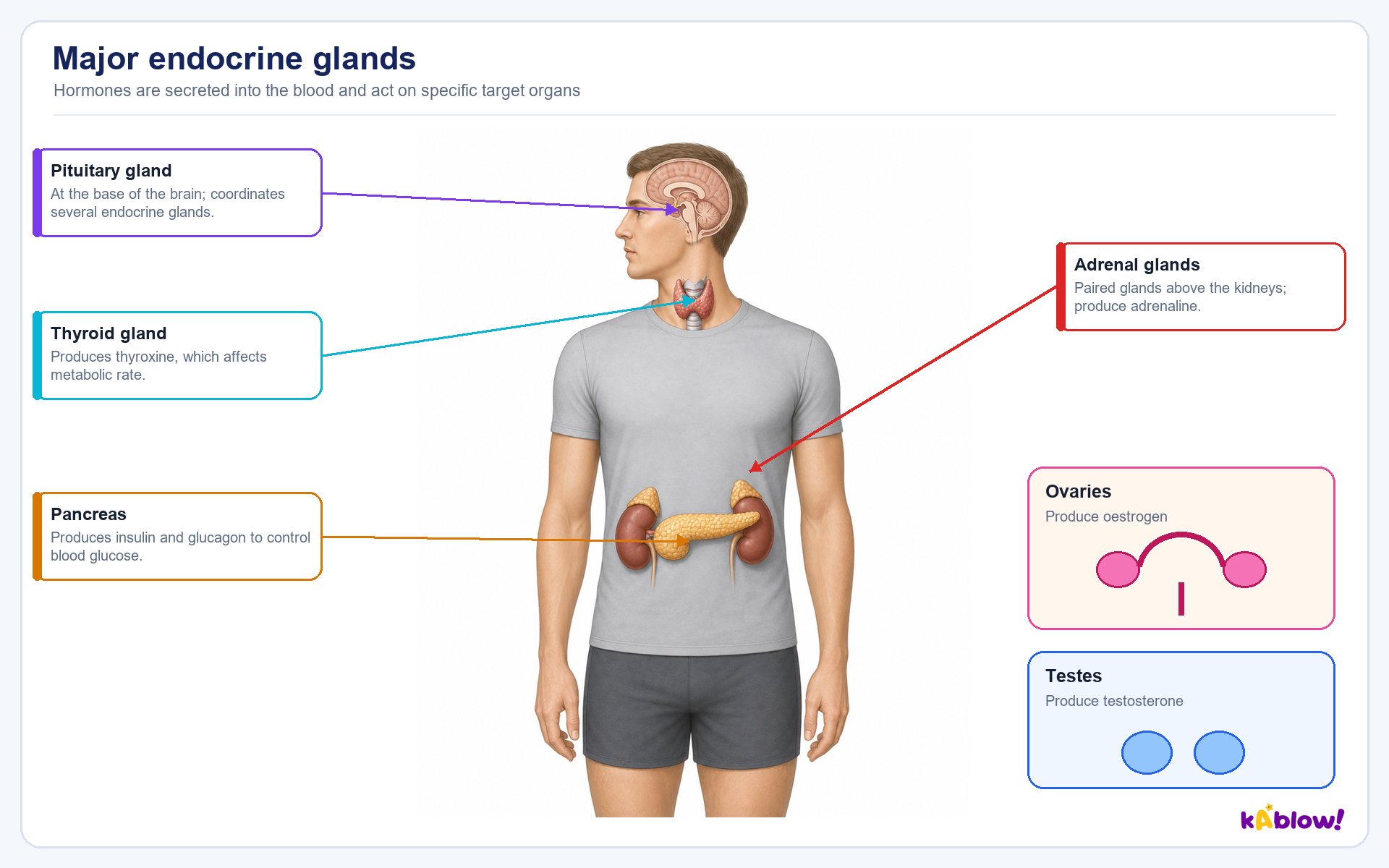
- A hormone is a chemical substance produced by a gland, carried by the blood, altering target organ activity.
- Endocrine glands (e.g., pancreas, adrenal, pituitary) secrete hormones directly into the blood.
- Adrenaline ('fight or flight') increases blood glucose, heart rate, breathing rate, diverts blood to muscles, dilates pupils.
- Insulin lowers blood glucose by converting excess glucose to glycogen in liver and muscles.
- Glucagon raises blood glucose by converting glycogen to glucose.
- Nervous system: fast, short-lived, electrical impulses. Hormonal system: slower, longer-lasting, chemical signals in blood.
The endocrine glands
Homeostasis & Negative Feedback (Extended)
- Homeostasis is the maintenance of a constant internal environment.
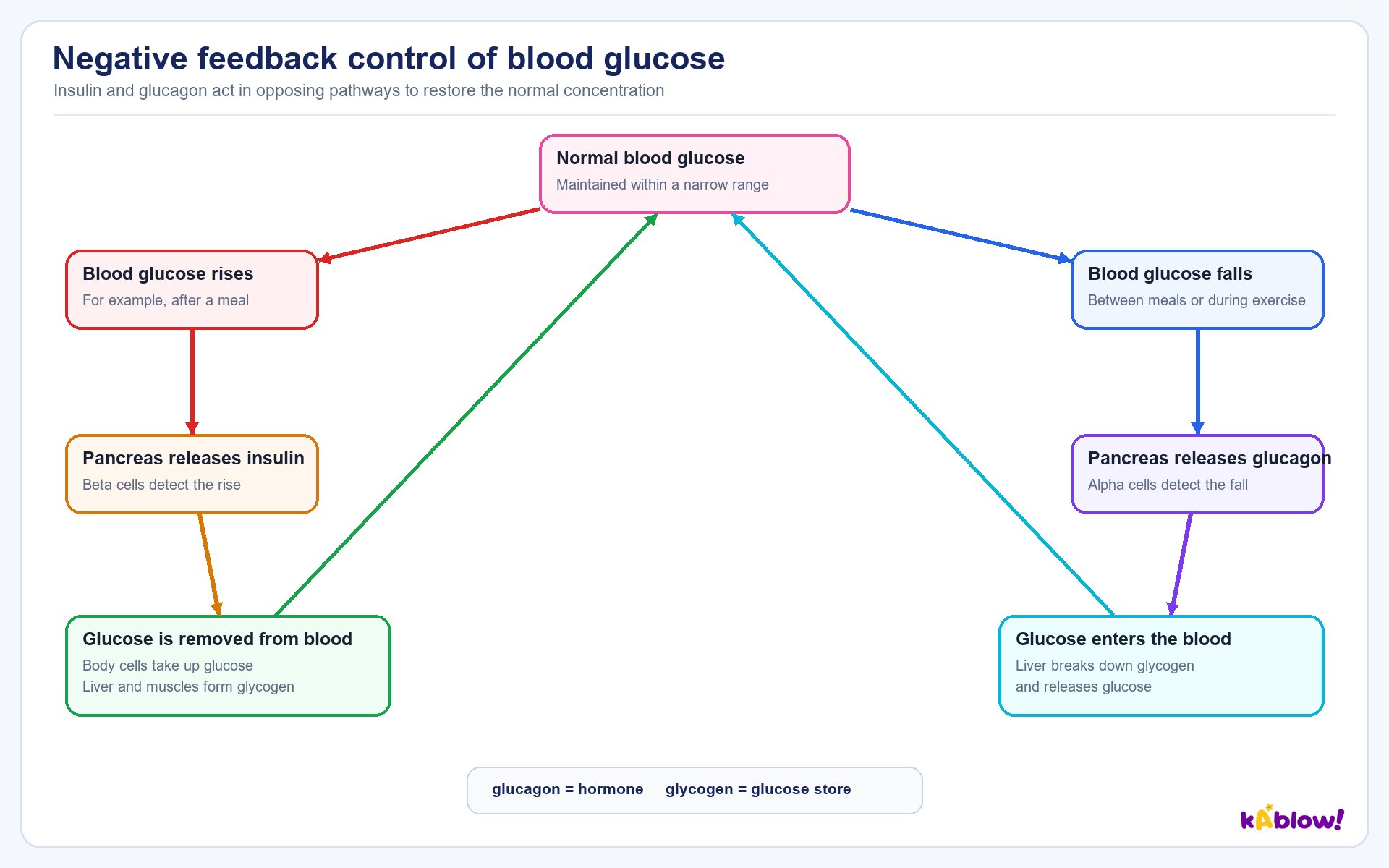
- Negative feedback reverses changes: if a level rises, mechanisms reduce it; if it falls, mechanisms raise it.
- Blood glucose control: high glucose → insulin released → glucose converted to glycogen → glucose falls. Low glucose → glucagon released → glycogen converted to glucose → glucose rises.
- Type 1 diabetes: pancreas cannot produce insulin; treated by insulin injections, diet control, and exercise.
Negative feedback control of blood glucose
Temperature Control (Extended)
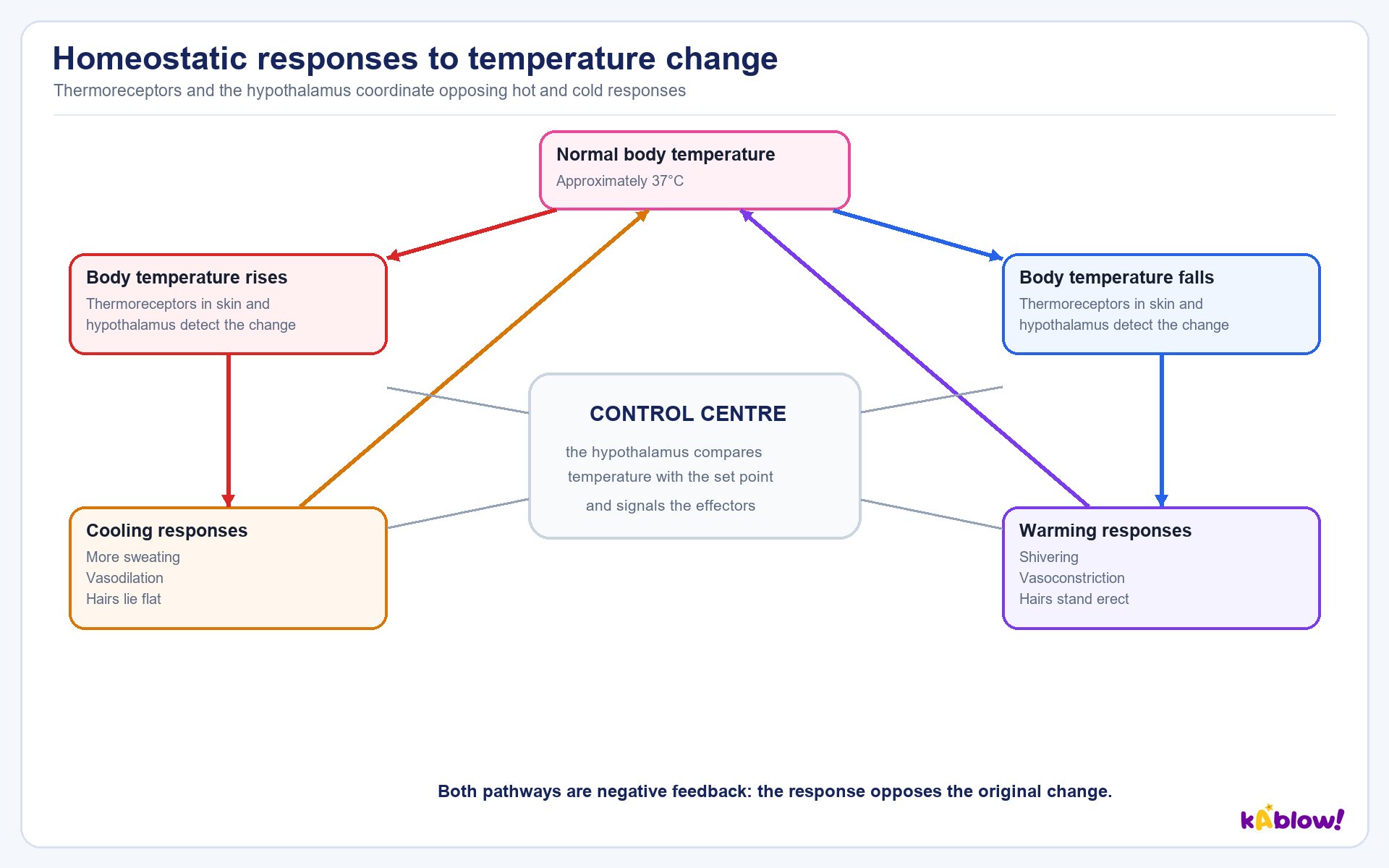
- Body temperature is maintained at ~37°C for optimal enzyme function.
- When hot: vasodilation (skin capillaries widen, more heat lost), sweat production (evaporative cooling), hairs lie flat.
- When cold: vasoconstriction (skin capillaries narrow, less heat lost), sweat stops, hairs stand up (trap insulating air), shivering generates heat.
Negative feedback control of body temperature
Tropisms
- Tropisms are plant growth responses to stimuli.
- Phototropism: shoots grow towards light (positive), roots grow away (negative).
- Gravitropism: shoots grow away from gravity (negative), roots grow towards gravity (positive).
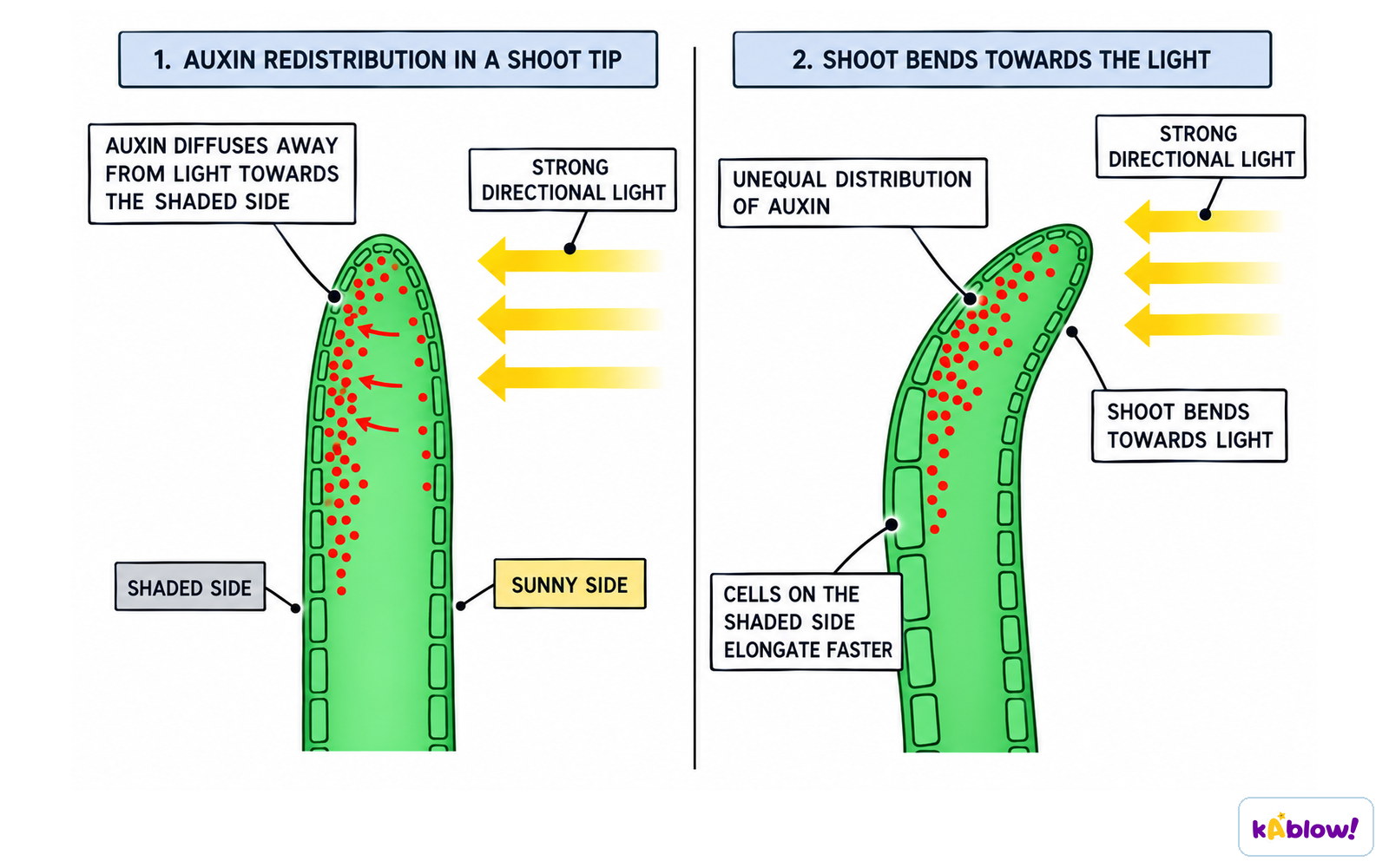
- Auxin is a plant hormone produced in shoot tips that stimulates cell elongation.
- Unequal light distribution causes auxin to accumulate on the shaded side of shoots, causing faster growth there and bending towards light.
- In roots, higher auxin concentration inhibits cell elongation, causing downward bending.
Auxin distribution and phototropism
スライド
練習問題
無料プレビュー — 51問中8問。すべて見るには登録を。
1.Which of the following is the correct order of components during a nervous response?
Easy- Astimulus → receptor → coordinator → effector → response
- Bstimulus → effector → coordinator → receptor → response
- Creceptor → stimulus → coordinator → effector → response
- Dstimulus → receptor → effector → coordinator → response
2.What is the name of the junction between two neurones?
Easy- Asynapse
- Baxon
- Cdendrite
- Dnode of Ranvier
3.Which part of the eye contains light receptor cells?
Easy- Aretina
- Bcornea
- Clens
- Diris
4.Which hormone is released by the adrenal glands in response to danger?
Easy- Aadrenaline
- Binsulin
- Cglucagon
- Dauxin
5.In a reflex arc, which type of neurone carries impulses from the receptor to the spinal cord?
Easy- Asensory neurone
- Bmotor neurone
- Crelay neurone
- Dintermediate neurone
6.In bright light, what happens to the circular and radial muscles of the iris?
Easy- Acircular muscles contract, radial muscles relax
- Bcircular muscles relax, radial muscles contract
- Cboth contract
- Dboth relax
7.Which of the following is an effect of adrenaline on the body?
Easy- Aincreased pulse rate
- Bdecreased breathing rate
- Cconstricted pupils
- Ddecreased blood glucose concentration
8.Which plant hormone stimulates cell elongation in shoots?
Easy- Aauxin
- Binsulin
- Cglucagon
- Dadrenaline
過去問
このトピックの過去問練習は近日公開。
近日公開