Organic Families
遊んで学ぼう
問題に答えてエネルギーを集めたら、釣りや探検を楽しもう。アカウント不要。
教育者の方へ: Organic Families(Chemistry、CIE)向けのすぐ使えるレッスンスライド, 復習ノート, 図解 — レッスンで使うか、学習者がライブゲームとして遊ぶインタラクティブなクラス活動としてトピックを実施できます。
レッスンノート
Fossil Fuels
- A fuel is a substance that releases heat energy when burned.
- Common fossil fuels: coal, natural gas (mainly methane, CH₄), and petroleum (crude oil).
- Hydrocarbons are compounds containing only hydrogen and carbon atoms.
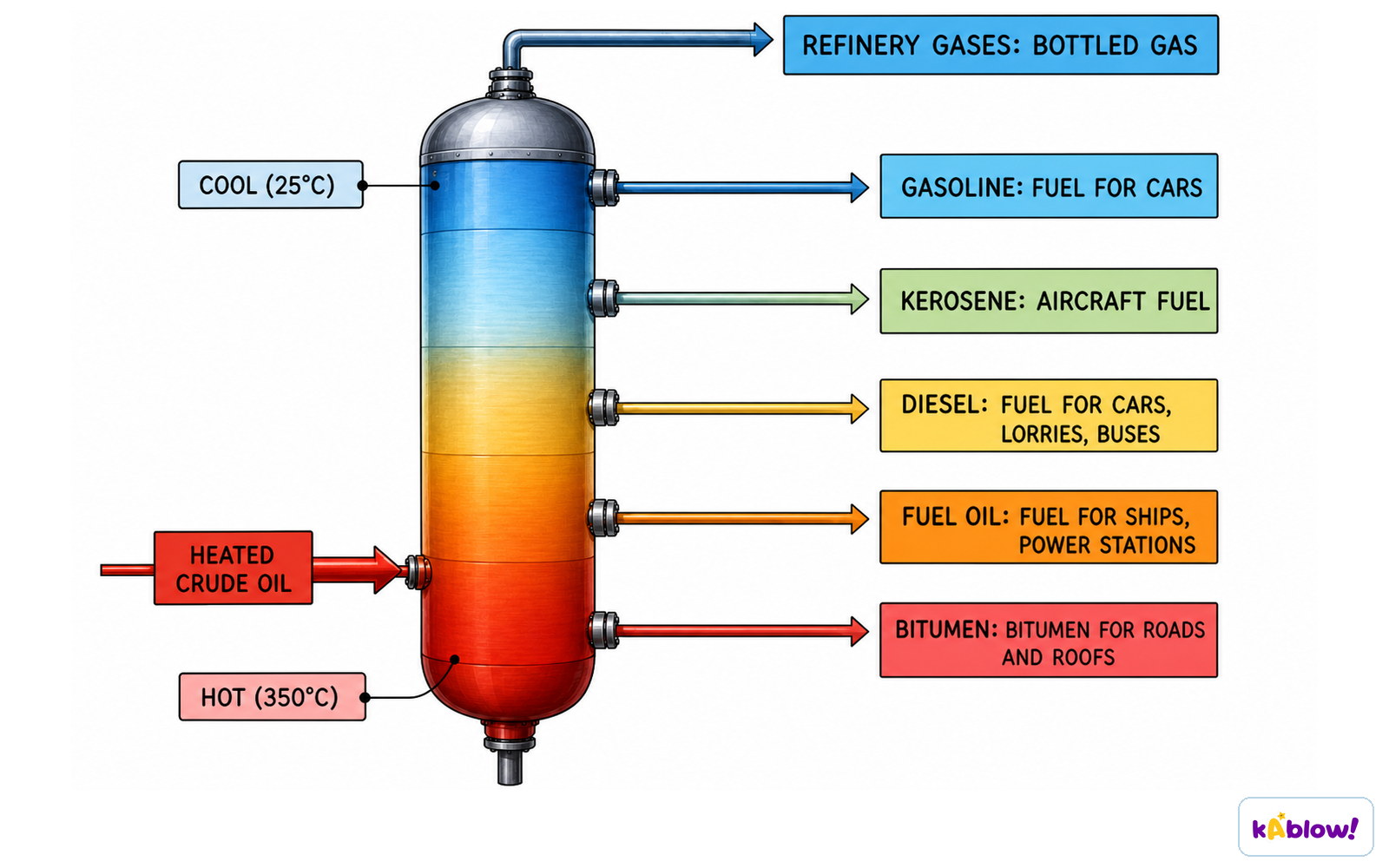
- Petroleum is a mixture of hydrocarbons separated by fractional distillation into fractions with similar boiling points.
- Fractional distillation uses a column with a temperature gradient: hot at bottom, cool at top.
- Properties of fractions: as chain length increases, viscosity increases, volatility decreases, and boiling point increases.
- Uses: refinery gas (heating/cooking), gasoline (car fuel), naphtha (chemicals), kerosene (jet fuel), diesel (engines), fuel oil (ships), lubricating oil, bitumen (roads).
Fractional distillation of petroleum
Alkanes
- Alkanes are saturated hydrocarbons with only single C–C bonds; general formula CₙH₂ₙ₊₂.
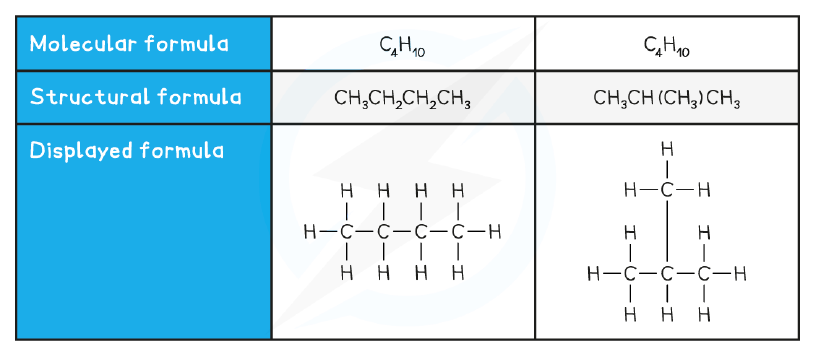
- First five: methane (CH₄), ethane (C₂H₆), propane (C₃H₈), butane (C₄H₁₀), pentane (C₅H₁₂).
- They undergo complete combustion: alkane + O₂ → CO₂ + H₂O.
- They can be cracked into smaller molecules (alkanes, alkenes, H₂).
- Substitution reaction with halogens (e.g., Cl₂) in UV light: H atom replaced by halogen (e.g., CH₄ + Cl₂ → CH₃Cl + HCl).
Butane and its branched isomer
Alkenes
- Alkenes are unsaturated hydrocarbons containing at least one C=C double bond; general formula CₙH₂ₙ.
- First four: ethene (C₂H₄), propene (C₃H₆), but-1-ene (C₄H₈), pent-1-ene (C₅H₁₀).
- Catalytic cracking of long-chain alkanes (600–700°C, alumina/silica catalyst) produces shorter alkanes, alkenes, and H₂.
- Alkenes decolourise bromine water (orange → colourless) – test for unsaturation; alkanes do not.
- More reactive than alkanes due to the C=C bond.
But-1-ene, an alkene
Addition Reactions (Extended)
- In addition reactions, atoms add across the C=C bond; only one product formed.
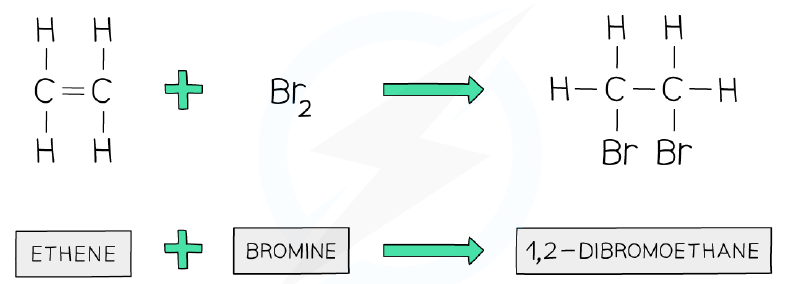
- With bromine: ethene + Br₂ → 1,2-dibromoethane (saturated).
- With hydrogen (Ni catalyst): ethene + H₂ → ethane.
- With steam (hydration, acid catalyst): ethene + H₂O → ethanol.
- These reactions produce saturated compounds from alkenes.
Addition reaction of ethene and bromine
Alcohols
- Alcohols contain the hydroxyl (-OH) functional group; general formula CₙH₂ₙ₊₁OH.
- First three: methanol (CH₃OH), ethanol (C₂H₅OH), propanol (C₃H₇OH).
- Ethanol is used in alcoholic drinks, as a fuel, and as a solvent; burns to CO₂ and H₂O.
- Manufacture: hydration of ethene (300°C, 60 atm, H₃PO₄ catalyst) – continuous, pure product, uses non-renewable crude oil.
- Manufacture: fermentation of glucose (yeast, 25–35°C, anaerobic) – batch process, renewable, dilute product.
- Fermentation equation: C₆H₁₂O₆ → 2CO₂ + 2C₂H₅OH.
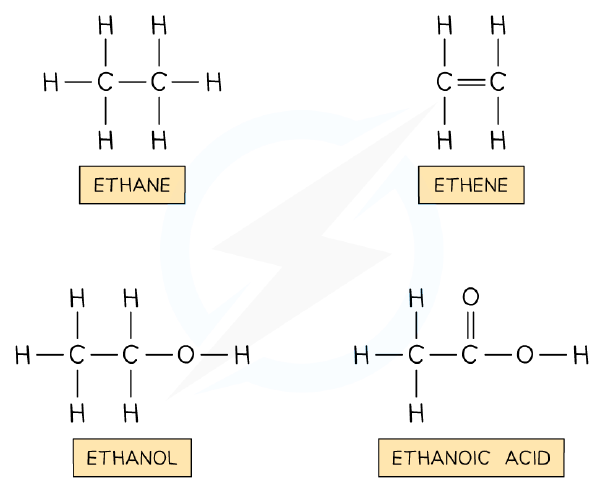
Displayed formulae of ethane, ethene, ethanol and ethanoic acid
Carboxylic Acids
- Carboxylic acids contain the -COOH group; they behave as typical acids.
- React with metals: e.g., 2CH₃COOH + Mg → (CH₃COO)₂Mg + H₂.
- React with bases (neutralisation): CH₃COOH + KOH → CH₃COOK + H₂O.
- React with carbonates: 2CH₃COOH + K₂CO₃ → 2CH₃COOK + H₂O + CO₂.
- Salts end in -anoate (e.g., ethanoate from ethanoic acid).
Displayed formulae of ethane, ethene, ethanol and ethanoic acid
Ethanoic Acid & Esterification (Extended)
- Ethanoic acid (CH₃COOH) is made by oxidation of ethanol: via fermentation (air, bacteria) or using acidified KMnO₄ (purple → colourless).
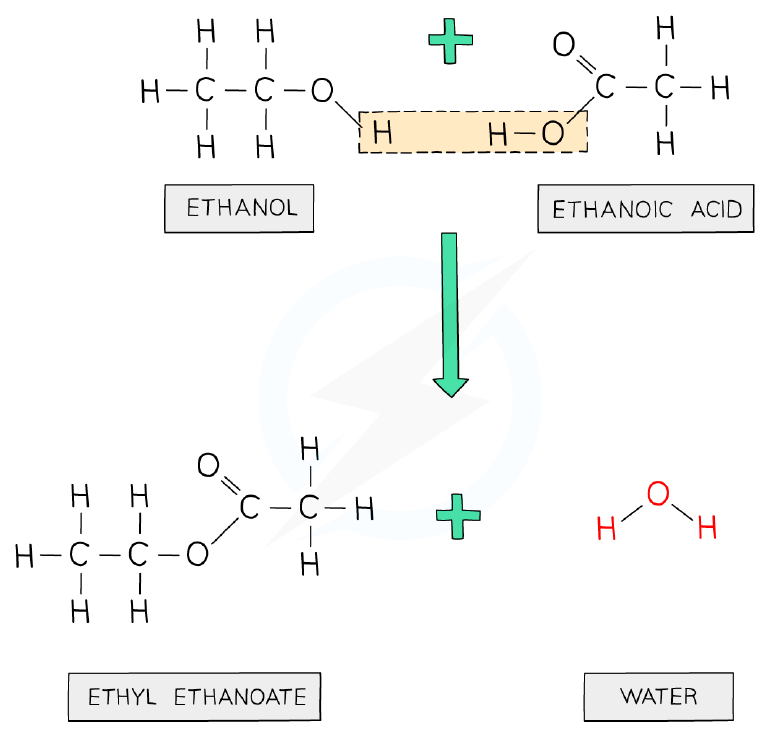
- Esterification: alcohol + carboxylic acid → ester + water, with concentrated H₂SO₄ catalyst.
- Example: CH₃COOH + C₂H₅OH ⇌ CH₃COOC₂H₅ (ethyl ethanoate) + H₂O.
- Esters are sweet-smelling oils used in flavourings and perfumes.
- Naming: first part from alcohol (ends -yl), second from acid (ends -oate); e.g., pentanol + butanoic acid → pentyl butanoate.
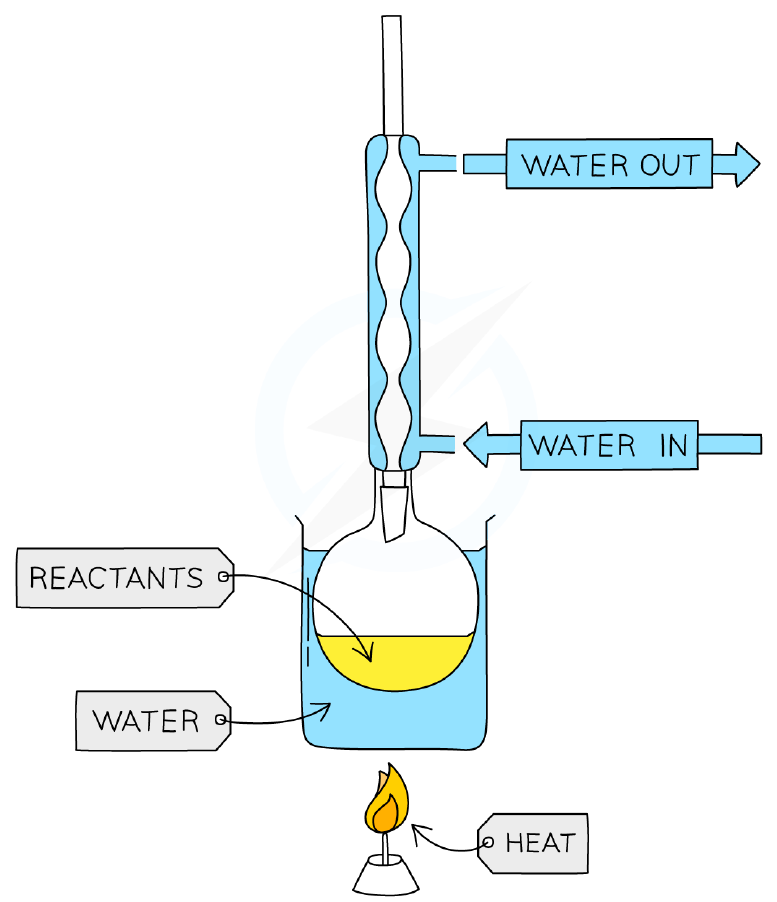
Reflux apparatus for the oxidation of ethanol
スライド
練習問題
無料プレビュー — 48問中8問。すべて見るには登録を。
1.What is meant by the term hydrocarbon?
Easy- AA compound containing hydrogen and carbon only
- BA compound containing carbon and oxygen only
- CA compound containing hydrogen, carbon and oxygen
- DA compound containing carbon and nitrogen only
2.What is meant by the term saturated in the context of hydrocarbons?
Easy- AContains only single carbon-carbon bonds
- BContains at least one carbon-carbon double bond
- CContains the maximum number of hydrogen atoms possible
- DContains only carbon and hydrogen atoms
3.What is the general formula for the homologous series of alkanes?
Easy- ACₙH₂ₙ₊₂
- BCₙH₂ₙ
- CCₙH₂ₙ₋₂
- DCₙH₂ₙ₊₁OH
4.Which of the following is the correct equation for the complete combustion of methane?
Easy- ACH₄ + 2O₂ → CO₂ + 2H₂O
- BCH₄ + O₂ → CO₂ + H₂O
- CCH₄ + 2O₂ → CO + 2H₂O
- DCH₄ + 2O₂ → CO₂ + H₂
5.Which of the following is a test to distinguish between an alkane and an alkene?
Easy- AShake with bromine water; alkane remains orange, alkene turns colourless
- BShake with bromine water; alkane turns colourless, alkene remains orange
- CAdd sodium hydroxide; alkane produces gas, alkene does not
- DAdd silver nitrate; alkane gives precipitate, alkene does not
6.What are the products of the cracking of decane (C₁₀H₂₂) when it produces octane and ethene?
Medium- AC₈H₁₈ and C₂H₄
- BC₈H₁₆ and C₂H₆
- CC₈H₁₈ and C₂H₆
- DC₈H₁₆ and C₂H₄
7.In the esterification reaction between ethanoic acid and ethanol, which catalyst is used?
Easy- AConcentrated sulfuric acid
- BNickel
- CPhosphoric acid
- DAlumina
8.Which of the following fractions of crude oil is used as fuel for cars?
Easy- AGasoline (petrol)
- BKerosene
- CDiesel
- DBitumen
過去問
このトピックの過去問練習は近日公開。
近日公開