Variation And Natural Selection
遊んで学ぼう
問題に答えてエネルギーを集めたら、釣りや探検を楽しもう。アカウント不要。
レッスンノート
Variation
- Variation refers to differences between individuals of the same species, giving rise to different phenotypes.
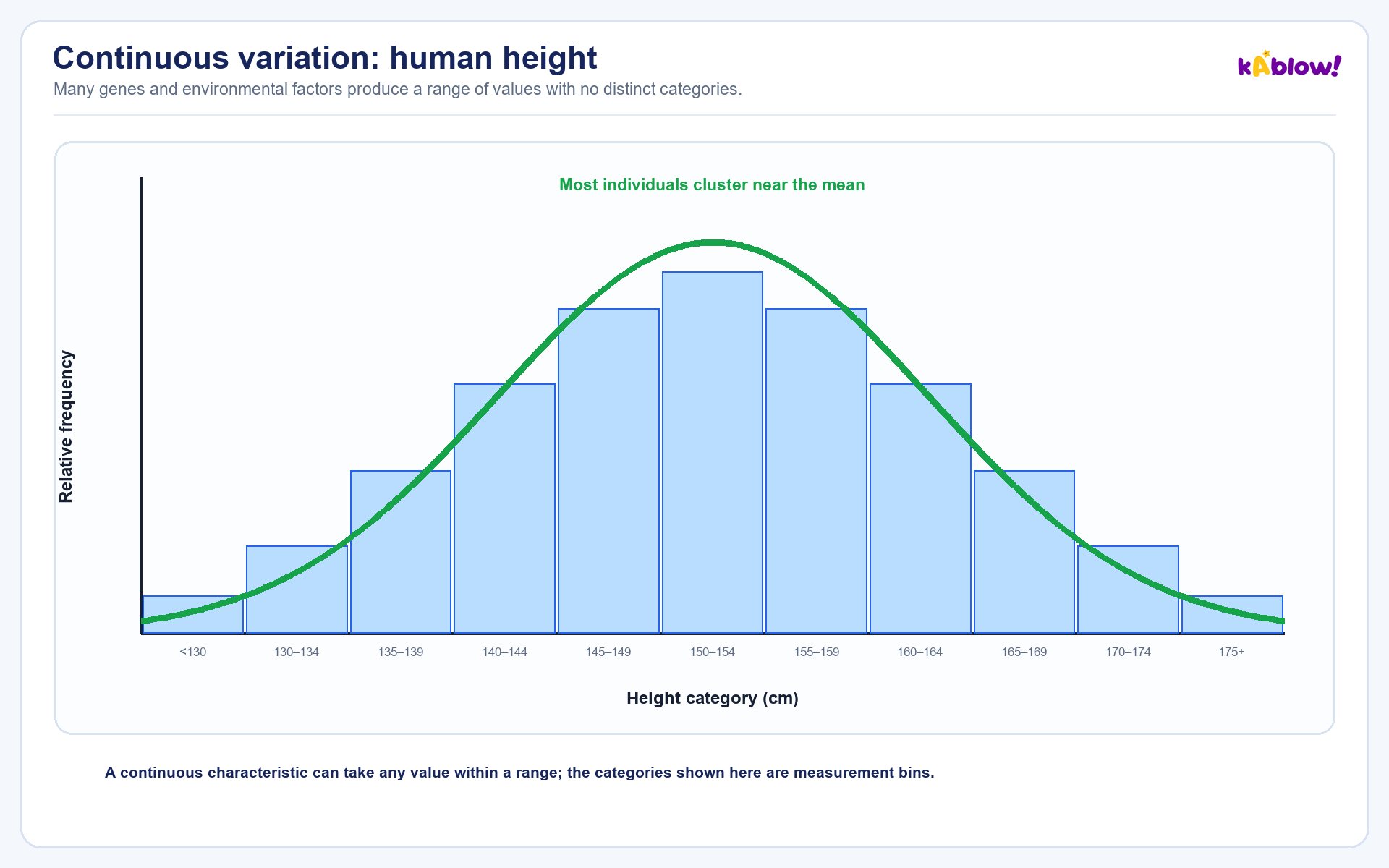
- Continuous variation shows a range of phenotypes with no distinct categories (e.g., height, body mass).
- Continuous variation produces a smooth bell-shaped curve when plotted as a frequency histogram.
- Discontinuous variation results in a limited number of distinct phenotypes (e.g., blood group, pea seed shape).
- Discontinuous variation produces a step-shaped bar graph.
- Mutation is a genetic change involving alterations to DNA, leading to new alleles and phenotypic variation.
Distribution of height showing continuous variation
Natural Selection
- Natural selection is the process where better adapted individuals survive and reproduce more successfully.
- Individuals in a species show variation due to genetic differences.
- Overproduction of offspring leads to competition for resources and a struggle for survival.
- Individuals with advantageous alleles are more likely to survive and reproduce.
- Advantageous alleles are passed on to offspring, increasing in frequency over generations.
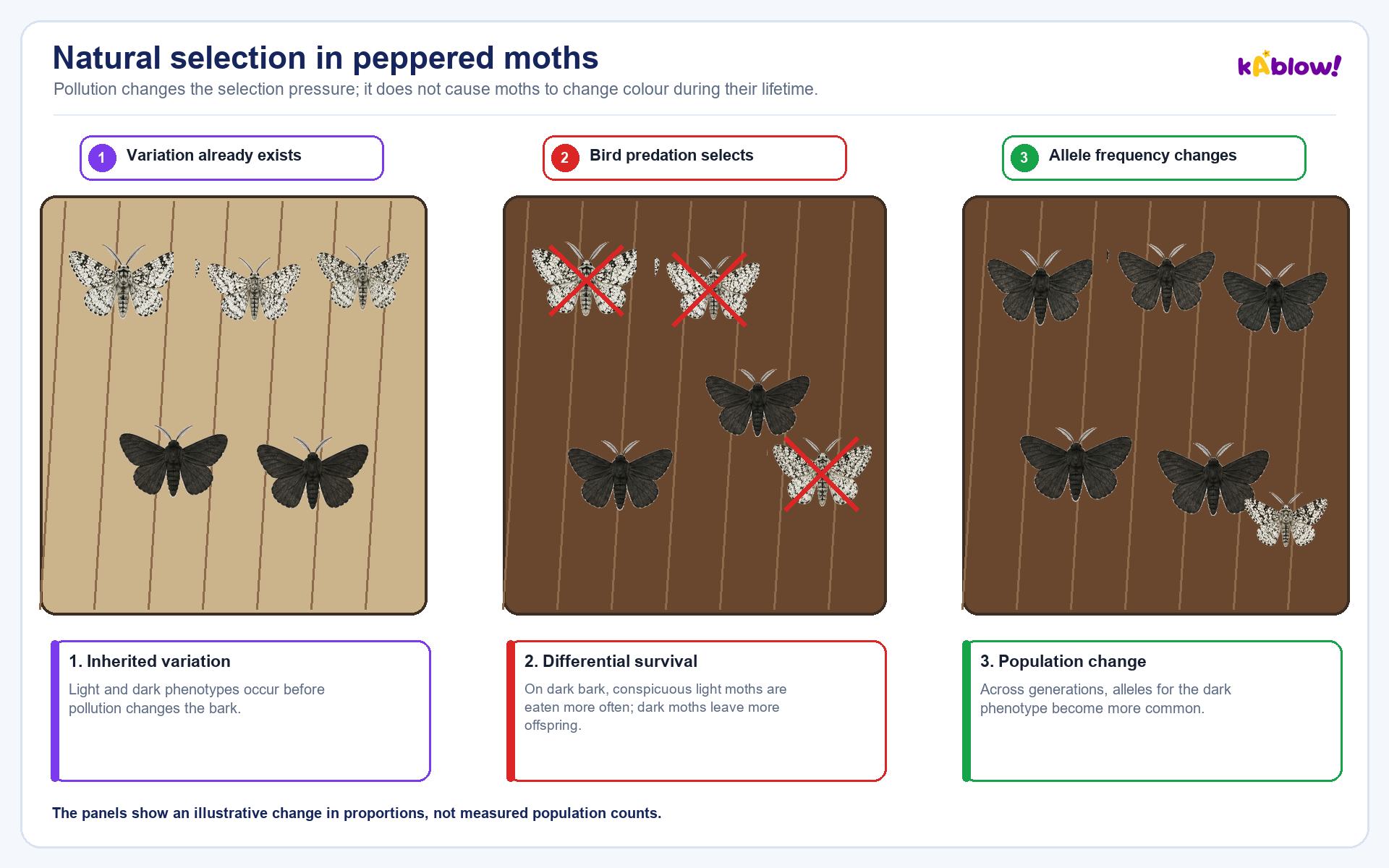
- Example: Peppered moths – environmental change made the dark allele advantageous, leading to increased frequency.
Natural selection in peppered moths
Natural Selection: Antibiotic Resistance (Extended)
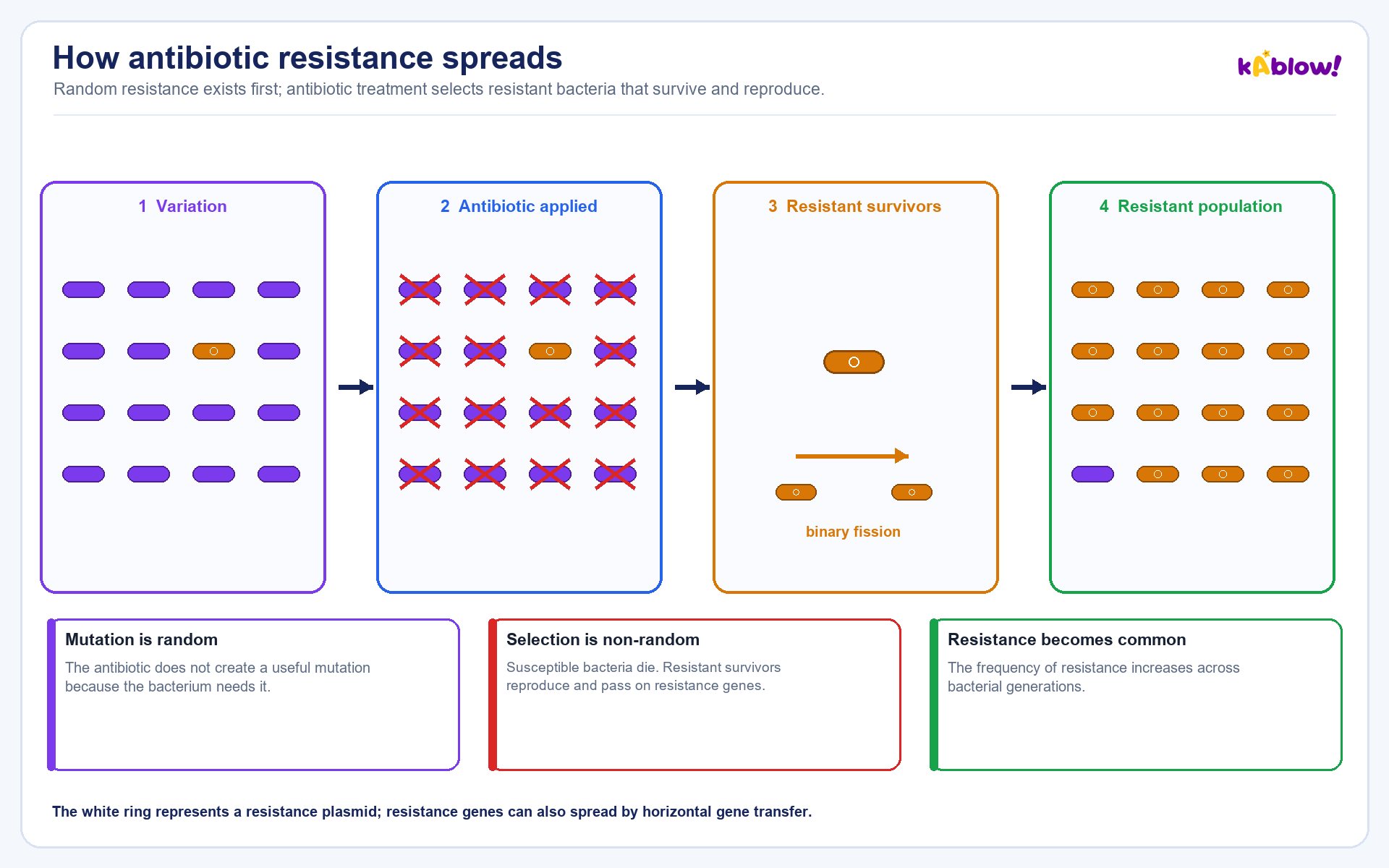
- Variation in bacteria includes some with resistance alleles to an antibiotic.
- Exposure to antibiotic kills non-resistant bacteria; resistant ones survive and reproduce.
- The resistance allele is passed on, becoming more common in the population.
- Over time, the entire population becomes an antibiotic-resistant strain.
- Key steps: variation → competition → survival of fittest → inheritance of advantageous alleles.
Natural selection in bacteria: antibiotic resistance
Artificial Selection (Selective Breeding)
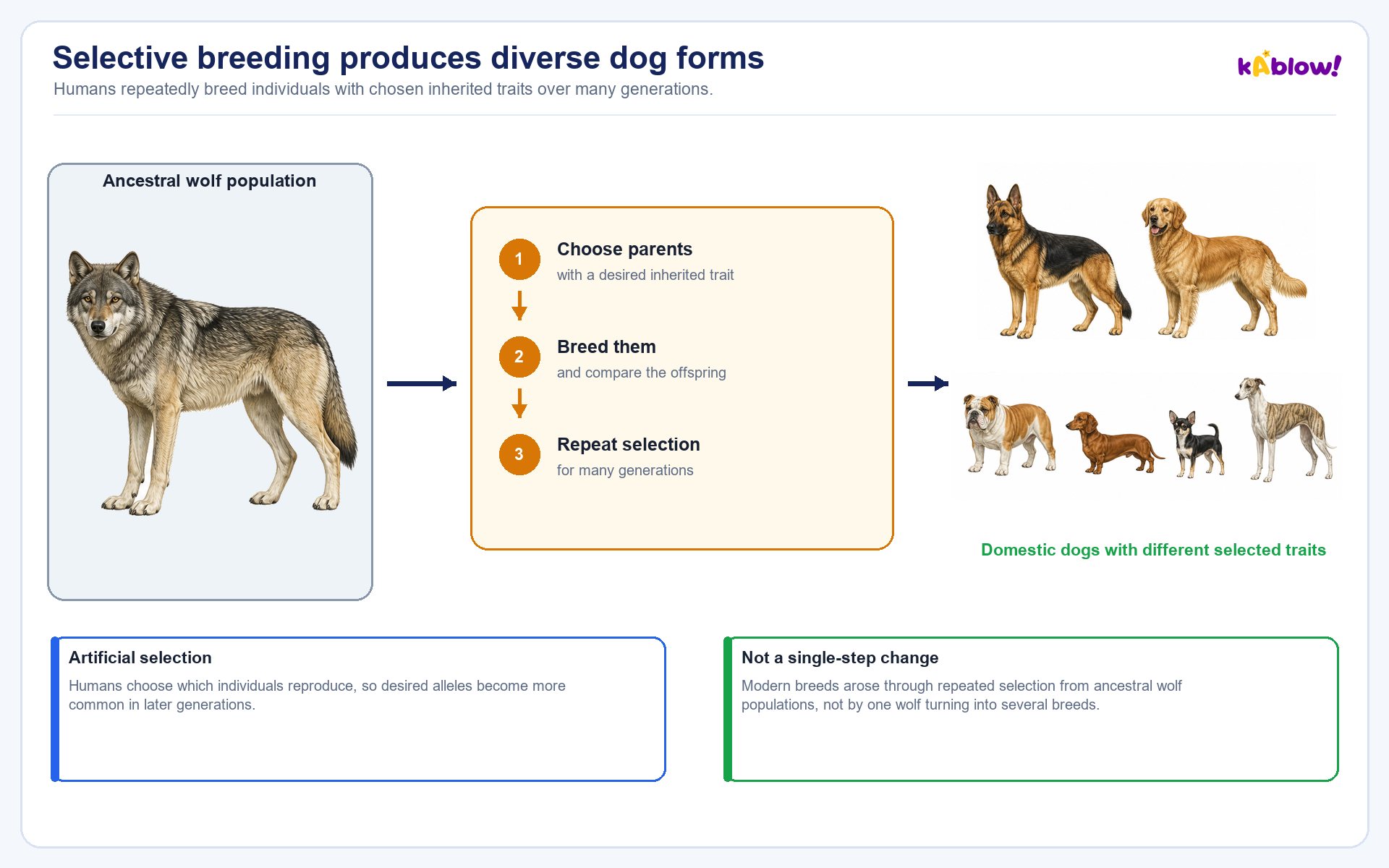
- Selective breeding is the process where humans choose individuals with desirable characteristics to breed.
- Selected individuals are crossed together, and offspring with the desired traits are chosen.
- This process is repeated over many generations to enhance the traits.
- Examples: dog breeds with calm temperaments, crop varieties with high yield or pest resistance.
- Selective breeding has produced a wide range of domestic varieties from wild ancestors.
Selective breeding of dog breeds from wolves
スライド
練習問題
無料プレビュー — 57問中8問。すべて見るには登録を。
1.Which of the following is an example of discontinuous variation?
Easy- AHeight in humans
- BBody mass in dogs
- CBlood group in humans
- DLeaf length in plants
2.Continuous variation produces a limited number of distinct phenotypes.
EasyTrue or false?
3.Define variation.
Easy4.Complete the sentence about natural selection:
EasyIndividuals that are better ____ to their environment have a higher chance of survival and more chances to reproduce.
5.Place the following steps of natural selection in the correct order:
Medium- Advantageous alleles become more common in the population
- Individuals in a species show variation
- Better adapted individuals survive and reproduce
- Struggle for survival due to competition
6.What is the source of new alleles in a population?
Easy7.Match each type of variation with its correct description:
Easy- Continuous variation
- Discontinuous variation
- Shows a range of phenotypes
- Results in a limited number of phenotypes
8.In a population of bacteria, 5% initially carry a resistance allele. After exposure to an antibiotic, 80% of the surviving bacteria carry the resistance allele. If the survival rate of non-resistant bacteria is 0.1%, what is the survival rate of resistant bacteria? (Assume the population was large and the antibiotic killed all non-resistant bacteria that did not survive.)
Hard- A10
- B7
- C8
- D9