Properties Uses And Alloys Of Metals
遊んで学ぼう
問題に答えてエネルギーを集めたら、釣りや探検を楽しもう。アカウント不要。
先生の方へ: Properties Uses And Alloys Of Metals(Co-ordinated Sciences (Double Award) [CIE]、Chemistry)向けのすぐ使えるレッスンスライド, 復習ノート — レッスンで使うか、生徒がライブゲームとして遊ぶインタラクティブなクラス活動としてトピックを実施できます。
レッスンノート
Physical Properties of Metals
- Metals conduct heat and electricity due to delocalised electrons that move through the structure.
- They are malleable (can be hammered into shapes) and ductile (can be drawn into wires) because layers of positive ions can slide over each other.
- Metals generally have high melting and boiling points because of strong electrostatic attraction (metallic bonds) between positive ions and delocalised electrons.
Metallic bonding in aluminium
Chemical Properties of Metals
- Metals react with water (cold or steam) to produce a metal hydroxide or oxide plus hydrogen gas.
- Example with cold water: Ca + 2H₂O → Ca(OH)₂ + H₂.
- Example with steam: Zn + H₂O → ZnO + H₂.
- Metals react with acids to produce a salt and hydrogen: metal + acid → salt + hydrogen.
- Example: Fe + 2HCl → FeCl₂ + H₂.
Uses of Aluminium
- Aluminium has low density and is resistant to corrosion due to a protective oxide layer.
- Used in aeroplane bodies because of high strength-to-weight ratio.
- Used in overhead power cables because it is a good electrical conductor and has low density.
- Used in food cans because it is non-toxic and resistant to corrosion and acidic foods.
Uses of Copper
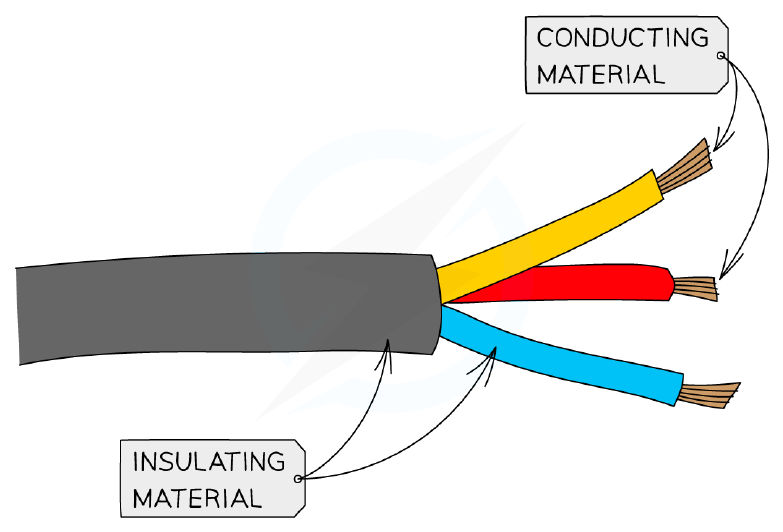
- Copper is a very good electrical conductor and is ductile.
- Used in electrical wiring due to high conductivity and ductility.
- Used in pots and pans because it is a good heat conductor, unreactive, and malleable.
- Used in water pipes because it is non-toxic, unreactive with water, and malleable.
Structure of an electrical cable
Alloys – Composition and Properties
- An alloy is a mixture of a metal with other elements (often other metals, sometimes non-metals).
- Brass (copper + zinc) is much stronger than either metal; used in musical instruments, ornaments, door knobs.
- Stainless steel (iron + chromium, nickel, carbon) is hard and resistant to corrosion/rusting; used in cutlery.
- Other alloys: iron with tungsten (extremely hard, heat resistant); aluminium with copper, manganese, silicon (strong, low density for aircraft).
- Alloys are not compounds – they are mixtures, not chemically combined.
Structure of Alloys (Extended Tier)
- Pure metals have a regular arrangement of positive ions in layers.
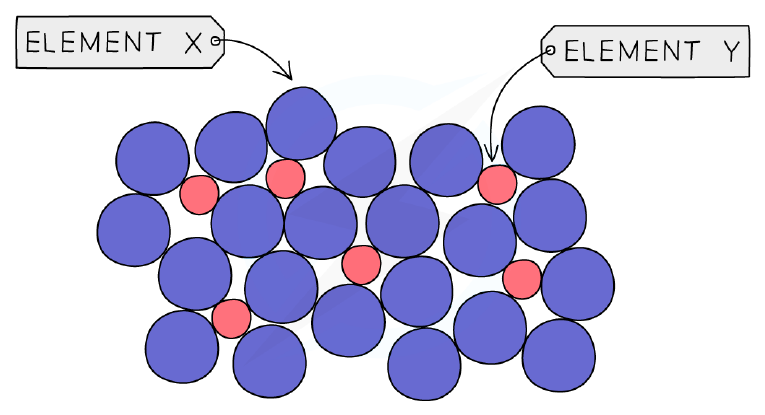
- Alloys contain atoms of different sizes, which distort the regular lattice.
- The distortion makes it harder for layers to slide over each other, so alloys are usually harder/stronger than pure metals.
Structure of an alloy
スライド
練習問題
無料プレビュー — 56問中8問。すべて見るには登録を。
1.State two physical properties of metals.
Easy2.State two uses of aluminium.
Easy3.State two uses of copper.
Easy4.What is an alloy?
Easy5.State two examples of alloys and their uses.
Easy6.Explain why alloys are usually harder than pure metals.
Medium7.Which property makes aluminium suitable for making aeroplane bodies?
Easy- Ahigh density
- Blow density
- Chigh reactivity
- Dpoor conductor of electricity
8.Which of the following is an alloy?
Easy- Apure copper
- Bpure iron
- Cbrass
- Daluminium
過去問
このトピックの過去問練習は近日公開。
近日公開