Redox
遊んで学ぼう
問題に答えてエネルギーを集めたら、釣りや探検を楽しもう。アカウント不要。
教育者の方へ: Redox(Co-ordinated Sciences (Double Award) [CIE]、Chemistry)向けのすぐ使えるレッスンスライド, 復習ノート — レッスンで使うか、学習者がライブゲームとして遊ぶインタラクティブなクラス活動としてトピックを実施できます。
レッスンノート
Oxidation & Reduction in Terms of Oxygen
- Oxidation is the addition of oxygen to an element or compound.
- Reduction is the removal of oxygen from an element or compound.
- A redox reaction involves both oxidation and reduction occurring simultaneously.
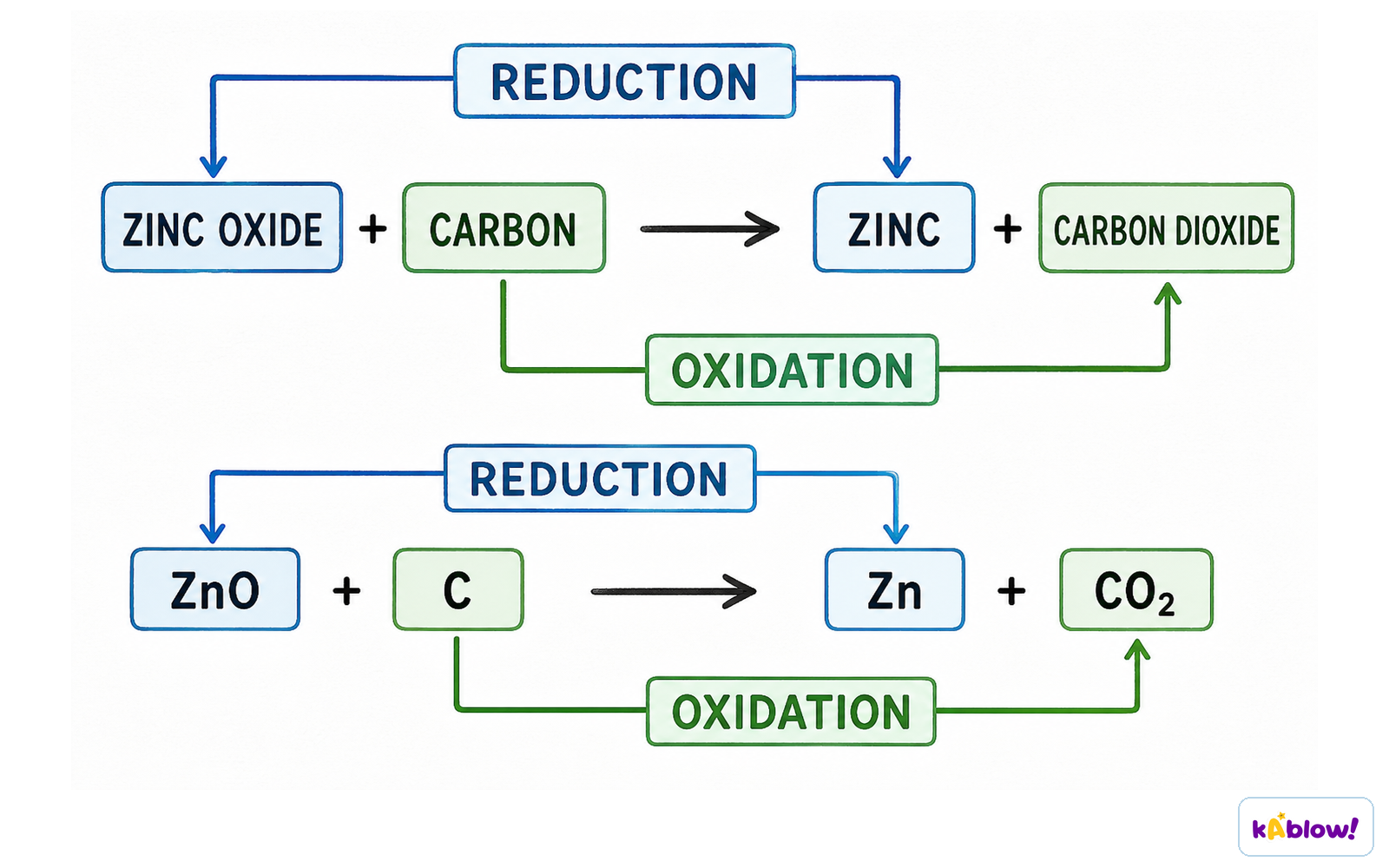
- Example: ZnO + C → Zn + CO – zinc oxide is reduced (loses oxygen), carbon is oxidised (gains oxygen).
Oxidation and reduction shown for zinc oxide + carbon
Oxidation & Reduction in Terms of Electrons (Extended)
- Oxidation is the loss of electrons; the oxidation number increases.
- Reduction is the gain of electrons; the oxidation number decreases.
- Mnemonic: OIL RIG – Oxidation Is Loss, Reduction Is Gain.
- Half-equations show electron transfer, e.g. Ag → Ag⁺ + e⁻ (oxidation) and O₂ + 4e⁻ → 2O²⁻ (reduction).
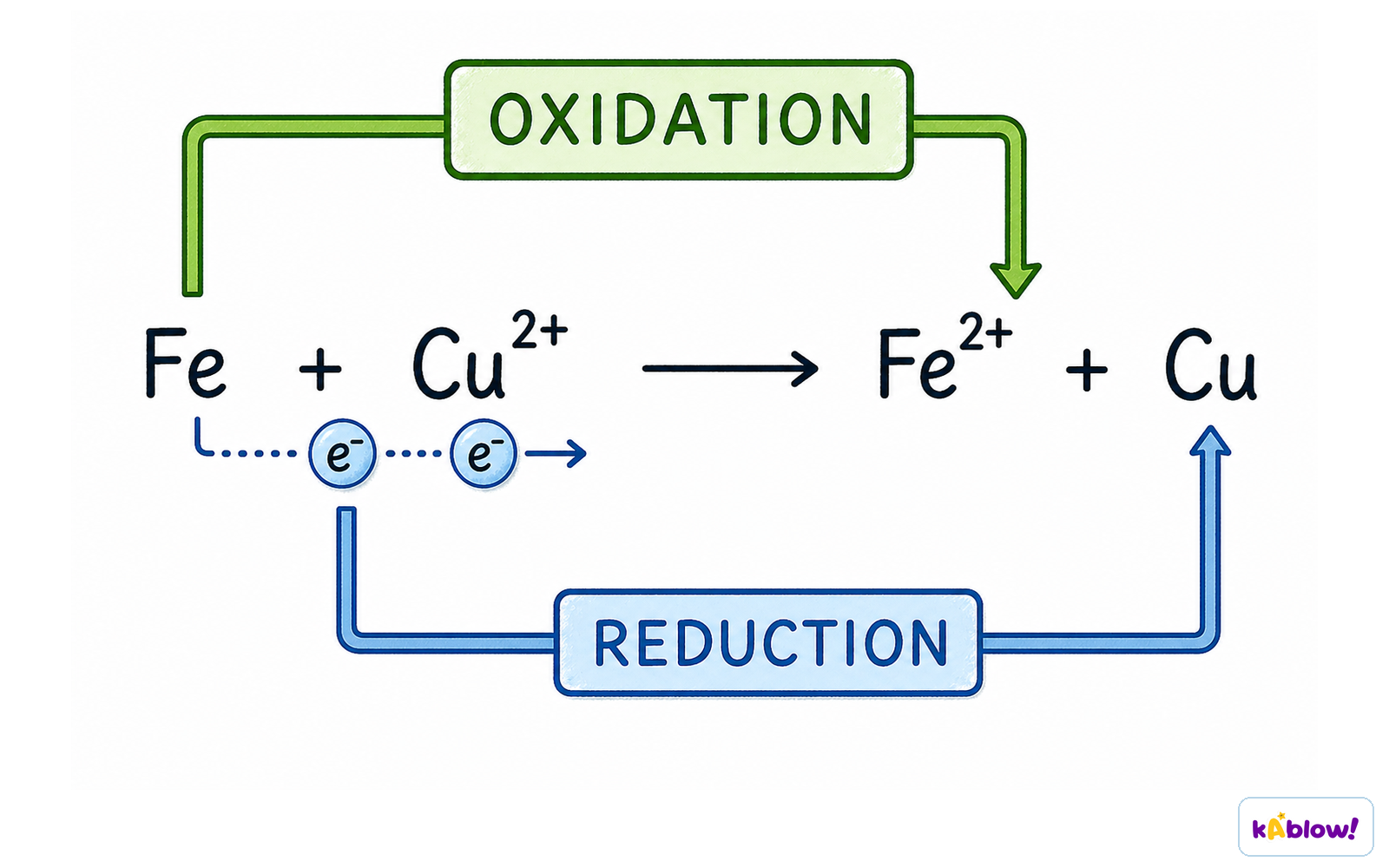
- Example: when iron reacts with copper sulfate, Fe + Cu²⁺ → Fe²⁺ + Cu – iron loses electrons (oxidised), copper(II) ions gain electrons (reduced).
Redox reaction between Fe and Cu²⁺ shown by electron transfer
Oxidation Numbers & Roman Numerals
- Transition metals can form ions with different charges; the charge is shown by a Roman numeral in the name.
- The Roman numeral equals the oxidation number of the metal ion.
- Example: Fe²⁺ is iron(II); Fe³⁺ is iron(III).
- Example: FeO is iron(II) oxide; Fe₂O₃ is iron(III) oxide.
- In CoCl₂, chloride ions are each 1−, so cobalt is 2+ → cobalt(II) chloride.
Bohr model of iron atom showing electron shells
Identifying Redox Reactions
- In a redox reaction, one species is oxidised and another is reduced.
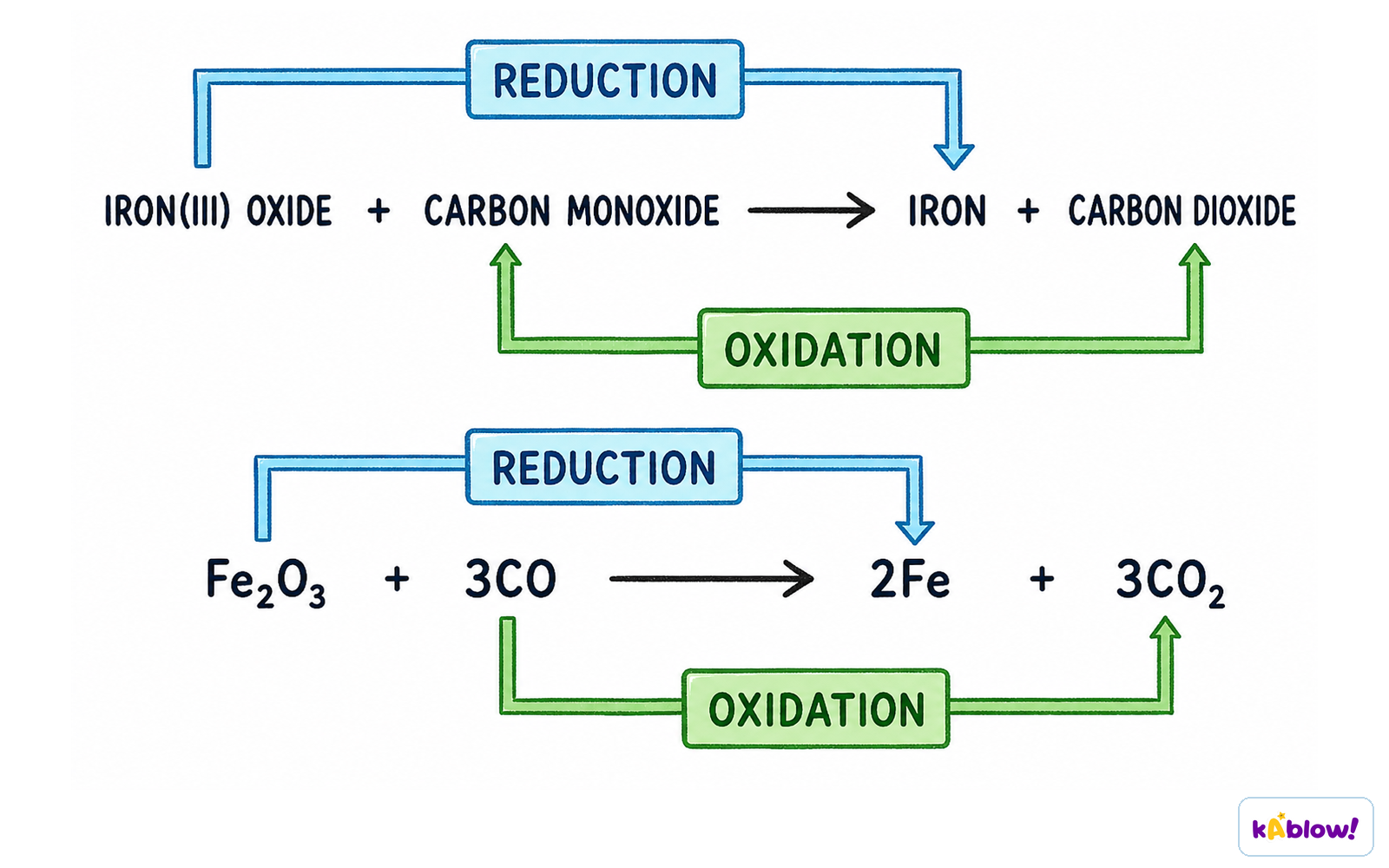
- Example: Fe₂O₃ + 3CO → 2Fe + 3CO₂ – Fe₂O₃ is reduced (loses oxygen), CO is oxidised (gains oxygen).
- In ionic equations, spectator ions are removed to show the redox change.
- Example: Fe + Cu²⁺ → Fe²⁺ + Cu – Fe is oxidised (loses electrons), Cu²⁺ is reduced (gains electrons).
- The reducing agent is the species that is oxidised (it loses electrons); the oxidising agent is the species that is reduced (it gains electrons).
Oxidation and reduction shown for iron(III) oxide + carbon monoxide
スライド
練習問題
無料プレビュー — 49問中8問。すべて見るには登録を。
1.State the meaning of the mnemonic OIL-RIG in terms of electron transfer.
Easy2.In the reaction between zinc oxide and carbon, which substance is reduced?
Medium- Azinc oxide
- Bcarbon
- Czinc
- Dcarbon dioxide
3.Complete the sentence using the words 'oxidation' or 'reduction'.
EasyIn terms of oxygen, ____ is the gain of oxygen and ____ is the loss of oxygen.
4.What is the oxidation number of the transition metal in silver(I) chloride, AgCl?
Easy5.In the reaction V3+ + Fe3+ → V4+ + Fe2+, which species is oxidised?
Medium6.Which half-equation represents reduction?
Medium- AAg → Ag+ + e-
- BO2 + 4e- → 2O2-
- CFe → Fe2+ + 2e-
- DCu → Cu2+ + 2e-
7.Match each term with its correct definition in terms of oxygen.
Easy- Oxidation
- Reduction
- Gain of oxygen
- Loss of oxygen
8.Arrange the following steps in the correct order to show the process of identifying oxidation in the reaction V3+ + Fe3+ → V4+ + Fe2+.
Medium- Identify changes for each species
- Determine oxidation or reduction
- Identify species that loses electrons
- Write the overall equation
過去問
このトピックの過去問練習は近日公開。
近日公開