Simple Molecules And Covalent Bonds
遊んで学ぼう
問題に答えてエネルギーを集めたら、釣りや探検を楽しもう。アカウント不要。
教育者の方へ: Simple Molecules And Covalent Bonds(Co-ordinated Sciences (Double Award) [CIE]、Chemistry)向けのすぐ使えるレッスンスライド, 復習ノート — レッスンで使うか、学習者がライブゲームとして遊ぶインタラクティブなクラス活動としてトピックを実施できます。
レッスンノート
Covalent Bonds
- Covalent bonds form when pairs of electrons are shared between atoms.
- Only non-metal elements participate in covalent bonding.
- Each atom gains a full outer shell of electrons, achieving a noble gas configuration.
- Covalently bonded atoms form molecules.
- Dot-and-cross diagrams show the arrangement of electrons: dots for one atom, crosses for the other.
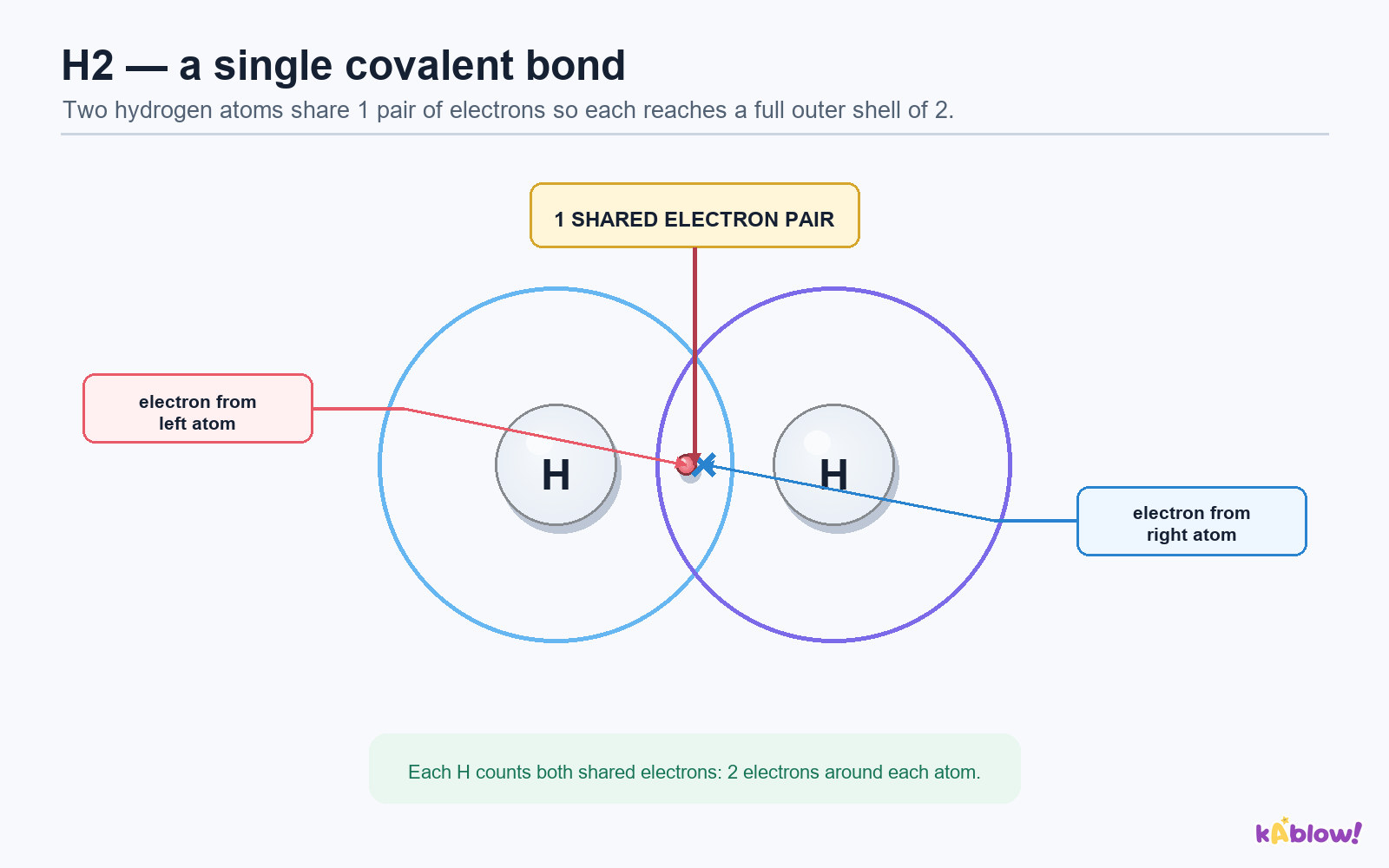
- A single covalent bond involves one shared pair of electrons (e.g., H₂, Cl₂, H₂O, CH₄, NH₃, HCl).
H₂ dot-and-cross diagram: single covalent bond formed by one shared pair of electrons.
Molecules & Compounds
- Some atoms share more than one pair of electrons to achieve a full outer shell.
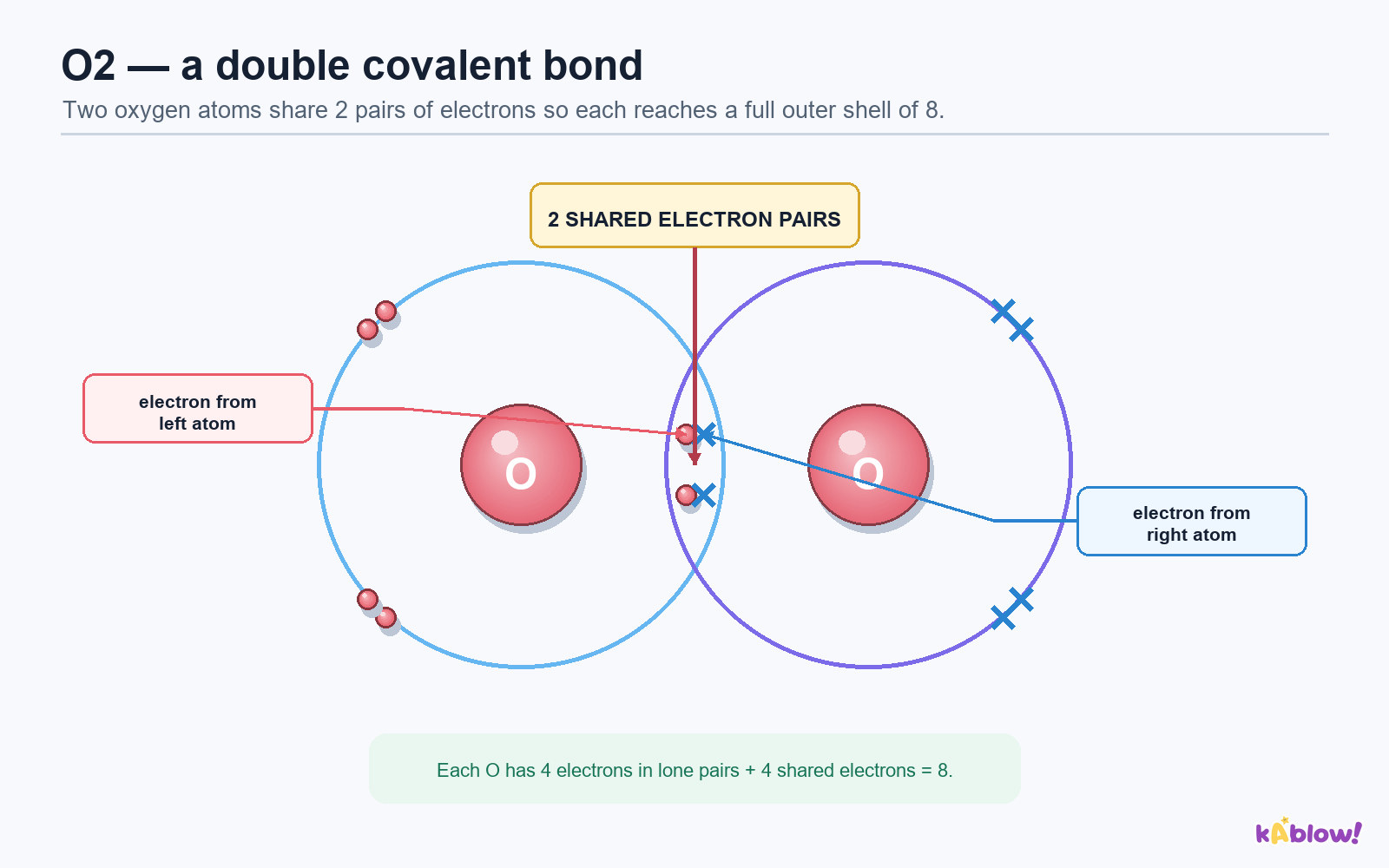
- A double bond involves two shared pairs (e.g., O₂, ethene, CO₂).
- A triple bond involves three shared pairs (e.g., N₂).
- In ethene, the two carbon atoms are joined by a double bond.
- In carbon dioxide, each oxygen is double-bonded to the central carbon.
O₂ dot-and-cross diagram: a double covalent bond formed by two shared pairs of electrons.
Properties of Simple Molecular Compounds
- Simple molecules have low melting and boiling points; most are liquids or gases at room temperature.
- Melting and boiling points increase as molecular size increases.
- They are poor conductors of electricity because there are no free ions or electrons.
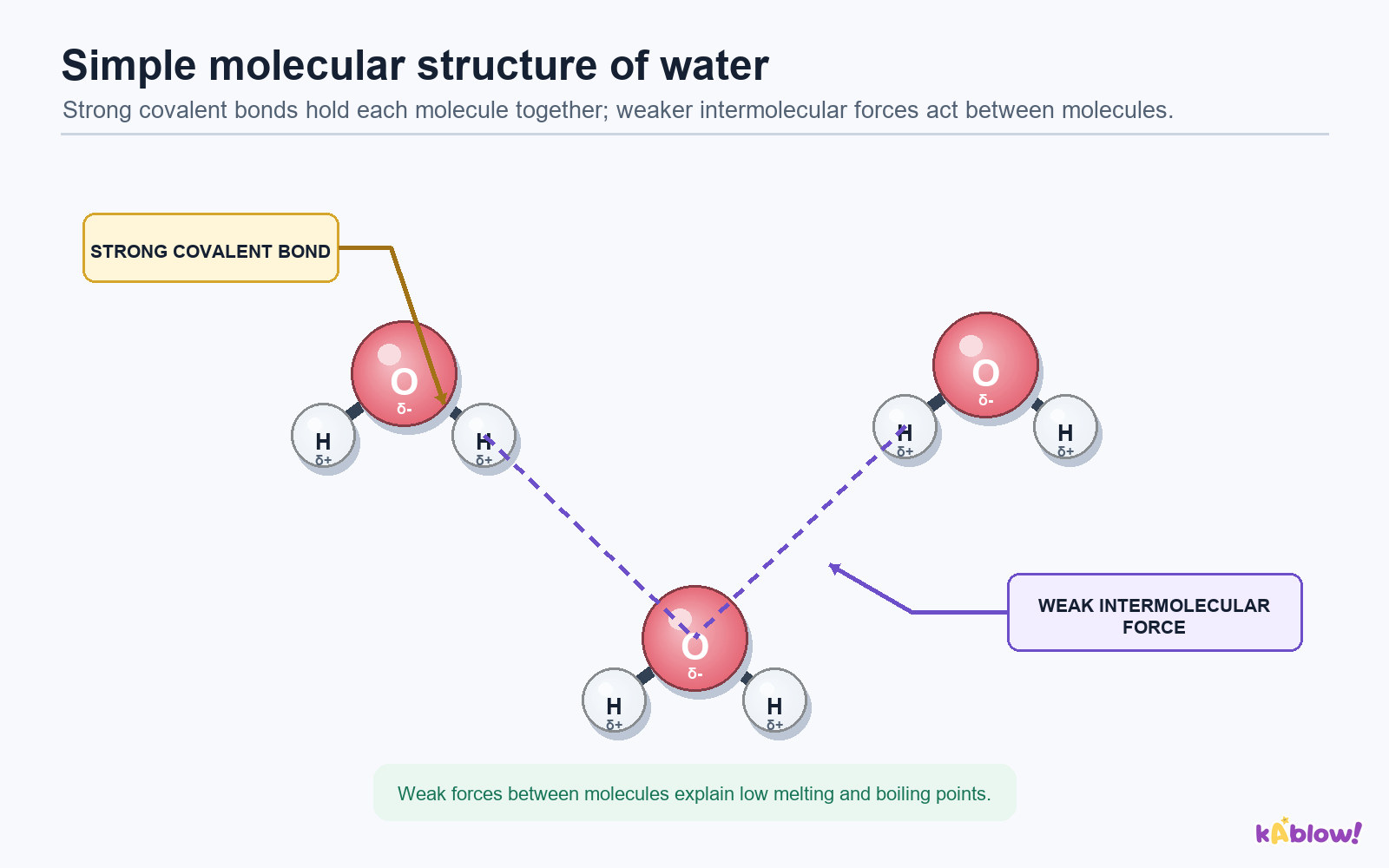
- The atoms within a molecule are held by strong covalent bonds; between molecules there are weak intermolecular forces.
- Weak intermolecular forces explain low melting/boiling points; larger molecules have stronger intermolecular forces.
- Covalent compounds are often insulators (e.g., plastic coating on wires).
Simple molecular structure of water: strong covalent bonds within each molecule, weak intermolecular forces between molecules.
スライド
練習問題
無料プレビュー — 56問中8問。すべて見るには登録を。
1.Covalent bonds are formed by the sharing of electrons between non-metal atoms.
EasyTrue or false?
2.Complete the sentence:
EasyIn a covalent bond, atoms share ____ of electrons to achieve a full outer shell.
3.Name the type of bond formed when two atoms share three pairs of electrons.
Easy4.Which of the following molecules contains a double covalent bond?
Medium- AHydrogen
- BChlorine
- COxygen
- DMethane
5.Simple molecular compounds have high melting and boiling points due to strong covalent bonds between molecules.
MediumTrue or false?
6.Explain why simple molecular compounds are poor conductors of electricity.
Medium7.How many electrons are shared in a double covalent bond?
Easy- A5
- B4
- C6
- D3
8.Match each molecule to the number of covalent bonds between its atoms.
Medium- Hydrogen (H2)
- Oxygen (O2)
- Nitrogen (N2)
- 1
- 2
- 3
過去問
このトピックの過去問練習は近日公開。
近日公開