Validation & Verification
遊んで学ぼう
問題に答えてエネルギーを集めたら、釣りや探検を楽しもう。アカウント不要。
レッスンノート
Validation & Verification Overview
- Validation is an automated process checking if input is sensible and meets program requirements.
- Verification checks that data entered matches the original intended data (accuracy).
- Validation ensures data is possible/reasonable; verification ensures it is correct.
Types of Validation Checks
- Range check: ensures a number falls within a specified range (e.g., 0–100).
- Length check: ensures a string has a required number of characters (e.g., PIN = 4 digits).
- Type check: ensures data is of the correct data type (e.g., integer, string).
- Presence check: ensures a field is not left blank.
- Format check: ensures data matches a pattern (e.g., XX9999, email with @ and .).
- Check digit: a final digit calculated by algorithm to detect errors in codes (e.g., ISBN).
Type, presence and length checks keep entered data the right kind, actually present, and the right size.

Verification Methods
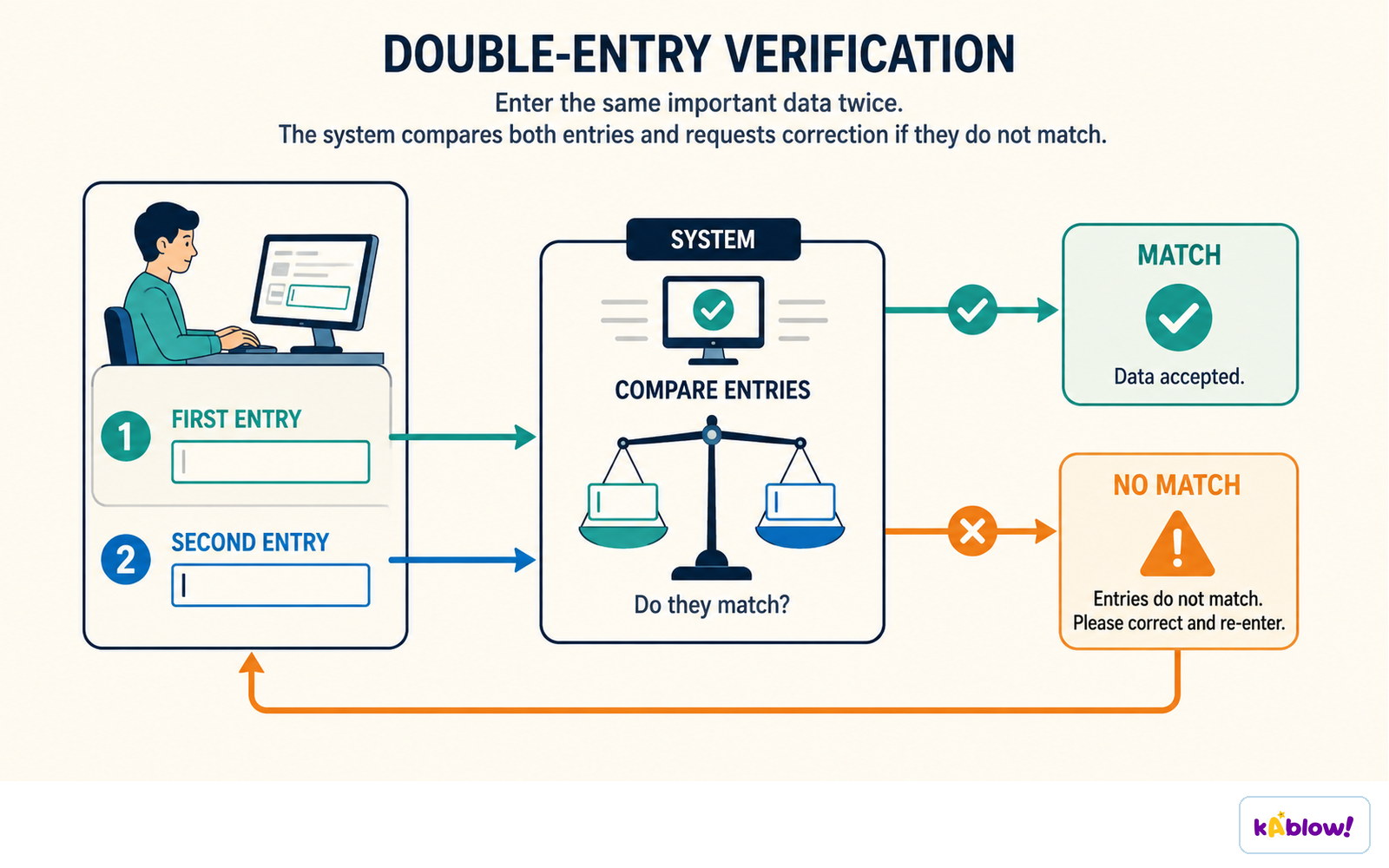
- Double entry: data entered twice; system compares both entries; mismatch triggers error.
- Visual check: user reviews data on screen and confirms correctness (e.g., popup).
- Example: password confirmation uses double entry; name entry uses visual check.
Double entry asks for the same data twice and compares the two entries before accepting it.
Suitable Test Data Categories
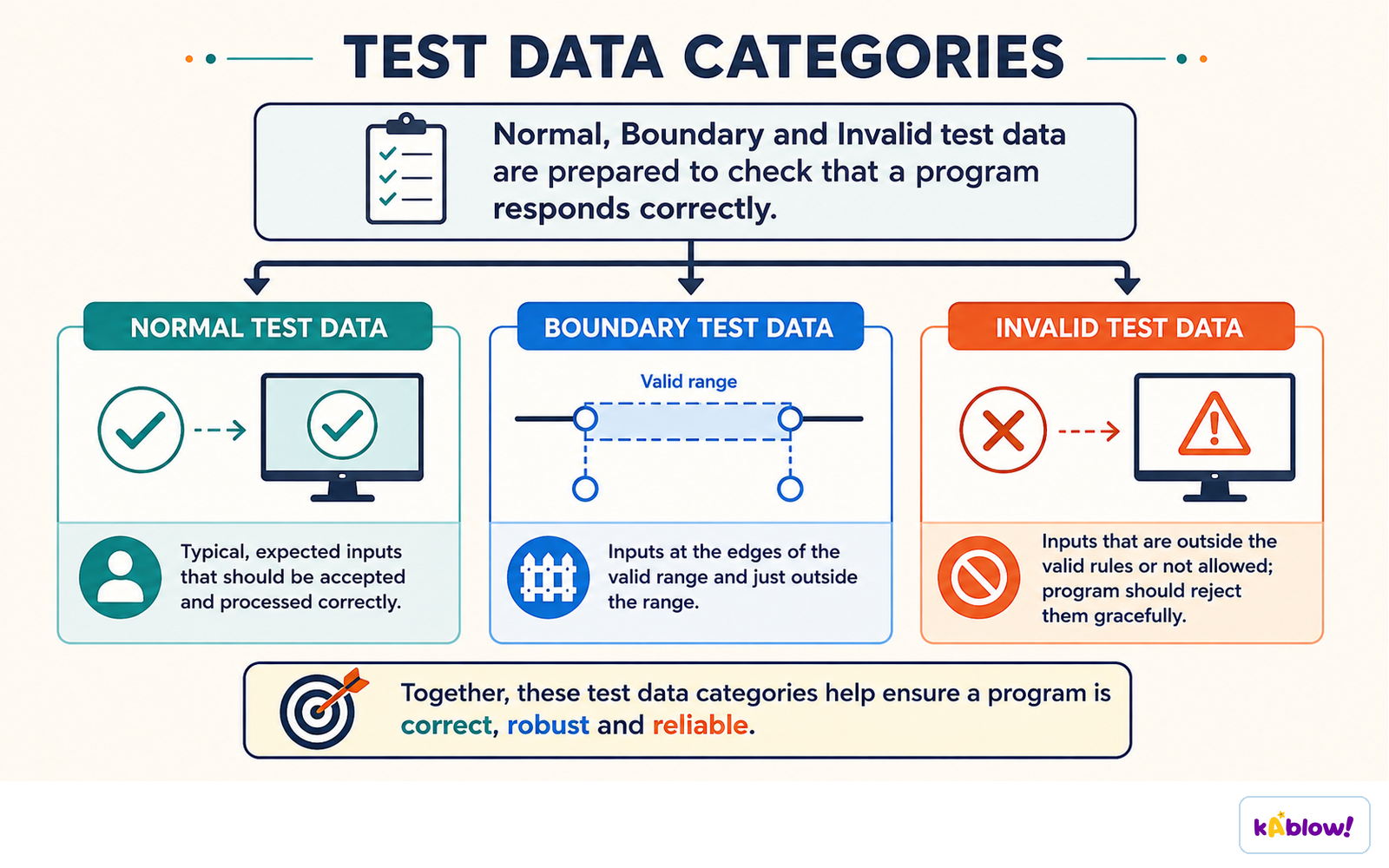
- Normal data: valid input that should be accepted (e.g., age 16 for range 12–18).
- Abnormal data: invalid data type or value that should be rejected (e.g., 'H' for age).
- Extreme data: boundary values that are still acceptable (e.g., 12 and 18).
- Boundary data: values just inside and just outside the acceptable range (e.g., 11, 19).
Normal, boundary and invalid test data check that a program handles each kind of input correctly.
Trace Tables
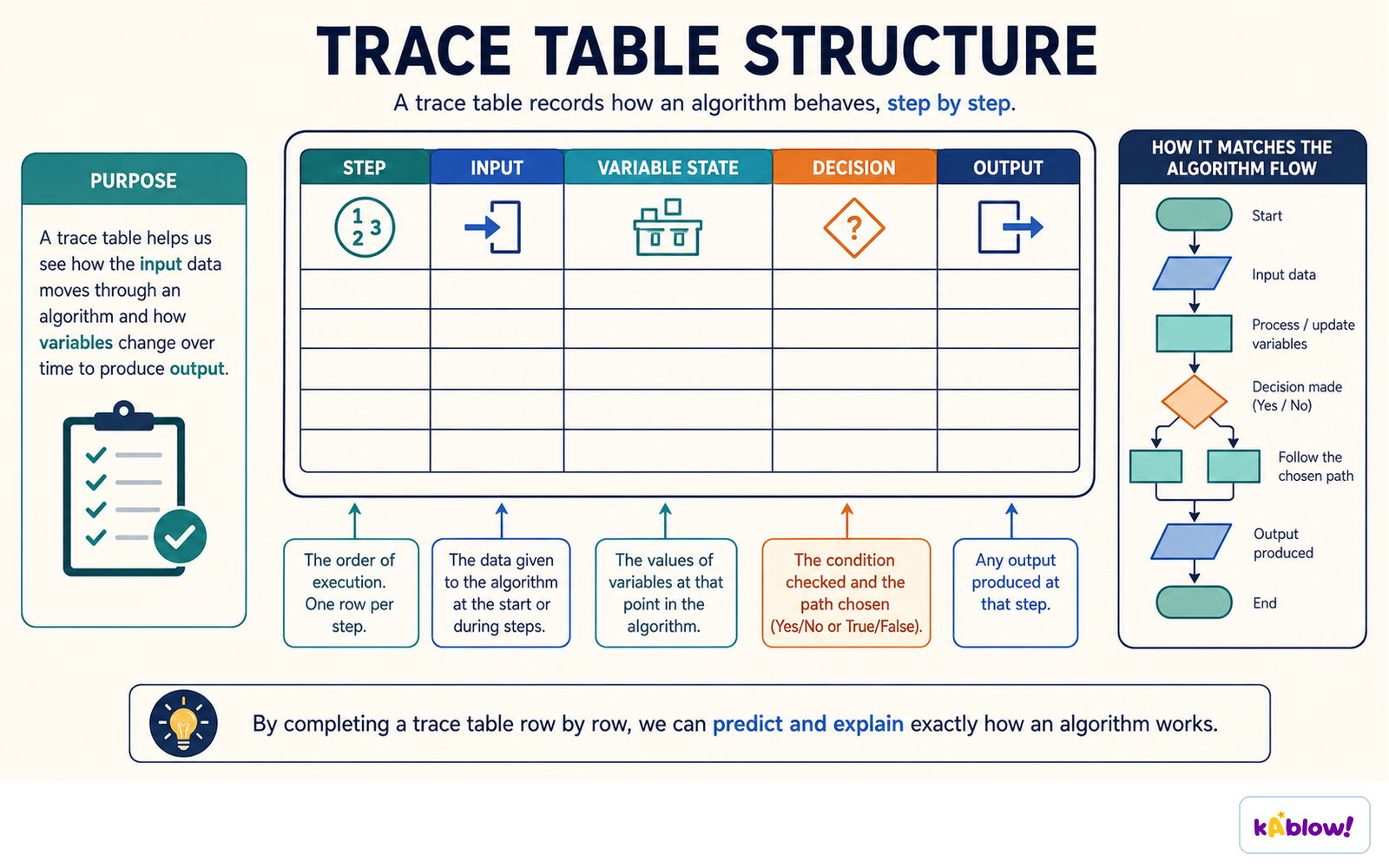
- A trace table records the state of variables and outputs at each step of an algorithm.
- Used to detect logic errors in flowcharts, pseudocode, or program code.
- Each row corresponds to one step/iteration; columns for inputs, outputs, and variables.
- Helps discover the purpose of an algorithm by showing intermediate results.
A trace table records one row per step: the input taken, the variable values, the decision made and any output.
Validation asks whether the data is sensible; verification asks whether it was copied or entered correctly.
スライド
練習問題
無料プレビュー — 58問中8問。すべて見るには登録を。
1.What is the purpose of validation?
Easy- ATo check that data entered is sensible and meets program requirements
- BTo check that data entered is exactly what was intended
- CTo check that data is stored correctly in the database
- DTo check that data is transmitted without errors
2.A program asks the user to enter a password. Which two validation checks would be most appropriate for a password field?
Medium- ALength check and presence check
- BRange check and type check
- CFormat check and check digit
- DPresence check and range check
3.A program uses the following pseudocode to validate input: REPEAT INPUT Number IF Number < 0 OR Number > 100 THEN OUTPUT "Invalid" ENDIF UNTIL Number ≥ 0 AND Number ≤ 100 Which type of validation is being performed?
Easy- ARange check
- BLength check
- CType check
- DPresence check
4.Which of the following is an example of verification?
Easy- ADouble entry checking
- BRange check
- CFormat check
- DCheck digit
5.A website registration form asks users to enter their email address twice. This is an example of:
Easy- AVerification using double entry
- BValidation using format check
- CValidation using presence check
- DVerification using visual check
6.An ISBN number ends with a check digit. What is the purpose of the check digit?
Easy- ATo help detect errors when the number is entered or transmitted
- BTo ensure the number is in the correct format
- CTo verify that the number belongs to a valid book
- DTo encrypt the number for security
7.Which validation check would reject the input "ABC" for an age field?
Easy- AType check
- BRange check
- CLength check
- DPresence check
8.A program checks that a username is not left blank. Which validation check is this?
Easy- APresence check
- BLength check
- CType check
- DFormat check