Expanding And Factorising Brackets
遊んで学ぼう
問題に答えてエネルギーを集めたら、釣りや探検を楽しもう。アカウント不要。
教育者の方へ: Expanding And Factorising Brackets(Maths [CIE]、Extended)向けのすぐ使えるレッスンスライド, 復習ノート, 図解 — レッスンで使うか、学習者がライブゲームとして遊ぶインタラクティブなクラス活動としてトピックを実施できます。
レッスンノート
Expanding & Simplifying Single Brackets
- To expand a bracket, multiply the term outside by each term inside.
- Example: 3x(x + 2) = 3x × x + 3x × 2 = 3x² + 6x.
- Beware of minus signs: − × − = +, − × + = −.
- When simplifying expressions with multiple brackets, expand each bracket first, then collect like terms.
- Example: 2(x + 5) + 3x(x − 8) = 2x + 10 + 3x² − 24x = 3x² − 22x + 10.
Expanding Double Brackets
- Multiply every term in the first bracket by every term in the second bracket (4 multiplications).
- Use FOIL (First, Outer, Inner, Last) to remember the order.
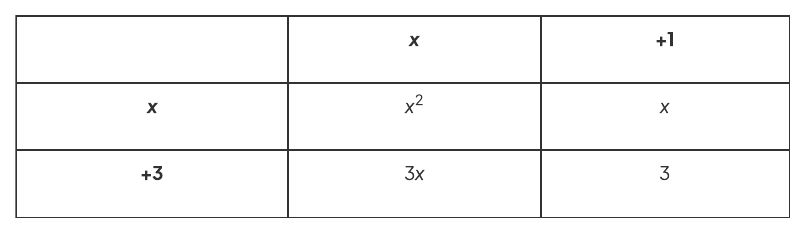
- A grid can help organise multiplication: write one bracket as row headings, the other as column headings, multiply cells, then sum.
- Example: (x + 1)(x + 3) = x² + 3x + x + 3 = x² + 4x + 3.
- For squared brackets, rewrite as a product: (x + 3)² = (x + 3)(x + 3) = x² + 6x + 9.
- When expanding with multiple variables, combine only like terms (e.g., xy terms).
Grid method for double brackets
Expanding Triple Brackets
- First expand and simplify any two brackets, then multiply the result by the third bracket.
- Use a grid to multiply the resulting quadratic by the linear bracket.
- Example: (2x − 3)(x + 4)(3x − 1) → first expand (2x − 3)(x + 4) = 2x² + 5x − 12, then multiply by (3x − 1) to get 6x³ + 13x² − 41x + 12.
Factorising Out Terms
- Factorisation is the reverse of expanding brackets: write an expression as a product of factors.
- Identify the highest common factor (HCF) of the coefficients and variables.
- Write the HCF outside brackets and the remaining terms inside.
- Example: 12x² + 18x = 6x(2x + 3).
- Always factorise fully (e.g., 2x(3x + 5) is not fully factorised; 6x(2x + 3) is).
- Check your answer by expanding the brackets.
Factorising by Grouping
- Used when an expression has four terms and can be grouped into pairs with common factors.
- Factorise each pair separately, then look for a common bracket.
- Example: xy + 3x + 5y + 15 = x(y + 3) + 5(y + 3) = (y + 3)(x + 5).
- The order of terms can be rearranged as long as grouping is possible.
Factorising Simple Quadratics (a = 1)
- For x² + bx + c, find two numbers that multiply to c and add to b.
- Write these numbers in brackets: (x + p)(x + q).
- Example: x² − 2x − 8: numbers 2 and −4 → (x + 2)(x − 4).
- Methods: inspection (quickest), splitting the middle term, or using a grid.
Factorising Harder Quadratics (a ≠ 1)
- For ax² + bx + c, find two numbers that multiply to ac and add to b.
- Use these numbers to split the middle term, then factorise by grouping.
- Example: 4x² − 25x − 21: ac = −84, b = −25 → numbers −28 and 3 → 4x² − 28x + 3x − 21 = 4x(x − 7) + 3(x − 7) = (x − 7)(4x + 3).
- A grid can also be used with the split terms.
Difference of Two Squares
- The difference of two squares is a² − b² = (a + b)(a − b).
- Both terms must be perfect squares and subtracted.
- Example: 9x² − 16 = (3x)² − 4² = (3x + 4)(3x − 4).
- Can be applied to powers: r⁸ − t⁶ = (r⁴)² − (t³)² = (r⁴ + t³)(r⁴ − t³).
- Sometimes a common factor must be taken out first: 2y² − 50 = 2(y² − 25) = 2(y + 5)(y − 5).
Deciding the Factorisation Method
- For two terms: check for common factor or difference of two squares.
- For three terms (quadratic): if a = 1, use simple factorisation; if a ≠ 1, check for a common factor first, then use grouping or grid.
- If the quadratic has a common factor, factor it out first: 3x² + 15x + 18 = 3(x² + 5x + 6) = 3(x + 2)(x + 3).
- Check if b² − 4ac is a perfect square to see if the quadratic factorises.
- Always factorise fully and check by expanding.
スライド
練習問題
無料プレビュー — 53問中8問。すべて見るには登録を。
1.Expand 7(x – 8).
Easy- A7x – 56
- B7x – 8
- C7x + 56
- Dx – 56
2.Factorise 5p + pt.
Easy- Ap(5 + t)
- B5(p + t)
- Cp(5t)
- D5p(1 + t)
3.Factorise 12x + 15.
Easy- A3(4x + 5)
- B12(x + 15)
- C3(4x + 15)
- D12x(1 + 15x)
4.Factorise 5y – 6py.
Medium- Ay(5 – 6p)
- B5y(1 – 6p)
- Cy(5 – 6)
- D5(1 – 6p)
5.Factorise 2x2 – x.
Medium- Ax(2x – 1)
- B2x(x – 1)
- Cx(2x – x)
- D2x2(1 – 1/2x)
6.Factorise completely 21a2 + 28ab.
Medium- A7a(3a + 4b)
- B7(3a2 + 4ab)
- C21a(a + 4b)
- D7a(3a + 4)
7.Expand and simplify (m – 3)(m + 2).
Medium- Am2 – m – 6
- Bm2 – 5m – 6
- Cm2 – m + 6
- Dm2 + m – 6
8.Expand and simplify (x + 3)(x + 5).
Medium- Ax2 + 8x + 15
- Bx2 + 8x + 8
- Cx2 + 15x + 8
- Dx2 + 2x + 15
過去問
このトピックの過去問練習は近日公開。
近日公開