Electromagnetic Spectrum
遊んで学ぼう
問題に答えてエネルギーを集めたら、釣りや探検を楽しもう。アカウント不要。
教育者の方へ: Electromagnetic Spectrum(Physics、CIE)向けのすぐ使えるレッスンスライド, 復習ノート, 図解 — レッスンで使うか、学習者がライブゲームとして遊ぶインタラクティブなクラス活動としてトピックを実施できます。
レッスンノート
Electromagnetic Waves
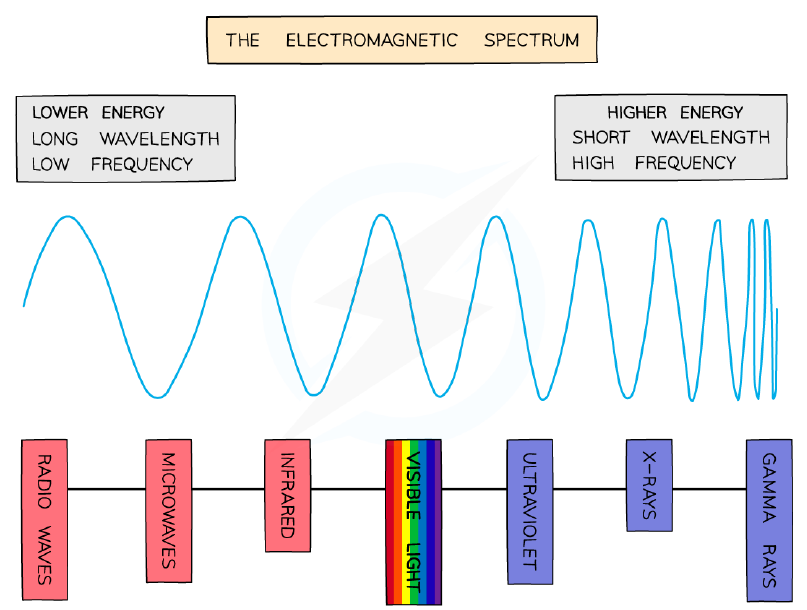
- The electromagnetic spectrum is a continuous range of waves arranged by wavelength or frequency.
- Longer wavelength → lower frequency; shorter wavelength → higher frequency.
- Order from longest to shortest wavelength: radio waves, microwaves, infrared, visible light (ROYGBIV), ultraviolet, X-rays, gamma rays.
- All EM waves are transverse waves that transfer energy.
- All EM waves travel at the same speed in a vacuum: 3.0 × 10⁸ m/s (also approximately the speed in air).
- Visible light is only a small part of the EM spectrum.
The electromagnetic spectrum, showing the seven regions in order of decreasing wavelength (increasing frequency), from radio waves to gamma rays.
Uses of Electromagnetic Waves
- Radio waves: radio/TV transmissions, astronomy, RFID.
- Microwaves: satellite TV, mobile phones, microwave ovens, WiFi.
- Infrared: remote controls, thermal imaging, optical fibres, intruder alarms.
- Visible light: vision, photography, illumination.
- Ultraviolet: security marking, detecting fake bank notes, sterilising water, fluorescence.
- X-rays: medical scanning, security scanners (absorbed by bone, pass through tissue).
- Gamma rays: sterilising food/equipment, cancer detection and treatment.
Dangers of Electromagnetic Waves
- Higher frequency EM waves carry more energy and can ionise atoms (UV, X-rays, gamma rays).
- Microwaves: internal heating of body cells (water absorption).
- Infrared: skin burns.
- Ultraviolet: skin cancer, eye damage; protection via sunscreen and sunglasses.
- X-rays and gamma rays: cell mutation, DNA damage, cancer; radiographers use lead screens.
- Ionising radiation risk increases with frequency and dose.
Communications
- Microwaves are used for satellite communication (mobile phones, satellite TV) because they are not absorbed/reflected by the atmosphere.
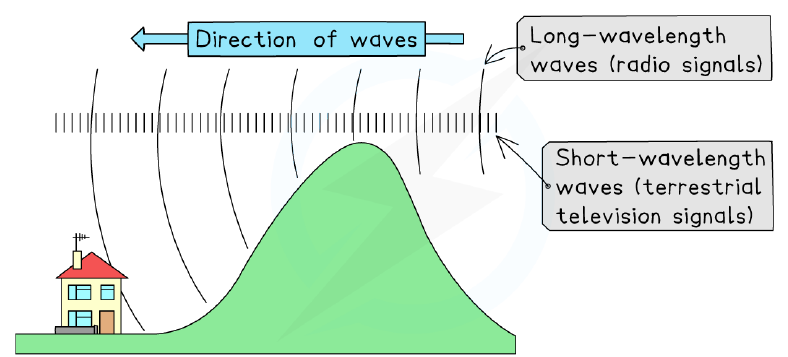
- Radio waves diffract around hills (similar wavelength to obstacles), used for local radio and Bluetooth.
- Optical fibres use visible light or infrared for high-speed broadband; high frequency allows high data rates.
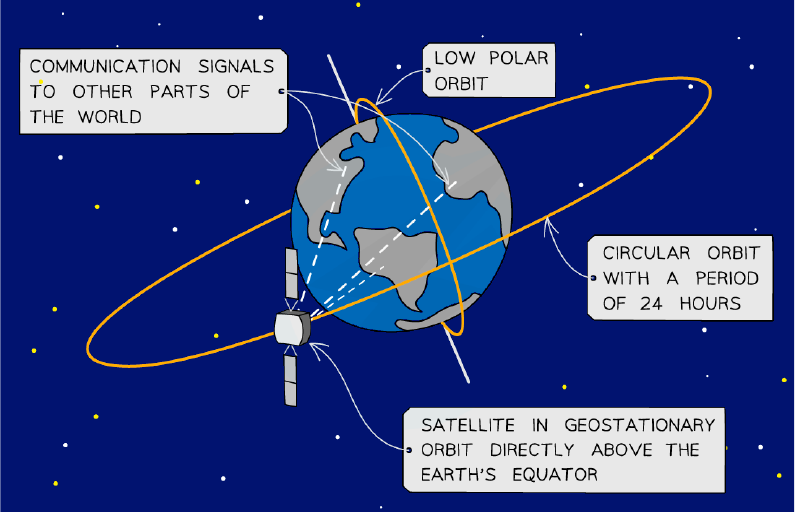
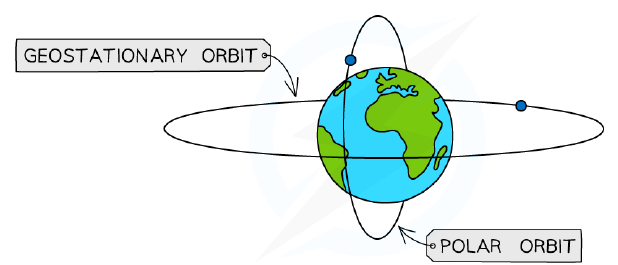
- Geostationary satellites: orbit at 36 000 km, period 24 h, used for broadcasting; longer time delay.
- Low‑orbit/polar satellites: orbit at ~200 km, shorter delay, used for weather and imaging.
A satellite in geostationary orbit above the Earth's equator, showing communication signals to other parts of the world.
Digital & Analogue Signals (Extended)
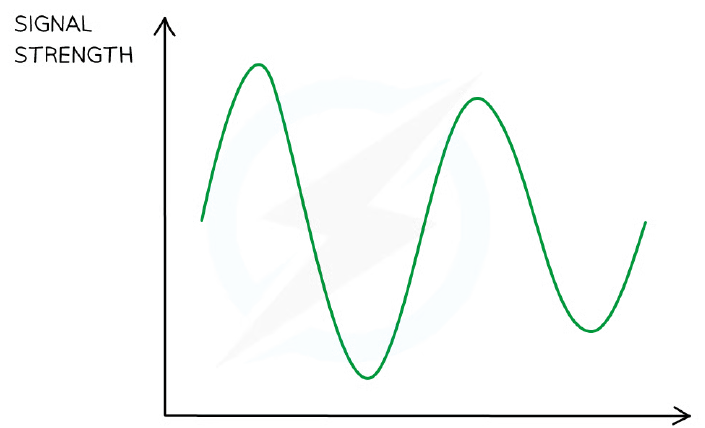
- Analogue signals vary continuously and can take any value.
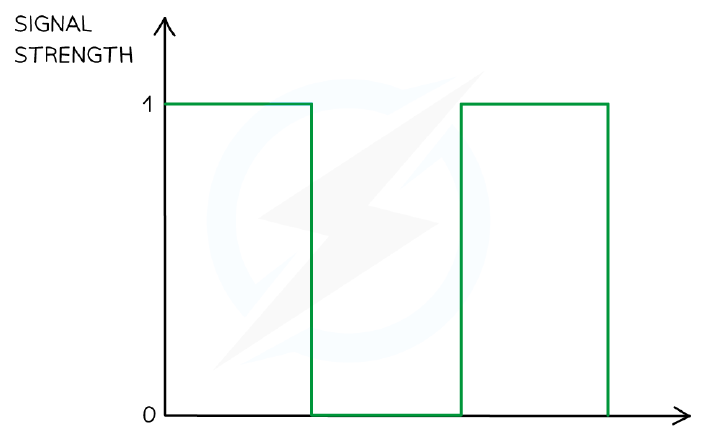
- Digital signals have only two states (0/1, high/low).
- Digital signals can be regenerated with minimal noise, giving larger range and higher data rate.
- Extra data can be added to digital signals for error checking.
- Digital sampling converts an analogue signal to digital by recording at set time intervals.
A digital signal, which can only take one of two states (0 or 1).
スライド
練習問題
無料プレビュー — 41問中8問。すべて見るには登録を。
1.Which of the following lists the electromagnetic spectrum in order of decreasing wavelength?
Easy- ARadio waves, microwaves, infrared, visible, ultraviolet, X-rays, gamma rays
- BGamma rays, X-rays, ultraviolet, visible, infrared, microwaves, radio waves
- CRadio waves, infrared, microwaves, visible, ultraviolet, gamma rays, X-rays
- DVisible, infrared, radio waves, microwaves, ultraviolet, X-rays, gamma rays
2.All electromagnetic waves travel at the same speed in a vacuum. What is this speed?
Easy- A3.0 × 108 m/s
- B3.0 × 106 m/s
- C3.0 × 1010 m/s
- D3.0 × 103 m/s
3.Which type of electromagnetic radiation is used for television remote controls?
Easy- AInfrared
- BRadio waves
- CUltraviolet
- DMicrowaves
4.Which of the following is a harmful effect of excessive exposure to ultraviolet radiation?
Easy- ASkin cancer
- BInternal heating of body cells
- CSkin burns
- DMutation of DNA
5.Which type of electromagnetic radiation has a wavelength of about 1 km?
Easy- ARadio waves
- BMicrowaves
- CInfrared
- DVisible light
6.A geostationary satellite orbits at a height of 36 000 km above the Earth's surface. What is its orbital period?
Easy- A24 hours
- B12 hours
- C48 hours
- D72 hours
7.Which property increases as you move from radio waves to gamma rays in the electromagnetic spectrum?
Easy- AFrequency
- BWavelength
- CSpeed in a vacuum
- DAmplitude
8.Which type of signal can only take one of two discrete values?
Easy- ADigital signal
- BAnalogue signal
- CRadio signal
- DMicrowave signal
過去問
このトピックの過去問練習は近日公開。
近日公開