Motion
遊んで学ぼう
問題に答えてエネルギーを集めたら、釣りや探検を楽しもう。アカウント不要。
教育者の方へ: Motion(Physics、CIE)向けのすぐ使えるレッスンスライド, 復習ノート, 図解 — レッスンで使うか、学習者がライブゲームとして遊ぶインタラクティブなクラス活動としてトピックを実施できます。
レッスンノート
Speed & Velocity
- Speed = distance travelled per unit time; a scalar quantity (magnitude only).
- Equation: v = \frac{s}{t}, where v in m/s, s in m, t in s.
- Average speed = total distance / total time; useful when speed varies.
- Velocity = speed in a given direction; a vector quantity (magnitude and direction).
- Velocity uses displacement (vector) instead of distance.
- Same speed but different directions → different velocities.
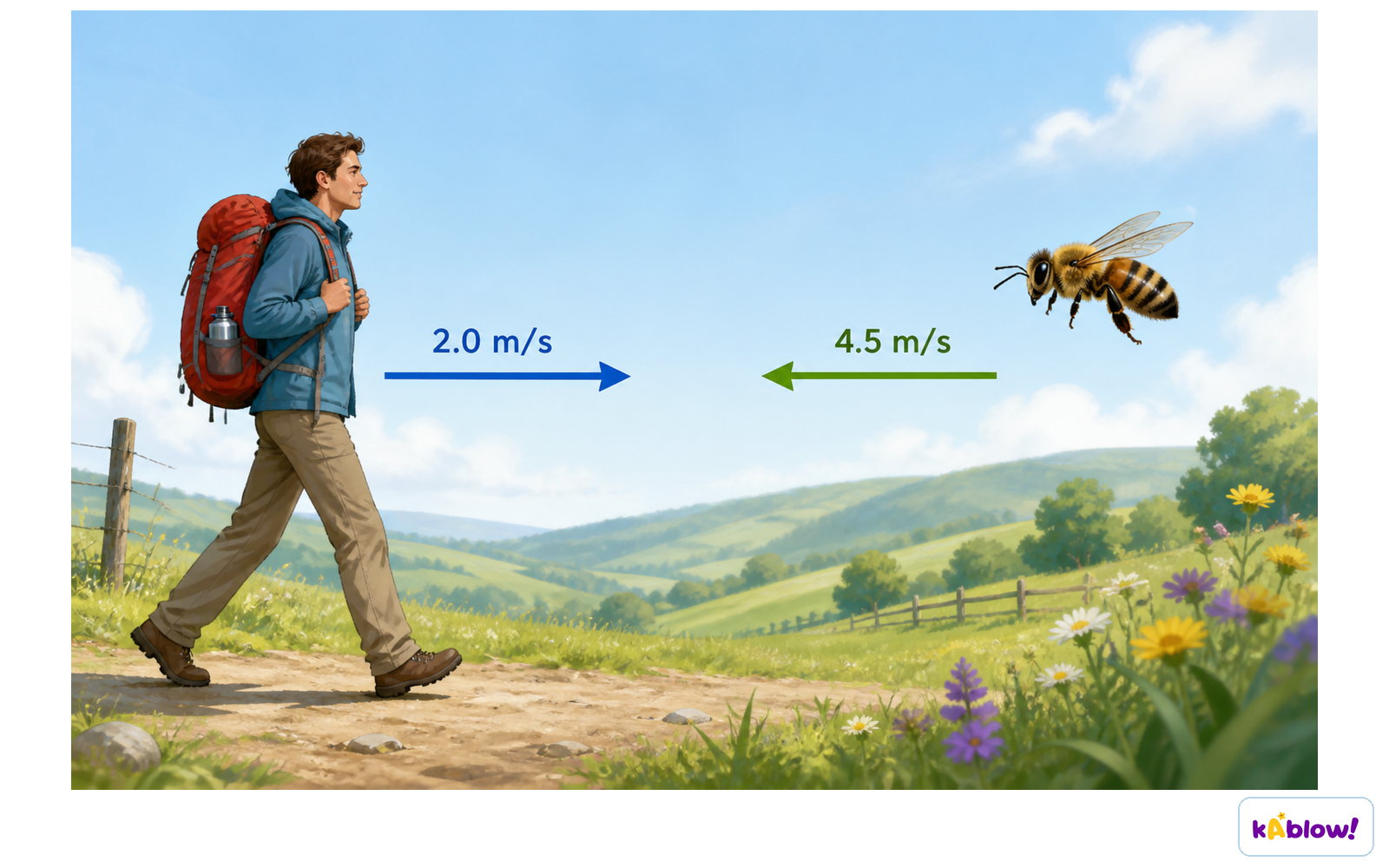
A person walking at 2.0 m/s and a bee flying at 4.5 m/s, illustrating speed.
Acceleration (Extended)
- Acceleration = rate of change of velocity; a = \frac{\Delta v}{\Delta t}, units m/s².
- Change in velocity: \Delta v = v - u (final minus initial).
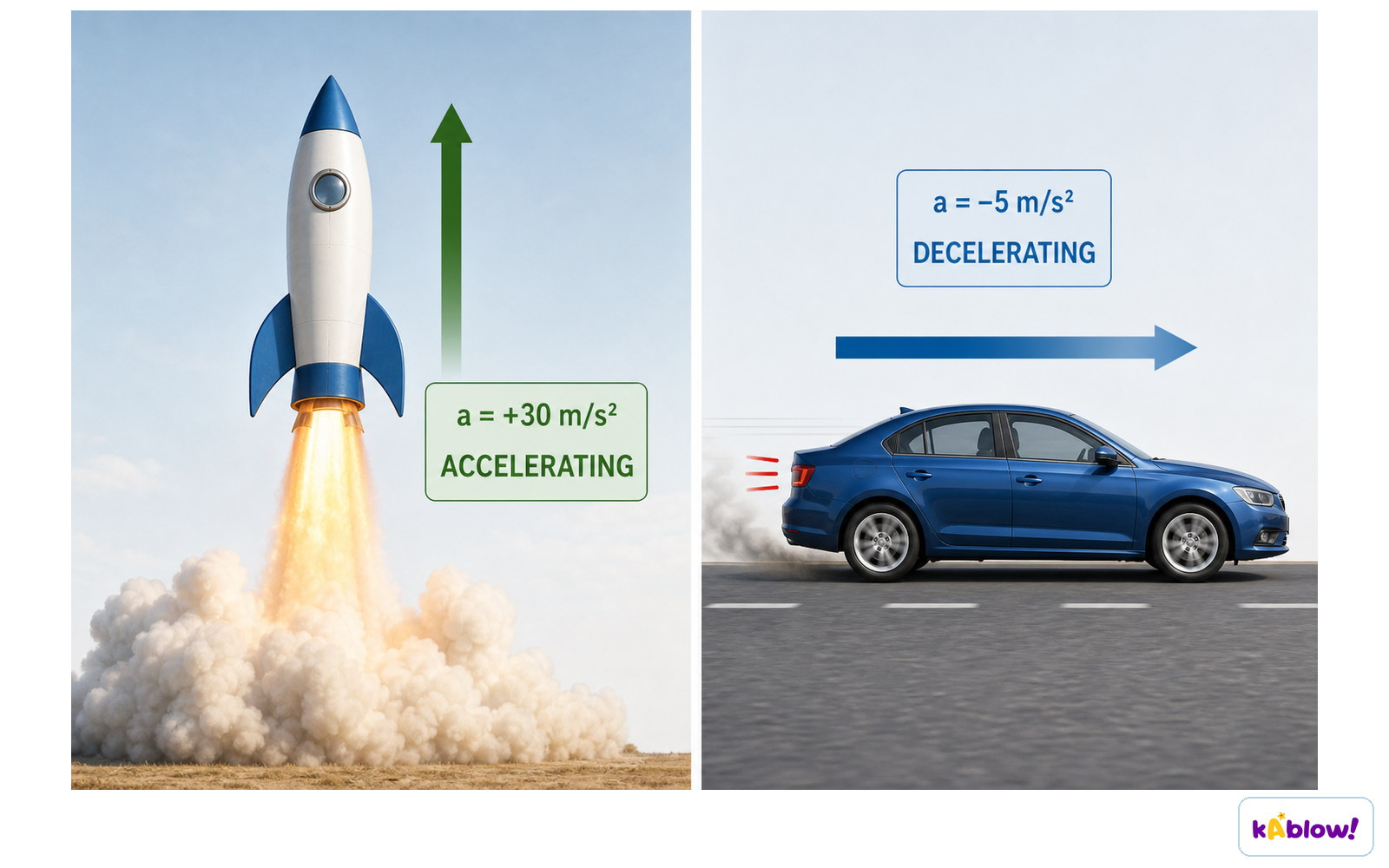
- Positive acceleration = speeding up; negative acceleration (deceleration) = slowing down.
- Any change in velocity (speed up, slow down, change direction) is acceleration.
- Formula triangle: cover the quantity to find; a = \frac{\Delta v}{\Delta t}, \Delta v = a \times \Delta t, \Delta t = \frac{\Delta v}{a}.
Examples of positive and negative acceleration
Distance-Time Graphs
- Distance-time graph: straight line = constant speed; horizontal line = stationary.
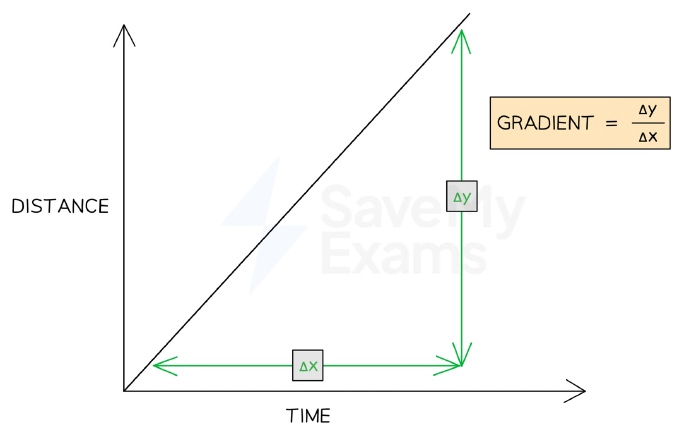
- Gradient = speed; steeper slope = faster speed.
- Curved line = changing speed (acceleration/deceleration); increasing gradient = speeding up, decreasing = slowing down.
- To calculate speed: draw a large gradient triangle, find \frac{\Delta y}{\Delta x}.
- Always check units (e.g., km → m, min → s).
The gradient of a distance-time graph, found from the change in distance (Δy) over the change in time (Δx), gives the speed.
Speed-Time Graphs
- Speed-time graph: straight line = constant acceleration; horizontal line = constant speed (zero acceleration).
- Gradient = acceleration; positive gradient = acceleration, negative = deceleration.
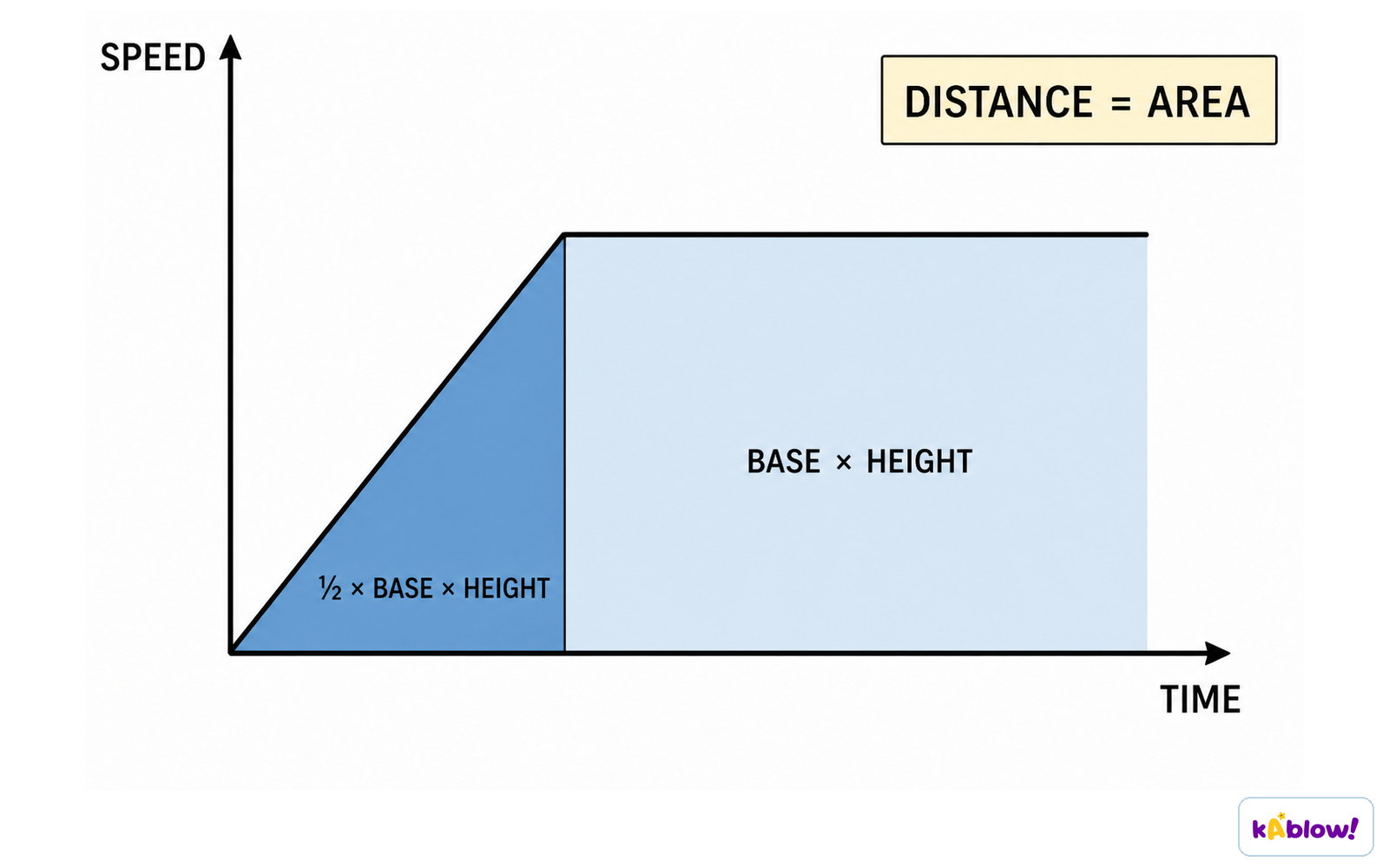
- Area under graph = distance travelled.
- Split area into triangles and rectangles: triangle area = \frac{1}{2}bh, rectangle area = bh.
- Total distance = sum of all areas under the line.
The area under a speed-time graph, split into a triangle and a rectangle (base × height), gives the distance travelled.
Calculating Acceleration from Speed-Time Graphs (Extended)
- For constant acceleration: gradient = \frac{\Delta v}{\Delta t} using a straight line.
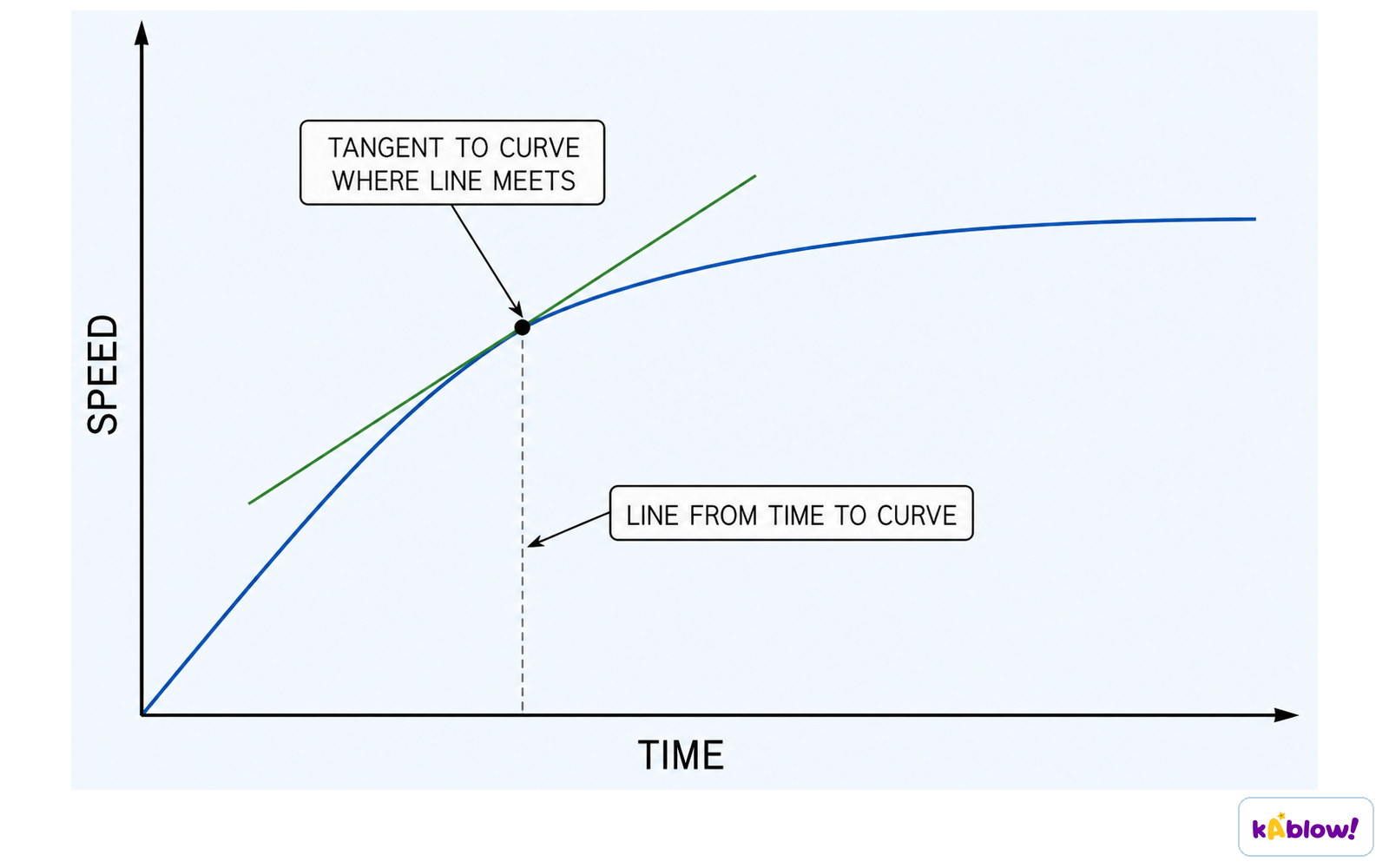
- For changing acceleration: draw a tangent at the point; gradient of tangent = instantaneous acceleration.
- A tangent is a straight line that just touches the curve at that point.
- Use a large gradient triangle on the tangent to calculate \frac{\Delta y}{\Delta x}.
A tangent drawn to a curved speed-time graph at a point gives the gradient, and so the instantaneous acceleration, at that point.
Freefall
- In absence of air resistance, all objects fall with same acceleration: g = 9.8 \, \text{m/s}2 (acceleration of freefall).
- Weight W = mg, where g is gravitational field strength (N/kg).
- With air resistance: forces are weight (down) and air resistance (up).
- Air resistance increases with speed; when it equals weight, resultant force = 0 → terminal velocity.
- Skydiver: initially accelerates, then air resistance increases, eventually reaches terminal velocity; deploying parachute increases air resistance → deceleration to a lower terminal velocity.
- In a vacuum (no air resistance), objects never reach terminal velocity; they accelerate at g continuously.
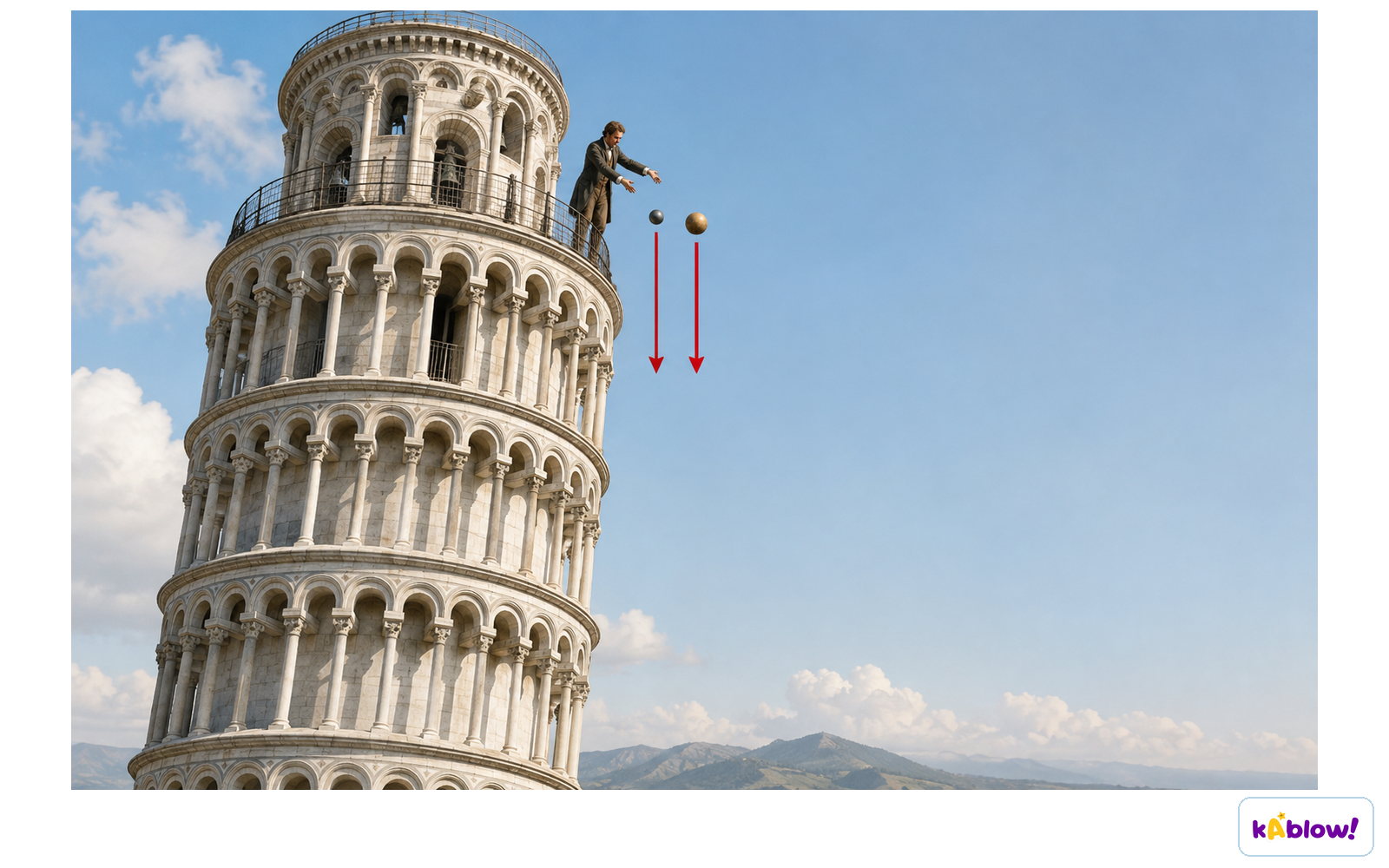
A person dropping two objects of different sizes from the Leaning Tower of Pisa to demonstrate freefall.
スライド
練習問題
無料プレビュー — 63問中8問。すべて見るには登録を。
1.Which of the following is a scalar quantity?
Easy- Avelocity
- Bdisplacement
- Cacceleration
- Dspeed
2.What is the acceleration of free fall near Earth's surface?
Easy- A9.8 m/s
- B9.8 m/s²
- C9.8 m/s² downward
- D9.8 N/kg
3.On a distance-time graph, a horizontal line indicates that the object is:
Easy- Aaccelerating
- Bmoving at constant speed
- Cstationary
- Ddecelerating
4.Which of the following is the correct definition of velocity?
Easy- ADistance travelled per unit time
- BSpeed in a given direction
- CChange in displacement per unit time
- DRate of change of speed
5.The area under a speed-time graph represents:
Easy- Aacceleration
- Bvelocity
- Cdistance travelled
- Ddeceleration
6.An object accelerates from 4 m/s to 10 m/s in 3 s. What is its acceleration?
Medium- A2 m/s²
- B3 m/s²
- C4 m/s²
- D6 m/s²
7.On a speed-time graph, a straight line with negative gradient represents:
Easy- Aconstant acceleration
- Bconstant deceleration
- Cconstant speed
- Dincreasing acceleration
8.A skydiver falls from a plane. After reaching terminal velocity, the parachute opens. Which statement is correct?
Medium- AThe skydiver immediately stops falling.
- BThe skydiver accelerates upward.
- CThe skydiver decelerates to a lower terminal velocity.
- DThe skydiver continues at the same terminal velocity.
過去問
このトピックの過去問練習は近日公開。
近日公開