Stars & The Universe
遊んで学ぼう
問題に答えてエネルギーを集めたら、釣りや探検を楽しもう。アカウント不要。
レッスンノート
The Sun as a Star
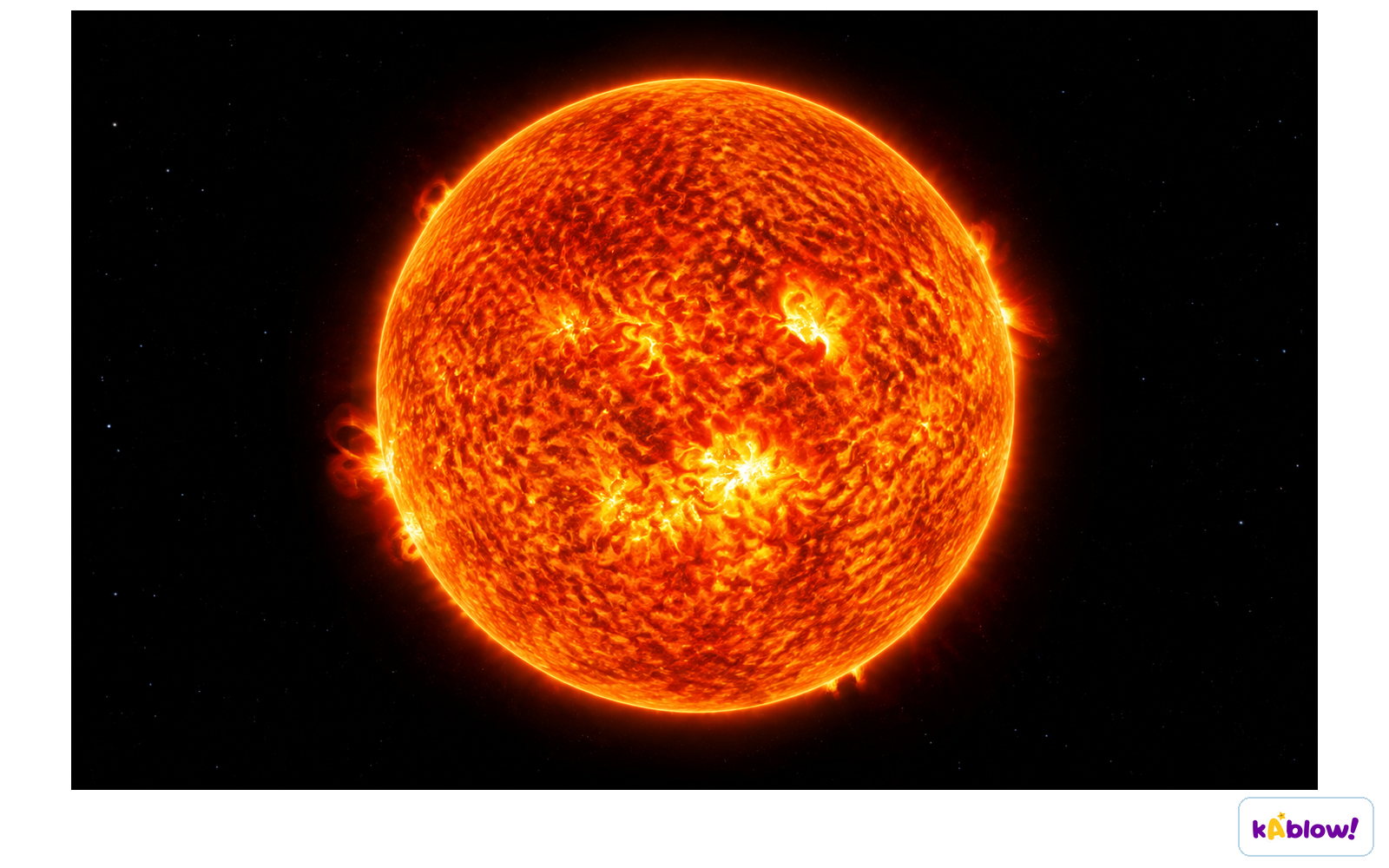
- The Sun is a medium-sized star at the centre of the Solar System.
- It consists mostly of hydrogen and helium.
- It radiates most energy in the infrared, visible and ultraviolet regions.
- In the core, nuclear fusion converts hydrogen into helium, releasing huge energy.
- All stable stars are powered by nuclear fusion.
The Sun as a star
Scale of the Universe
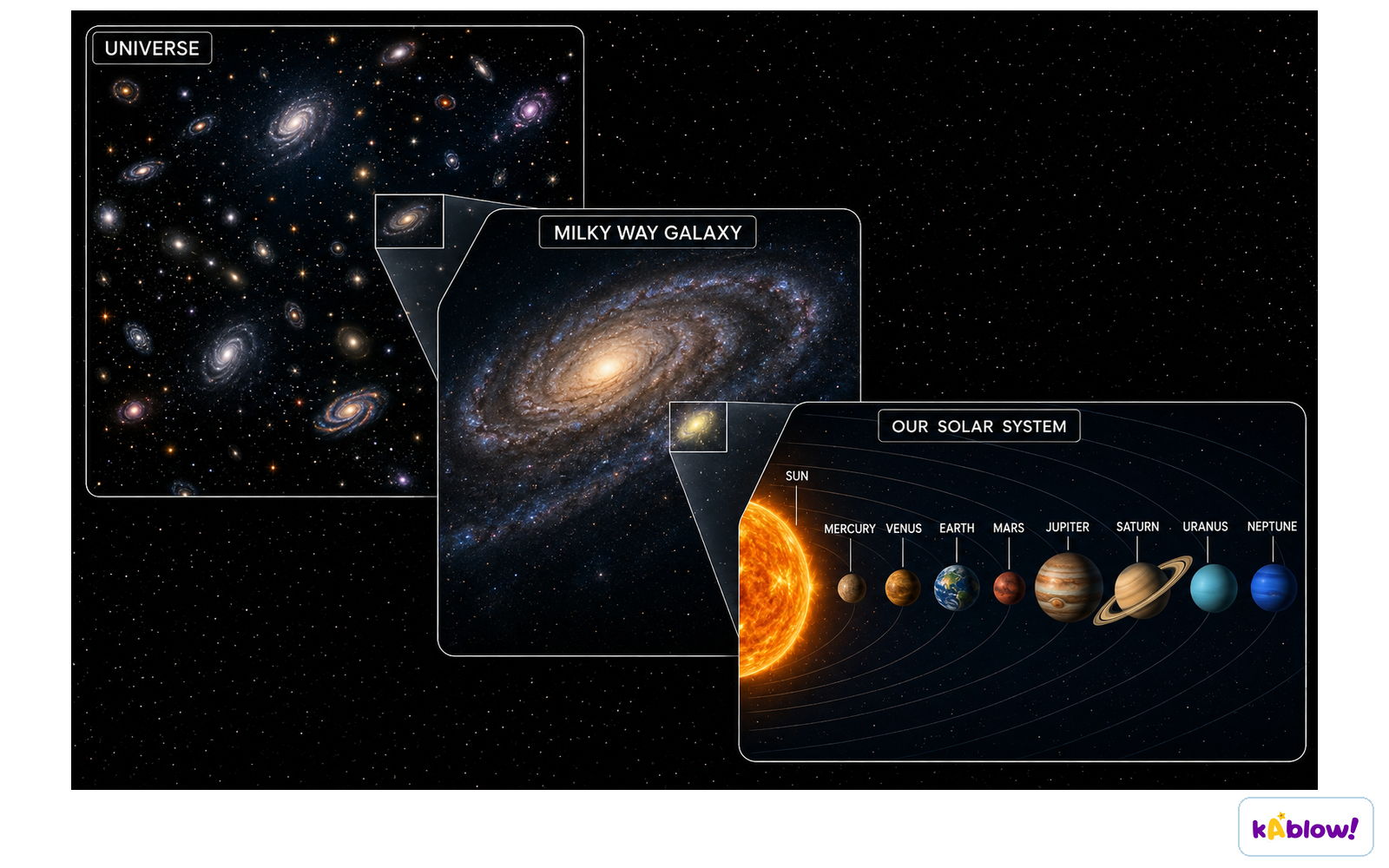
- The Universe is a large collection of billions of galaxies.
- A galaxy is a large collection of billions of stars.
- The Milky Way is our galaxy; the Sun is one of its billions of stars.
- Other stars in the Milky Way are much further from Earth than the Sun.
- A light-year is the distance light travels in one year (≈ 9.5 × 10¹⁵ m).
- The Milky Way's diameter is about 100 000 light-years.
Hierarchy of the Universe
Star Formation
- Stars form from a nebula (cloud of gas and dust).
- Gravity pulls particles together to form a protostar; density and temperature increase.
- When the core is hot enough, nuclear fusion begins → stable star.
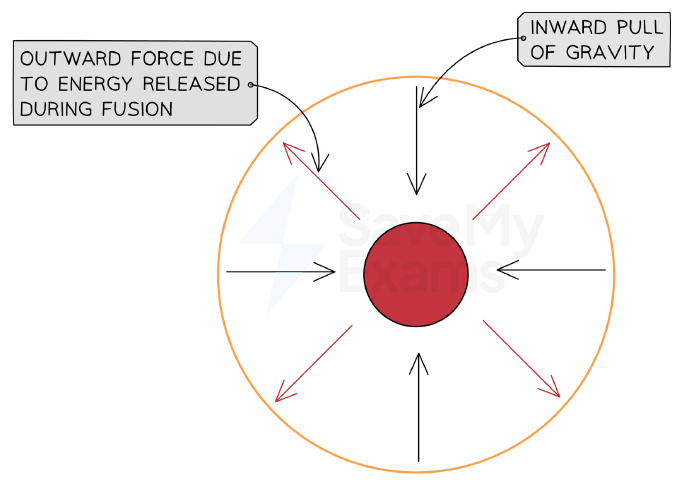
- In a stable star, inward gravitational forces balance outward thermal pressure.
Balanced forces in a stable star
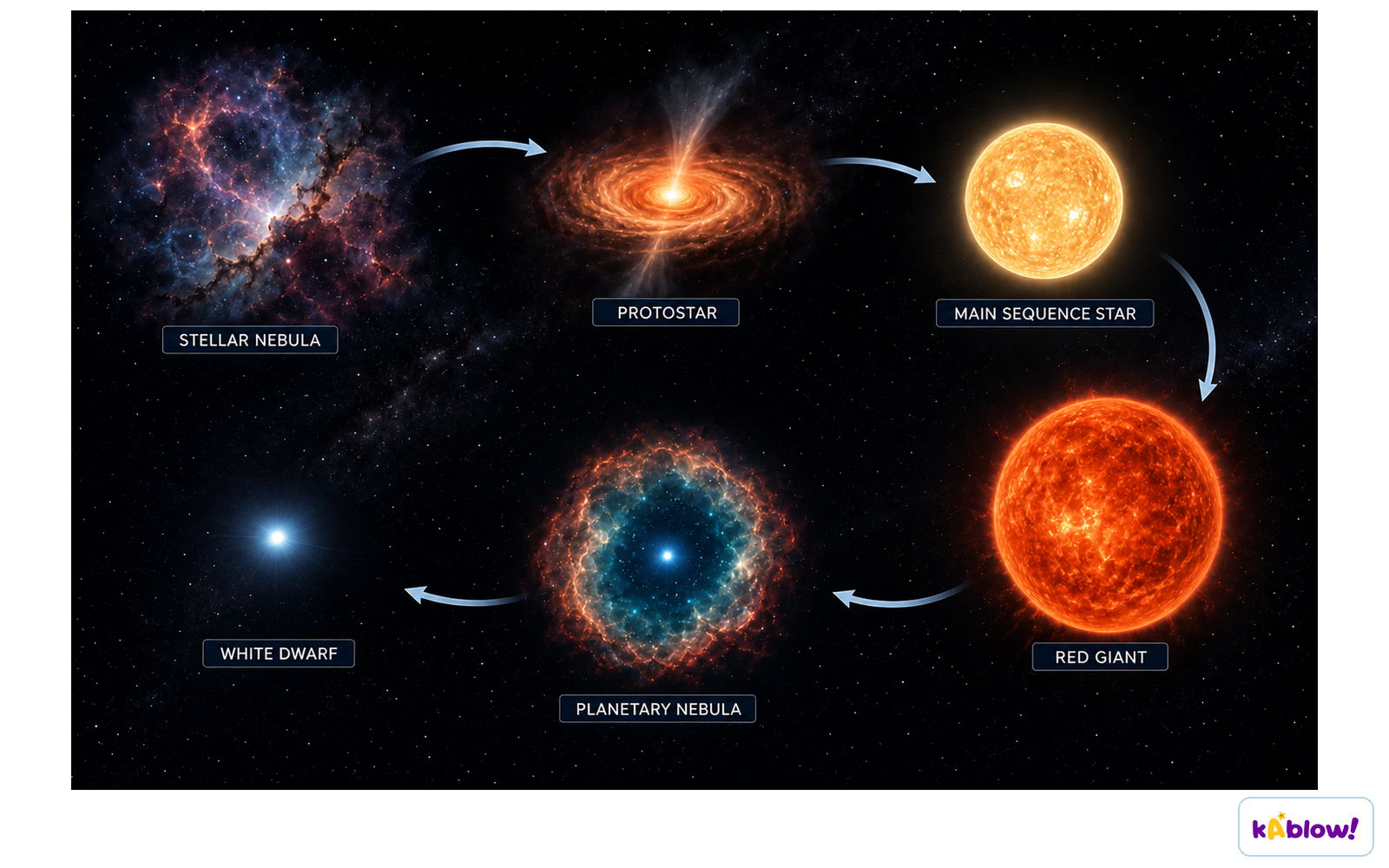
Life Cycle of Low-Mass Stars (≤ 8 solar masses)
- After stable phase: red giant → planetary nebula → white dwarf.
- Red giant: hydrogen depleted, core shrinks and heats, helium fuses to carbon, outer layers expand.
- Planetary nebula: outer layers ejected; core collapses.
- White dwarf: hot, dense core that cools and dims over time.
Life cycle of a low-mass star
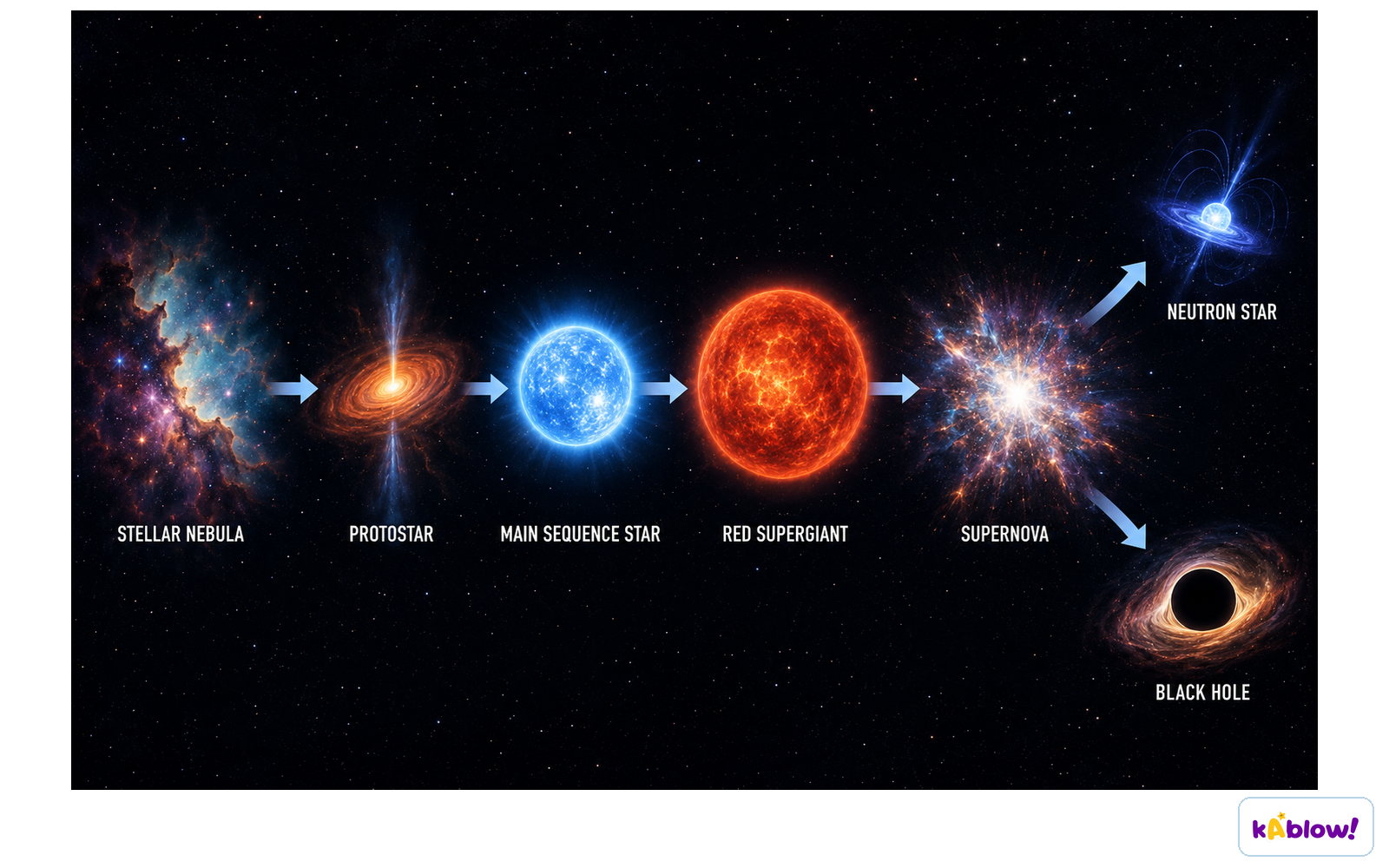
Life Cycle of High-Mass Stars (> 8 solar masses)
- After stable phase: red supergiant → supernova → neutron star or black hole.
- Red supergiant: fuses heavier elements up to iron; core collapses and expands repeatedly.
- Supernova: core collapses rapidly, triggering a huge explosion; heavy elements (heavier than iron) are formed.
- Neutron star: dense remnant at the centre; if massive enough, collapses to a black hole.
- Nebulae from supernovae may form new stars and planets.
Life cycle of high-mass stars
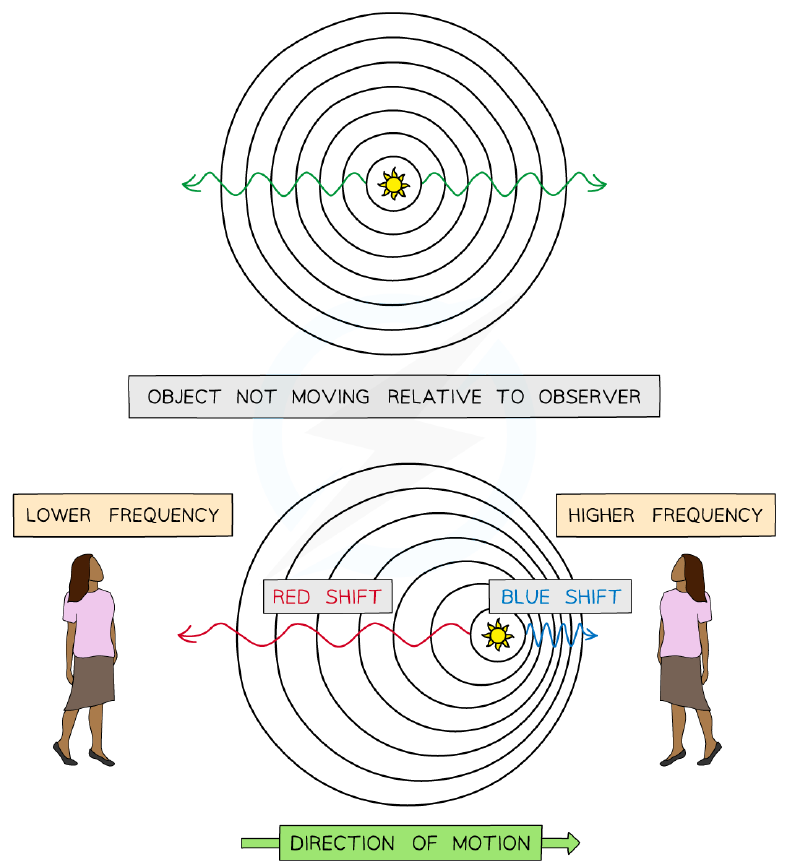
Galactic Redshift
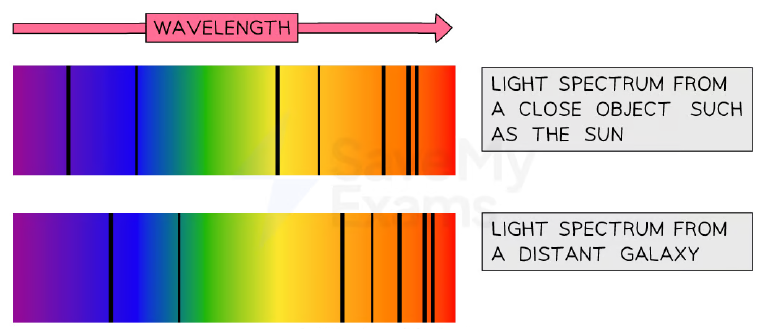
- Redshift is the increase in wavelength of light from a source moving away (Doppler effect).
- Light from distant galaxies is redshifted compared to hydrogen on Earth → galaxies are moving away.
- Greater redshift means the galaxy is further away and moving faster.
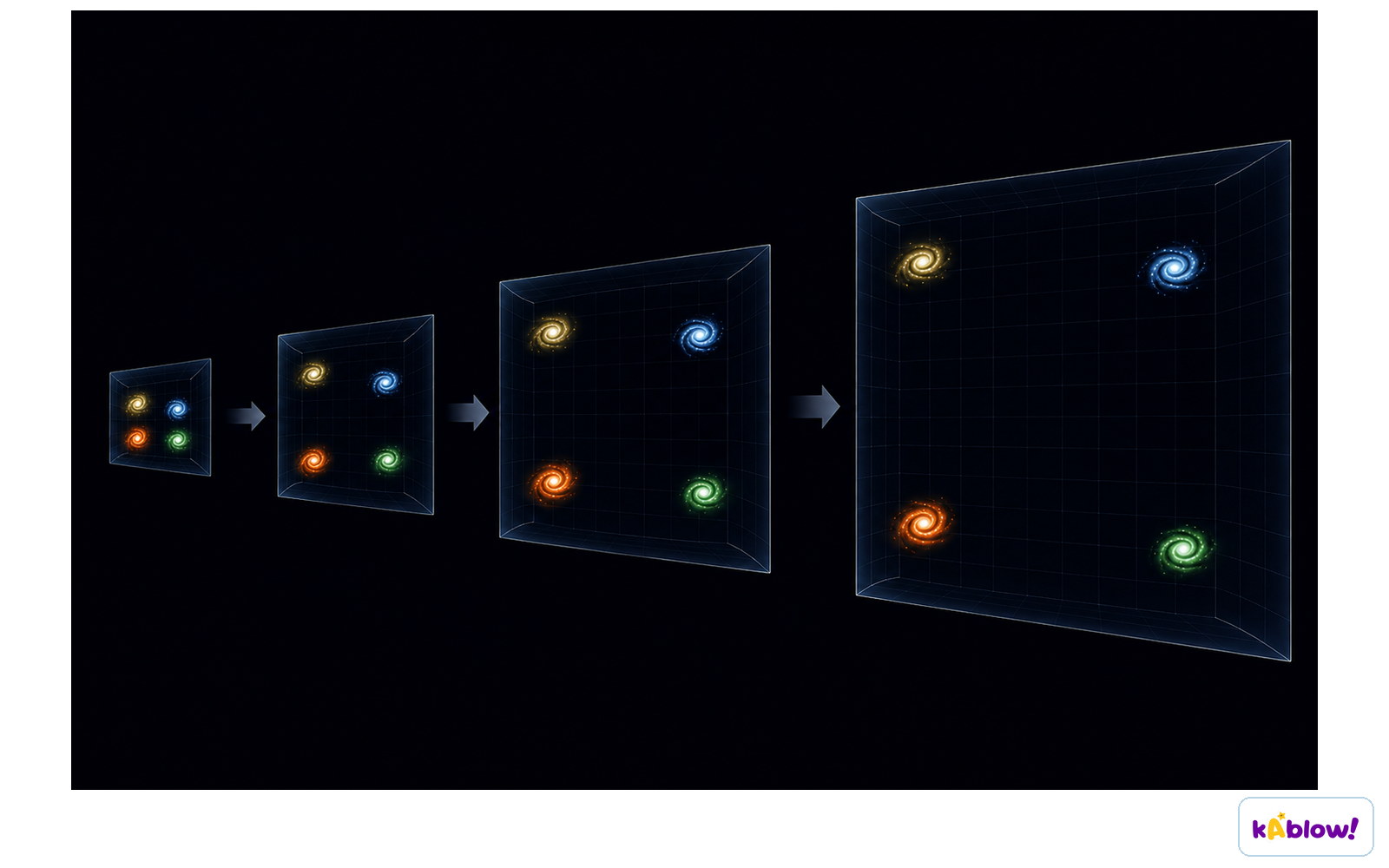
- This shows the Universe is expanding.
Redshift and blueshift of light
The Big Bang Theory
- The Universe began about 14 billion years ago from a hot, dense single point.
- Evidence: galactic redshift (galaxies receding → expansion) and cosmic microwave background radiation (CMBR).
- CMBR is uniform microwave radiation from all directions, left over from the early Universe.
- CMBR was originally high-energy gamma radiation; it has been redshifted as the Universe expanded.
The Big Bang Theory showing the expansion of the universe from a single point.
Age of the Universe (Extended)
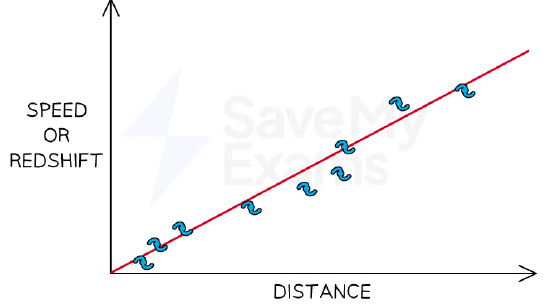
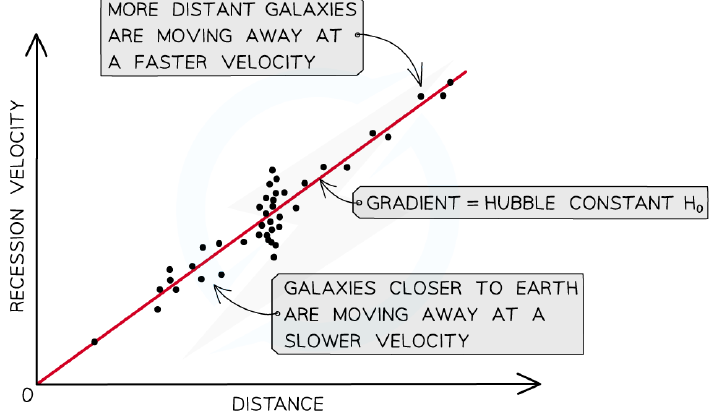
- Hubble's law: recession speed v is proportional to distance d: v = H₀ d.
- Hubble constant H₀ = 2.2 × 10⁻¹⁸ per second (current accepted value).
- Age of Universe ≈ 1 / H₀ ≈ 13.7 billion years.
- Distance to galaxies measured using redshift and brightness of supernovae (standard candles).
Graph of galaxy recession velocity against distance
スライド
練習問題
無料プレビュー — 46問中8問。すべて見るには登録を。
1.Which of the following is the correct definition of a galaxy?
Easy- AA large collection of billions of stars
- BA large collection of billions of planets
- CA large collection of billions of galaxies
- DA large collection of billions of moons
2.What is the approximate diameter of the Milky Way galaxy in light-years?
Easy- A100 000 light-years
- B1 million light-years
- C10 000 light-years
- D1 billion light-years
3.What is the name of the force that pulls the outer layers of a star inwards during its stable phase?
Easy- AGravitational force
- BThermal pressure
- CNuclear force
- DElectromagnetic force
4.What is the correct order of stages in the life cycle of a star similar in mass to the Sun after the stable star phase?
Easy- ARed giant, planetary nebula, white dwarf
- BRed supergiant, supernova, neutron star
- CPlanetary nebula, white dwarf, red giant
- DWhite dwarf, red giant, planetary nebula
5.What does the observed redshift in the light from distant galaxies indicate?
Easy- AGalaxies are moving away from Earth
- BGalaxies are moving towards Earth
- CGalaxies are stationary
- DGalaxies are shrinking
6.The Hubble constant H0 is approximately 2.2 × 10⁻¹⁸ per second. A galaxy is at a distance of 1.0 × 10²³ m. What is its recessional velocity?
Medium- A2.2 × 10⁵ m/s
- B2.2 × 10⁻⁴¹ m/s
- C4.5 × 10⁴⁰ m/s
- D2.2 × 10⁻⁵ m/s
7.Which of the following is evidence for the Big Bang theory?
Easy- AGalactic redshift and cosmic microwave background radiation
- BThe Sun's energy from nuclear fusion
- CThe existence of black holes
- DThe formation of planetary nebulae
8.What is the approximate age of the Universe according to the Hubble constant?
Easy- A13.7 billion years
- B13.7 million years
- C4.5 billion years
- D100 billion years