Binary numbers: counting in base two
遊んで学ぼう
問題に答えてエネルギーを集めたら、釣りや探検を楽しもう。アカウント不要。
教育者の方へ: Binary numbers: counting in base two(KS3 Computing、Computer Systems)向けのすぐ使えるレッスンスライド, 復習ノート — レッスンで使うか、学習者がライブゲームとして遊ぶインタラクティブなクラス活動としてトピックを実施できます。
レッスンノート
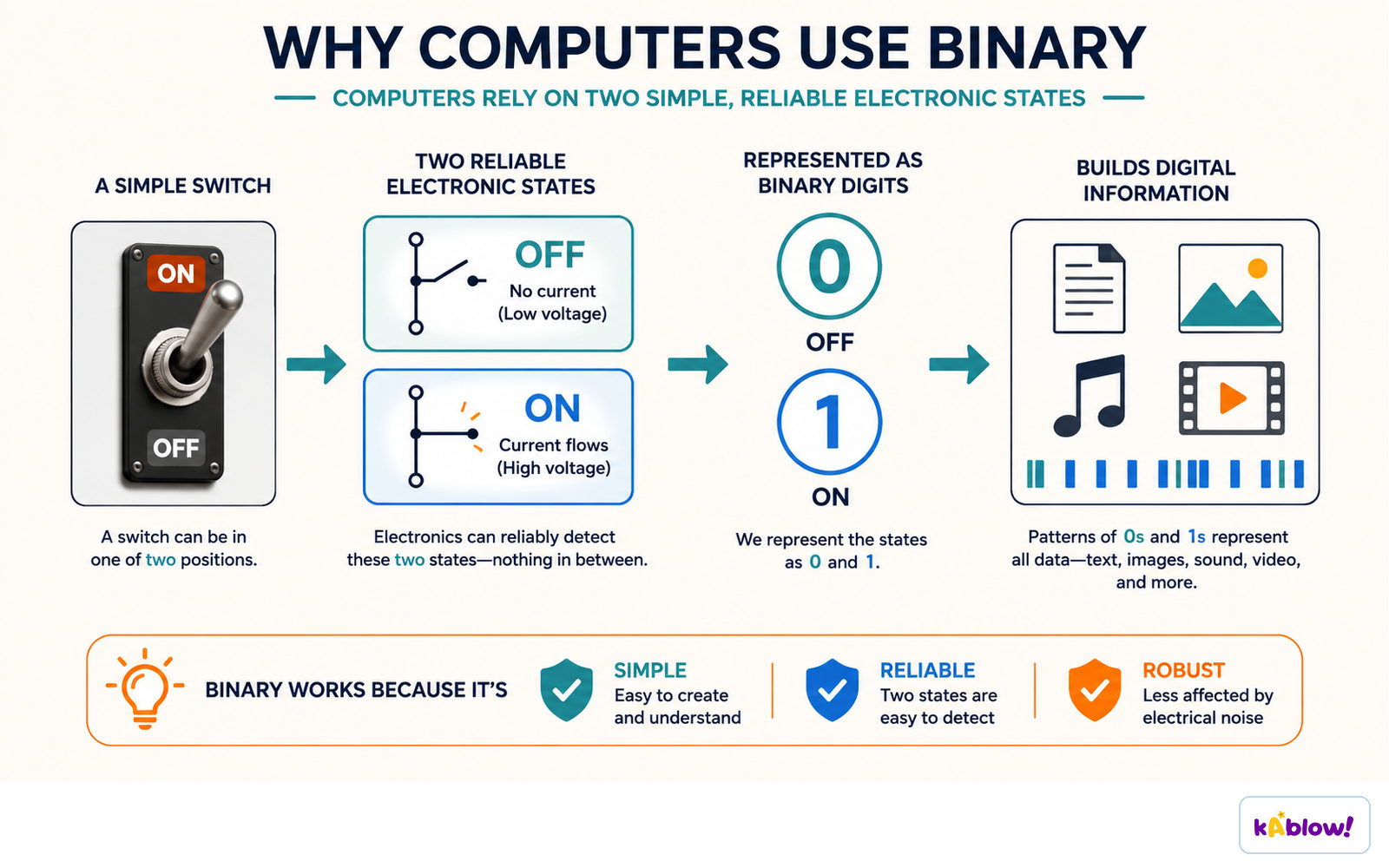
Why Computers Use Binary
- Computers use binary because their electronic circuits are two-state devices (on/off).
- Binary uses only two symbols: 0 and 1.
- This simplicity makes binary noise-immune and easy to implement with logic gates.
- Almost all modern computers and devices use the binary system.
Computers use binary because a switch has two reliable states, easy to detect and hard to confuse.
Place Value in Base Two
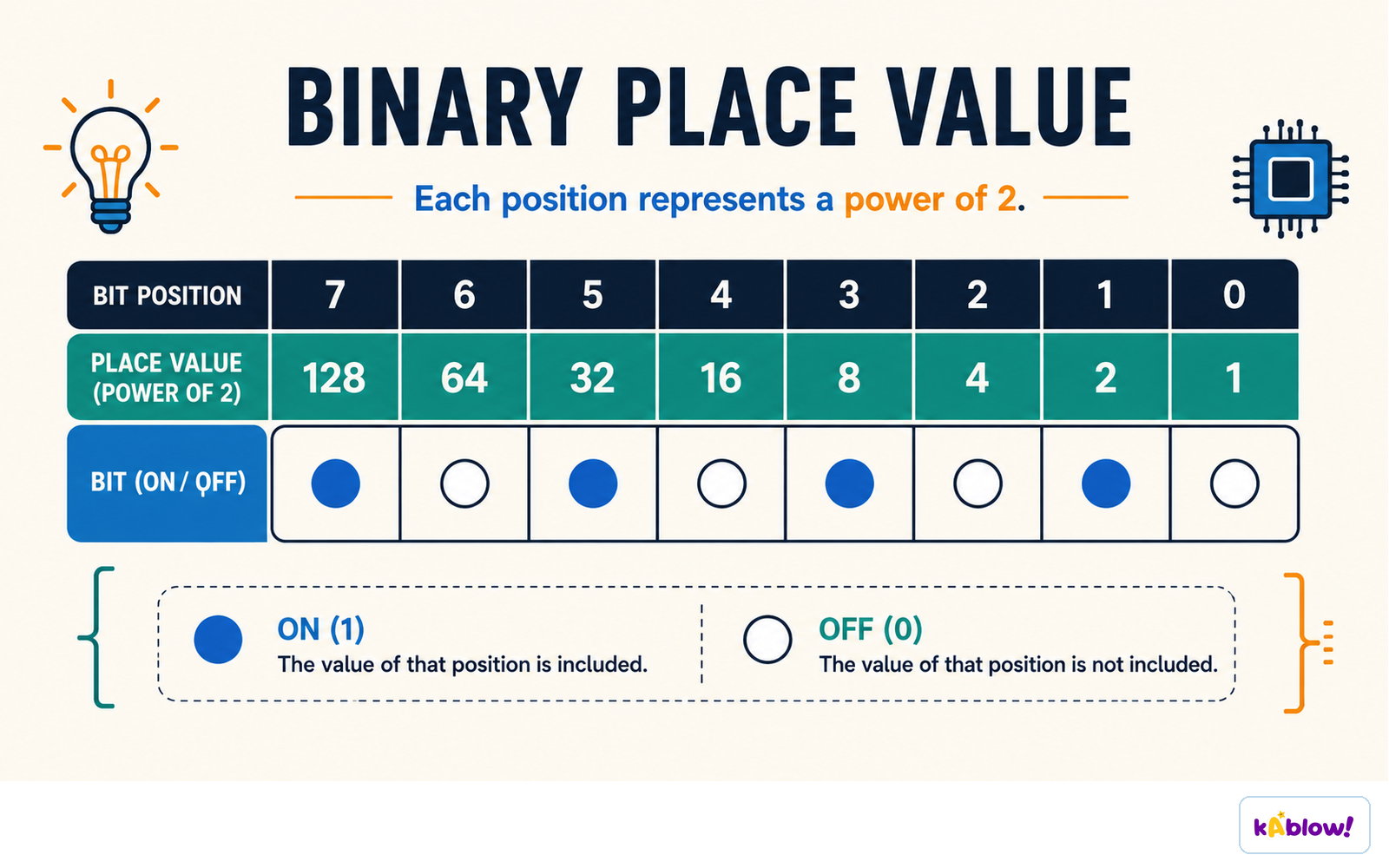
- Binary is a positional notation with a radix (base) of 2.
- Each digit in a binary number is called a bit (binary digit).
- In base two, each position represents a power of 2 (from right to left: 1, 2, 4, 8, 16, ...).
- The rightmost bit is the least significant bit (20 = 1).
- The leftmost bit is the most significant bit (highest power of 2).
In an 8-bit number each position is a power of two, from 128 down to 1.
Counting in Binary
- Counting in binary follows the same pattern as decimal, but only uses digits 0 and 1.
- When you reach 1, the next number is 10 (binary for 2).
- Binary sequence: 0, 1, 10, 11, 100, 101, 110, 111, ...
- Each time you add 1, you carry over to the next place when a bit becomes 2 (which is not allowed).
- With n bits, you can represent numbers from 0 to 2n - 1.
Bits, Nibbles, and Bytes
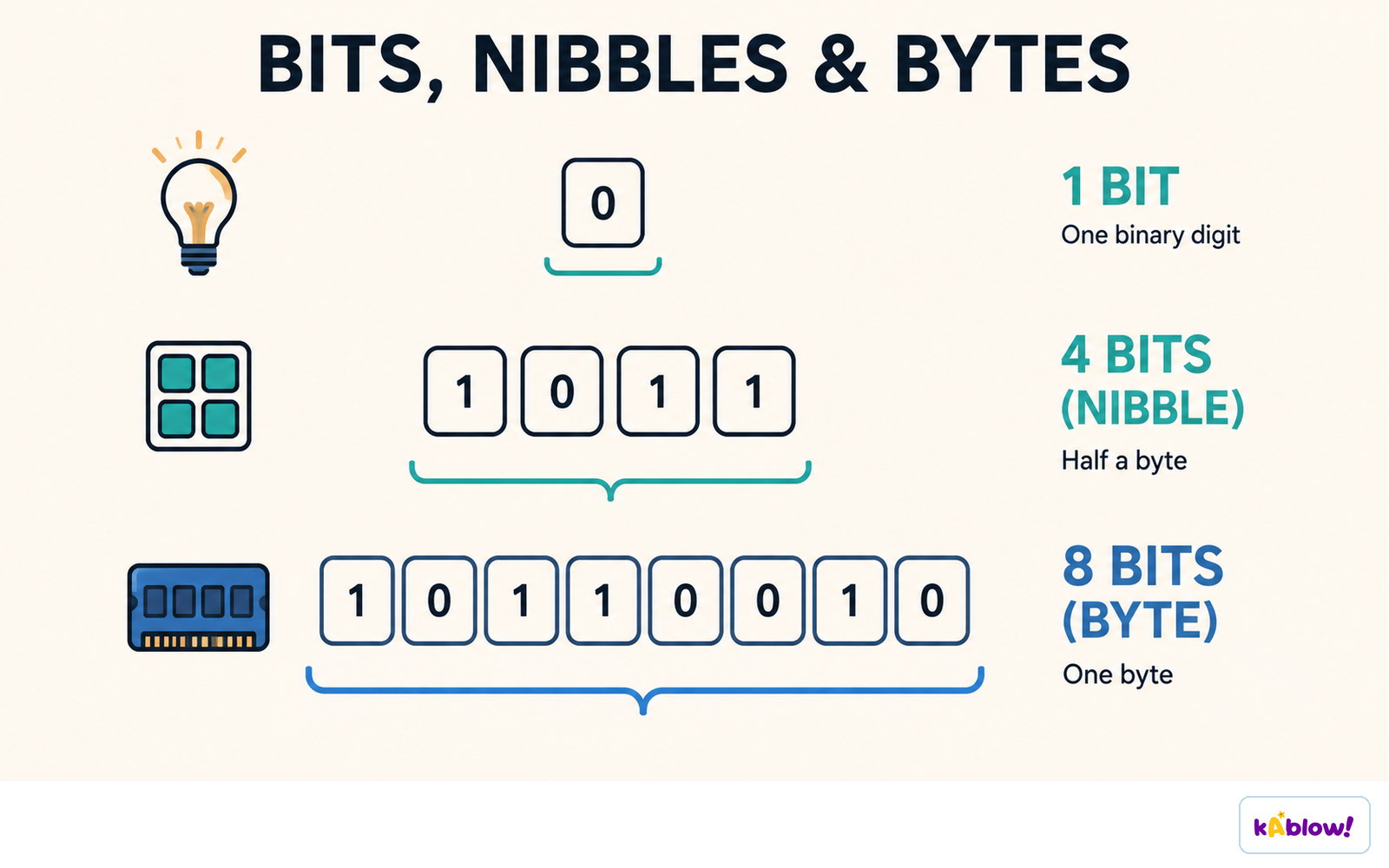
- A bit is a single binary digit (0 or 1).
- A nibble is a group of 4 bits (can represent 16 values, 0-15).
- A byte is a group of 8 bits (can represent 256 values, 0-255).
- Bytes are the standard unit for storing data in computers.
One binary digit is a bit, four bits are a nibble, and eight bits are a byte.
Converting Binary to Decimal
- To convert binary to decimal, multiply each bit by its place value (power of 2) and sum the results.
- Example: 1011₂ = 1×8 + 0×4 + 1×2 + 1×1 = 11₁₀.
- Start from the rightmost bit (20) and move left, doubling the place value each time.
- Practice with small numbers: 1101₂ = 13₁₀, 10000₂ = 16₁₀.
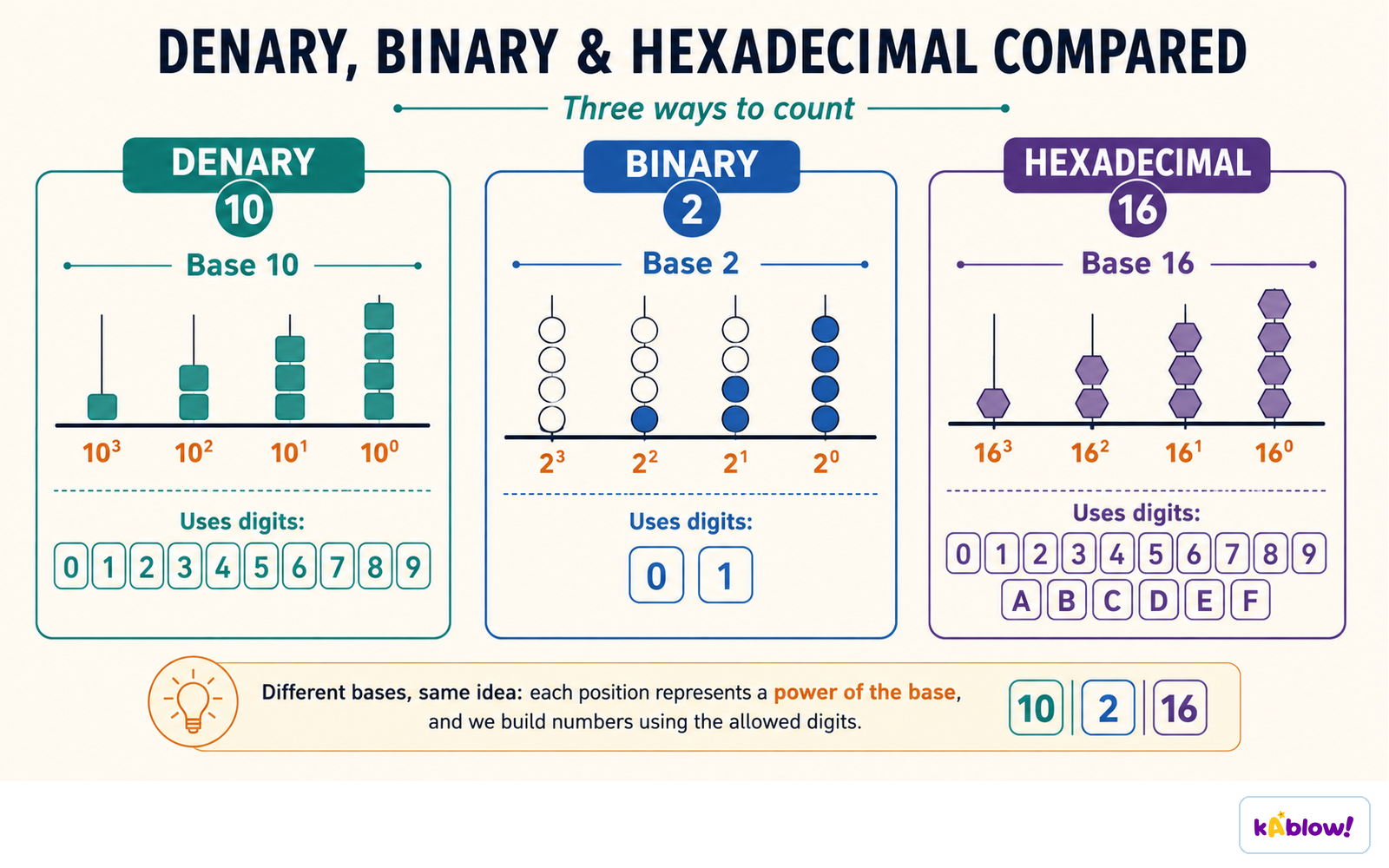
Denary, binary and hexadecimal are three ways to count: the same idea in a different base.
Historical Context
- The modern binary system was studied by Gottfried Leibniz in the 17th century.
- Earlier cultures used binary-like systems: ancient Egypt (Horus-Eye fractions), China (I Ching), India (Pingala's prosody).
- Ancient Egyptian multiplication used a method related to binary numbers.
- The I Ching uses trigrams and hexagrams that resemble binary numerals.
スライド
練習問題
無料プレビュー — 58問中8問。すべて見るには登録を。
1.A binary number system uses only the digits 0 and 1.
EasyTrue or false?
2.In the binary system, each digit is called a 'byte'.
EasyTrue or false?
3.Why do computers use the binary system?
Easy- ABecause it is easier for humans to read
- BBecause it is simple to implement in digital electronic circuitry
- CBecause it uses fewer digits than decimal
- DBecause it was invented by Charles Babbage
4.In binary, the place values are powers of 2 (1, 2, 4, 8, ...).
EasyTrue or false?
5.Which of the following is the correct binary representation of the decimal number 5?
Medium- A101
- B110
- C100
- D011
6.In binary, the number 1000 is equivalent to the decimal number 8.
MediumTrue or false?
7.Arrange the following binary numbers in increasing order of their decimal values.
Easy- 101
- 11
- 1000
- 110
8.Match each binary number to its decimal equivalent.
Medium- 1010
- 1100
- 1001
- 9
- 10
- 12
過去問
このトピックの過去問練習は近日公開。
近日公開