Alkali metals
遊んで学ぼう
問題に答えてエネルギーを集めたら、釣りや探検を楽しもう。アカウント不要。
教育者の方へ: Alkali metals(KS3 Science、Chemistry)向けのすぐ使えるレッスンスライド, 復習ノート, 図解 — レッスンで使うか、学習者がライブゲームとして遊ぶインタラクティブなクラス活動としてトピックを実施できます。
レッスンノート
Properties of Alkali Metals
- Alkali metals are in Group 1 of the periodic table.
- They have low melting points and are soft enough to be cut with a knife.
- They have low densities and are very reactive.
- They are stored in oil to prevent contact with air and water.
Alkali metals occupy the far-left column; hydrogen is not presented as a Group 1 metal.
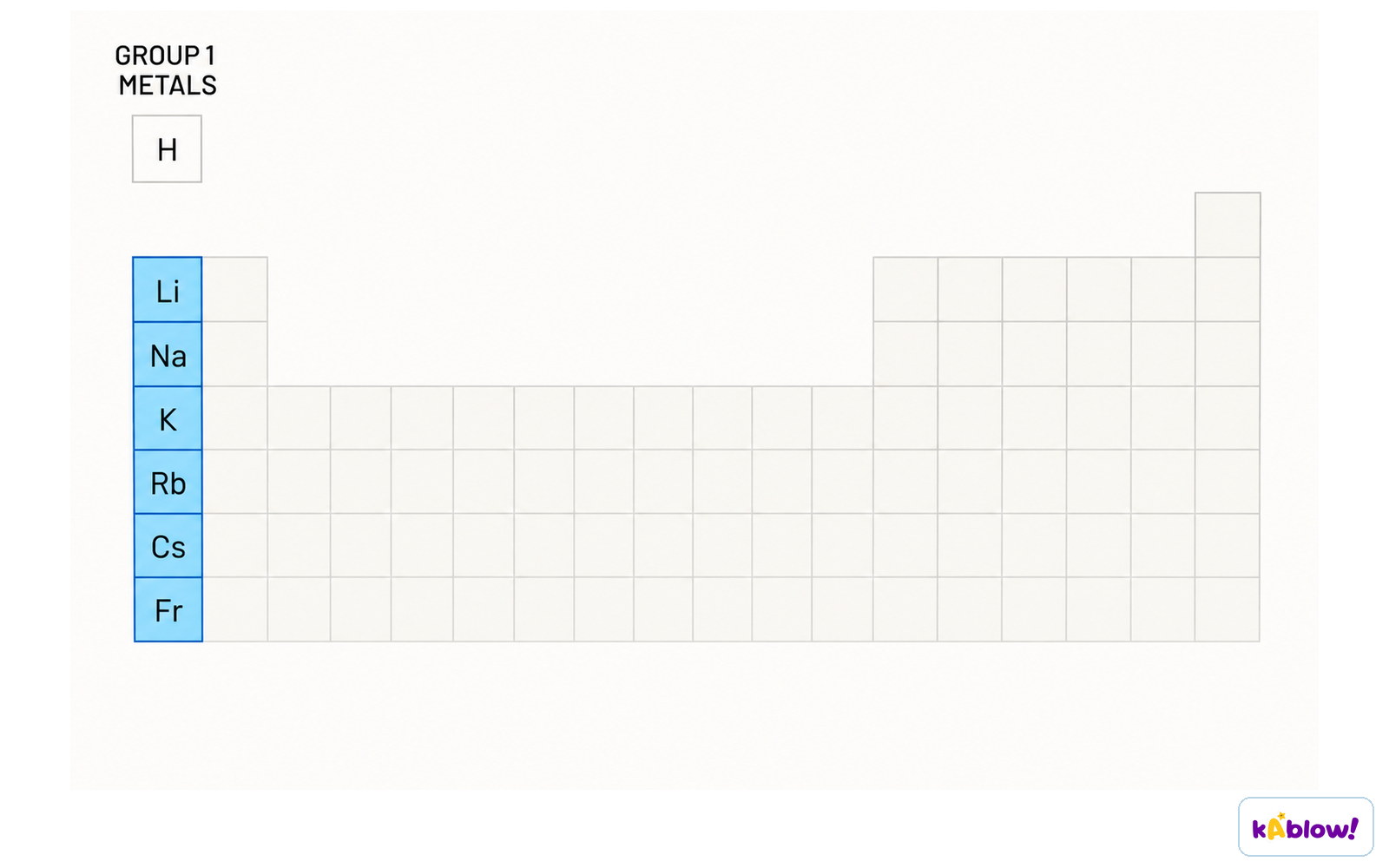
Trends Down Group 1
- Reactivity increases as you go down the group.
- Melting points decrease as you go down the group.
- Lithium is less reactive than potassium; caesium is even more reactive.
Reaction with Water
- Alkali metals react strongly with water.
- The general word equation: alkali metal + water → metal hydroxide + hydrogen.
- The metal hydroxides are alkaline (pH > 7).
- Reactions become more fierce down the group.
Examples of Reactions
- Lithium + water → lithium hydroxide + hydrogen (fizzes).
- Potassium + water → potassium hydroxide + hydrogen (ignites hydrogen).
- Caesium + water → caesium hydroxide + hydrogen (very vigorous).
Safety Precautions
- Demonstrations should be behind a safety screen.
- Only small amounts of alkali metal should be used.
- Keep alkali metals stored in oil.
Bohr model of a sodium atom (alkali metal) showing electron configuration 2.8.1.
Particle arrangement in solids, liquids, and gases. Alkali metals are solid at room temperature (except mercury).
スライド
練習問題
無料プレビュー — 60問中8問。すべて見るには登録を。
1.Which group of the periodic table are the alkali metals in?
Easy- AGroup 1
- BGroup 2
- CGroup 7
- DGroup 0
2.Which of the following is a property of alkali metals?
Easy- AThey have low melting points.
- BThey have high melting points.
- CThey are very unreactive.
- DThey are hard and cannot be cut with a knife.
3.What is the pH of an alkaline solution?
Easy- AGreater than 7
- BEqual to 7
- CLess than 7
- DExactly 7
4.Why are alkali metals stored in oil?
Easy- ATo keep air and water away from them
- BTo keep them cool
- CTo make them easier to cut
- DTo increase their reactivity
5.Complete the word equation: alkali metal + water → ?
Easy- Ametal hydroxide + hydrogen
- Bmetal oxide + hydrogen
- Cmetal hydroxide + oxygen
- Dmetal oxide + water
6.When lithium reacts with water, what causes the fizzing?
Easy- ARelease of hydrogen gas
- BRelease of oxygen gas
- CFormation of lithium hydroxide
- DIgnition of the metal
7.As you go down group 1, how does the reactivity of alkali metals change?
Easy- AReactivity increases
- BReactivity decreases
- CReactivity stays the same
- DReactivity first increases then decreases
8.Which alkali metal has a stronger reaction with water: lithium or potassium?
Easy- APotassium
- BLithium
- CThey react equally
- DNeither reacts
過去問
このトピックの過去問練習は近日公開。
近日公開