The atom
遊んで学ぼう
問題に答えてエネルギーを集めたら、釣りや探検を楽しもう。アカウント不要。
教育者の方へ: The atom(KS3 Science、Chemistry)向けのすぐ使えるレッスンスライド, 復習ノート, 図解 — レッスンで使うか、学習者がライブゲームとして遊ぶインタラクティブなクラス活動としてトピックを実施できます。
レッスンノート
Scientific Models
- A scientific model is a simplified version of an object or phenomenon, making it easier to understand while still representing key features.
- The particle model is one example; it explains and predicts the behaviour of solids, liquids and gases.
- Models are changed and updated over time as new evidence emerges.
Dalton Model of the Atom
- The Dalton model described atoms as indivisible – they could not be broken down into anything smaller.
- This was the earlier model before sub-atomic particles were discovered.
Current Model of the Atom
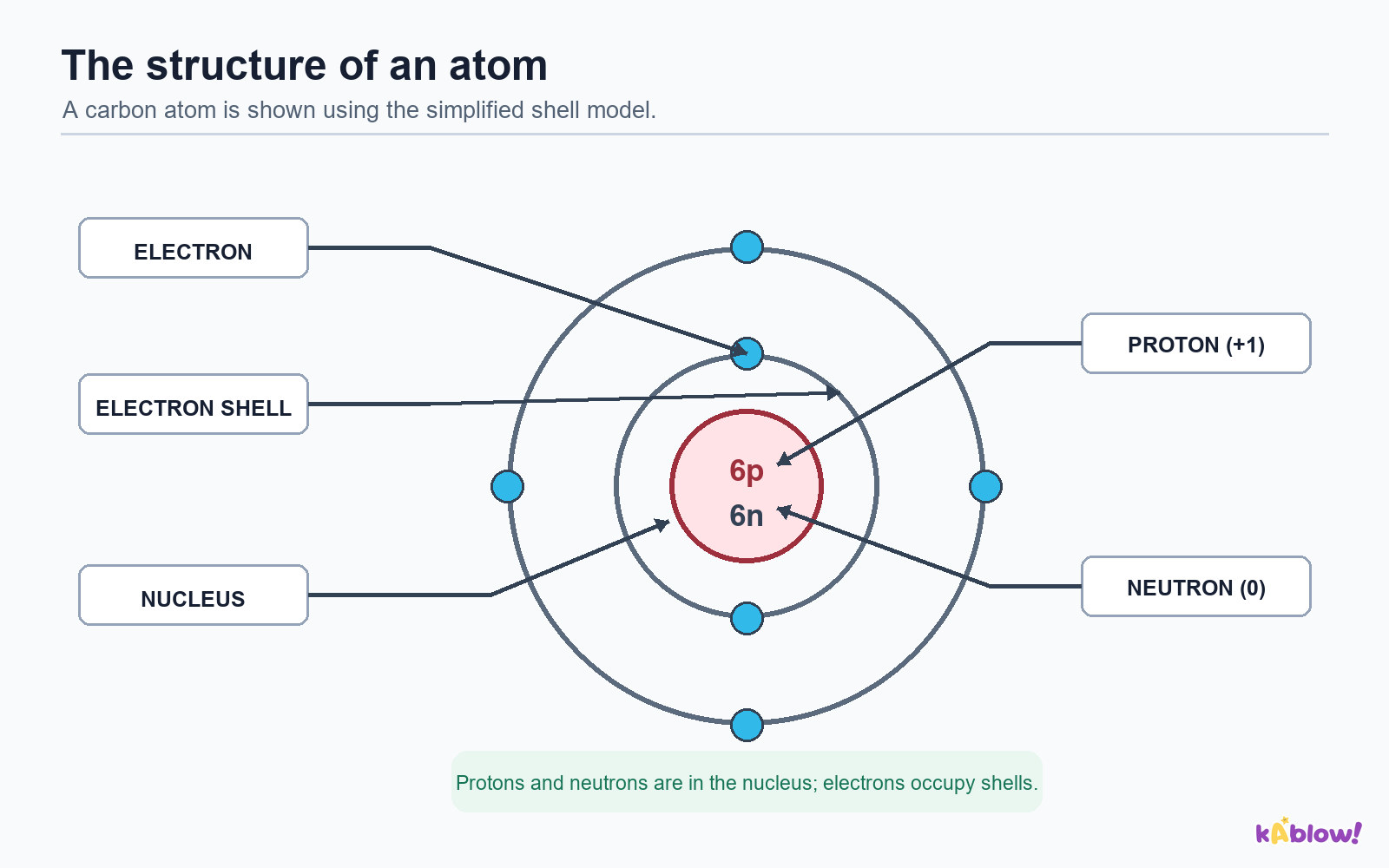
- The atom is made of three sub-atomic particles: protons, neutrons and electrons.
- Protons have a positive charge and are found in the nucleus.
- Neutrons are neutral (no charge) and also in the nucleus.
- Electrons have a negative charge and orbit around the nucleus.
- Most of the atom's mass is in the nucleus; protons and neutrons have about 2000 times more mass than an electron.
- Overall, an atom is neutral because it has equal numbers of protons and electrons.
Protons and neutrons in the nucleus; electrons orbiting in shells.
Peer Review
- Peer review is when other scientists examine new evidence to decide if it is valid.
- It prevents incorrect models and theories from being spread.
- After peer review, research can be published and other scientists may try to reproduce the results to check repeatability.
Bohr model of a sodium atom showing the nucleus (11 protons, 12 neutrons) and electron shells (2,8,1).
Particle arrangement in solids, liquids and gases.
スライド
練習問題
無料プレビュー — 40問中8問。すべて見るには登録を。
1.What is the Dalton model of the atom?
Easy- AAtoms are indivisible and cannot be broken down into anything smaller.
- BAtoms are made of protons, neutrons and electrons.
- CAtoms have a nucleus with electrons orbiting.
- DAtoms are mostly empty space.
2.Where is the nucleus of an atom located?
Easy- AIn the centre of the atom.
- BOrbiting the atom.
- COutside the electron shells.
- DScattered throughout the atom.
3.Which two sub-atomic particles are found in the nucleus?
Easy- AProtons and neutrons.
- BProtons and electrons.
- CNeutrons and electrons.
- DProtons, neutrons and electrons.
4.Which sub-atomic particle orbits around the nucleus?
Easy- AElectron
- BProton
- CNeutron
- DPositron
5.What is the charge on a proton?
Easy- APositive
- BNegative
- CNeutral
- DNo charge
6.What is the charge on an electron?
Easy- ANegative
- BPositive
- CNeutral
- DNo charge
7.What is the charge on a neutron?
Easy- ANeutral
- BPositive
- CNegative
- DNo charge
8.Which sub-atomic particle has the least mass?
Easy- AElectron
- BProton
- CNeutron
- DNucleus
過去問
このトピックの過去問練習は近日公開。
近日公開