The periodic table
遊んで学ぼう
問題に答えてエネルギーを集めたら、釣りや探検を楽しもう。アカウント不要。
教育者の方へ: The periodic table(KS3 Science、Chemistry)向けのすぐ使えるレッスンスライド, 復習ノート, 図解 — レッスンで使うか、学習者がライブゲームとして遊ぶインタラクティブなクラス活動としてトピックを実施できます。
レッスンノート
History of the Periodic Table
- Early tables arranged elements by atomic weight, but this didn't always match properties.
- In 1869, Dmitri Mendeleev rearranged elements so that similar properties were in the same group.
- Mendeleev left gaps for undiscovered elements and predicted their properties.
- When new elements were found, they matched Mendeleev's predictions.
Modern Periodic Table
- Elements are arranged by increasing atomic number (number of protons).
- Each element has a chemical symbol (e.g., Na for sodium).
- The atomic number is written above the symbol.
Groups and Periods
- Columns are called groups; elements in the same group have similar properties.
- Group 1 elements are alkali metals; they react vigorously with water.
- Rows are called periods.
- Metals are on the left of the bold line; non-metals on the right.
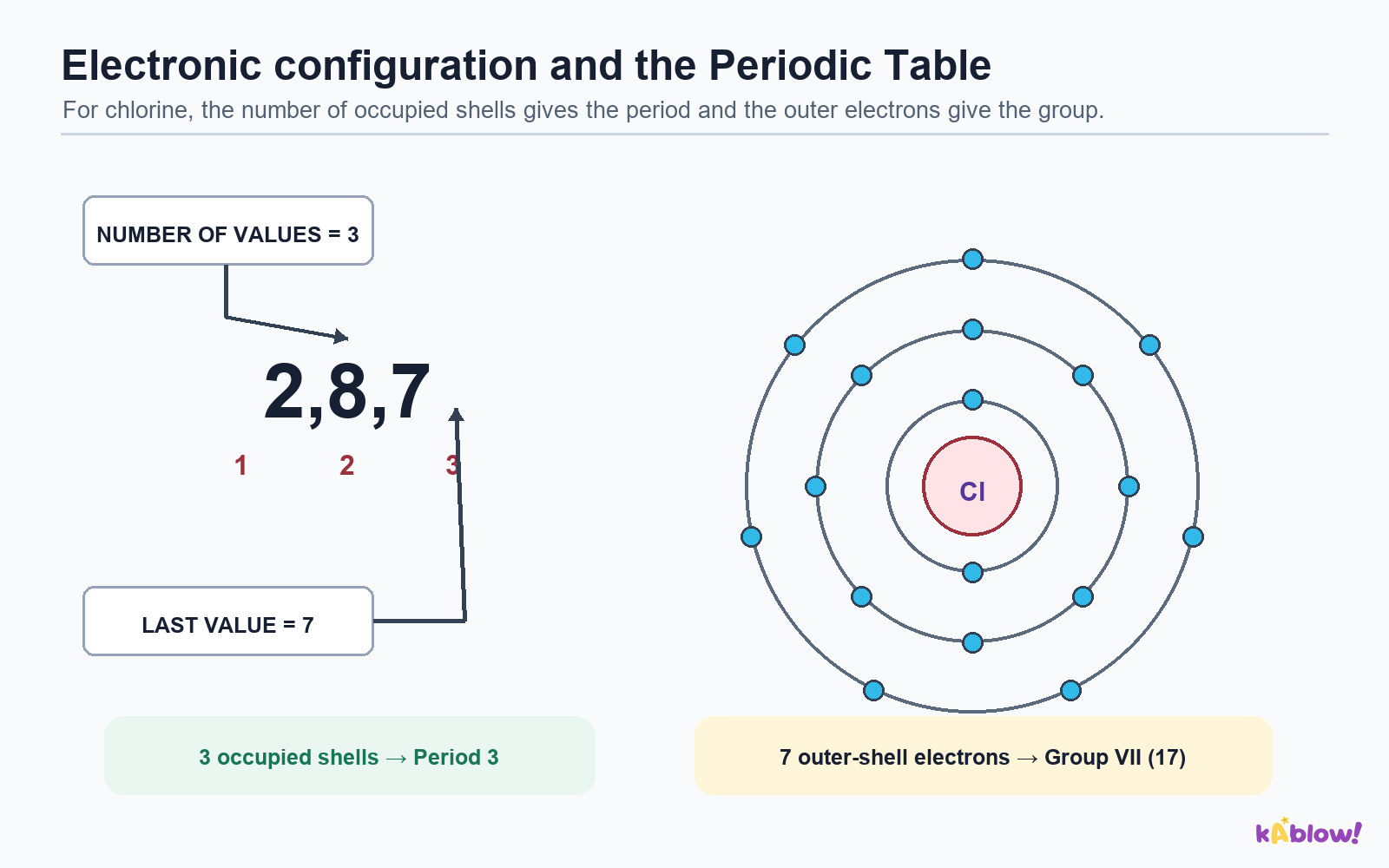
Chlorine's electron configuration (2,8,7): the number of notations gives the period, the last notation gives the group.
Metals and Non-Metals
- Aluminium (Al) is a metal (left of bold line).
- Carbon (C) is a non-metal (right of bold line).
- Metals are good conductors of electricity; non-metals are poor conductors.
Advantages of Grouping
- Similar properties in a group make it easy to predict properties of unknown elements.
- For example, all alkali metals react similarly with water.
Bohr model of sodium atom (atomic number 11) showing electron configuration 2,8,1.
スライド
練習問題
無料プレビュー — 56問中8問。すべて見るには登録を。
1.In the periodic table, elements are arranged in order of increasing:
Easy- Aatomic number
- Batomic weight
- Catomic radius
- Dnumber of neutrons
2.Which of the following statements about the periodic table is true?
Medium- AElements in the same period have similar properties.
- BElements are ordered by atomic mass.
- CColumns are called groups and contain elements with similar properties.
- DMetals are found on the right of the bold line.
3.What is the atomic number of iron (Fe)?
Easy- A26
- B56
- C55
- D30
4.Which of the following elements is a non-metal?
Easy- AAluminium (Al)
- BCarbon (C)
- CIron (Fe)
- DCopper (Cu)
5.Why did Mendeleev leave gaps in his periodic table?
Easy- ATo make the table look balanced
- BFor elements that had not yet been discovered
- CBecause the atomic weights did not match
- DTo separate metals from non-metals
6.Which of the following is a property of alkali metals (Group 1)?
Easy- AThey are unreactive
- BThey react vigorously with water
- CThey are non-metals
- DThey are gases at room temperature
7.Aluminium (Al) is a metal. Which of the following best explains why aluminium is a good conductor of electricity?
Easy- AIt is a non-metal
- BIt is a metal and metals are good conductors
- CIt is in Group 1
- DIt has a low atomic number
8.In the periodic table, what do the rows (periods) indicate?
Easy- ASimilar chemical properties
- BNumber of electron shells
- CAtomic mass increasing
- DNumber of neutrons
過去問
このトピックの過去問練習は近日公開。
近日公開