Cameras
遊んで学ぼう
問題に答えてエネルギーを集めたら、釣りや探検を楽しもう。アカウント不要。
教育者の方へ: Cameras(KS3 Science、Physics)向けのすぐ使えるレッスンスライド, 復習ノート, 図解 — レッスンで使うか、学習者がライブゲームとして遊ぶインタラクティブなクラス活動としてトピックを実施できます。
レッスンノート
Pinhole Camera
- A pinhole camera is a simple device that forms an image using a small hole.
- It consists of a box with a small hole at one end and a translucent screen (e.g., tracing paper) at the other.
- Translucent means allows some light to pass through, but not clear.
- Light rays from the object travel in straight lines through the pinhole.
- The image formed is inverted (upside down) because rays from the top and bottom cross at the pinhole.
- The image is formed on the screen and can be seen from outside.
Modern Camera
- A modern camera uses a convex lens instead of a pinhole.
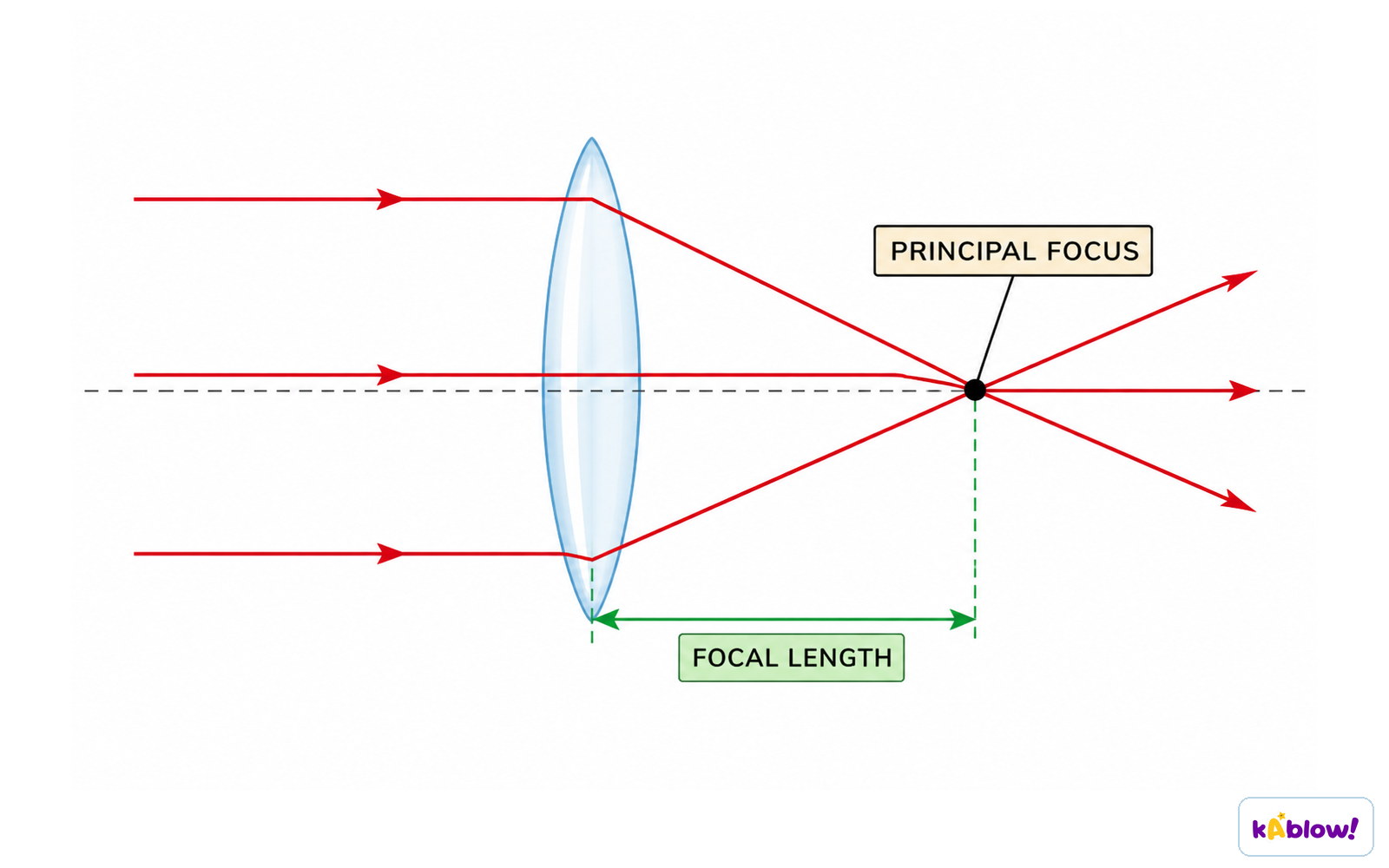
- The convex lens refracts (bends) light rays to bring them to a focus.
- The camera has a light-sensitive sensor (like the retina in the human eye).
- The sensor captures the focused image and converts it into an electronic signal.
- Even small phone cameras contain a lens and a sensor.
A converging lens brings parallel rays to the principal focus; focal length is measured from the lens to that point.
Comparison with the Human Eye
- Both the human eye and a camera contain a convex lens to focus light.
- The eye's retina is equivalent to the camera's sensor.
- Both produce an inverted image on the retina/sensor, but the brain corrects it for the eye.
Key Terms
- Inverted: upside down relative to the object.
- Translucent: allows light to pass through diffusely.
- Refraction: bending of light when it passes from one medium to another.
- Convex lens: a lens that bulges outward and converges light rays to a point.
Refraction of light through a convex lens (simplified).
スライド
練習問題
無料プレビュー — 57問中8問。すべて見るには登録を。
1.What does it mean if a material is translucent?
Easy- AIt allows all light to pass through.
- BIt allows some light to pass through.
- CIt allows no light to pass through.
- DIt reflects all light.
2.What does 'inverted' mean when describing an image in a pinhole camera?
Easy- AThe image is smaller than the object.
- BThe image is upside down.
- CThe image is the same size as the object.
- DThe image is larger than the object.
3.Which part of a modern camera is equivalent to the retina in the human eye?
Easy- ALens
- BSensor
- CScreen
- DAperture
4.Which of the following statements is true?
Medium- AA pinhole camera contains a convex lens.
- BThe human eye contains a convex lens, but a camera does not.
- CBoth the human eye and a camera contain a convex lens.
- DNeither the human eye nor a camera contains a convex lens.
5.What is the screen of a pinhole camera typically made of?
Easy- ACardboard
- BTracing paper
- CGlass
- DMetal
6.A student makes a pinhole camera with a larger hole. What effect does this have on the image?
Medium- AThe image becomes sharper.
- BThe image becomes brighter but blurrier.
- CThe image becomes dimmer but sharper.
- DThe image becomes inverted.
7.In a pinhole camera, why is the image inverted?
Medium- ABecause the screen is curved.
- BBecause light rays travel in straight lines and cross at the pinhole.
- CBecause the box is light-tight.
- DBecause the pinhole is too small.
8.Which of the following is NOT a component of a modern camera?
Easy- AConvex lens
- BSensor
- CRetina
- DAperture
過去問
このトピックの過去問練習は近日公開。
近日公開