Hooke's law
遊んで学ぼう
問題に答えてエネルギーを集めたら、釣りや探検を楽しもう。アカウント不要。
教育者の方へ: Hooke's law(KS3 Science、Physics)向けのすぐ使えるレッスンスライド, 復習ノート — レッスンで使うか、学習者がライブゲームとして遊ぶインタラクティブなクラス活動としてトピックを実施できます。
レッスンノート
Hooke's Law
- Hooke's law states that the extension of a spring is directly proportional to the force applied to it.
- This means doubling the force doubles the extension, provided the limit of proportionality is not exceeded.
- The law applies to both extension (stretching) and compression (squeezing) of a spring.
Masses are added to the spring and the extension is measured against a fixed ruler.
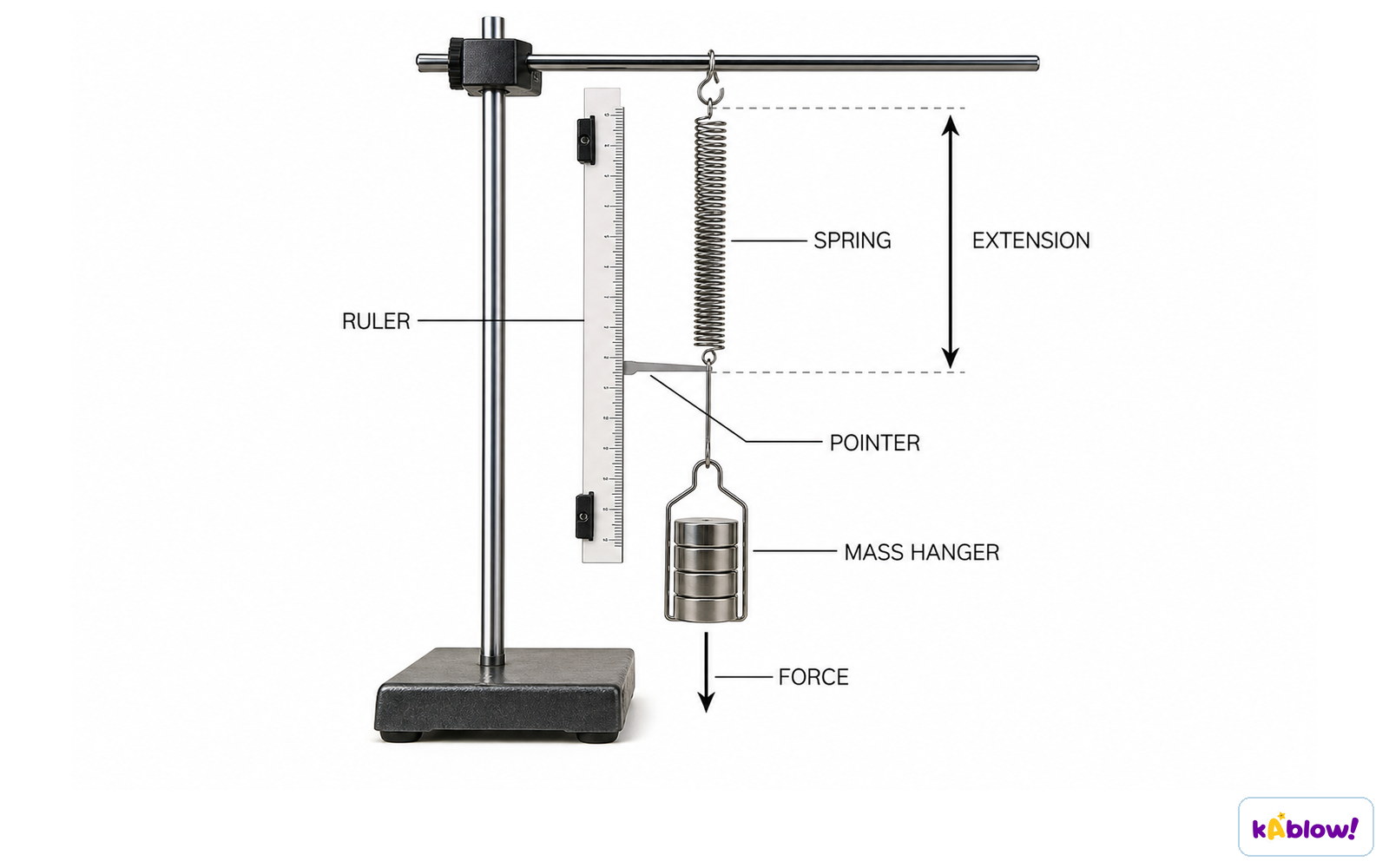
Key Equation
- The equation is: Force = Spring constant × Extension or F = k × e.
- F is force in newtons (N).
- k is the spring constant in newtons per metre (N/m).
- e is extension in metres (m).
Spring Constant
- The spring constant measures how stiff the spring is.
- A higher spring constant means more force is needed to stretch the spring by the same amount.
- A lower spring constant means the spring is easier to stretch.
Calculations
- To find force: F = k × e.
- To find extension: e = F ÷ k.
- To find spring constant: k = F ÷ e.
- Always use consistent units: N, N/m, m.
Example Calculation
- A spring with k = 4 N/m is extended by 0.1 m. Force = 4 × 0.1 = 0.4 N.
- A spring with k = 200 N/m is compressed by 0.04 m. Force = 200 × 0.04 = 8 N.
- A rubber band with k = 60 N/m is pulled with 15 N. Extension = 15 ÷ 60 = 0.25 m.
Graph of Force vs Extension
- A graph of force against extension is a straight line through the origin.
- The gradient of the line equals the spring constant.
- If the force is too large, the line curves (the spring is permanently deformed).
スライド
練習問題
無料プレビュー — 55問中8問。すべて見るには登録を。
1.What is the unit of force?
Easy- ANewton (N)
- BMetre (m)
- CNewton per metre (N/m)
- DJoule (J)
2.What is the unit of the spring constant?
Easy- ANewton (N)
- BMetre (m)
- CNewton per metre (N/m)
- DMetre per newton (m/N)
3.What is the unit of extension?
Easy- ANewton (N)
- BMetre (m)
- CNewton per metre (N/m)
- DCentimetre (cm)
4.According to Hooke's law, how is the extension of a spring related to the force applied to it?
Easy- AExtension is inversely proportional to force
- BExtension is directly proportional to force
- CExtension is equal to force
- DExtension is independent of force
5.A spring with a spring constant of 4 N/m is extended by 0.1 m. What force is applied?
Easy- A0.4 N
- B4 N
- C40 N
- D0.04 N
6.A rubber band with a spring constant of 10 N/m is extended by 0.2 m. What force is applied?
Easy- A2 N
- B0.5 N
- C50 N
- D20 N
7.A spring with a spring constant of 20 N/m is compressed by 0.05 m. What force is applied?
Easy- A1 N
- B4 N
- C0.25 N
- D400 N
8.The same force is applied to two springs. Spring X has a high spring constant, Spring Y a low spring constant. Which spring has the larger extension?
Medium- ASpring X
- BSpring Y
- CBoth have same extension
- DCannot tell
過去問
このトピックの過去問練習は近日公開。
近日公開