Introduction to waves
遊んで学ぼう
問題に答えてエネルギーを集めたら、釣りや探検を楽しもう。アカウント不要。
教育者の方へ: Introduction to waves(KS3 Science、Physics)向けのすぐ使えるレッスンスライド, 復習ノート, 図解 — レッスンで使うか、学習者がライブゲームとして遊ぶインタラクティブなクラス活動としてトピックを実施できます。
レッスンノート
What are waves?
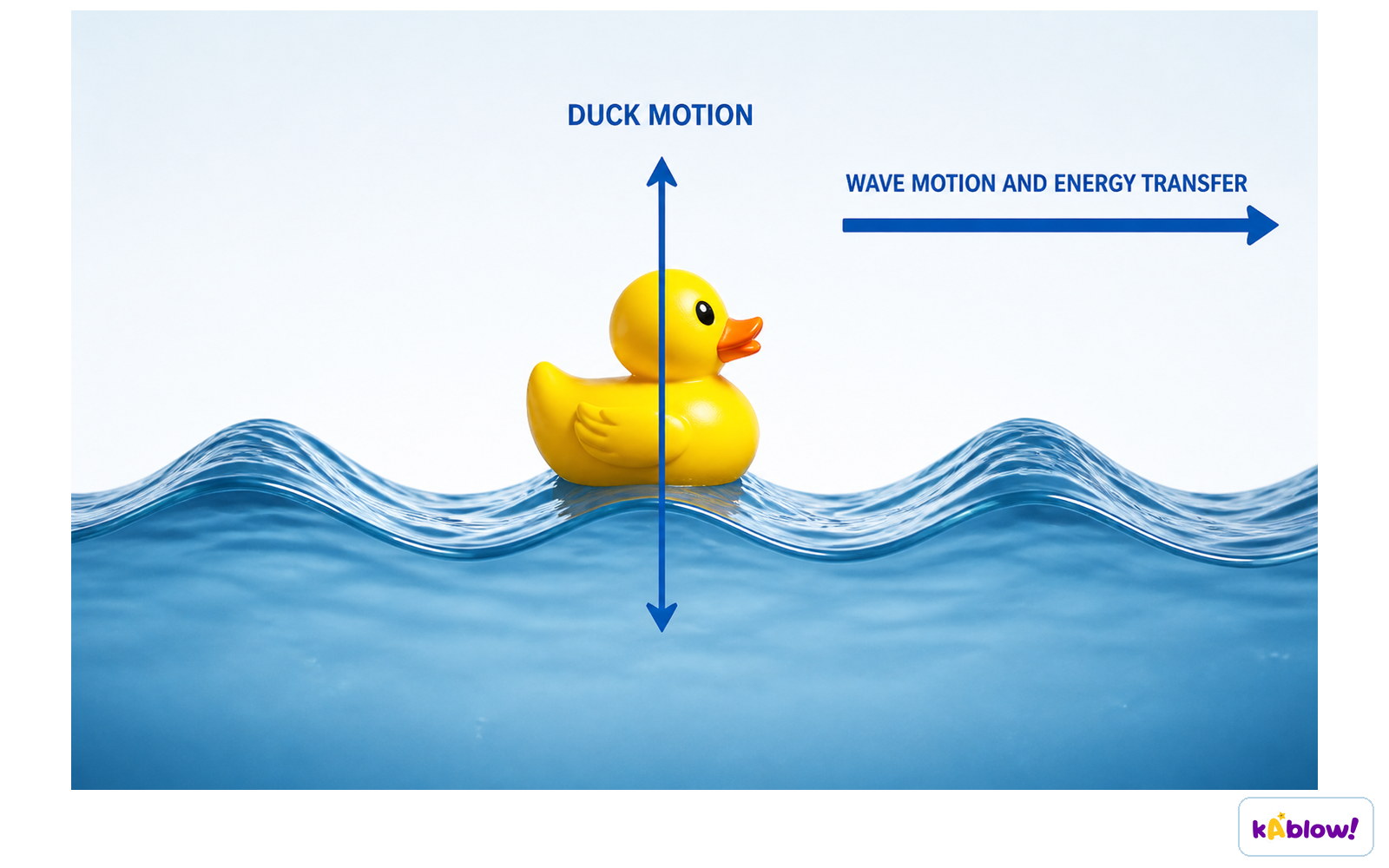
- Waves transfer energy from one place to another.
- Waves do not transfer matter – the particles vibrate but stay in position.
A toy duck bobbing up and down on water waves, illustrating that waves transfer energy but not matter.
Types of wave
- There are two types: longitudinal and transverse.
- Both types are caused by vibrations.
Transverse waves
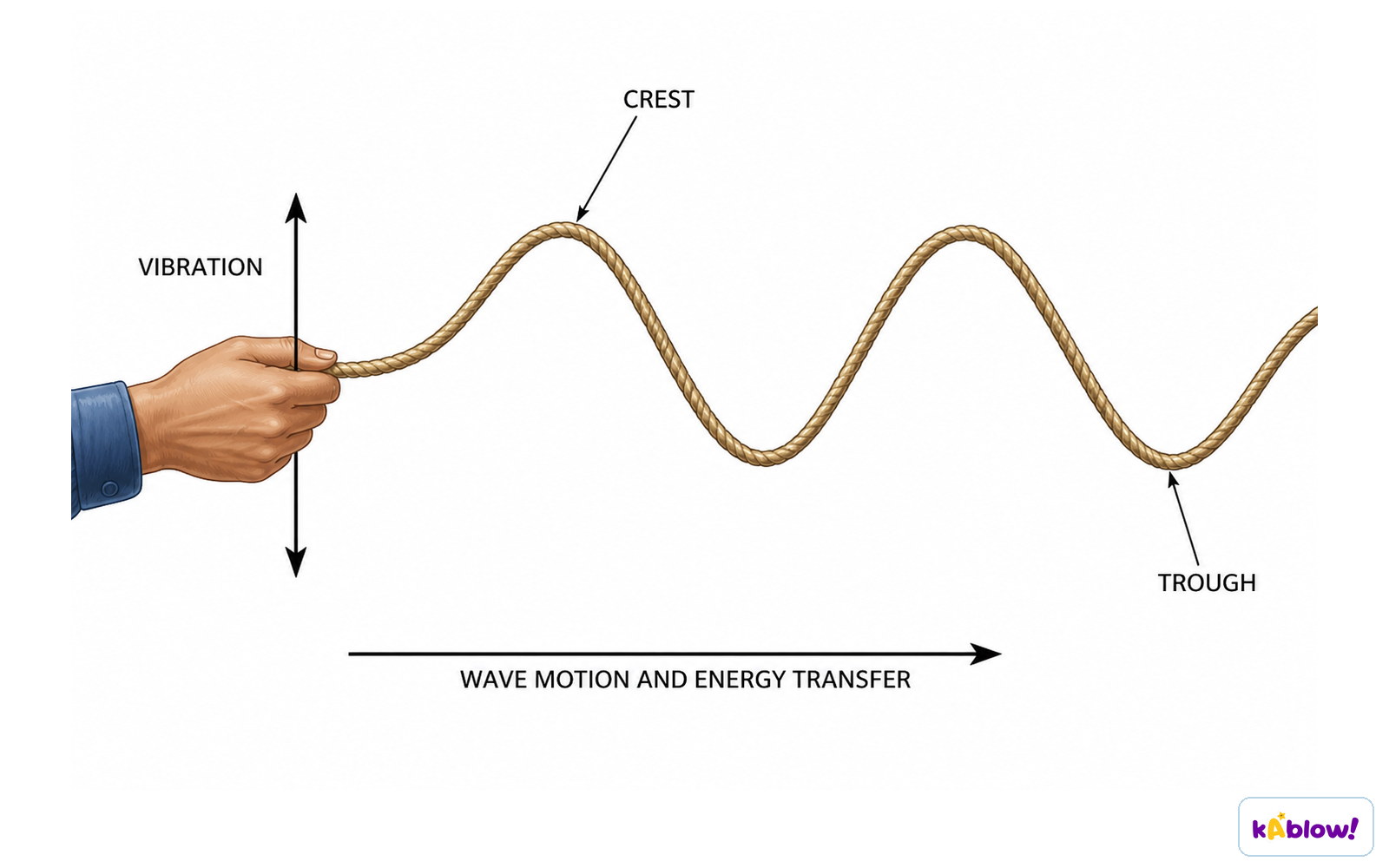
- The vibration is perpendicular to the direction of wave travel.
- Example: waves on a slinky moved side-to-side.
- Key terms: displacement (distance from rest), wavelength (peak to peak), amplitude (maximum displacement).
Transverse wave motion in a rope: the vibration is at 90 degrees to the direction of wave motion and energy transfer, with the crest and trough labelled.
Longitudinal waves
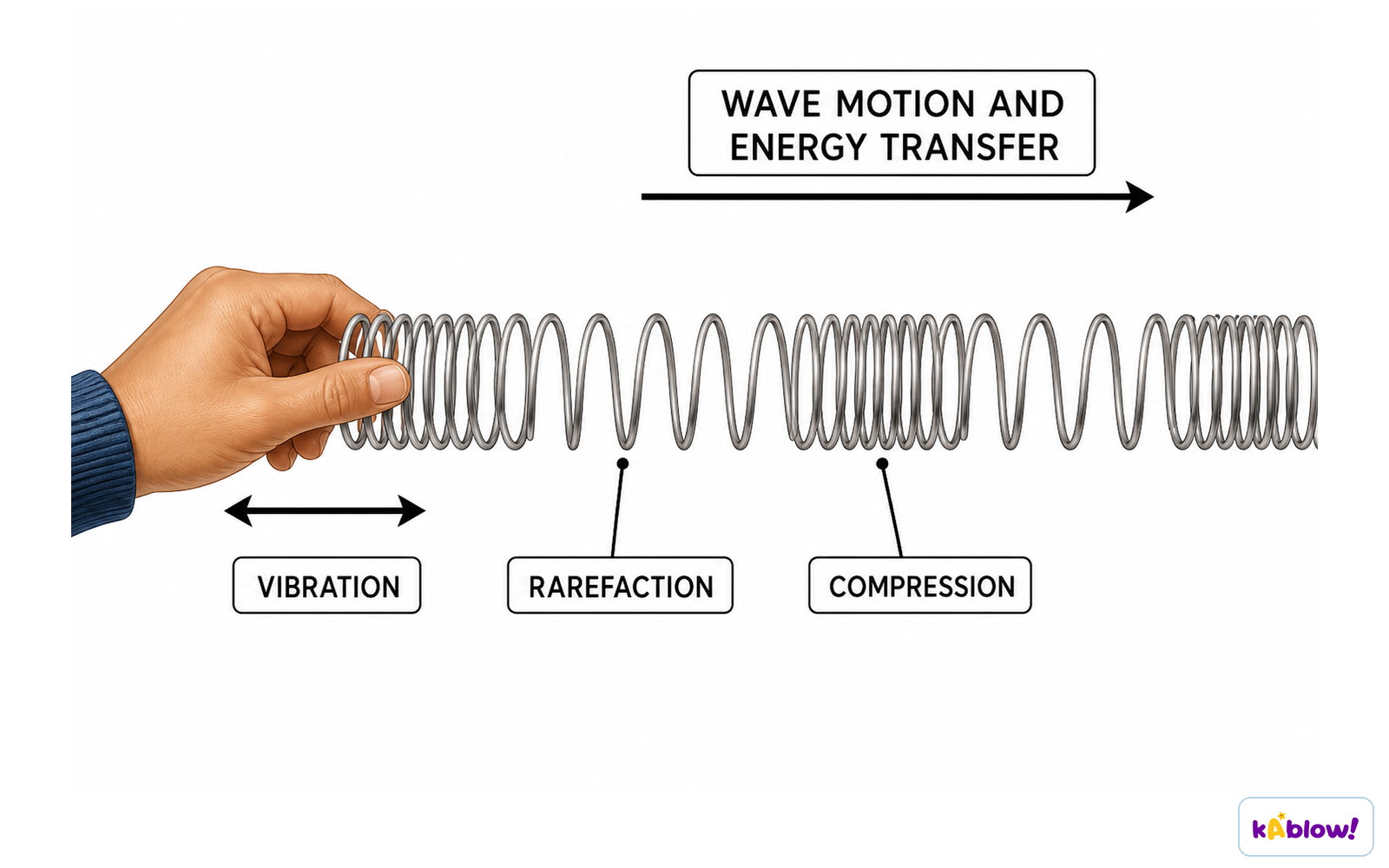
- The vibration is parallel to the direction of wave travel.
- Example: waves on a slinky moved back-and-forth.
- A compression is where particles are closest together.
- A rarefaction is where particles are furthest apart.
Longitudinal wave motion in a spring, showing compression and rarefaction relative to the direction of wave motion and energy transfer.
Similarities and differences
- Similarity: Both transfer energy and are caused by vibrations.
- Difference: In transverse waves, vibration is perpendicular; in longitudinal, vibration is parallel.
スライド
練習問題
無料プレビュー — 53問中8問。すべて見るには登録を。
1.Which of the following best describes what a wave transfers?
Easy- AEnergy
- BMatter
- CBoth energy and matter
- DNeither energy nor matter
2.In a transverse wave, the direction of vibration is:
Easy- Aperpendicular to the direction of wave travel
- Bparallel to the direction of wave travel
- Cthe same as the direction of wave travel
- Dopposite to the direction of wave travel
3.Which of the following is true about longitudinal waves?
Easy- AThey transfer matter along the wave.
- BThe vibration is parallel to the direction of wave travel.
- CThey cannot travel through a medium.
- DThey have crests and troughs.
4.In a longitudinal wave, the region where particles are closest together is called a:
Easy- Ararefaction
- Bcompression
- Ccrest
- Dtrough
5.In a longitudinal wave, the region where particles are furthest apart is called a:
Easy- Acompression
- Brarefaction
- Camplitude
- Dwavelength
6.Which labelled part on a transverse wave diagram represents the maximum displacement from the rest position?
Easy- AWavelength
- BAmplitude
- CCrest
- DTrough
7.The distance between two consecutive peaks on a transverse wave is called the:
Easy- Aamplitude
- Bfrequency
- Cwavelength
- Dspeed
8.Both longitudinal and transverse waves are caused by:
Easy- Avibrations
- Belectric fields
- Cmagnetic fields
- Dparticle movement
過去問
このトピックの過去問練習は近日公開。
近日公開