The solar system
遊んで学ぼう
問題に答えてエネルギーを集めたら、釣りや探検を楽しもう。アカウント不要。
教育者の方へ: The solar system(KS3 Science、Physics)向けのすぐ使えるレッスンスライド, 復習ノート — レッスンで使うか、学習者がライブゲームとして遊ぶインタラクティブなクラス活動としてトピックを実施できます。
レッスンノート
The Solar System Overview
- The solar system consists of a star (the Sun) and eight planets.
- The Sun contains most of the mass of the solar system.
- Gravitational forces keep the planets in orbit around the Sun.
- The Sun's surface temperature is around 6000°C.
The Solar System: the Sun, eight planets, natural and artificial satellites, and the asteroid belt
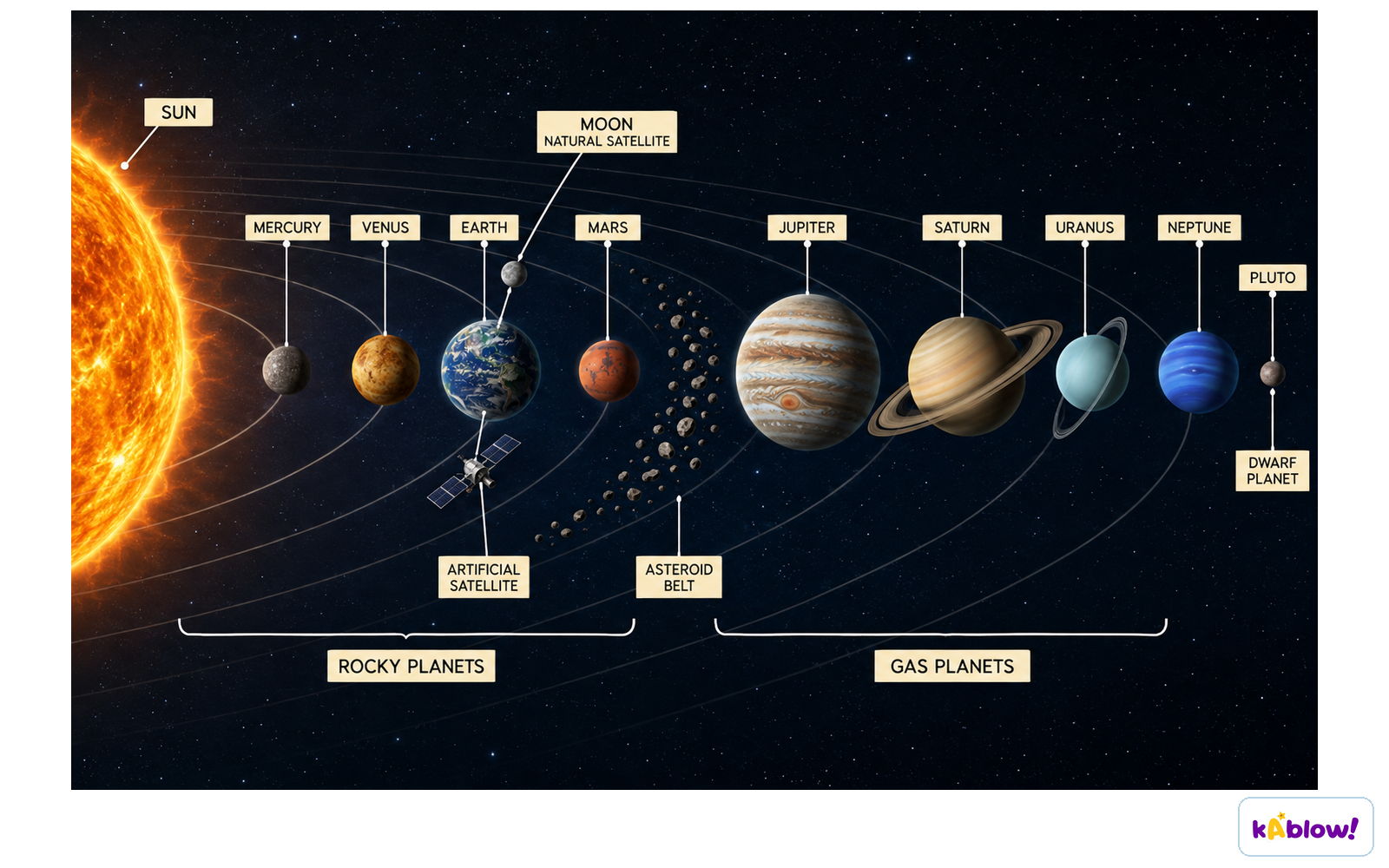
Planets in Order from the Sun
- 1. Mercury – smallest planet, closest to the Sun.
- 2. Venus – has a carbon dioxide atmosphere, hottest planet.
- 3. Earth – only known planet with life.
- 4. Mars – colder than Earth, further from the Sun.
- 5. Jupiter – largest planet, Great Red Spot (storm lasting >400 years).
- 6. Saturn – second largest, rings made of ice and rock.
- 7. Uranus – third largest, rotates on its side.
- 8. Neptune – furthest planet, lowest average temperature.
Types of Planets
- Terrestrial (rocky) planets: Mercury, Venus, Earth, Mars (closest four).
- Gas giants: Jupiter and Saturn.
- Ice giants: Uranus and Neptune.
- Pluto is a dwarf planet, beyond Neptune.
Temperature and Gravity
- Planet temperature generally decreases with distance from the Sun.
- Venus is an exception – its CO₂ atmosphere traps heat (greenhouse effect).
- Neptune has the lowest average temperature (furthest from Sun).
- Jupiter has the largest gravitational field strength (25 N/kg).
Mnemonic for Planet Order
- My Very Easy Method Just Speeds Up Naming (Planets).
- Corresponds to: Mercury, Venus, Earth, Mars, Jupiter, Saturn, Uranus, Neptune.
スライド
練習問題
無料プレビュー — 54問中8問。すべて見るには登録を。
1.How many planets are there in the solar system?
Easy- A8
- B7
- C9
- D10
2.Which of the following are the four terrestrial planets?
Easy- AMercury, Venus, Earth, Mars
- BMercury, Venus, Earth, Jupiter
- CVenus, Earth, Mars, Jupiter
- DEarth, Mars, Jupiter, Saturn
3.Which planets are the gas giants?
Easy- AJupiter and Saturn
- BUranus and Neptune
- CSaturn and Uranus
- DJupiter and Neptune
4.Which planets are the ice giants?
Easy- AUranus and Neptune
- BJupiter and Saturn
- CSaturn and Uranus
- DNeptune and Pluto
5.What is the correct order of planets from the Sun outward?
Easy- AMercury, Venus, Earth, Mars, Jupiter, Saturn, Uranus, Neptune
- BMercury, Venus, Earth, Mars, Saturn, Jupiter, Uranus, Neptune
- CVenus, Mercury, Earth, Mars, Jupiter, Saturn, Neptune, Uranus
- DMercury, Earth, Venus, Mars, Jupiter, Saturn, Uranus, Neptune
6.Which planet has the highest average surface temperature and why?
Medium- AVenus, because of its carbon dioxide atmosphere
- BMercury, because it is closest to the Sun
- CVenus, because it is closest to the Sun
- DJupiter, because it is a gas giant
7.What object contains most of the mass in the solar system?
Easy- AThe Sun
- BJupiter
- CEarth
- DSaturn
8.What force keeps planets in orbit around the Sun?
Easy- AGravitational force
- BMagnetic force
- CCentrifugal force
- DNuclear force
過去問
このトピックの過去問練習は近日公開。
近日公開