Cycling of matter and energy in ecosystems
遊んで学ぼう
問題に答えてエネルギーを集めたら、釣りや探検を楽しもう。アカウント不要。
先生の方へ: Cycling of matter and energy in ecosystems(NGSS Middle School Science、Biology)向けのすぐ使えるレッスンスライド, 復習ノート — レッスンで使うか、生徒がライブゲームとして遊ぶインタラクティブなクラス活動としてトピックを実施できます。
レッスンノート
Feeding Types and Roles
- Producers (autotrophs) make their own food via photosynthesis, e.g., plants.
- Consumers (heterotrophs) obtain food by eating other organisms.
- Herbivores eat only plants; carnivores eat other animals.
- Omnivores eat both plants and animals.
- Decomposers break down dead organisms and waste, recycling nutrients.
- Scavengers are carnivores that eat dead animals.
- Insectivores are carnivores that eat insects and small invertebrates.
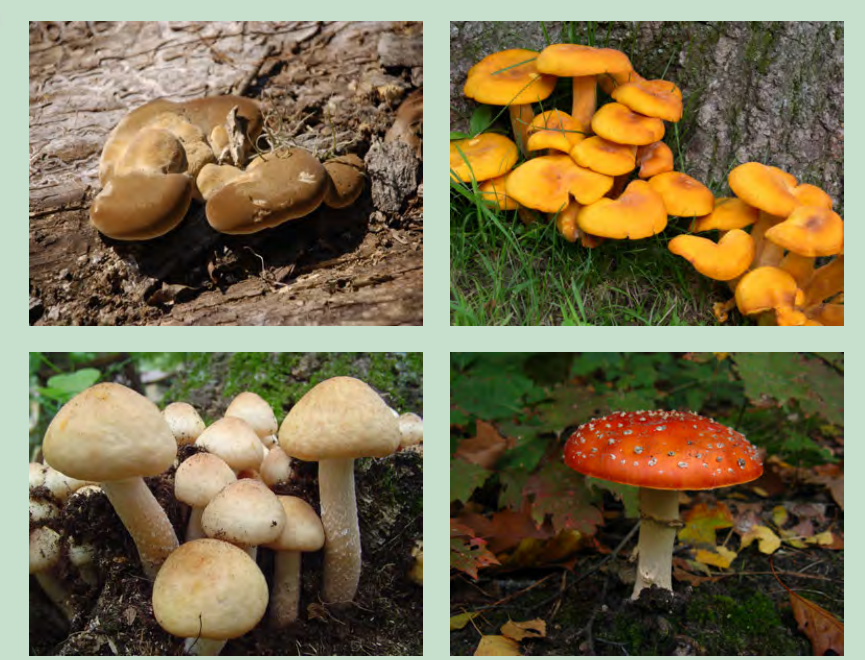
Photographs of four different fungi growing on dead wood
Food Chains and Food Webs
- A food chain shows the linear flow of energy and matter from one organism to the next.
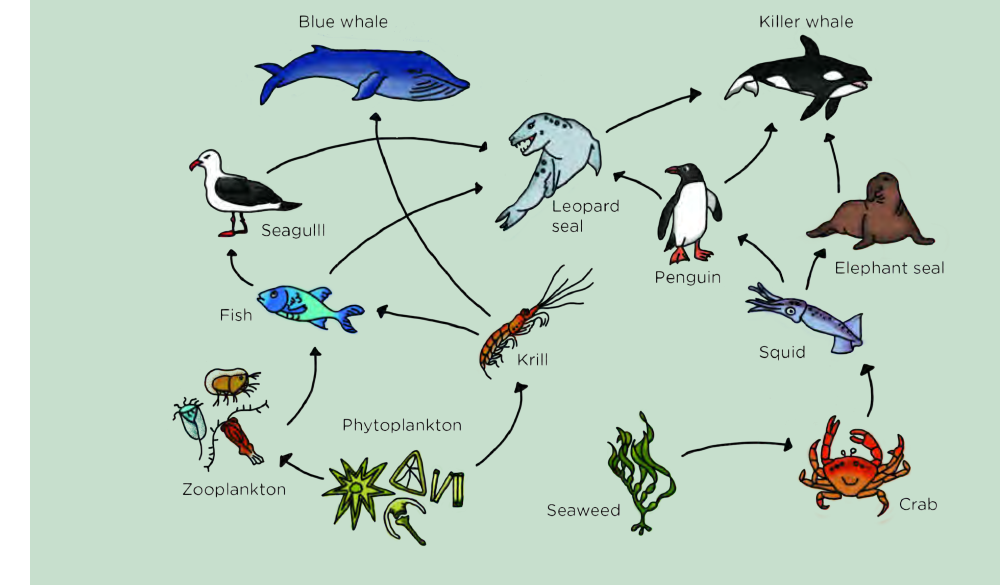
- Arrows in a food chain point from the eaten organism to the eater, indicating energy transfer.
- A food web consists of interconnected food chains, showing multiple feeding relationships.
- Producers are always at the start of a food chain, bringing energy into the ecosystem.
- Most organisms eat multiple things, making food webs more realistic than simple chains.
A food web of the Southern Ocean
Trophic Levels: Primary, Secondary and Tertiary Consumers
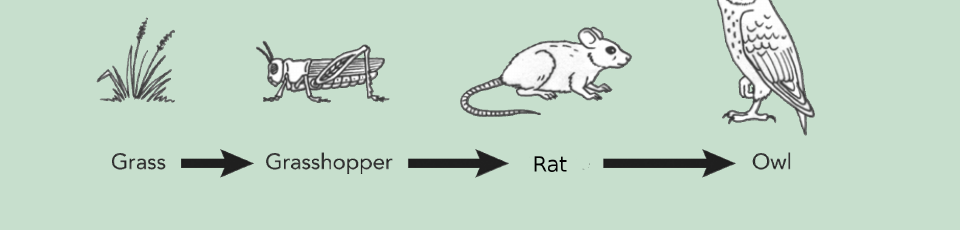
- A food chain such as grass → grasshopper → rat → owl shows how energy passes from one trophic level to the next.
- Animals that eat producers directly, like the grasshopper, are primary consumers.
- Animals that eat primary consumers, like the rat, are secondary consumers.
- Animals that eat secondary consumers, like the owl, are tertiary consumers.
- Each feeding step in a food chain is called a trophic level.
A simple food chain: grass, grasshopper, rat, owl
Energy Flow and Pyramids
- The sun is the ultimate energy source for most ecosystems.
- Energy flows through ecosystems, being converted from light to chemical energy in photosynthesis.
- Energy is not cycled; it flows and is lost as heat at each trophic level.
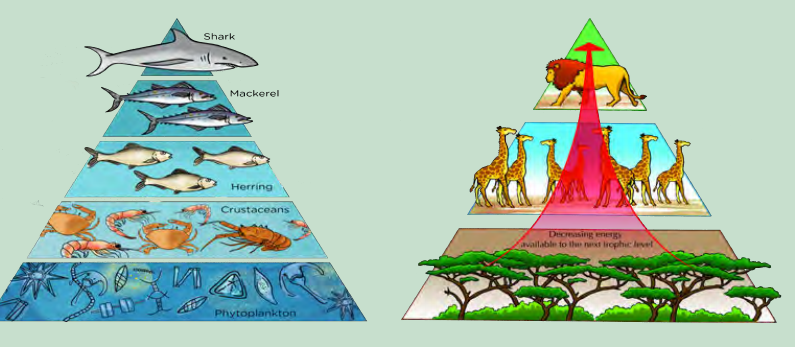
- Only about 10% of energy is transferred to the next trophic level; 90% is used for life processes or lost as heat.
- An energy pyramid illustrates the decreasing energy and number of organisms at higher trophic levels.
- Producers are the most numerous and form the base of the pyramid.
Energy pyramids for a marine ecosystem and a savanna ecosystem
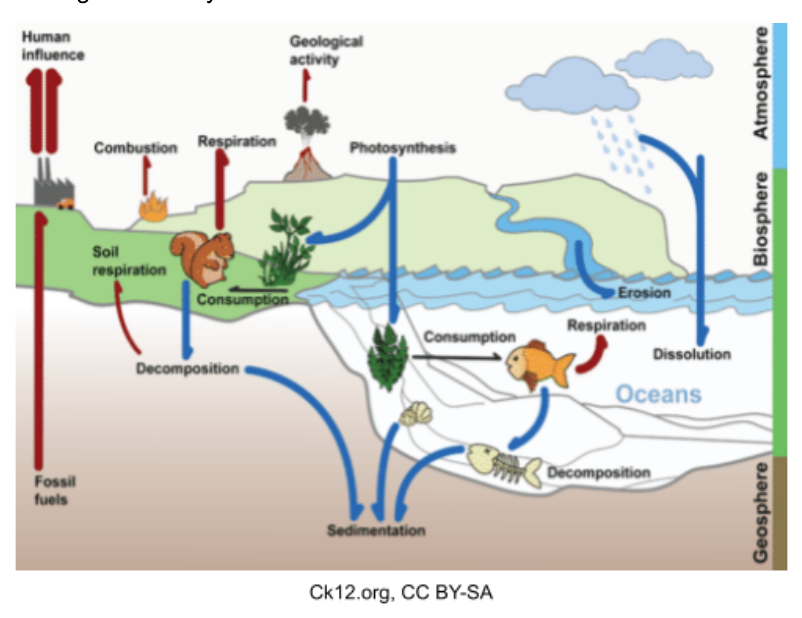
Matter Cycling and the Carbon Cycle
- Matter cycles in ecosystems; it is reused over and over again.
- The carbon cycle moves carbon between living and nonliving parts of the ecosystem.
- Carbon is released as CO2 through cellular respiration, decomposition, and burning of organic matter.
- Photosynthesis removes CO2 from the atmosphere or water to produce glucose.
- Carbon can be stored for long periods in rocks, fossil fuels, and the ocean.
- Human activities like burning fossil fuels and deforestation increase atmospheric CO2.
The carbon cycle
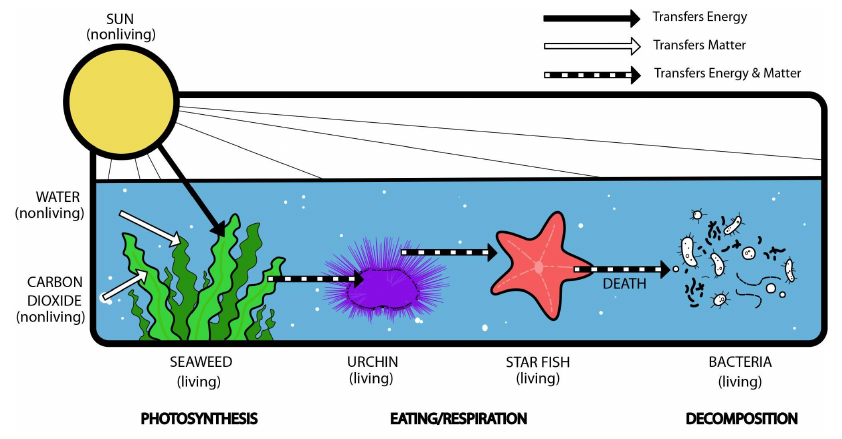
Matter Cycles, Energy Flows: What Happens When Ecosystems Are Disrupted
- Matter cycles through the living and nonliving parts of an ecosystem, while energy flows through it in one direction.
- A model of a tide-pool ecosystem shows sunlight and carbon dioxide (nonliving) providing matter and energy to seaweed (a producer), which passes them on to a sea urchin, then a starfish, and finally to bacteria that decompose it.
- The model distinguishes transfers of energy alone, matter alone, and both energy and matter together.
- A disruption to one part of the model — such as pollution that clouds the water or a rise in temperature — can reduce how much energy the producer captures, slowing the cycling of matter and flow of energy through the whole system.
- Because every part of an ecosystem is connected, a change to the living or nonliving parts can affect the stability of the whole system.
A model of matter and energy transfer in a tide-pool ecosystem
スライド
練習問題
無料プレビュー — 43問中8問。すべて見るには登録を。
1.What is the primary source of energy for almost all ecosystems?
Easy- AThe sun
- BThe moon
- CGeothermal heat
- DChemical reactions
2.Which of the following is a producer?
Easy- ACattail
- BGrasshopper
- CFrog
- DHawk
3.What do the arrows in a food chain represent?
Easy- AThe direction of energy and matter flow
- BThe size of the organisms
- CThe speed of the organisms
- DThe number of organisms
4.Approximately what percentage of energy is transferred from one trophic level to the next?
Easy- A10%
- B50%
- C90%
- D100%
5.Decomposers release nutrients back into the environment for producers to use.
EasyTrue or false?
6.Which process removes carbon dioxide from the atmosphere?
Easy- APhotosynthesis
- BCellular respiration
- CDecomposition
- DBurning fossil fuels
7.Which of the following are consumers? (Select all that apply)
Easy- AHerbivore
- BCarnivore
- COmnivore
- DProducer
- EDecomposer
8.Which of the following is the correct sequence in a food chain?
Medium- AProducer → Primary consumer → Secondary consumer → Tertiary consumer
- BPrimary consumer → Producer → Secondary consumer → Tertiary consumer
- CProducer → Secondary consumer → Primary consumer → Tertiary consumer
- DTertiary consumer → Secondary consumer → Primary consumer → Producer
過去問
このトピックの過去問練習は近日公開。
近日公開