Gravity in the solar system and galaxies
遊んで学ぼう
問題に答えてエネルギーを集めたら、釣りや探検を楽しもう。アカウント不要。
教育者の方へ: Gravity in the solar system and galaxies(NGSS Middle School Science、Earth and Space Science)向けのすぐ使えるレッスンスライド, 復習ノート, 図解 — レッスンで使うか、学習者がライブゲームとして遊ぶインタラクティブなクラス活動としてトピックを実施できます。
レッスンノート
Gravity Holds Objects in Orbit
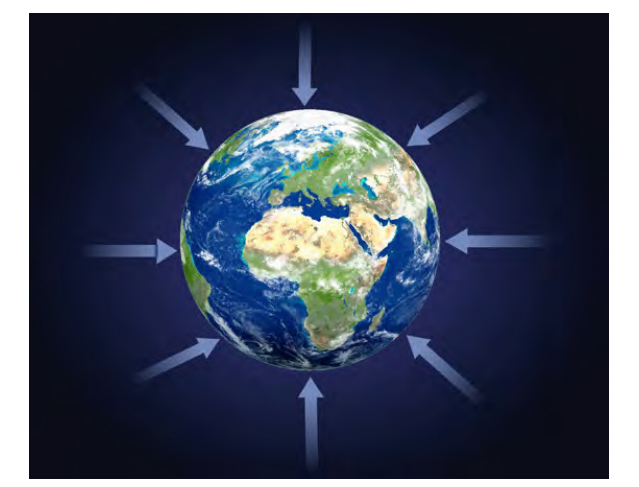
- Everything that has mass has gravity — gravity is the pulling force of attraction between any two objects with mass.
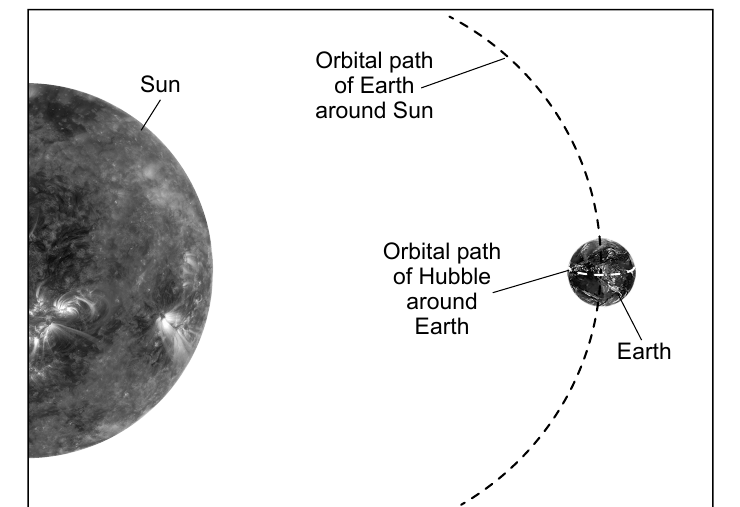
- The Sun is the most massive object in the solar system, so it exerts the greatest gravitational pull; its gravity holds Earth and every other planet in orbit around it.
- The greater an object's mass, the stronger its gravitational pull on other objects.
- The Sun's gravity makes the planets move in curved, orbital paths around it instead of travelling off in a straight line.
The direction of Earth's gravitational pull
Gravity, Mass, and Distance
- Gravity gets weaker as objects move further apart: doubling the distance between two objects cuts the gravitational force between them to a quarter; tripling the distance cuts it to a ninth.
- The Sun is about 333,000 times more massive than Earth, but because we are so far from the Sun, Earth's own gravity holds us to its surface far more strongly than the Sun's gravity does.
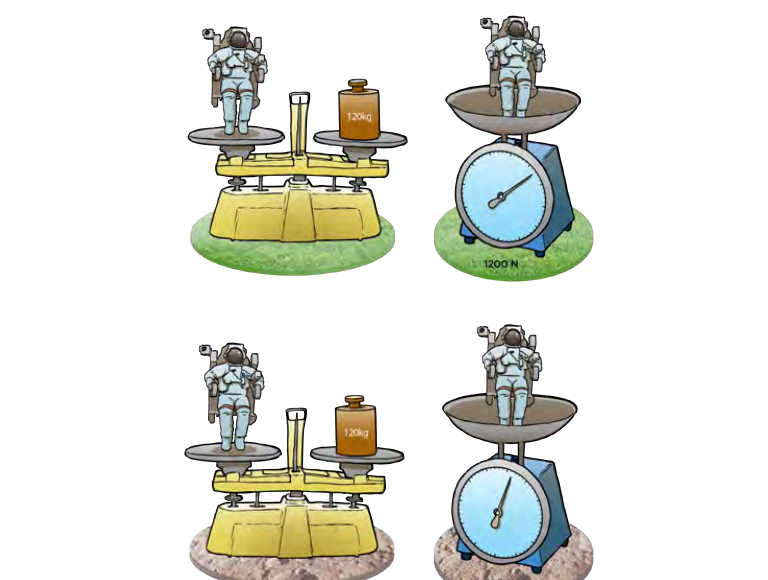
- Weight is the force of gravity acting on an object's mass, so it changes depending on where the object is; mass — the amount of matter in the object — stays the same everywhere.
- The Moon's gravity is about one-sixth of Earth's, so an object weighs one-sixth as much on the Moon as it does on Earth, even though its mass has not changed.
An astronaut's mass and weight on Earth and the Moon
Inertia and Orbital Motion
- Inertia is the tendency of an object to keep moving the way it is already moving; objects with more mass have more inertia.
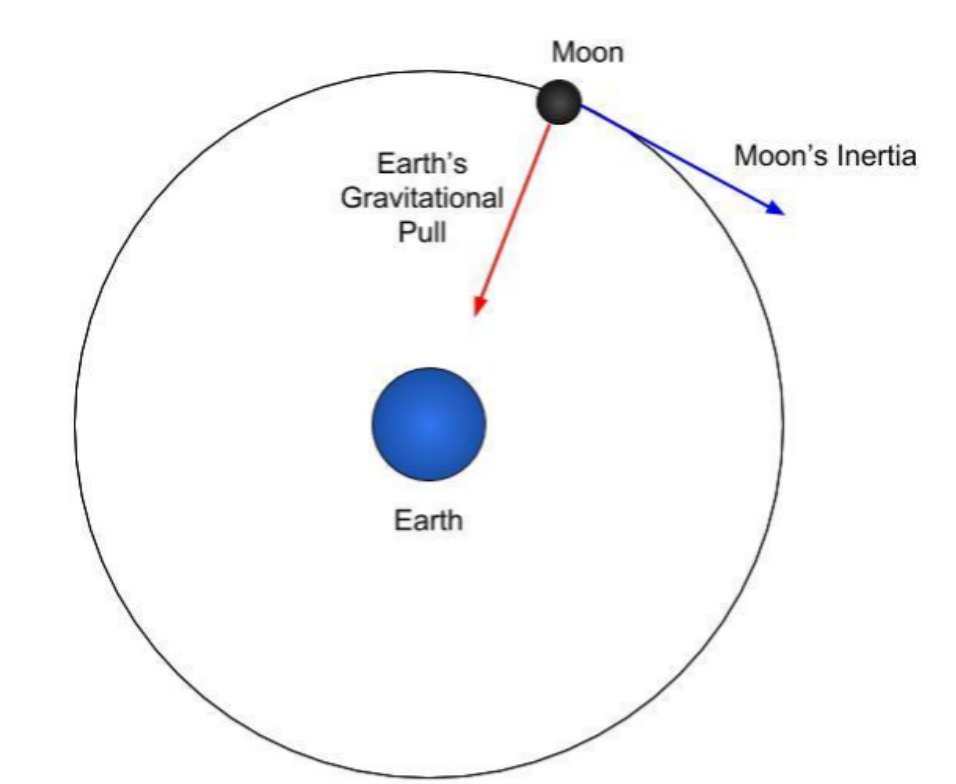
- Earth does not fall into the Sun: its forward motion (inertia) constantly carries it sideways while the Sun's gravity constantly pulls it inward, so gravity and inertia together make Earth fall around the Sun instead of into it.
- This combined motion is called orbital motion. It happens whenever an object is moving forward while gravity pulls it toward another object.
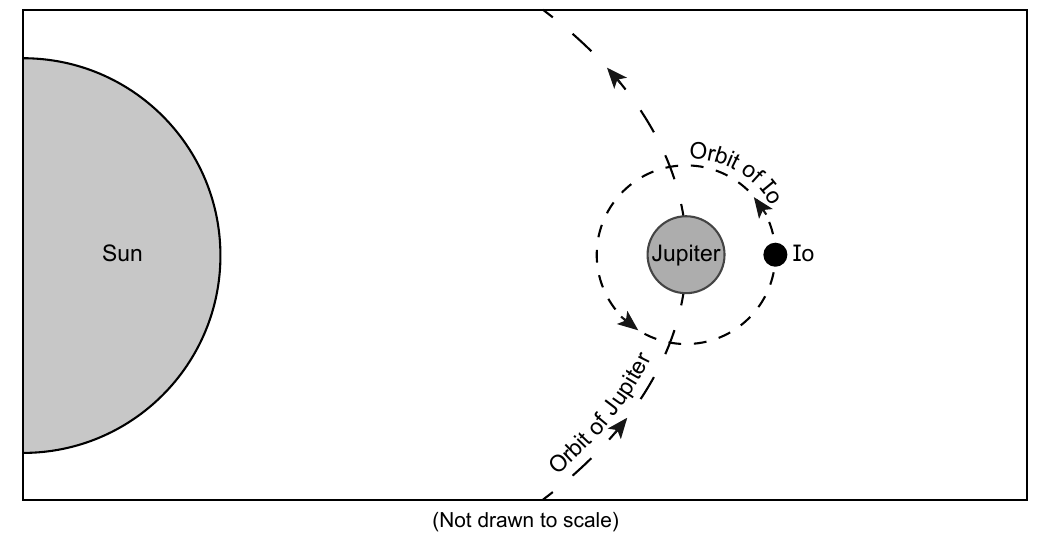
- The Moon orbits Earth the same way: Earth's gravity pulls the Moon toward Earth, while the Moon's inertia keeps carrying it forward, so it continually falls around Earth instead of crashing into it.
Gravity and inertia keep the Moon in orbit around Earth
Solar System Objects & What Makes a Planet
- In orbit around the Sun are the eight planets, their moons, dwarf planets, and many smaller objects such as asteroids, Kuiper Belt objects, and comets.
- Terrestrial planets (Mercury, Venus, Earth, Mars) have solid rocky surfaces; gas giants (Jupiter, Saturn, Uranus, Neptune) are much larger and made mainly of gas.
- To count as a planet, an object must: orbit the Sun; be large enough that its own gravity pulls it into a spherical shape; and have cleared other objects out of its orbital path.
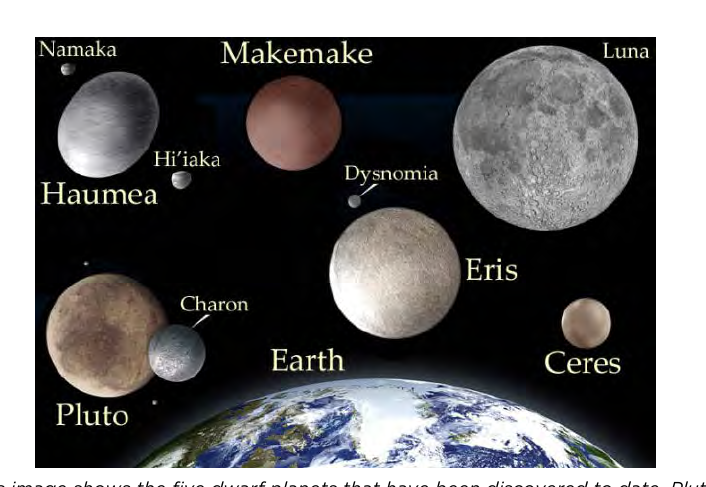
- Pluto was reclassified from a planet to a dwarf planet in 2006 because, although it orbits the Sun and is nearly round, it has not cleared its orbit of similar-sized objects.
The five known dwarf planets, shown to scale with Earth
Terrestrial vs Gas Giant Planets
- Terrestrial planets are close to the Sun, small, rocky, dense, and slow-spinning, with thin atmospheres, few or no moons, and no rings.
- Gas giants are far from the Sun, large, made mainly of gas, less dense, fast-spinning, with thick atmospheres, many moons, and rings.
- In the early solar system it was hot close to the Sun, so only metals and rock could stay solid there; further out it was cold enough for ices and gases to collect, which is why the outer planets grew so much larger.
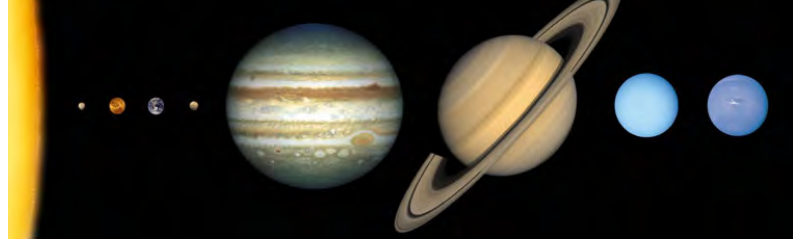
- Moon counts show the pattern clearly: Mercury 0, Venus 0, Earth 1, Mars 2, compared with Jupiter 67, Saturn 62, Uranus 27, Neptune 13. Saturn's rings alone are over 200,000 km wide but only a few tens of metres thick.
The relative sizes of the terrestrial planets and gas giants
Planetary Temperatures
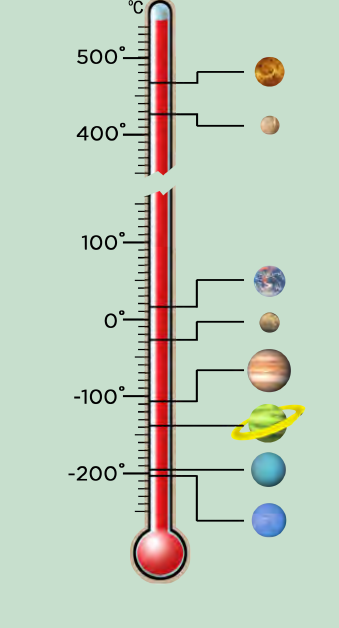
- Planets closer to the Sun are usually warmer, and planets farther away are usually colder.
- Venus is the hottest planet (464°C) even though Mercury is closer to the Sun, because Venus's thick carbon dioxide atmosphere traps heat in a strong greenhouse effect.
- Neptune is the coldest planet (-200°C), as it is the farthest planet from the Sun.
- Excluding Venus, planetary temperatures decrease with distance from the Sun.
Surface temperatures of the planets
Small Bodies: Asteroids, Kuiper Belt, and Comets
- Asteroids are small rocky leftovers from the solar system's formation, mostly found in the asteroid belt between Mars and Jupiter; more than 100,000 have been catalogued there.
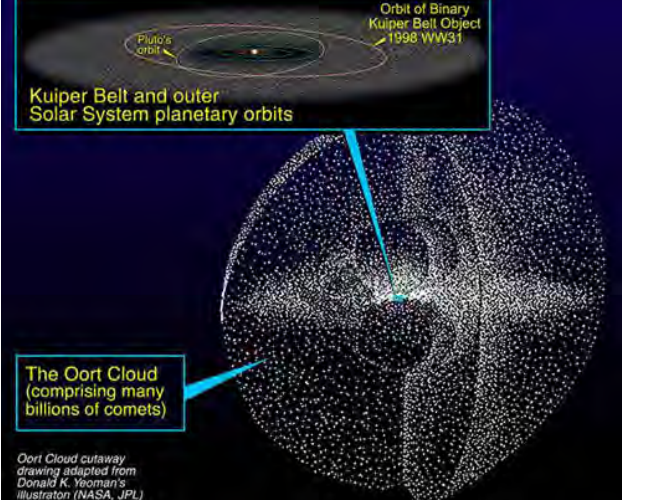
- The Kuiper Belt is a region of icy objects beyond Neptune's orbit; its two largest known members, Pluto and Eris, are both dwarf planets.
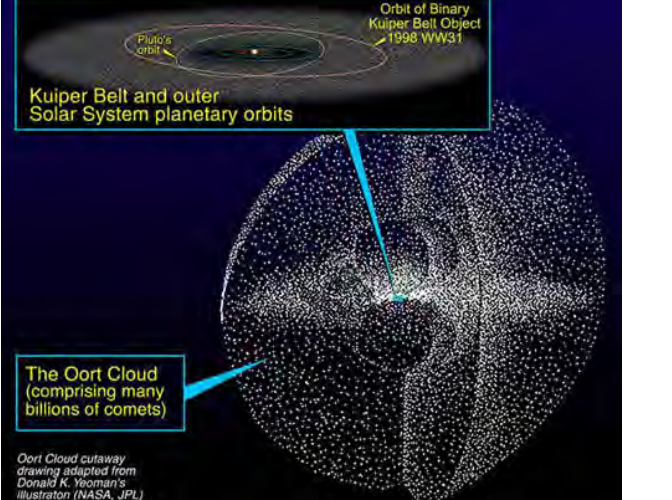
- Comets are icy, dusty objects that orbit the Sun from the Kuiper Belt or the far more distant Oort Cloud; they only become visible from Earth when they travel close to the Sun.
- As a comet nears the Sun, heat evaporates its ices, forming a dust tail that points back along its path, and a second ion tail, pushed by the solar wind, that always points directly away from the Sun.
The Kuiper Belt and the Oort Cloud
Scale and Distances
- The average distance from Earth to the Sun is called an astronomical unit (AU), about 150 million km.
- The Kuiper Belt lies between about 30 and 50 times Earth's distance from the Sun.
- The Oort Cloud is a predicted cloud of icy objects at about 5,000 to 100,000 times Earth's distance from the Sun.
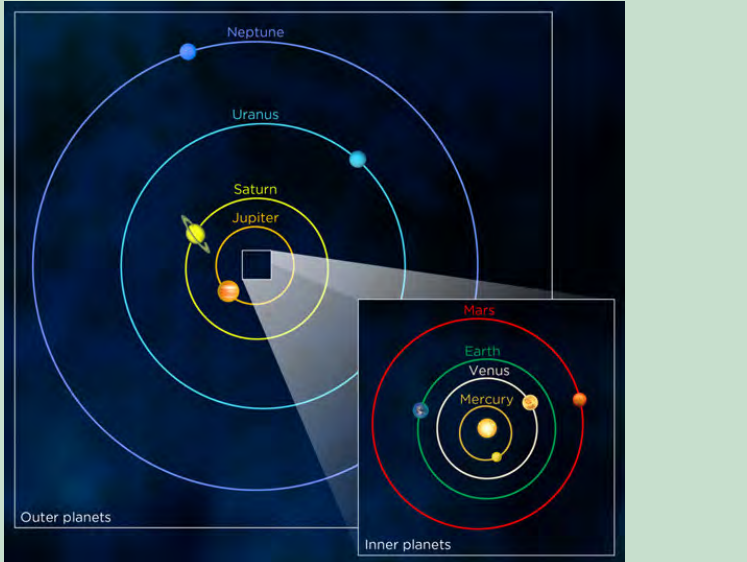
- Gravity holds all of this together across enormous distances: the Sun's pull, though far weaker at greater distances, still keeps even the most distant objects in orbit around it.
The orbits of the planets in the solar system
The Milky Way Galaxy
- A galaxy is a massive collection of stars, gas, and dust held together by gravity.
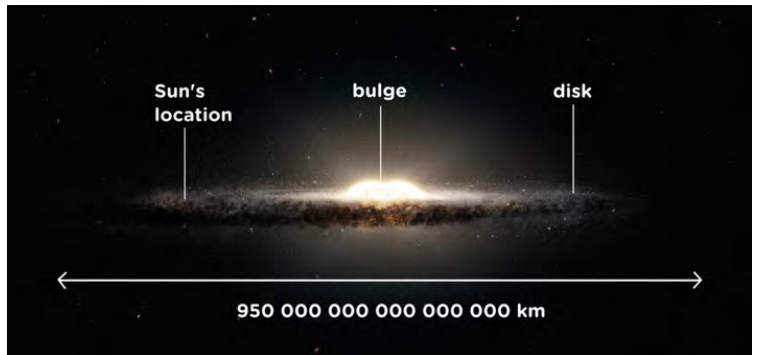
- The Milky Way has about 200 billion stars, including our Sun, arranged in a disk with a central bulge and spiral arms.
- Our Sun sits in a small spiral arm called the Orion (or Local) Arm, roughly halfway out from the galaxy's centre.
- Gravity keeps the whole galaxy turning: the Sun and the rest of the solar system orbit the centre of the Milky Way once every 225 million years, even while travelling at about 250 km/s.
The Milky Way seen from the side
スライド
練習問題
無料プレビュー — 42問中8問。すべて見るには登録を。
1.What is the name of the force that keeps the planets in orbit around the Sun?
Easy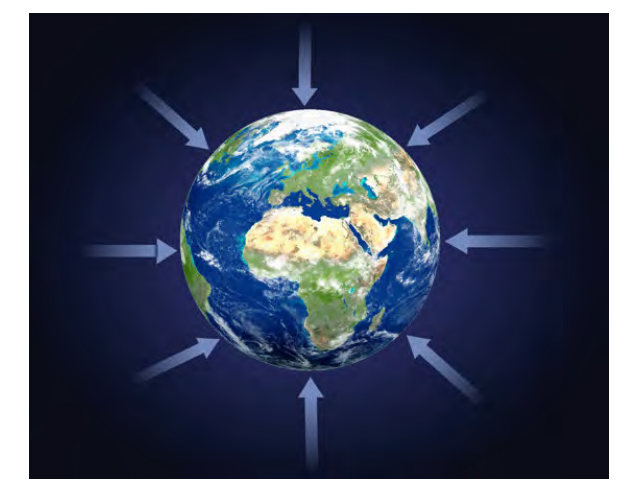
- AGravity
- BMagnetism
- CFriction
- DInertia
2.The Sun makes up 98% of the total mass of the solar system.
EasyTrue or false?
3.Which of the following is NOT a criterion for an object to be classified as a planet?
Easy- AIt must orbit the Sun
- BIt must be large enough to be spherical due to its own gravity
- CIt must have cleared its orbit of other objects
- DIt must have a moon
4.The asteroid belt is located between the orbits of Mars and Jupiter.
EasyTrue or false?
5.Which of the following is a gas giant?
Easy- AMars
- BJupiter
- CVenus
- DMercury
6.What is the main component of the atmosphere of Venus?
Easy- ACarbon dioxide
- BOxygen
- CNitrogen
- DMethane
7.The Sun is located at the centre of the Milky Way Galaxy.
EasyTrue or false?
8.What is a galaxy?
Easy- AA collection of stars, gas and dust held together by gravity
- BA single star with planets
- CA cloud of gas and dust
- DA group of planets orbiting a star
過去問
このトピックの過去問練習は近日公開。
近日公開