Describing motion: distance, speed and acceleration
遊んで学ぼう
問題に答えてエネルギーを集めたら、釣りや探検を楽しもう。アカウント不要。
レッスンノート
Position and Reference Points
- To describe motion you first have to say where something is. Position is the location of an object measured from a reference point (also called the origin).
- A position needs a number, a unit and a direction: "300 m from Kosma's house, towards the shop".
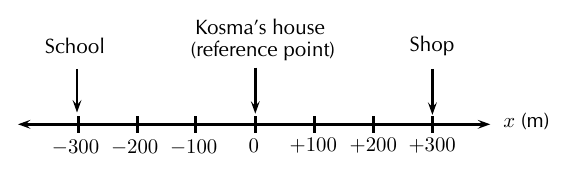
- Along a straight line we choose one direction as positive; the opposite direction is then negative. In the figure the shop is at +300 m and the school is at -300 m.
- Choosing a different reference point changes the position numbers, but not where anything really is or how far apart things are.
A number line with Kosma's house as the reference point: the school is at -300 m and the shop is at +300 m.
Distance and Displacement
- Distance is the total length of the path travelled. It has no direction and is never negative.
- Displacement is the change in position: the straight line from where you started to where you finished, with a direction. Displacement = final position - initial position.
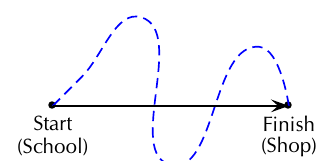
- In the figure the dashed winding path is the distance; the straight solid arrow from start to finish is the displacement.
- If you walk 500 m to school and 500 m back home, your distance is 1000 m but your displacement is 0 m, because you ended where you started.
- Both are measured in metres (m).
A winding dashed path from the school (start) to the shop (finish), with a straight solid arrow from start to finish.
Calculating Speed
- Speed tells you how fast something moves: how much distance it covers in each unit of time.
- average speed = distance / time, or v = d / t. With distance in metres and time in seconds, speed is in metres per second (m/s).
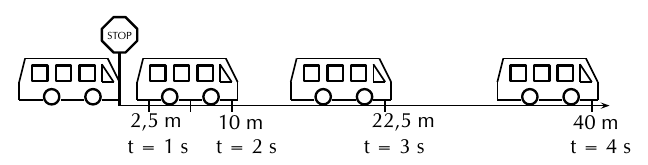
- Example: a car travels between two poles 50 m apart in 2.5 s. Speed = 50 m / 2.5 s = 20 m/s.
- Rearranged: distance = speed × time, and time = distance / speed. A car moving at 30 m/s covers 90 m in 3 s.
- Make the units match before you divide: 1 km = 1000 m, 1 min = 60 s, 1 h = 3600 s. To change km/h into m/s, divide by 3.6 (72 km/h = 20 m/s).
Velocity: Speed with a Direction
- Velocity is speed in a given direction. average velocity = displacement / time.
- Velocity can be positive or negative: the sign shows the direction of travel along the line.
- Example: James walks 2 km away from home in 30 minutes, then walks back in another 30 minutes. Distance = 4000 m and time = 3600 s, so his average speed is 4000 / 3600 = 1.1 m/s.
- His displacement is 0 m, so his average velocity for the whole trip is 0 m/s, even though he never stopped walking.
- Two cars can have the same speed but different velocities if they travel in different directions.
Acceleration
- Acceleration is how quickly velocity changes. acceleration = change in velocity / time, or a = (final velocity - initial velocity) / t.
- The unit is metres per second squared (m/s²): an acceleration of 2 m/s² means the velocity changes by 2 m/s every second.
- Example: a car speeds up from 2 m/s to 10 m/s in 8 s. a = (10 - 2) / 8 = 1 m/s².
- The same car then slows from 10 m/s to 4 m/s in 6 s. a = (4 - 10) / 6 = -1 m/s². The negative sign shows the acceleration points against the motion, so the car slows down.
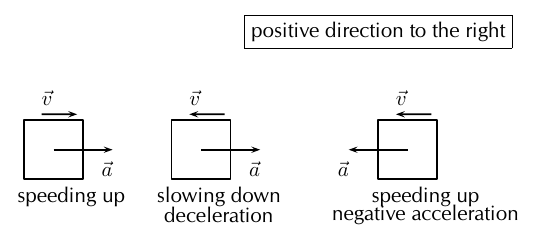
- When the velocity and acceleration arrows point the same way, the object speeds up. When they point opposite ways, it slows down.
- An object moving at a constant velocity has zero acceleration, however fast it is going.
Three objects with velocity and acceleration arrows: arrows in the same direction (speeding up) and in opposite directions (slowing down).
Distance-Time Graphs
- A distance-time graph puts time on the horizontal axis and distance on the vertical axis.
- A flat (horizontal) line means the distance is not changing: the object is stationary.
- A straight sloping line means the object covers equal distances in equal times: constant speed. A steeper line means a faster speed.
- The slope of the line is the speed: slope = change in distance / change in time. In the figure the walker covers 100 m in 100 s, so the speed is 1 m/s.
- A line that curves upwards, getting steeper, shows an object that is speeding up.
Distance-time graph for a walker: a straight line from 0 m at 0 s to 100 m at 100 s.
Speed-Time Graphs
- A speed-time graph puts time on the horizontal axis and speed on the vertical axis.
- A flat line means constant speed (not stationary, unless the line sits at 0 m/s).
- A line sloping upwards means the object is speeding up; a line sloping downwards means it is slowing down.
- The slope of the line is the acceleration: slope = change in speed / change in time. In the figure the cyclist goes from 0 to 12 m/s in 4 s, an acceleration of 3 m/s².
- Read the axis titles first. The same flat line means "stopped" on a distance-time graph and "steady speed" on a speed-time graph.
Speed-time graph of a cyclist's ride in three parts.
スライド
練習問題
無料プレビュー — 55問中8問。すべて見るには登録を。
1.What is a reference point?
Easy- AThe fastest point in a journey
- BA fixed place that positions are measured from
- CThe place where a journey ends
- DThe total length of a path
2.The figure shows seven buildings along a straight street. Each building is 100 m from the next. Kosma's house is the reference point and the direction towards the shop is positive. What is the position of Kevin's house?
Easy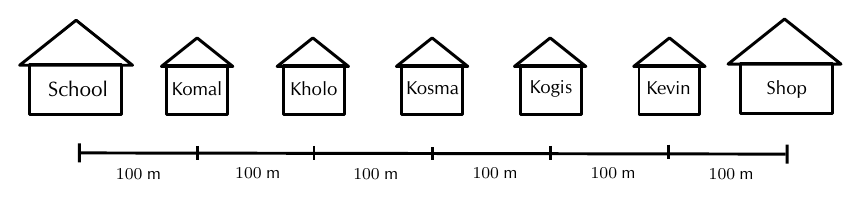
- A-200 m
- B+500 m
- C+100 m
- D+200 m
3.The figure shows seven buildings along a straight street. Each building is 100 m from the next. Kosma's house is the reference point and the direction towards the shop is positive. What is the position of Komal's house?
Easy- A-200 m
- B+200 m
- C-100 m
- D-300 m
4.Changing the reference point changes the actual distance between two houses.
EasyTrue or false?
5.Complete the sentence.
EasyA position is measured from a fixed place called the ____.
6.Which statement best describes displacement?
Easy- AThe total length of the path travelled
- BThe straight-line change in position from start to finish, with a direction
- CHow fast an object is moving
- DThe time taken for a journey
7.Distance can be negative.
EasyTrue or false?
8.It is possible to travel a distance of 1000 m and have a displacement of 0 m.
EasyTrue or false?