Biodiversity and the effect of human interaction on ecosystems
플레이하며 배우기
이 문제들을 풀어 에너지를 얻은 뒤 낚시하고 탐험하세요. 계정이 필요 없어요.
교육자를 위해: Biodiversity and the effect of human interaction on ecosystems(Science, Biology)을(를) 위한 바로 쓸 수 있는 수업 슬라이드, 복습 노트 — 수업에 사용하거나, 학습자들이 실시간 게임으로 즐기는 인터랙티브 클래스 활동으로 진행하세요.
수업 노트
What Biodiversity Is and Why It Matters
- Biodiversity is the variety of all the different species of organisms on Earth, or within a particular ecosystem.
- A highly biodiverse ecosystem is stable because of the large number of interdependent species it contains.
- Species depend on each other for food, shelter (such as birds nesting in trees) and maintenance of the physical environment (such as tree roots holding soil together).
- High biodiversity reduces the dependence of one species on another, so if one population is lost, others can still survive on alternative food sources.
- A large number of interconnected food chains is most likely to produce a biodiverse ecosystem.
- The future of the human species relies on maintaining biodiversity: we depend on photosynthetic organisms for oxygen, pollinators such as bees for food crops, and plants for medicines.
Human Population Growth and Waste
- The human population has grown exponentially over the last 150 years.
- Growth is driven by improved technology giving an abundance of food (raising the birth rate) and improved medicine, hygiene and health care (lowering the death rate).
- A rising population and an increasing standard of living mean more resources are used and more waste is produced.
- Unless waste and chemical materials are properly handled, pollution will continue to be created.
- Pollution kills plants and animals, which reduces biodiversity.
Types of Pollution
- Water pollution comes from sewage, fertiliser or toxic chemicals.
- Air pollution comes from smoke and acidic gases, such as sulfur dioxide released by burning fossil fuels.
- Land pollution comes from landfill and from toxic chemicals.
- Pollutants can build up in organisms: bioaccumulation is the build-up of a substance within one organism, while biomagnification is the increase in concentration of a dangerous compound at successive trophic levels.
- Air pollution such as sulfur dioxide can lead to acid rain, which damages habitats.
Eutrophication
- Runoff of fertiliser from farmland enters water and causes increased growth of algae and water plants.
- The resulting algal bloom blocks sunlight, so water plants on the bottom die, and the algae die too when competition for nutrients becomes too intense.
- As plants and algae die in greater numbers, decomposing bacteria increase and use up the dissolved oxygen while respiring aerobically.
- With less dissolved oxygen, aquatic organisms such as fish and insects may be unable to survive, reducing biodiversity.
- Sewage and fertiliser runoff both end with a decrease in dissolved oxygen, but only fertiliser runoff causes algal blooms.
- Indicator species can reveal pollution levels: stonefly larvae and freshwater shrimps indicate clean water, while blood worms and sludgeworms indicate very high water pollution.
- Lichen and blackspot fungus are sensitive to sulfur dioxide, so a high abundance of bushy lichen indicates very clean air.
Sequence of events causing eutrophication
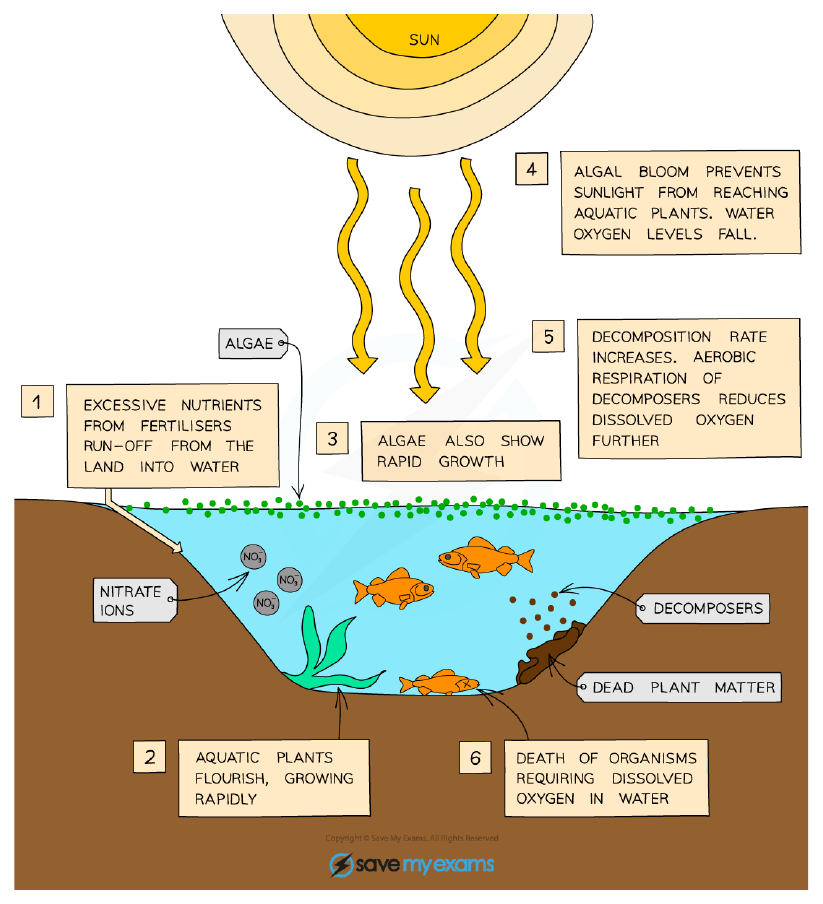
Land Use and Peat Bogs
- An increasing human population needs more land for building, quarrying, farming and dumping waste, destroying habitats such as rainforests and woodlands.
- This reduces biodiversity and interrupts food chains and webs, so more species may die because their prey is gone.
- Peat bogs are waterlogged, acidic areas where plants do not fully decay due to a lack of oxygen, so partly decomposed plant matter accumulates as peat.
- Carbon that would have been released as carbon dioxide is instead stored in the peat.
- Peat bogs are drained for farming, dried and burned as fuel, or used to produce compost for gardens and farms.
- Burning peat releases carbon dioxide into the atmosphere, contributing to global warming, and the loss of peat bog habitat reduces biodiversity.
- Peat bogs form so slowly that peat is effectively a non-renewable resource and is being used unsustainably.
Deforestation
- Deforestation is the clearing of trees, usually on a large scale.
- It can be sustainable if trees are replanted, but unsustainable deforestation is occurring where forests are cut down faster than they can regenerate.
- Large-scale deforestation in tropical areas occurs to provide land for cattle and rice fields and to grow crops for biofuels.
- Deforestation is a severe form of habitat destruction, causing extinction of species, loss of soil, flooding and an increase of carbon dioxide in the atmosphere.
- Removing trees means less carbon dioxide is removed from the air by photosynthesis, and burning or decaying vegetation releases carbon dioxide.
- Reforestation — replanting large areas with a variety of tree species — helps rebuild biodiversity and maintain the global carbon balance.
Global Warming
- Greenhouse gases absorb infrared radiation from the Sun so heat remains trapped in the Earth's atmosphere.
- The most important greenhouse gases include water vapour, carbon dioxide, methane, nitrous oxides and CFCs.
- Carbon dioxide is produced by the combustion of fossil fuels; methane is released by cattle digesting grass and by rice paddy fields.
- Rising levels of greenhouse gases cause an enhanced greenhouse effect, raising the Earth's average temperature beyond normal — this is global warming.
- Consequences include melting polar ice caps, rising sea levels, flooding, coral bleaching, extreme weather such as super storms and droughts, habitat loss, and decreased biodiversity.
- Global warming can also increase the migration of species to new places, including the spread of pests and disease.
- There is scientific consensus that global warming is happening and that human activities are largely responsible, based on systematic reviews of thousands of peer-reviewed papers.
Maintaining Biodiversity
- Humans can interact positively with ecosystems through conservation programmes.
- Protected areas are habitats that are not allowed to be interfered with, for example no building work is allowed.
- Breeding programmes selectively breed organisms, often in zoos, to increase population numbers of endangered species.
- Seed banks store seeds of plant species for many years under the right conditions to future-proof the species.
- Reducing deforestation and carbon dioxide emissions, and recycling resources rather than dumping waste in landfill, also help.
- Field margins and hedgerows can be reintroduced in agricultural areas where farmers grow only one type of crop, providing habitats and increasing biodiversity.
- Maintaining biodiversity protects the human food supply, sources of medicines, jobs in conservation and ecotourism, and cultural traditions linked to nature.
- Peatlands and wetlands store large amounts of carbon, so protecting them helps reduce carbon dioxide released into the atmosphere.
Conflicting Pressures on Biodiversity
- Protecting biodiversity can be very expensive; for example, land used for field margins could otherwise grow crops, so governments may pay farmers a subsidy.
- It also costs money to check that programmes designed to maintain biodiversity are actually being followed.
- Land protected for biodiversity could instead be used for farming, causing conflict where there are food shortages.
- Organisms seen as a threat by farmers, such as locusts and wolves, may be killed to protect crops and livestock, which can negatively affect food chains.
- Increasing amounts of land are needed for housing and new agricultural land as the human population grows, so undisturbed habitats with high biodiversity are increasingly used for development.
슬라이드
연습 문제
무료 미리 보기 — 61개 중 8개 문제. 가입하면 전부 볼 수 있어요.
1.Biodiversity means the total number of individual organisms in an ecosystem, rather than the variety of species.
EasyTrue or false?
2.Which of the following best defines biodiversity?
Easy- AThe variety of different species within an ecosystem or on Earth
- BThe total number of organisms in a habitat
- CThe number of individuals of a single species
- DThe total biomass of all organisms in an ecosystem
3.Which of the following human activities reduce biodiversity? (Select all that apply)
Medium- ADeforestation
- BProducing waste
- CGlobal warming
- DPlanting a variety of tree species
- EUsing field margins
4.Which of the following is not a consequence of deforestation?
Medium- AIncreased biodiversity
- BExtinction of species
- CLoss of soil
- DIncrease of carbon dioxide in the atmosphere
5.Eutrophication is caused by increased growth of algae due to fertiliser runoff, which eventually leads to decreased oxygen levels in water.
EasyTrue or false?
6.What is the first step in eutrophication?
Medium- ARunoff of fertiliser into water
- BDeath of aquatic organisms
- CDecomposition of algae by bacteria
- DIncrease in dissolved oxygen
7.The presence of stonefly larvae in a stream indicates that the water is polluted.
EasyTrue or false?
8.Which organism is an indicator of very high water pollution?
Easy- ABlood worms
- BStonefly larvae
- CFreshwater shrimps
- DBushy lichen
기출 문제
이 주제의 기출 문제 연습이 곧 나와요.
곧 출시