Photosynthesis
플레이하며 배우기
이 문제들을 풀어 에너지를 얻은 뒤 낚시하고 탐험하세요. 계정이 필요 없어요.
교육자를 위해: Photosynthesis(Science, Biology)을(를) 위한 바로 쓸 수 있는 수업 슬라이드, 복습 노트 — 수업에 사용하거나, 학습자들이 실시간 게임으로 즐기는 인터랙티브 클래스 활동으로 진행하세요.
수업 노트
The Photosynthetic Reaction
- Photosynthesis is the process by which plants make their own food using light, water and carbon dioxide.
- Plants are producers because they make their own food, and they are the first organism in most food chains.
- Photosynthesis is an endothermic reaction: energy is transferred from the environment to the chloroplasts by light.
- The word equation is: carbon dioxide + water → glucose + oxygen (light energy is needed).
- The balanced symbol equation is: 6CO₂ + 6H₂O → C₆H₁₂O₆ + 6O₂.
- The reactants are carbon dioxide and water; the products are glucose and oxygen.
- Most photosynthesis happens in the leaves, in mesophyll cells packed with chloroplasts containing chlorophyll to absorb light energy.
- The glucose made is used to build all the substances a plant needs and is also used in respiration to release energy.
Factors Affecting the Rate of Photosynthesis
- The rate of photosynthesis is affected by light intensity, carbon dioxide concentration, temperature and the amount of chlorophyll.
- Although water is needed, it is not considered a limiting factor because the amount required is small compared to the amount lost by transpiration.
- A limiting factor is something in short supply that restricts the rate of photosynthesis.
- Temperature affects the kinetic energy of particles: lower temperatures mean fewer successful collisions between reactants and enzymes, so the rate is slower.
- As temperature increases, particles have more kinetic energy and collisions become more likely, increasing the rate.
- At high temperatures, the enzymes controlling photosynthesis can become denatured, so the rate falls.
- Light intensity: the more light a plant receives, the faster the rate, until another factor becomes limiting.
- Carbon dioxide concentration: more carbon dioxide increases the rate, until another factor becomes limiting.
- Chlorophyll: more chloroplasts means more chlorophyll, so the rate is faster; chlorophyll amount can be reduced by diseases (e.g. tobacco mosaic virus), lack of nutrients (e.g. magnesium) or loss of leaves.
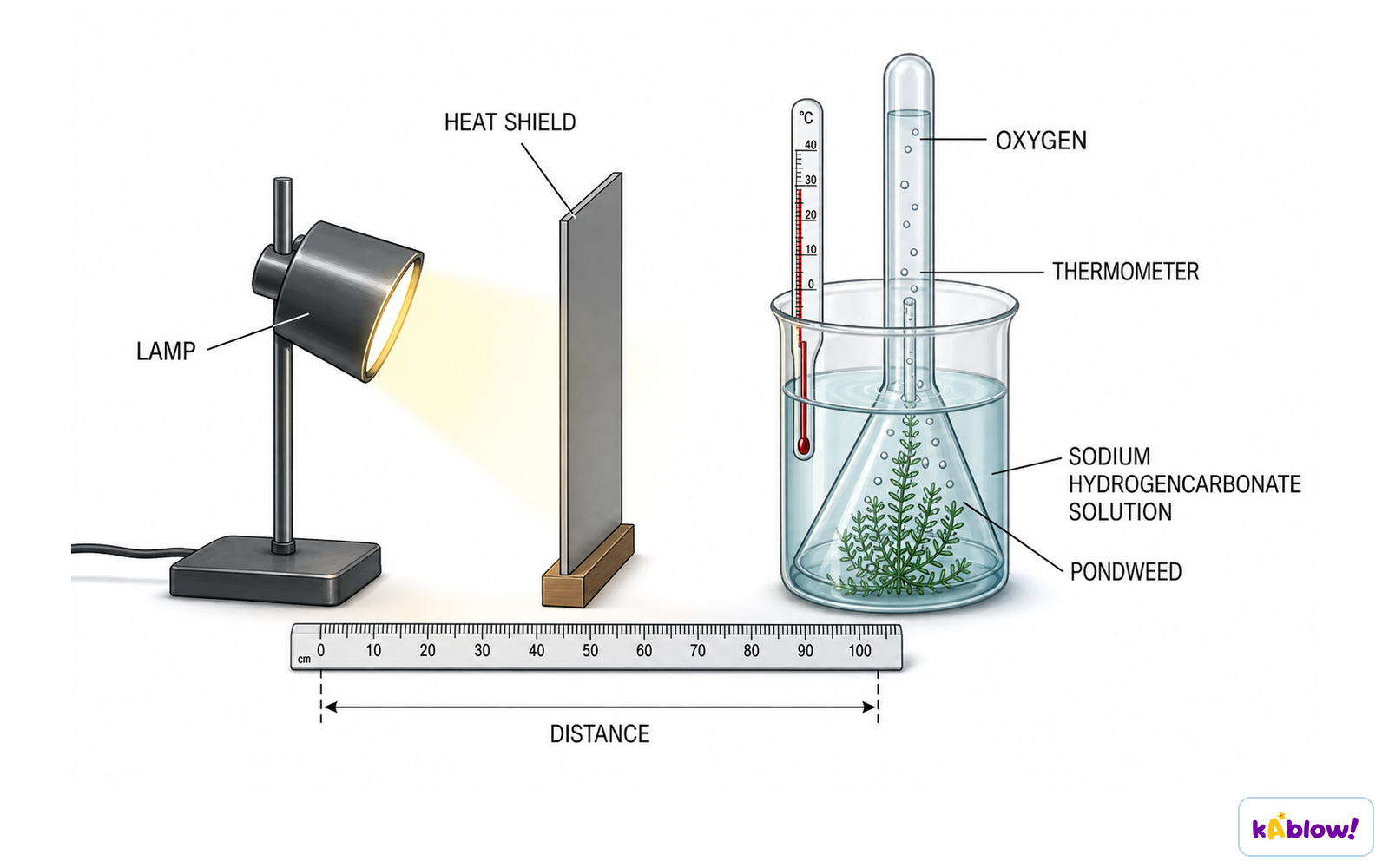
Investigating light intensity and rate of photosynthesis
Interactions of Limiting Factors (Higher Tier)
- More than one limiting factor can affect the rate of photosynthesis at the same time.
- On a graph, if the rate is increasing as the variable on the x-axis increases, that variable is the limiting factor.
- If the graph levels off (becomes horizontal), the factor on the x-axis is no longer limiting; something else is now in short supply.
- For example, at low light intensities both lines on a graph may show the same rate because light is limiting; at higher light intensities the line for the lower temperature is lower, showing temperature is now limiting.
- When three factors interact, the highest rate occurs when temperature and carbon dioxide concentration are both high, and light is not limiting.
- In some experiments, carbon dioxide concentration is the limiting factor even when light intensity increases.
Light Intensity and the Inverse Square Law (Higher Tier)
- Light intensity decreases as the distance from the light source increases.
- Light intensity is inversely proportional to the square of the distance: light intensity ∝ 1/d².
- If the distance doubles, the light intensity decreases by a factor of four.
- Calculating 1/d² gives a relative light intensity in arbitrary units, not an absolute value in lux.
- Example: if the distance is 30 cm, relative light intensity = 1/30² = 1/900 = 0.001 arbitrary units.
Required Practical: Investigating the Rate of Photosynthesis
- Aim: investigate the effect of light intensity on the rate of photosynthesis using an aquatic organism such as pondweed (Elodea or Cabomba).
- The rate is measured by counting the oxygen bubbles released per minute, or by collecting the gas in a gas syringe to measure volume.
- Method: place pondweed in a beaker of water, position a light source a set distance away, record bubbles per minute, repeat at least twice and calculate a mean, then repeat for different distances.
- A glass tank of water is placed between the lamp and the plant to absorb heat and prevent the temperature from changing; an LED bulb can also be used as it releases little heat.
- To investigate carbon dioxide, use different concentrations of sodium hydrogencarbonate in the water.
- To investigate temperature, change the temperature of the water surrounding the pondweed using water baths.
- Control variables: keep other factors constant, use the same plant or species, and repeat for reliability.
- Results: as distance decreases (light intensity increases), the volume of oxygen produced increases, until another factor becomes limiting.
Uses of Glucose from Photosynthesis
- Glucose produced in photosynthesis is used for respiration (aerobic and anaerobic) to release energy.
- It is converted into insoluble starch for storage in stems, leaves and roots.
- It is used to produce fat or oil for storage, especially in seeds.
- It is used to produce cellulose, which strengthens the cell wall.
- It combines with nitrate ions absorbed from the soil to produce amino acids for protein synthesis.
- Glucose is also used to make sucrose for transport in the phloem, and nectar to attract insects for pollination.
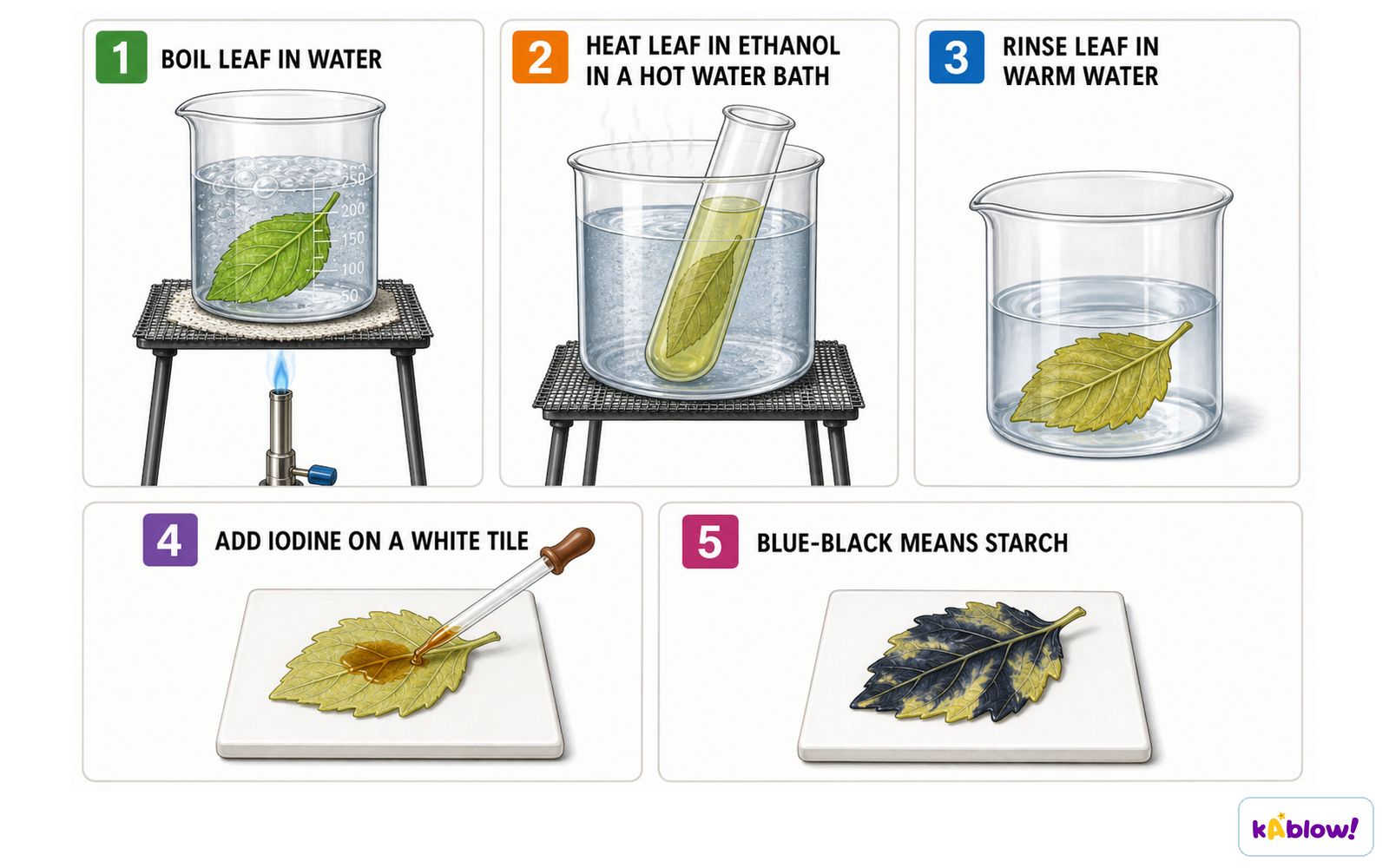
Testing a Leaf for Starch
- A test for starch shows whether photosynthesis has been taking place.
- Method: boil the leaf in water, then place it in ethanol for 10 minutes, wash it in water, place it on a white tile and add iodine solution.
- Iodine solution is a qualitative reagent; it starts brown and turns blue-black if starch is present.
- Glucose made during photosynthesis is converted to starch, so this test can show the effect of light on photosynthesis.
- Plants always respire, but they only photosynthesise during the day if conditions are right.
Testing a leaf for starch
Greenhouses and Limiting Factors (Higher Tier)
- Commercial growers use greenhouses to control limiting factors and maximise the rate of photosynthesis.
- They control levels of heat, light, water, carbon dioxide and nutrients to increase yield.
- The aim is to gain the maximum rate of photosynthesis while still making a profit.
- Increasing a factor beyond the point where it has an effect is a waste of money, because another factor is limiting.
- For example, adding more carbon dioxide when light is limiting will not increase the rate and wastes money.
슬라이드
연습 문제
무료 미리 보기 — 65개 중 8개 문제. 가입하면 전부 볼 수 있어요.
1.Which of the following is the correct word equation for photosynthesis?
Easy- Acarbon dioxide + water → glucose + oxygen
- Bglucose + oxygen → carbon dioxide + water
- Ccarbon dioxide + oxygen → glucose + water
- Dglucose + water → carbon dioxide + oxygen
2.Which chemical formula represents glucose?
Easy- AC6H12O6
- BCO2
- CH2O
- DO2
3.Photosynthesis is an endothermic reaction.
EasyTrue or false?
4.Which of the following is a limiting factor of photosynthesis?
Medium- ALight intensity
- BSoil pH
- CWind speed
- DDay length
5.Which of the following are uses of glucose in a plant? (select all that apply)
Medium- AConverted into starch for storage
- BUsed to produce cellulose for cell walls
- CUsed in respiration to release energy
- DConverted into oxygen for release
- EUsed to produce fat or oil for storage
6.Match each term with its correct definition.
Medium- Endothermic
- Chlorophyll
- Limiting factor
- A reaction that takes in energy from the environment
- The green pigment that absorbs light energy
- Something in short supply that restricts a process
7.A student investigates the effect of light intensity on the rate of photosynthesis using pondweed. Why is a glass tank placed between the lamp and the plant?
Medium- ATo absorb heat from the lamp and prevent the temperature of the water changing
- BTo increase the amount of light reaching the plant
- CTo supply carbon dioxide to the plant
- DTo filter out harmful UV radiation
8.Which statement about water as a limiting factor of photosynthesis is correct?
Medium- AWater is not usually a limiting factor because the amount needed is small compared to the amount transpired.
- BWater is always the main limiting factor in photosynthesis.
- CWater is not needed for photosynthesis.
- DWater limits photosynthesis only at night.
기출 문제
이 주제의 기출 문제 연습이 곧 나와요.
곧 출시