Transport in cells
플레이하며 배우기
이 문제들을 풀어 에너지를 얻은 뒤 낚시하고 탐험하세요. 계정이 필요 없어요.
수업 노트
Diffusion: The Basics
- Diffusion is the spreading out of the particles of any substance in solution, or particles of a gas, resulting in a net movement of particles from an area of higher concentration to an area of lower concentration.
- Particles in a solution or gas move about randomly; if there are more particles in one region, there is an overall (net) movement to a region where there are fewer particles.
- Diffusion is a passive process — it does not require energy from the cell; particles move using their own kinetic energy.
- The higher the temperature, the more kinetic energy particles have, so they move and diffuse faster.
- The cell membrane is partially permeable: some substances can diffuse across it, while others cannot.
- Small molecules such as oxygen and carbon dioxide can diffuse across the cell membrane, but large molecules like starch cannot (they are too big).
- Examples of substances entering cells by diffusion: oxygen for aerobic respiration and carbon dioxide for photosynthesis.
- Examples of substances leaving cells by diffusion: carbon dioxide from respiration and urea (a toxic waste product) which must be excreted by the kidneys.
Factors that Affect the Rate of Diffusion
- Concentration gradient: the greater the difference in concentration between two regions, the faster the rate of diffusion.
- Temperature: higher temperature gives particles more kinetic energy, so they move and spread faster.
- Surface area of the membrane: a greater surface area gives more 'entry or exit points', increasing the rate of diffusion.
- Diffusion distance: the smaller the distance molecules have to travel, the faster transport occurs — this is why capillary and alveoli walls are only one cell thick.
- Surface area to volume ratio (SA:V): as the size of an organism increases, its surface area to volume ratio decreases.
- Single-celled organisms such as bacteria have a large surface area compared to their volume, so substances do not have to travel far and diffusion alone meets their needs.
- Larger organisms with smaller SA:V ratios need exchange surfaces and transport systems to supply their cells.
Diffusion in Multicellular Organisms
- Large multicellular organisms have relatively small surface areas compared to their volumes, so the distance from the surface to the centre is large.
- This is why they need exchange surfaces and transport systems — diffusion, osmosis and active transport alone cannot meet their needs.
- Small intestine: most absorption of digested food molecules into the blood occurs across its wall.
- The small intestine has a highly folded surface lined with epithelial cells (which have folded membranes) to increase surface area; it is only one cell thick to decrease diffusion distance; and it has a good blood supply to maintain a concentration gradient.
- Lungs (alveoli): millions of alveoli provide a huge surface area; each alveolus wall is one cell thick with a moist lining and excellent blood supply to maintain a concentration gradient.
- Fish gills: made of filaments covered in lamellae to increase surface area, with a dense capillary network carrying blood in the opposite direction to the water to maintain a concentration gradient.
- Plant roots: highly branched with root hair cells (root hair projections) to increase surface area for absorbing water and mineral ions.
- Leaves: stomata (mainly on the lower surface) let air circulate inside the leaf, decreasing the diffusion distance for carbon dioxide and oxygen; spongy mesophyll cells also allow air to circulate.
Osmosis: Principles
- Osmosis is the diffusion of water molecules from a dilute solution to a concentrated solution through a partially permeable membrane.
- Osmosis is a special type of diffusion, so water molecules move about randomly; it applies only to water.
- Water always moves from a more dilute solution to a more concentrated solution to even up the concentration of water molecules on each side of the membrane.
- A dilute solution has a high concentration of water molecules, a high water potential, and a low concentration of solute.
- A concentrated solution has a low concentration of water molecules, a low water potential, and a high concentration of solute.
- Osmosis occurs when two solutions are separated by a partially permeable membrane; always identify which solution is more concentrated and which is more dilute to determine the direction of water movement.
Effects of Osmosis on Plant and Animal Cells
- If plant tissue gains mass, water has moved into it by osmosis and the surrounding solution is more dilute than the plant tissue.
- If plant tissue loses mass, water has moved out of it by osmosis and the surrounding solution is more concentrated than the plant tissue.
- If there is no overall change in mass, there is no net movement of water because the concentration in the tissue and the solution are equal (water still moves in and out, but equally).
- In a strong sugar solution (lower water potential than the cell), a plant cell loses water: the vacuole shrinks and the cell membrane pulls away from the cell wall — the cell becomes flaccid or plasmolysed.
- In distilled water (higher water potential than the cell), a plant cell gains water: the vacuole gets bigger, pushing the cell membrane against the cell wall — the cell becomes turgid (high turgor pressure).
- Turgid plant cells provide support and strength, keeping the plant upright with leaves held out to catch sunlight; if plants do not get enough water, cells cannot stay rigid and the plant wilts.
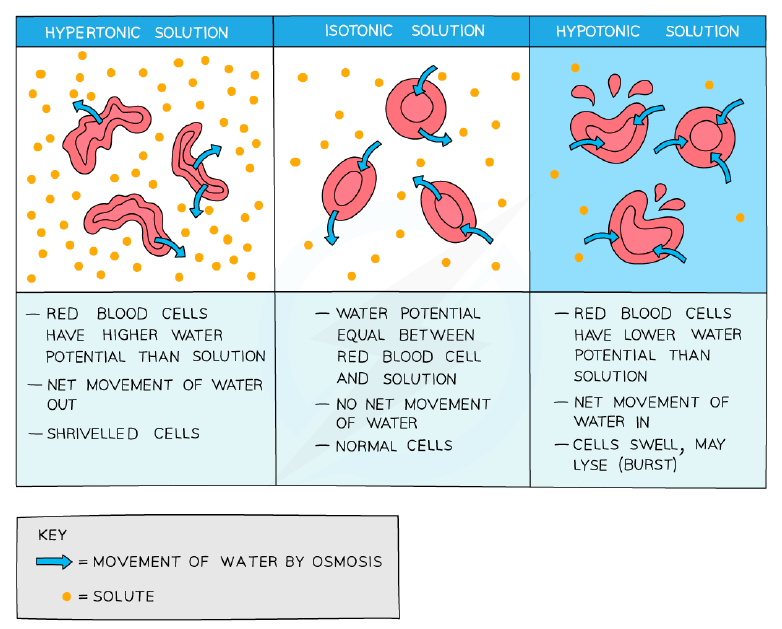
- Animal cells have no supporting cell wall, so osmosis can be severe: in a strong sugar solution they lose water and become crenated (shrivelled); in distilled water they gain water until the membrane stretches too far and the cell bursts.
- Plant cells are protected from bursting (cell lysis) by their supporting cell wall.
Effect of osmosis on animal cells
Required Practical: Osmosis
- Aim: to investigate the effect of different concentrations of salt or sugar solutions on the mass of plant tissue.
- Method: prepare potato cylinders of equal size, measure their mass and length, place one in each concentration of sugar or salt solution, leave for a set time, then remove, blot dry and reweigh.
- Independent variable: the concentration of salt or sucrose solution in mol dm⁻³.
- Dependent variable: the mass and length of each potato cylinder before and after soaking; the percentage change in mass is calculated from these measurements.
- Control variables include: type and volume of solute in solution, temperature, and time.
- On a graph of percentage change in mass against concentration, results above 0 mean the potato gained water by osmosis (solution more dilute); results below 0 mean the potato lost water (solution more concentrated).
- Where the line crosses the x-axis, there is no net water movement — this is the concentration of sugar/salt inside the potato.
- To improve reliability, repeat the investigation with several potato cylinders for each concentration so anomalous results can be identified and a mean calculated.
Active Transport
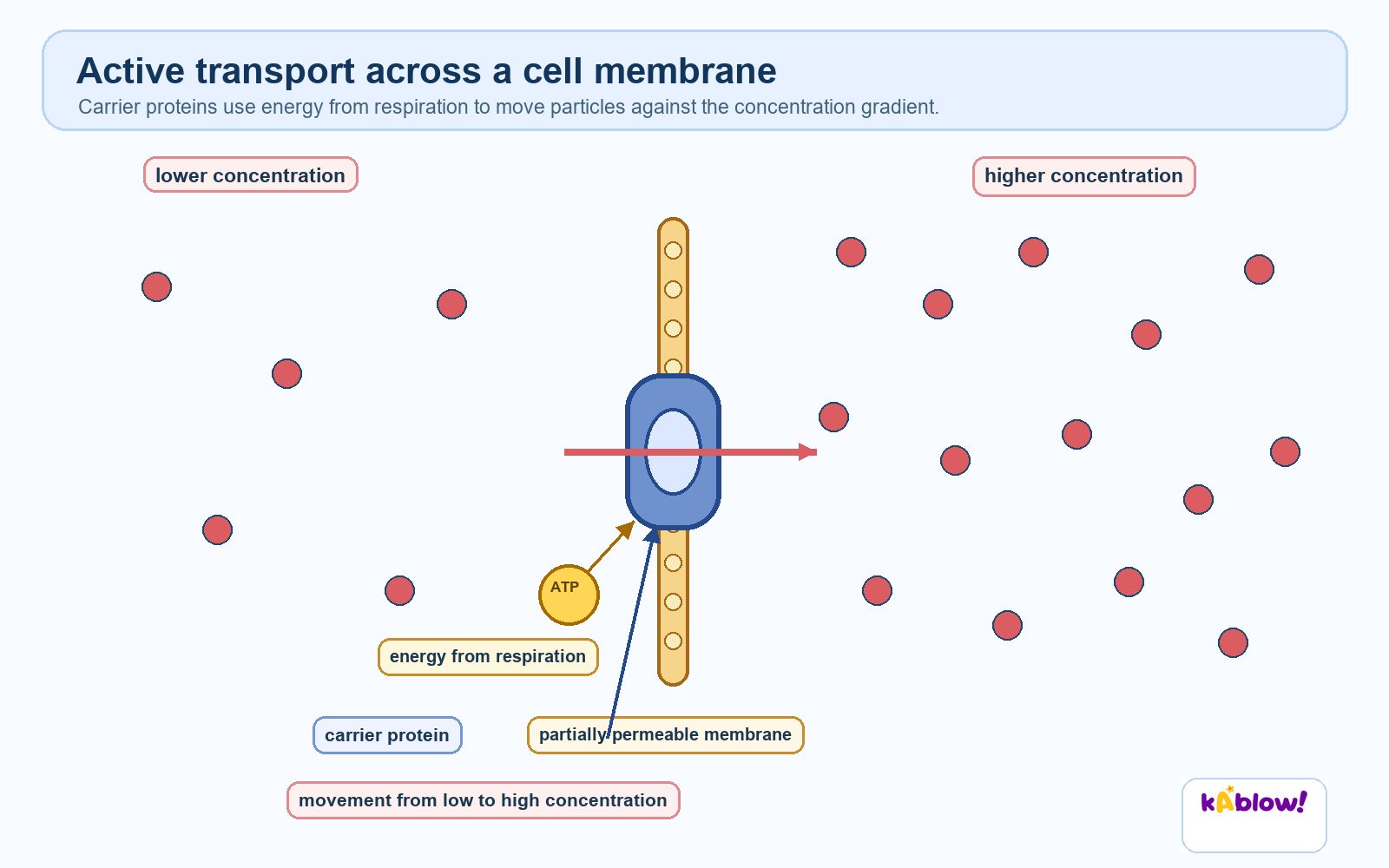
- Active transport is the movement of particles through a cell membrane from a region of lower concentration to a region of higher concentration, using energy from respiration.
- Energy is needed because particles are moved against a concentration gradient, in the opposite direction from which they would naturally move by diffusion.
- Active transport uses protein carrier molecules embedded in the cell membrane, powered by energy released by respiration (ATP).
- Plants: root hair cells move mineral ions such as magnesium ions from the dilute solution in the soil into the more concentrated cytoplasm of the cell.
- Magnesium ions are needed to make chlorophyll; nitrate ions are needed to make amino acids for protein synthesis and growth.
- Animals: active transport allows glucose to be absorbed into the bloodstream from the lumen of the small intestine even when the concentration of sugar in the blood is higher than in the gut.
- In the kidney, active transport in the tubules reabsorbs glucose back into the blood so none is lost in the urine.
The process of active transport
Comparing Transport Processes
- Diffusion: movement of substances in a fluid down a concentration gradient; no energy from respiration required.
- Osmosis: a special type of diffusion of water between two solutions separated by a partially permeable membrane, down a water potential gradient (from dilute to concentrated solution); no energy required.
- Active transport: movement of substances actively across a membrane, usually against a concentration gradient; energy from respiration is required.
- Substances moved by diffusion include oxygen, carbon dioxide, glucose, amino acids and urea.
- Substances moved by active transport include glucose and mineral ions (e.g. sodium, potassium, magnesium, nitrates).
- Diffusion occurs in the lungs and leaves (gas exchange) and in the digestive system; osmosis occurs between all cells and their immediate environment; active transport occurs between the gut lumen and intestinal cells and between roots and the soil.
Application: Sports Drinks
- During exercise, body temperature rises and water and salts are lost through sweat (and water vapour through the lungs from increased breathing rate).
- Muscle activity increases the rate of aerobic respiration, so more glucose is used up in muscle cells and must be replaced.
- Sports drinks are designed to replace water, salts (ions/electrolytes) and glucose lost during exercise.
- The balance between ions and water must be correct: if there is too little water in the blood or the ion concentration is too high, cells lose too much water by osmosis and shrink/dehydrate.
- If the water concentration in the blood is too high or the ion concentration is too low, cells absorb too much water, swelling and possibly bursting.
- Isotonic drinks contain similar concentrations of salt and sugar to the human body and are used for hydration and fluid replacement.
- Hypertonic drinks contain higher concentrations of salt and sugar than blood, suitable for supplying glucose during intense exercise (e.g. a marathon).
- Hypotonic drinks contain lower concentrations of salt and sugar than blood, suitable for rapid rehydration as water is drawn into the bloodstream by osmosis.
슬라이드
연습 문제
무료 미리 보기 — 62개 중 8개 문제. 가입하면 전부 볼 수 있어요.
1.Which process is the spreading out of particles of a gas or of a substance in solution, resulting in a net movement from an area of higher concentration to an area of lower concentration?
Easy- ADiffusion
- BOsmosis
- CActive transport
- DRespiration
2.Diffusion is an active process that requires energy from respiration.
EasyTrue or false?
3.Which factor does NOT affect the rate of diffusion across a cell membrane?
Easy- AThe colour of the substance diffusing
- BThe concentration gradient
- CThe temperature
- DThe surface area of the membrane
4.A plant cell is placed in a solution with a higher water potential than the cell. What will happen to the cell?
Medium- AIt will become turgid as water moves in by osmosis.
- BIt will become flaccid as water moves out by osmosis.
- CIt will burst as water moves in by osmosis.
- DIt will shrivel as water moves out by active transport.
5.Which of the following statements about active transport are correct? (Select all that apply)
Medium- AIt moves substances against a concentration gradient.
- BIt requires energy from respiration.
- CIt is a passive process.
- DIt uses protein carrier molecules in the cell membrane.
- EIt only transports water molecules.
6.Match each transport process with its correct description.
Medium- Diffusion
- Osmosis
- Active transport
- Movement of substances in a fluid down a concentration gradient.
- Movement of water across a partially permeable membrane from a dilute to a concentrated solution.
- Movement of substances across a membrane against a concentration gradient, using energy.
7.According to Fick's law, what happens to the rate of diffusion if the diffusion distance is halved?
Hard- AIt doubles.
- BIt halves.
- CIt stays the same.
- DIt quadruples.
8.Arrange the steps of the osmosis required practical in the correct order.
Medium- Prepare potato cylinders of equal size.
- Blot each cylinder and weigh it.
- Place one cylinder into each sucrose solution.
- After 4 hours, remove cylinders, blot and reweigh.
- Calculate percentage change in mass.