Exothermic and endothermic reactions
플레이하며 배우기
이 문제들을 풀어 에너지를 얻은 뒤 낚시하고 탐험하세요. 계정이 필요 없어요.
교육자를 위해: Exothermic and endothermic reactions(Science, Chemistry)을(를) 위한 바로 쓸 수 있는 수업 슬라이드, 복습 노트 — 수업에 사용하거나, 학습자들이 실시간 게임으로 즐기는 인터랙티브 클래스 활동으로 진행하세요.
수업 노트
Energy Transfer in Reactions
- Chemical reactions involve energy transfer to or from the surroundings.
- Energy is conserved: the total amount of energy in the universe remains the same before and after a reaction.
- If a reaction transfers energy to the surroundings, the products have less energy than the reactants by the same amount.
- Temperature changes can be measured with a thermometer to determine whether a reaction is exothermic or endothermic.
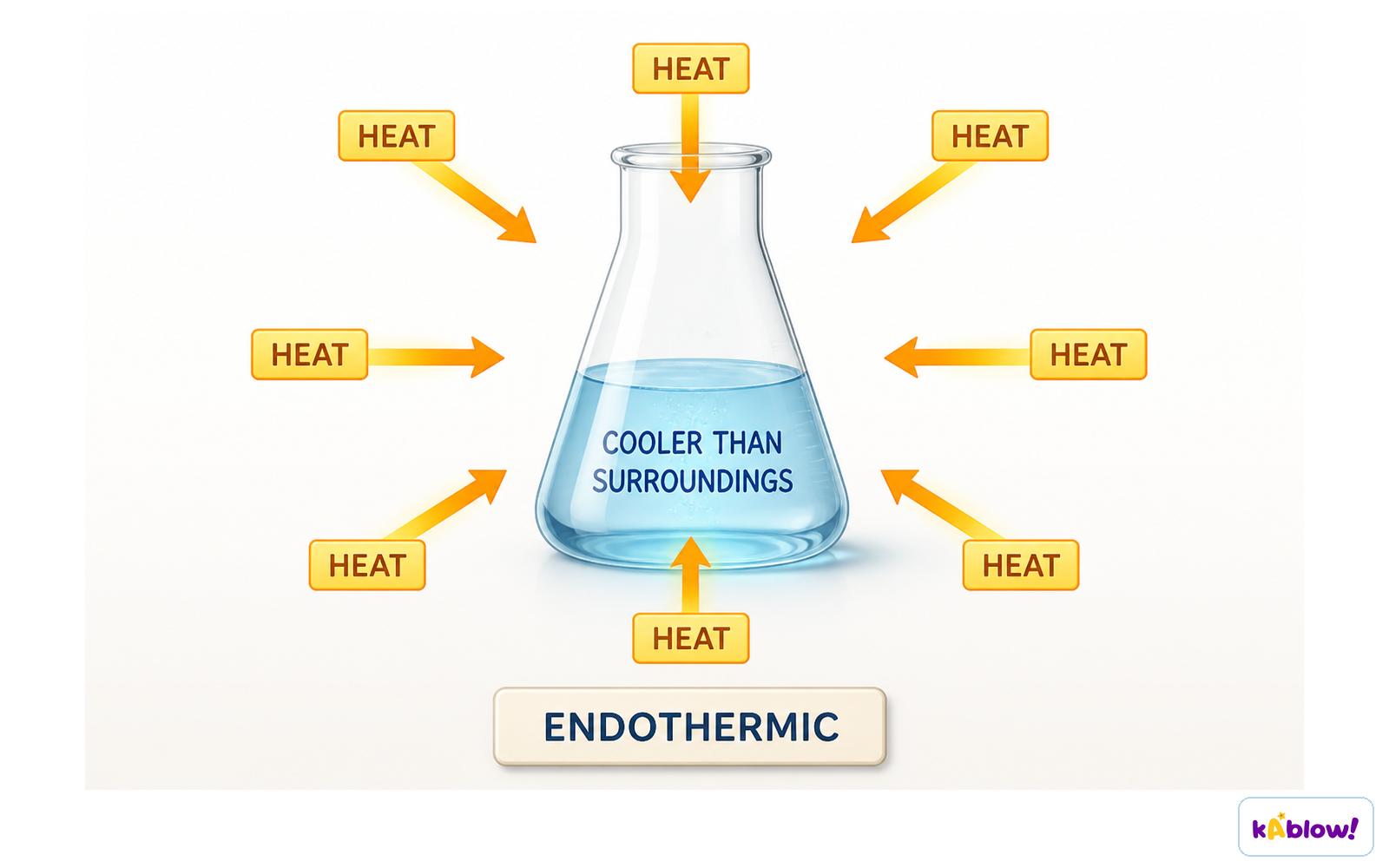
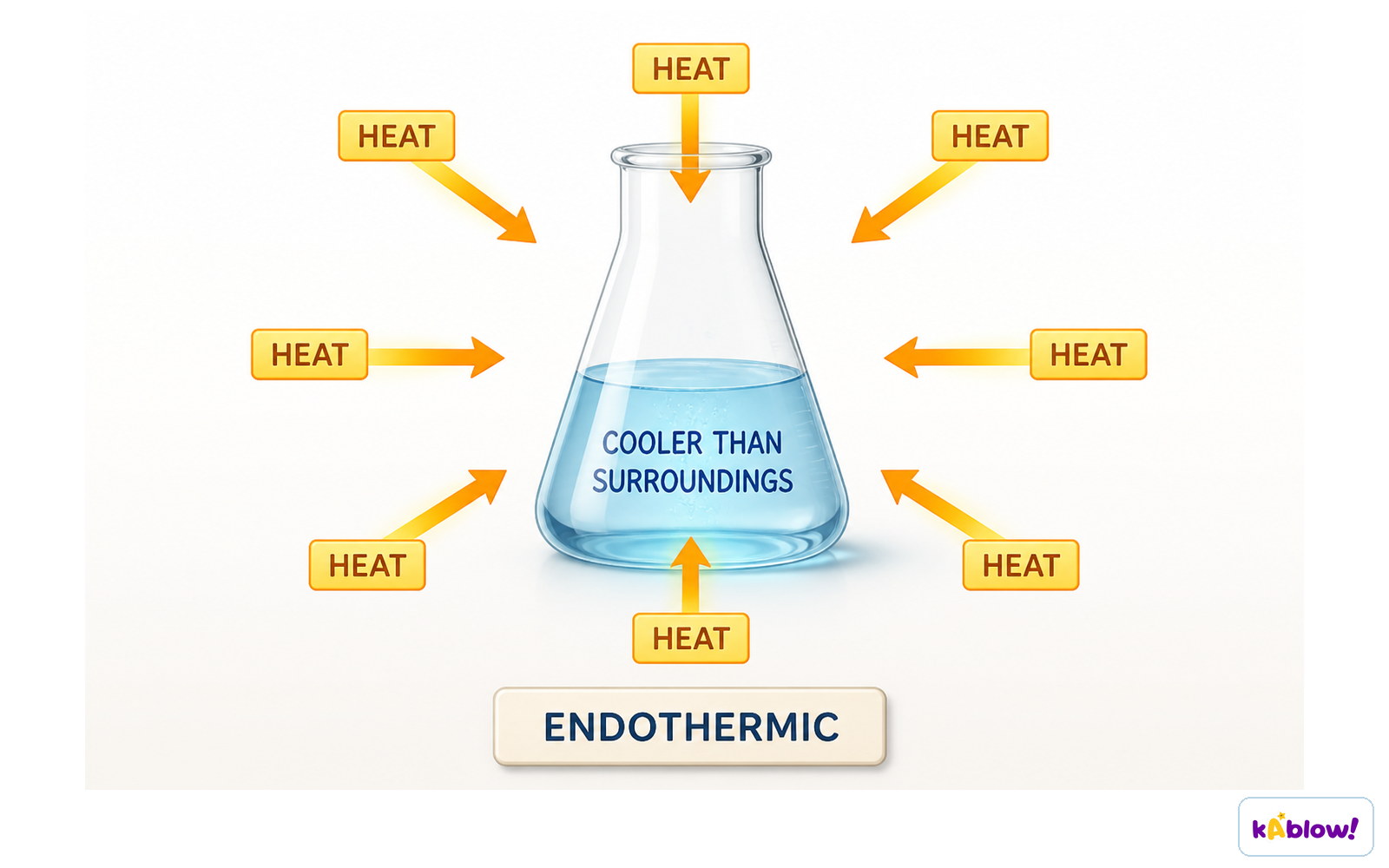
Heat transfer inwards in an endothermic reaction
Exothermic Reactions
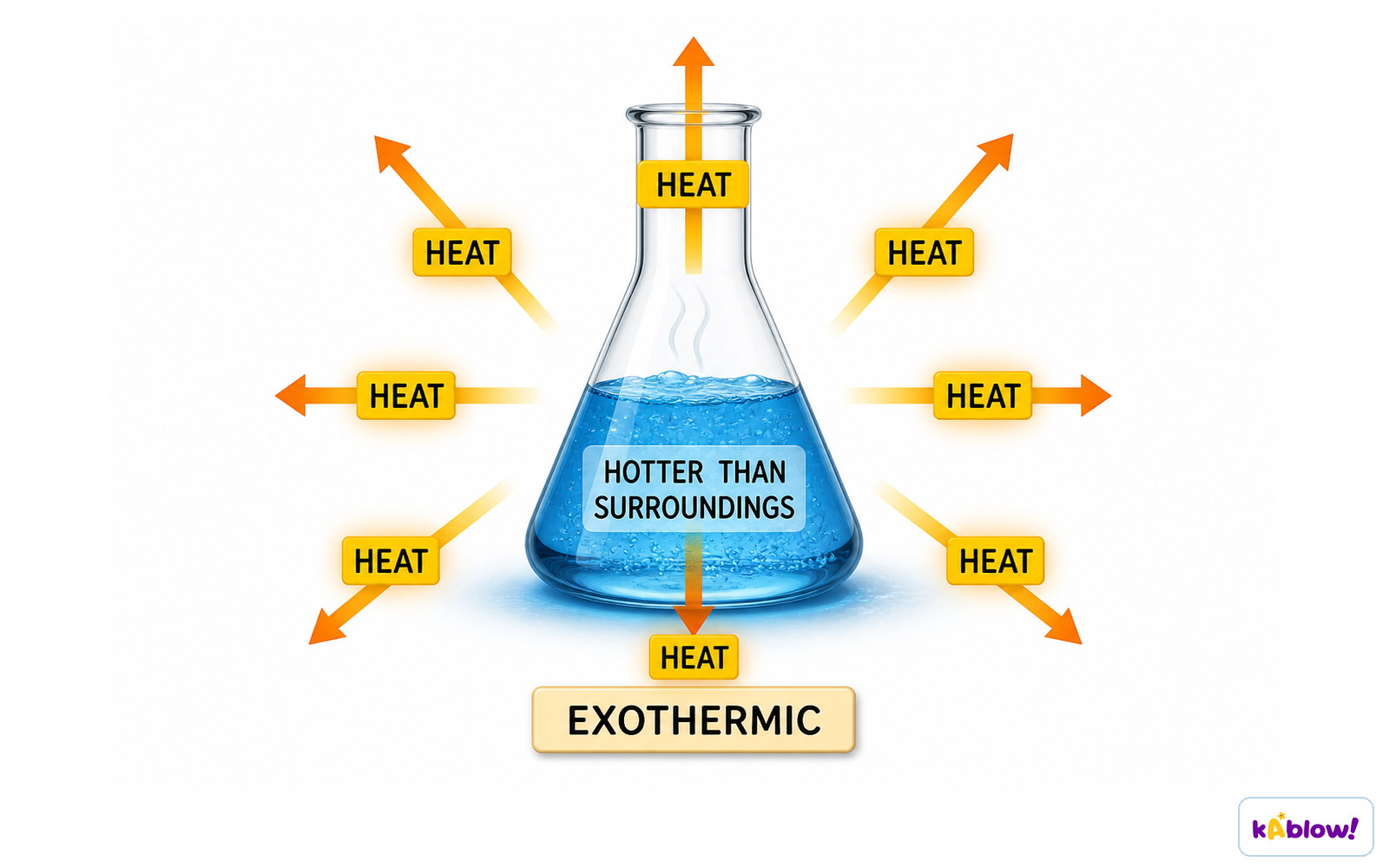
- An exothermic reaction transfers energy to the surroundings, causing the temperature of the surroundings to increase.
- Examples include combustion, neutralisation, and many oxidation reactions.
- Everyday uses include hand warmers and self-heating cans.
- In exothermic reactions, the energy released from forming new bonds is greater than the energy needed to break existing bonds.
Heat transfer outwards in an exothermic reaction
Endothermic Reactions
- An endothermic reaction takes in energy from the surroundings, causing the temperature of the surroundings to decrease.
- Examples include thermal decomposition, electrolysis, the first stages of photosynthesis, and the reaction between citric acid and sodium hydrogencarbonate.
- Sports injury cold packs use endothermic reactions to take heat away from the injured area.
- In endothermic reactions, the energy needed to break existing bonds is greater than the energy released from forming new bonds.
Diagram showing the transfer of heat energy from the surroundings into an endothermic reaction
Required Practical: Investigating Temperature Changes
- Objective: to investigate variables that affect temperature changes in reacting solutions, such as acid plus alkali (neutralisation).
- Use a polystyrene cup (calorimeter) to reduce heat loss, a thermometer, and measuring cylinders.
- Method: measure initial temperature of acid, add alkali in increments, record highest temperature after each addition.
- The temperature rises as more alkali is added, reaches a peak, then falls when one reactant is in excess.
- The peak occurs when neutralisation is complete; further addition dilutes the solution and absorbs heat.
- Plot a graph of volume added (x-axis) against mean temperature (y-axis) and draw two lines of best fit to find the volume at which neutralisation is complete.
Reaction Profiles
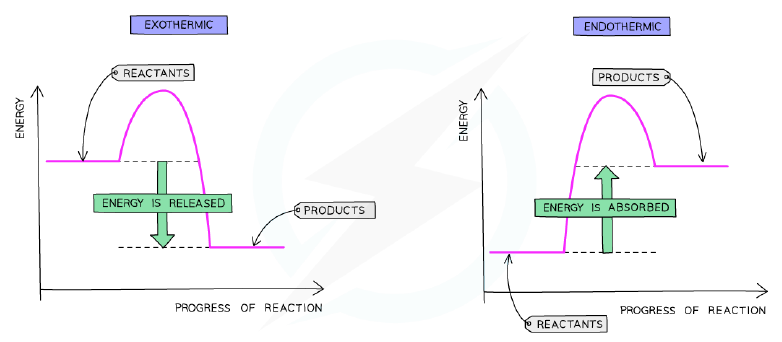
- Reaction profiles (energy level diagrams) show the relative energies of reactants and products.
- The y-axis shows energy; the x-axis shows progress of the reaction.
- The initial rise represents the activation energy (Ea), the minimum energy colliding particles need to react.
- In an exothermic reaction, products have lower energy than reactants; the overall energy change is negative (downward arrow).
- In an endothermic reaction, products have higher energy than reactants; the overall energy change is positive (upward arrow).
- A catalyst lowers the activation energy by providing an alternative pathway, increasing the rate of reaction.
Reaction pathway diagrams for exothermic and endothermic reactions
The Energy Change of Reactions
- Bond breaking is endothermic (energy absorbed); bond making is exothermic (energy released).
- Overall energy change = energy taken in to break bonds – energy given out when new bonds form.
- If more energy is released than absorbed, the reaction is exothermic (negative energy change).
- If more energy is absorbed than released, the reaction is endothermic (positive energy change).
- Bond energies can be used to calculate the overall energy change: add bond energies of reactants (energy in) and products (energy out), then subtract.
슬라이드
연습 문제
무료 미리 보기 — 62개 중 8개 문제. 가입하면 전부 볼 수 있어요.
1.Which statement best describes an exothermic reaction?
Easy- AIt transfers energy to the surroundings so the temperature of the surroundings increases
- BIt takes in energy from the surroundings so the temperature of the surroundings decreases
- CIt transfers energy from the surroundings so the temperature of the surroundings decreases
- DIt produces energy, which is created during the reaction
2.Which statement best describes an endothermic reaction?
Easy- AIt takes in energy from the surroundings so the temperature of the surroundings decreases
- BIt transfers energy to the surroundings so the temperature of the surroundings increases
- CIt releases heat energy so the temperature increases
- DIt destroys energy from the surroundings
3.In an exothermic reaction, the temperature of the surroundings increases.
EasyTrue or false?
4.Bond breaking releases energy to the surroundings.
EasyTrue or false?
5.A reaction is carried out in a test tube. The temperature of the mixture falls from 21 °C to 15 °C. What type of reaction is this?
Medium- AEndothermic, because energy is taken in from the surroundings
- BExothermic, because energy is transferred to the surroundings
- CExothermic, because the temperature decreased
- DEndothermic, because energy is transferred to the surroundings
6.A student adds magnesium to dilute hydrochloric acid. The mixture becomes warm. Which statement is correct?
Medium- AThe reaction is exothermic and energy is transferred to the surroundings
- BThe reaction is endothermic and energy is taken in from the surroundings
- CThe reaction is exothermic and energy is taken in from the surroundings
- DThe reaction is endothermic and energy is transferred to the surroundings
7.Which of the following are examples of exothermic reactions? (select all that apply)
Medium- ACombustion of methane
- BNeutralisation of hydrochloric acid with sodium hydroxide
- CThermal decomposition of calcium carbonate
- DElectrolysis of water
- EOxidation of magnesium
8.Which of the following are examples of endothermic reactions? (select all that apply)
Medium- AThermal decomposition of calcium carbonate
- BElectrolysis of water
- CCombustion of ethanol
- DReaction of citric acid with sodium hydrogencarbonate
- ENeutralisation of an acid with an alkali
기출 문제
이 주제의 기출 문제 연습이 곧 나와요.
곧 출시