Purity, formulations and chromatography
플레이하며 배우기
이 문제들을 풀어 에너지를 얻은 뒤 낚시하고 탐험하세요. 계정이 필요 없어요.
수업 노트
Pure Substances in Chemistry
- In chemistry, a pure substance is a single element or compound that contains no other substances.
- For example, pure water contains only H₂O molecules and nothing else.
- In everyday language, 'pure' means a substance that is natural or clean and has had nothing added to it, such as pure milk.
- A mixture consists of two or more elements or compounds that are physically mixed together, not chemically combined.
- The chemical properties of substances in a mixture remain unchanged, and they can be separated by physical means.
- Air is a mixture of nitrogen, oxygen, and small amounts of other gases such as carbon dioxide and argon.
Distinguishing Purity Using Melting and Boiling Points
- Pure substances melt and boil at specific and sharp temperatures; for example, pure water boils at 100 °C and melts at 0 °C.
- Impure substances have a range of melting and boiling points because they contain different substances.
- Compared to pure substances, impurities lower the melting point and raise the boiling point.
- Melting and boiling point data can be used to distinguish pure substances from mixtures.
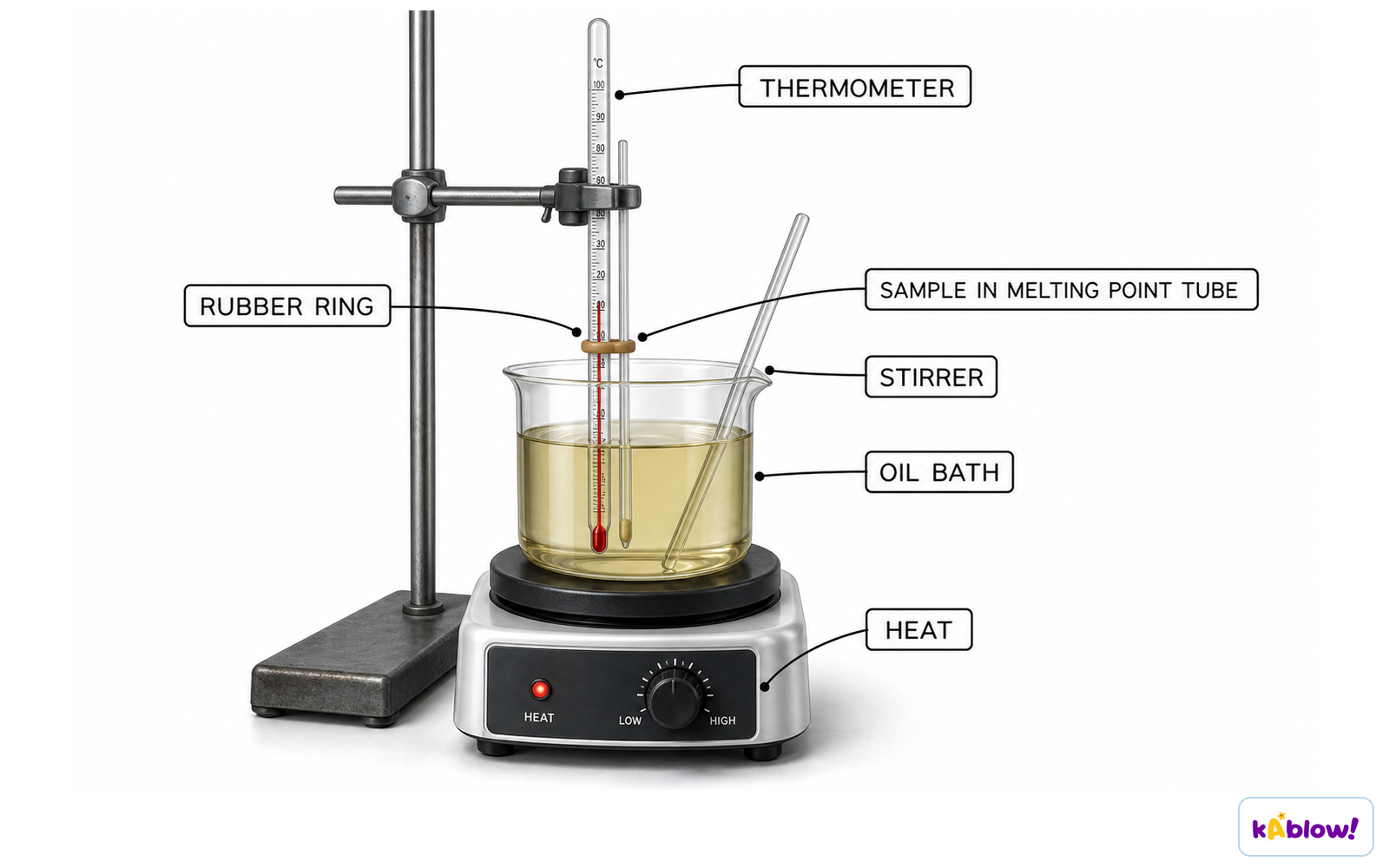
- Melting point analysis is routinely used to assess the purity of drugs using a melting point apparatus, and the result is compared to data tables.
- The closer the measured melting or boiling point is to the actual value, the purer the sample.
Melting point apparatus
Cooling Curves and Purity
- A cooling curve shows how the temperature of a liquid changes as it cools and freezes.
- A pure substance produces a cooling curve with a horizontal section at the melting point, indicating a sharp melting point.
- An impure substance produces a gradual decrease in temperature as it freezes, with no flat plateau.
- The shape of the cooling curve can therefore be used to determine whether a substance is pure or impure.
Formulations
- A formulation is a mixture that has been designed as a useful product.
- Formulations are made by mixing components in carefully measured quantities to ensure the product has the required properties.
- Each component in a formulation has a particular purpose.
- Examples of formulations include fuels, cleaning agents, paints, medicines, alloys, fertilisers, and foods.
- Paint is a formulation containing pigment (gives colour), binder (holds pigment), and solvent (dissolves components and alters viscosity).
- Formulations are important in the pharmaceutical industry, where exact ratios ensure the drug is delivered safely and effectively.
- Formulations are not compounds because the components are not chemically combined.
Chromatography: Separating Mixtures
- Chromatography is used to separate substances and provide information to help identify them.
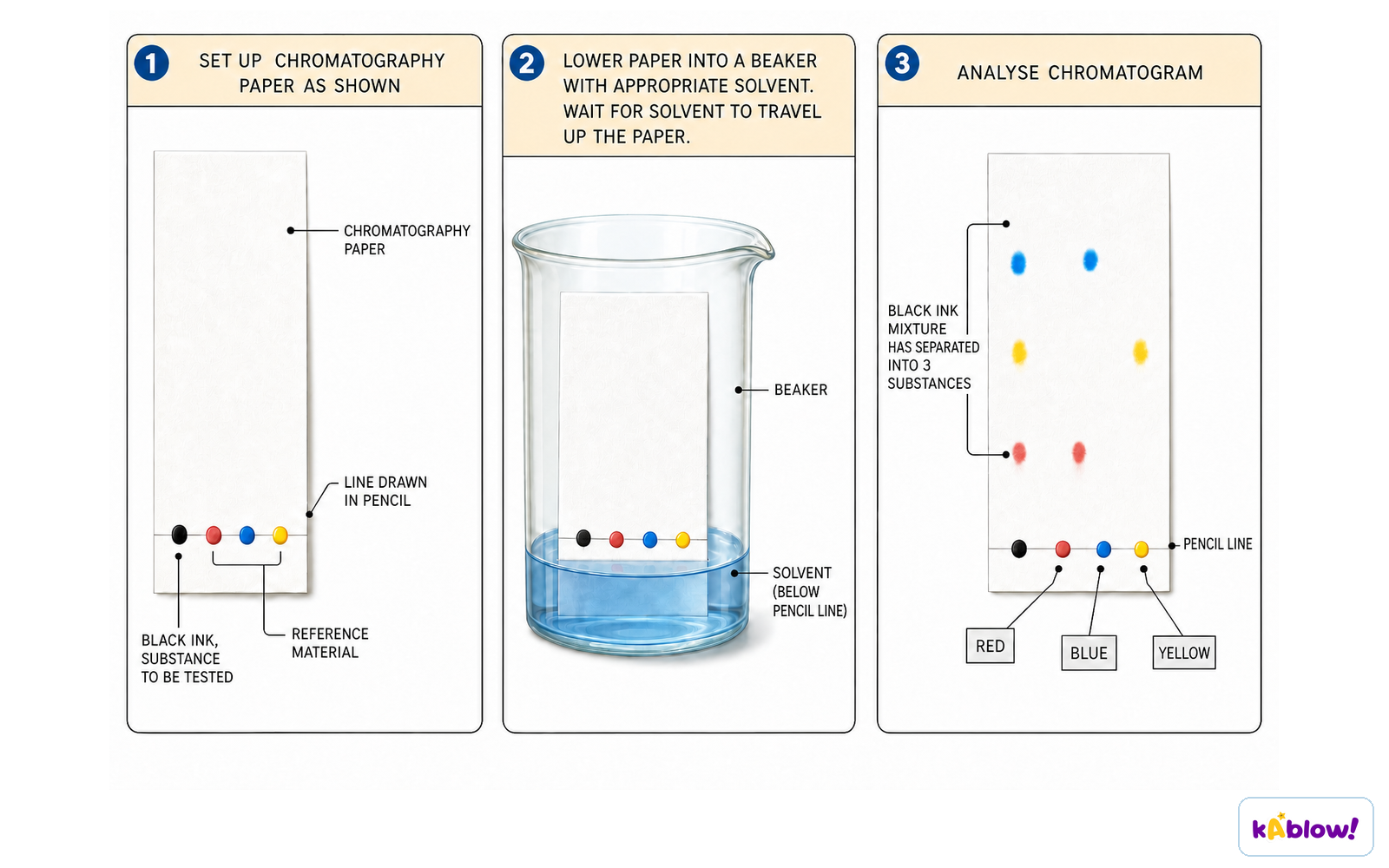
- It involves a stationary phase (the chromatography paper) and a mobile phase (the solvent).
- Separation depends on the distribution of substances between the two phases.
- Substances with higher solubility in the solvent travel further up the paper because they spend more time in the mobile phase.
- A pencil line is drawn on the chromatography paper because ink would run into the chromatogram.
- The pencil line must be above the level of the solvent so the samples do not wash into the solvent container.
- The solvent travels up the paper by capillary action, carrying the substances with it.
Setting up and running paper chromatography
Interpreting Chromatograms and Rf Values
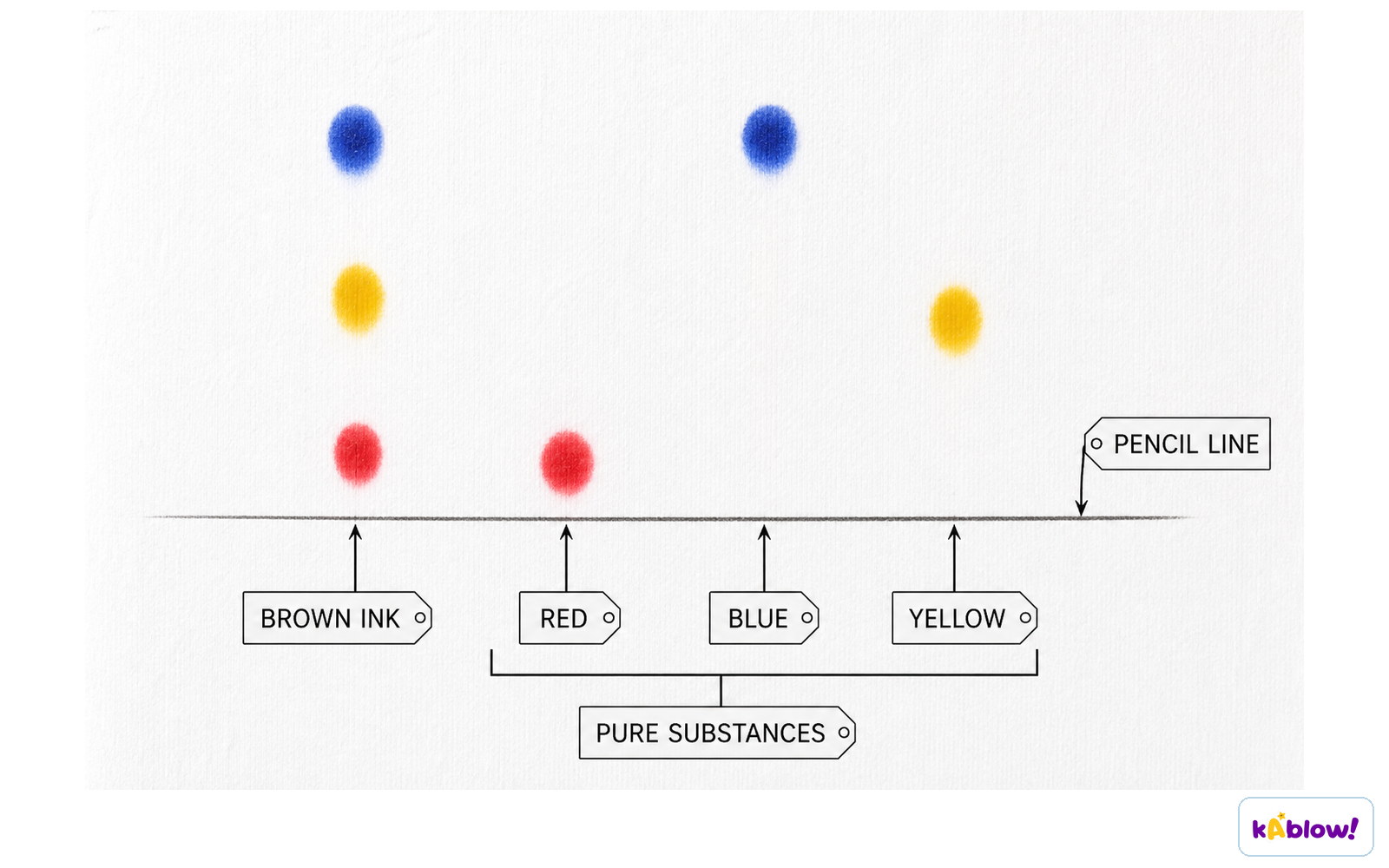
- A pure substance produces only one spot on a chromatogram.
- An impure substance (mixture) produces more than one spot as the components separate.
- If two or more substances are the same, they produce identical chromatograms.
- The Rf value (retention factor) is calculated using: Rf = distance moved by substance ÷ distance moved by solvent.
- Both distances are measured from the baseline (the pencil start line).
- The Rf value is a ratio with no units and always lies between 0 and 1; the closer to 1, the more soluble the substance.
- The Rf value of a compound is always the same under the same conditions but changes if the solvent is changed.
- Rf values can be compared with reference values to identify unknown substances.
Example chromatogram of a mixture
Required Practical: Investigating Chromatography
- The aim is to investigate how paper chromatography can separate and identify a mixture of food colourings.
- A horizontal pencil line is drawn 2 cm from the end of the chromatography paper.
- Small spots of known colourings (A–D) and an unknown mixture (U) are placed on the line using capillary tubes.
- The paper is lowered into water so the pencil line is above the solvent level.
- The solvent is allowed to travel at least three quarters of the way up the paper, then the paper is removed and the solvent front is marked.
- The distance travelled by the solvent and by each spot is measured, and Rf values are calculated.
- The Rf values of the unknown mixture are compared with those of known substances to identify its components.
Key Practical Points and Safety
- The pencil line must never be below the level of the solvent, or the samples will be washed away.
- The initial line must be drawn in pencil because ink would smudge or run in the solvent.
- Solvents used in chromatography (e.g., ethanol, propanone) are often flammable and harmful to health.
- Keep solvents away from naked flames and avoid contact with skin or breathing in vapours.
- A fume cupboard can be used for harmful solvents.
슬라이드
연습 문제
무료 미리 보기 — 61개 중 8개 문제. 가입하면 전부 볼 수 있어요.
1.In chemistry, which of the following is the definition of a pure substance?
Easy- AA single element or compound that contains no other substances
- BA substance that has had nothing added to it
- CA useful product made by mixing substances
- DA substance made from only one type of atom
2.Which of the following are examples of pure substances in chemistry terms? (Select all that apply)
Medium- APure water
- BPure orange juice
- CPure carbon dioxide
- DPure air
- EPure milk
3.Which statement describes the melting and boiling points of a pure substance?
Medium- AIt has a sharp melting point and a sharp boiling point
- BIt has a range of melting and boiling points
- CIt has a lower melting point and a higher boiling point than an impure sample
- DIt has no fixed melting or boiling point
4.Which of the following are examples of formulations? (Select all that apply)
Medium- AFertilisers
- BAspirin tablets
- CPure water
- DFuels
- EPure carbon dioxide
5.In paper chromatography, what is the stationary phase?
Medium- AThe chromatography paper
- BThe solvent
- CThe dye mixture
- DThe solvent front
6.A student sets up paper chromatography but makes two mistakes. Which two of the following are mistakes? (Select all that apply)
Medium- AThe solvent used is water but the dyes are soluble in propanone, not water
- BThe start line is drawn in ink
- CA lid is placed on the beaker
- DThe dyes are all on the same piece of chromatography paper
- EThe water is not level with the dyes
7.What would the Rf value of the blue dye be if the blue dye is not soluble in the solvent?
Medium- A0
- B1.0
- CGreater than the Rf value of the yellow dye
- DThere is not enough information to determine the Rf value
8.Green ink is made up of 25% blue ink and 75% green ink. Which word correctly describes the green ink?
Medium- AFormulation
- BElement
- CCompound
- DMobile phase