Reactions of acids
플레이하며 배우기
이 문제들을 풀어 에너지를 얻은 뒤 낚시하고 탐험하세요. 계정이 필요 없어요.
교육자를 위해: Reactions of acids(Science, Chemistry)을(를) 위한 바로 쓸 수 있는 수업 슬라이드, 복습 노트 — 수업에 사용하거나, 학습자들이 실시간 게임으로 즐기는 인터랙티브 클래스 활동으로 진행하세요.
수업 노트
Reactions of Acids with Metals
- Acids react with some metals to produce a salt and hydrogen gas.
- General equation: metal + acid → salt + hydrogen.
- Only metals above hydrogen in the reactivity series react with dilute acids; copper does not react.
- The more reactive the metal, the more vigorous the reaction; potassium and sodium react explosively.
- The salt produced depends on the acid: hydrochloric acid gives chlorides, sulfuric acid gives sulfates.
- Example: Mg (s) + 2HCl (aq) → MgCl₂ (aq) + H₂ (g).
- Test for hydrogen: a lit splint gives a squeaky pop.
Metal-Acid Reactions as Redox (Higher Tier)
- Metal-acid reactions are redox reactions: reduction and oxidation occur together.
- Oxidation is loss of electrons; reduction is gain of electrons.
- In the reaction Zn + 2HCl → ZnCl₂ + H₂, the ionic equation is Zn + 2H⁺ → Zn²⁺ + H₂.
- Oxidation half-equation: Zn → Zn²⁺ + 2e⁻ (zinc is oxidised).
- Reduction half-equation: 2H⁺ + 2e⁻ → H₂ (hydrogen ions are reduced).
- Metal atoms tend to lose electrons and are usually the species oxidised.
Neutralisation and Salt Production
- A base neutralises an acid; examples include metal oxides, hydroxides and carbonates.
- An alkali is a soluble base; all alkalis are bases, but not all bases are alkalis.
- General neutralisation: acid + base → salt + water.
- With a metal carbonate: acid + carbonate → salt + water + carbon dioxide.
- The salt name has two parts: the metal (from the base) and the acid ending (chloride, sulfate, nitrate).
- Hydrochloric acid → chlorides; sulfuric acid → sulfates; nitric acid → nitrates.
- Example: 2HCl + CuO → CuCl₂ + H₂O.
- Test for carbon dioxide: bubble through limewater; it turns milky/cloudy.
Soluble Salts and Their Preparation
- Soluble salts can be made by reacting an acid with an insoluble base (metal, oxide, hydroxide or carbonate).
- The solid is added in excess to ensure all the acid reacts; otherwise unreacted acid would become dangerously concentrated during evaporation.
- The excess solid is removed by filtration, leaving a solution of salt and water.
- The solution is heated to evaporate water until small crystals begin to appear (about half the water removed).
- Slow evaporation over days gives larger crystals.
- Example: CuO (s) + H₂SO₄ (aq) → CuSO₄ (aq) + H₂O (l).
- Acids can also react with metals if the metal is above hydrogen but not too reactive.
Required Practical: Preparation of a Soluble Salt
- Aim: prepare a pure, dry sample of a soluble salt from an insoluble oxide or carbonate.
- Add dilute acid to a beaker and warm gently.
- Add the insoluble oxide slowly until it is in excess (no more dissolves).
- Filter to remove excess solid, collecting the filtrate in an evaporating basin.
- Heat gently (water bath or electric heater) to evaporate water and make the solution saturated.
- Test saturation by dipping a cold glass rod; crystals form on it.
- Leave to crystallise, then decant excess solution and dry the crystals.
- Expected result: bright blue, regularly shaped hydrated copper(II) sulfate crystals.
The pH Scale and Neutralisation
- Acids produce hydrogen ions (H⁺) in aqueous solution; alkalis produce hydroxide ions (OH⁻).
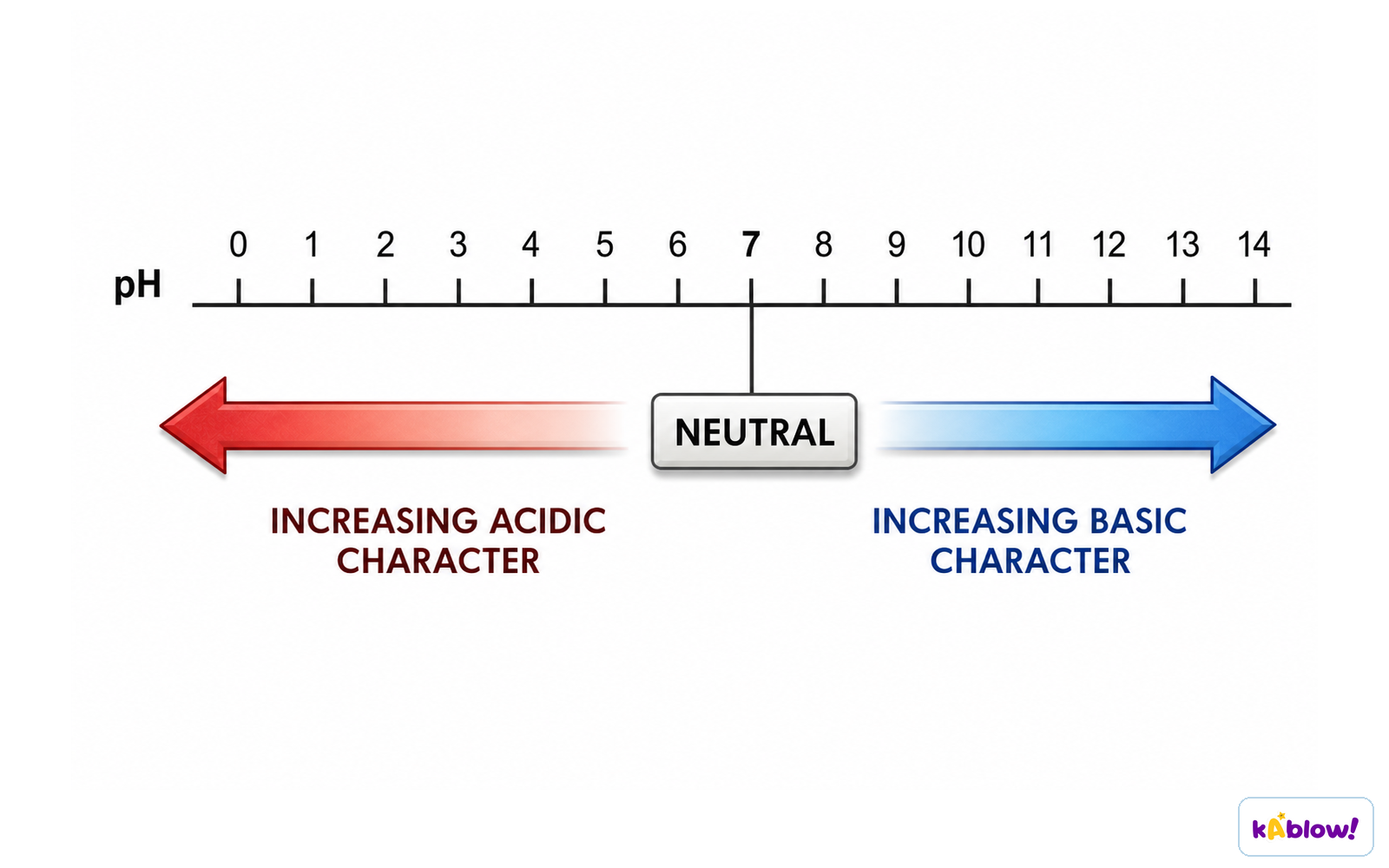
- The pH scale runs from 0 to 14; pH 7 is neutral.
- Acids have pH below 7; alkalis have pH above 7.
- pH 1–3 = strong acid; pH 4–6 = weak acid; pH 8–11 = weak alkali; pH 12–14 = strong alkali.
- pH can be measured with universal indicator (approximate) or a pH probe (more accurate).
- Neutralisation: H⁺ (aq) + OH⁻ (aq) → H₂O (l).
- Not all acid reactions are neutralisations: metal + acid produces a salt but no water.
The pH scale
Strong and Weak Acids
- Strong acids are completely ionised in water, giving a high concentration of H⁺ and low pH (1–3).
- Examples of strong acids: hydrochloric, nitric and sulfuric acids.
- Weak acids are only partially ionised in water, giving a lower concentration of H⁺ and pH 4–6.
- Examples of weak acids: ethanoic, citric and carbonic acids.
- Weak acids set up an equilibrium, e.g. CH₃CH₂COOH ⇌ H⁺ + CH₃CH₂COO⁻; the equilibrium lies to the left.
- Concentration (dilute/concentrated) is different from strength (strong/weak).
- A dilute strong acid can have a lower pH than a concentrated weak acid.
- pH is logarithmic: a change of 1 unit means a tenfold change in H⁺ concentration.
Titrations
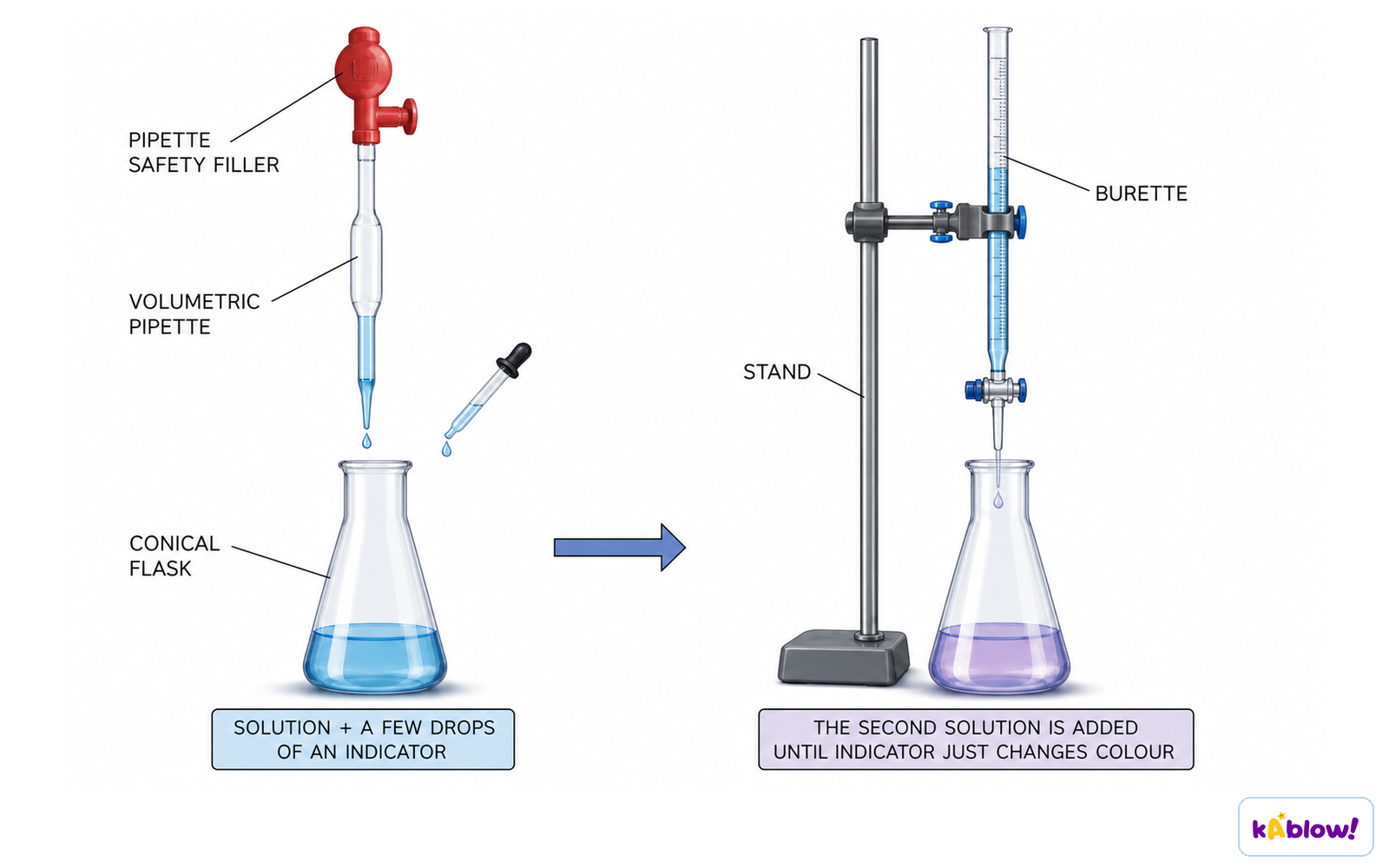
- Titrations measure the volume of one solution that reacts exactly with a known volume of another.
- Acid-base titrations can determine the concentration of an acid or alkali.
- A pipette measures a fixed volume (e.g. 25.0 cm³) of one solution into a conical flask.
- A burette delivers the other solution; the volume used is the titre.
- A suitable indicator (e.g. phenolphthalein or methyl orange) shows the end-point by a sharp colour change.
- Universal indicator is not suitable for titrations because its colour change is not sharp.
- Concordant results are within 0.1 cm³ of each other; only these are used to calculate the mean titre.
Titration apparatus set-up
Required Practical: Strong Acid & Strong Alkali Titration
- Aim: determine the reacting volumes of a strong acid and a strong alkali by titration.
- Use a pipette to place exactly 25.0 cm³ of alkali into a conical flask.
- Add a few drops of a suitable indicator (e.g. phenolphthalein).
- Perform a rough titration, then repeat accurately, adding dropwise near the end-point.
- Record the volume to the nearest 0.05 cm³, reading the bottom of the meniscus at eye level.
- Repeat until two concordant results are obtained.
- Calculate the mean titre, ignoring anomalous results.
Titration Calculations (Higher Tier)
- Use the relationship: moles = concentration × volume (in dm³).
- Convert cm³ to dm³ by dividing by 1000.
- Use the balanced equation to find the mole ratio between acid and alkali.
- Calculate moles of the known solution, then use the ratio to find moles of the unknown.
- Concentration = moles ÷ volume (in dm³).
- Example: 25.00 cm³ of 0.15 mol/dm³ Ba(OH)₂ neutralises 12.80 cm³ HNO₃; moles Ba(OH)₂ = 0.15 × 0.025 = 3.75 × 10⁻³ mol; moles HNO₃ = 7.5 × 10⁻³ mol; concentration = 7.5 × 10⁻³ ÷ 0.0128 = 0.59 mol/dm³.
슬라이드
연습 문제
무료 미리 보기 — 57개 중 8개 문제. 가입하면 전부 볼 수 있어요.
1.Which ion is present in aqueous solutions of all acids?
Easy- AHydroxide ion, OH⁻
- BHydrogen ion, H⁺
- CChloride ion, Cl⁻
- DHydroxide ion, OH⁺
2.Which ions make a solution alkaline?
Easy- AHydrogen ions, H⁺
- BHydroxide ions, OH⁻
- COxide ions, O²⁻
- DHydroxide ions, OH⁺
3.All alkalis are bases, but not all bases are alkalis.
EasyTrue or false?
4.Which acid should be used to produce magnesium sulfate from magnesium?
Easy- AHydrochloric acid
- BNitric acid
- CSulfuric acid
- DEthanoic acid
5.Which salt is formed when zinc carbonate reacts with nitric acid?
Easy- AZinc
- BZinc chloride
- CZinc nitrate
- DZinc oxide
6.Which of the following statements about neutralisation reactions are correct? (select all that apply)
Medium- ANeutralisation always produces water.
- BThe reaction between an acid and a metal is a neutralisation reaction.
- CAcid + base → salt + water is the general equation for neutralisation.
- DWhen the base is a metal carbonate, carbon dioxide is also produced.
- ENeutralisation always produces hydrogen gas.
7.Match each acid to the type of salt it produces.
Medium- Hydrochloric acid
- Sulfuric acid
- Nitric acid
- Chlorides
- Sulfates
- Nitrates
8.Which statement correctly describes a strong acid?
Medium- AIt is completely ionised in aqueous solution.
- BIt is partially ionised in aqueous solution.
- CIt always has a high concentration.
- DIt always contains a high number of acid molecules per dm³.
기출 문제
이 주제의 기출 문제 연습이 곧 나와요.
곧 출시