Structure and bonding of carbon
플레이하며 배우기
이 문제들을 풀어 에너지를 얻은 뒤 낚시하고 탐험하세요. 계정이 필요 없어요.
교육자를 위해: Structure and bonding of carbon(Science, Chemistry)을(를) 위한 바로 쓸 수 있는 수업 슬라이드, 복습 노트 — 수업에 사용하거나, 학습자들이 실시간 게임으로 즐기는 인터랙티브 클래스 활동으로 진행하세요.
수업 노트
Diamond: Structure and Bonding
- Diamond and graphite are allotropes of carbon: both contain only carbon atoms but have different bonding arrangements, making them physically completely different.
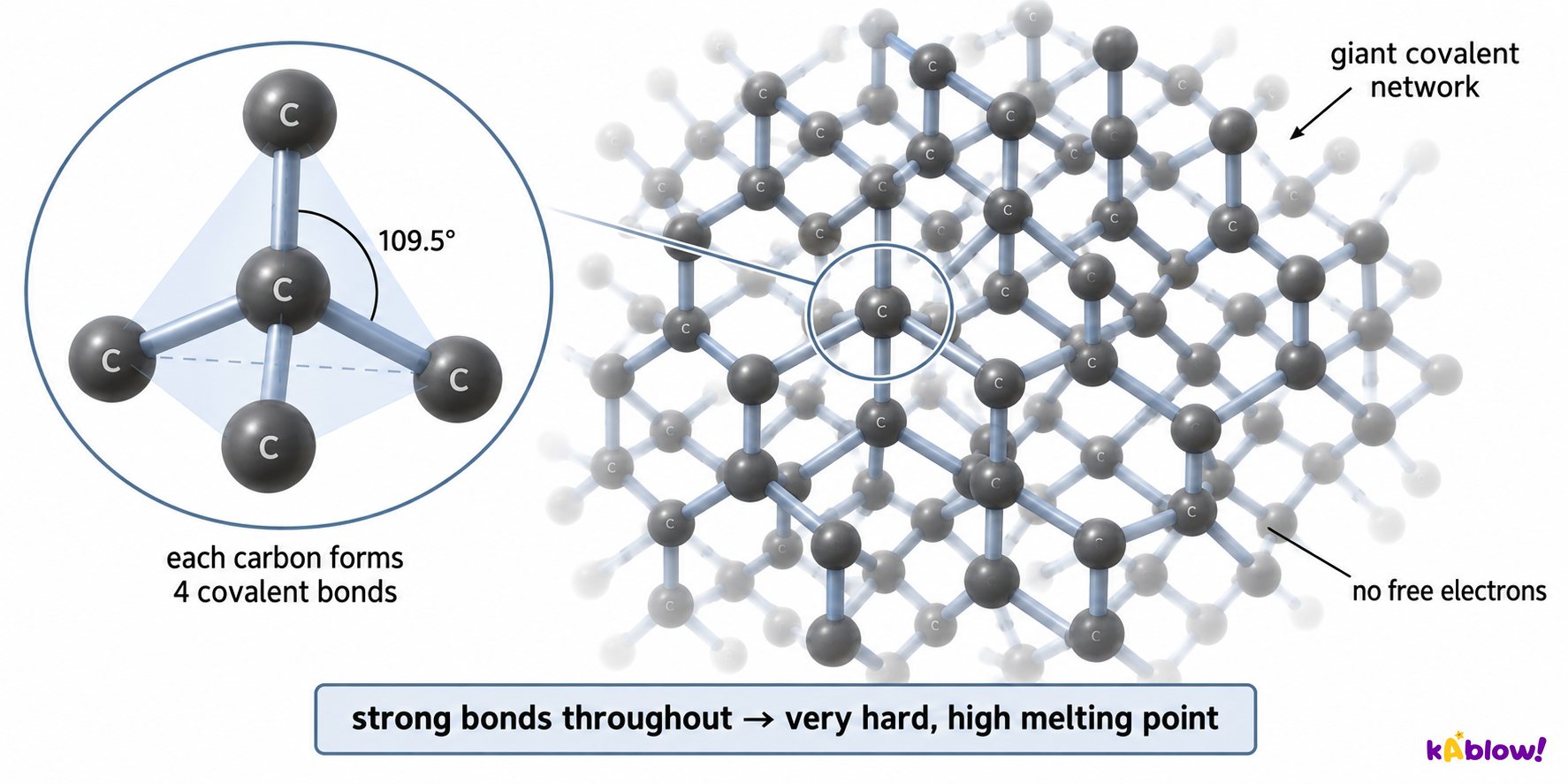
- In diamond, each carbon atom forms four covalent bonds with four other carbon atoms, creating a giant covalent tetrahedral structure.
- All the covalent bonds in diamond are identical, very strong, and there are no intermolecular forces between separate molecules.
- All outer shell electrons of each carbon atom are held in the four covalent bonds, so there are no freely moving particles to carry charge.
- Diamond has a very high melting point because its giant covalent structure has strong covalent bonds that need lots of energy to break.
- Diamond is extremely hard and dense due to its strong covalent bonds and each carbon atom being bonded to four others.
- Diamond's hardness makes it useful in cutting tools like drills; it is the hardest naturally occurring mineral but is brittle and can be smashed with a hammer.
Diamond's giant covalent network
Graphite: Structure and Bonding
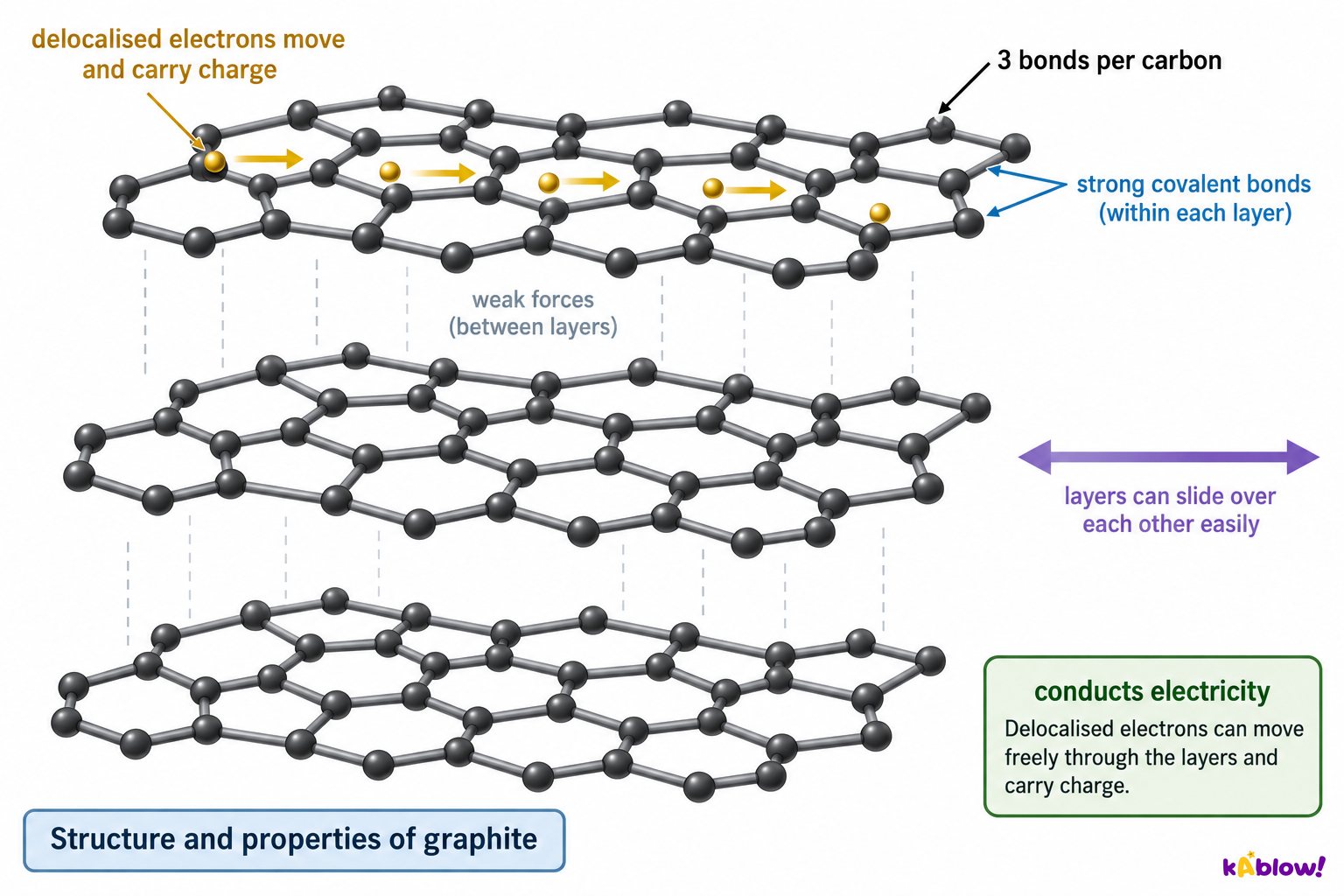
- In graphite, each carbon atom forms three covalent bonds with three other carbon atoms, forming layers of hexagonal rings.
- One electron per carbon atom is delocalised (free to move) and exists between the layers, allowing graphite to conduct electricity.
- The covalent bonds within the layers are very strong, but the layers are held together by weak intermolecular forces, so they can slide over each other.
- Graphite is soft and slippery because its layers can slide over each other, making it useful as a lubricant and in pencils.
- Graphite has a high melting point because it has a giant covalent structure with strong covalent bonds needing lots of energy to break.
- Graphite can be used to make inert electrodes for electrolysis, important in the extraction of metals such as aluminium.
- Graphite is similar to metals in that it has delocalised electrons; it does not conduct because of free ions.
Graphite layers and delocalised electrons
Graphene: Structure and Properties
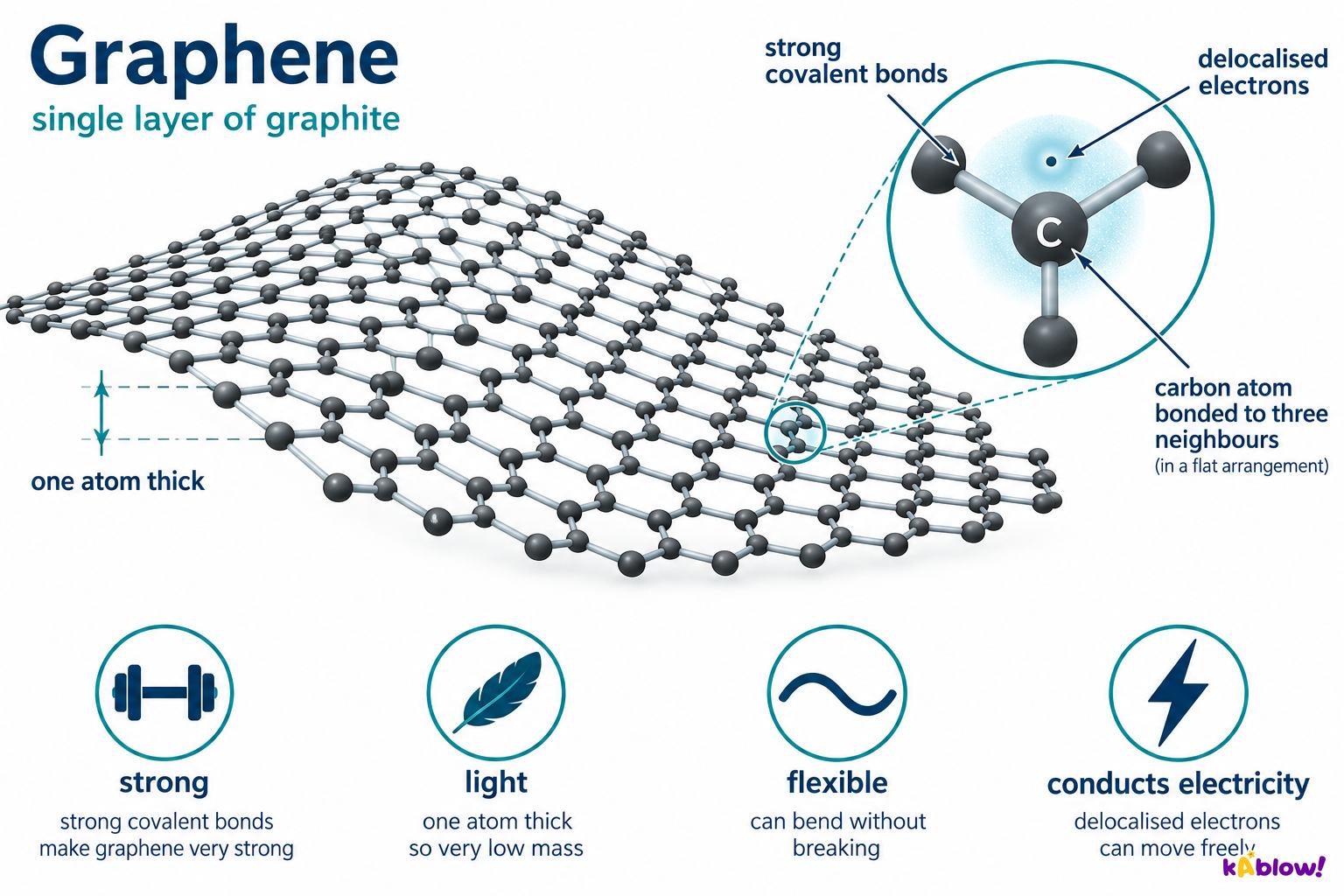
- Graphene is a single layer of graphite, just one atom thick, consisting of a sheet of carbon atoms covalently bonded in a continuous hexagonal layer.
- It is essentially a 2D molecule and has very unusual properties that make it useful in composites and electronics.
- Graphene is extremely strong due to its unbroken pattern and strong covalent bonds between carbon atoms; even stitched patches remain the strongest material.
- It is also amazingly light, transparent (absorbs 2.3% of visible light), and flexible—it can be twisted, pulled and curved without breaking.
- Graphene conducts heat and electricity because it has delocalised electrons that can move along its surface; it moves electrons 200 times faster than silicon.
- Its transparency gives it potential for making computer screens of the future.
Graphene: one carbon layer
Fullerenes: Structure and Uses
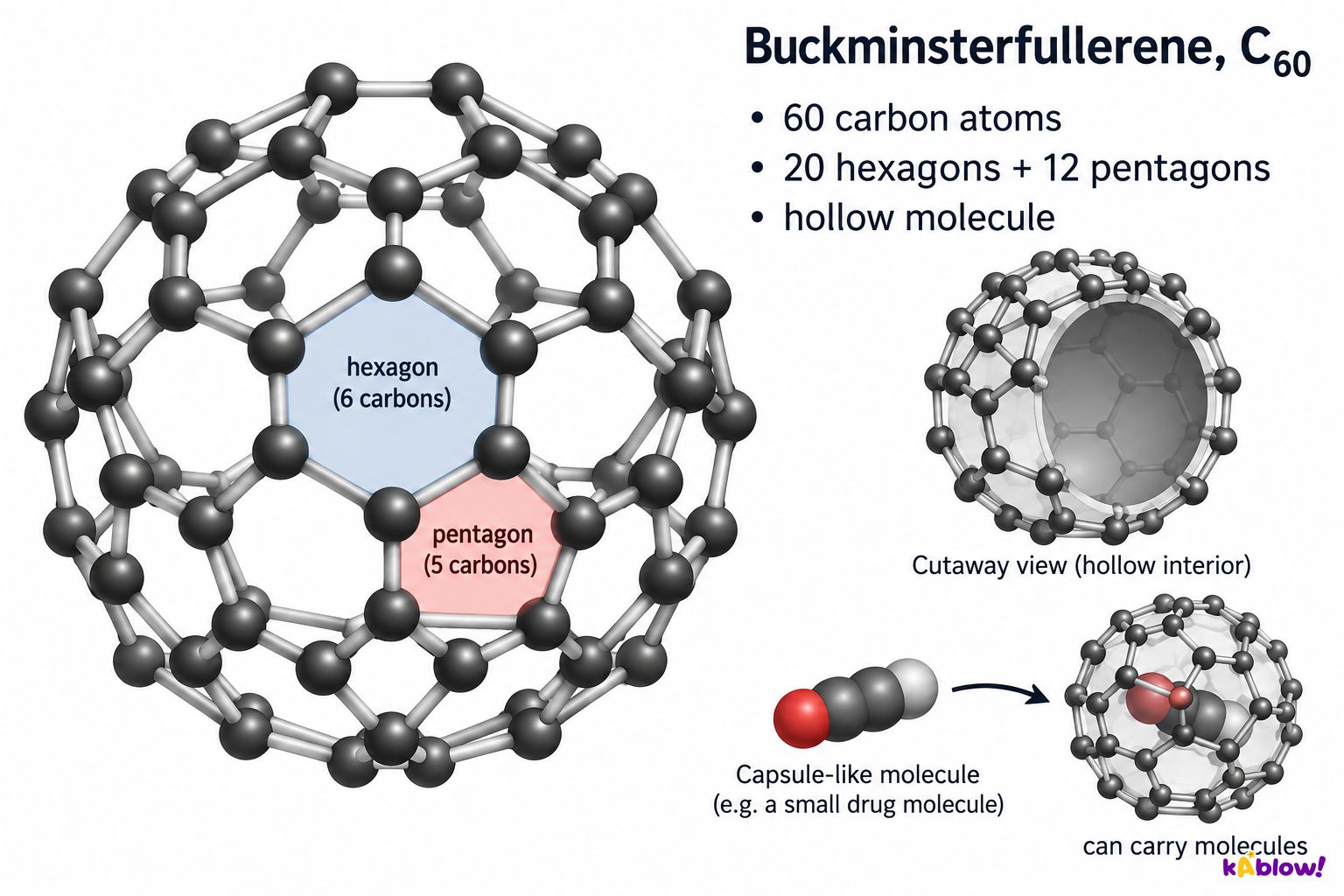
- Fullerenes are carbon allotropes consisting of molecules with hollow tubes or spheres.
- Their structures are based on interlocking hexagonal rings, but may also contain rings of five or seven carbon atoms.
- Fullerenes can trap other molecules by forming around them, making them useful for targeted drug delivery systems.
- They have a huge surface area, useful for trapping catalyst molecules so catalysis can take place.
- Some fullerenes are excellent lubricants and are used in industrial processes.
- The first fullerene discovered was Buckminsterfullerene (C60), a hollow sphere of 60 carbon atoms forming 20 hexagons and 12 pentagons, shaped like a football.
- Buckminsterfullerene was discovered as a component of soot and its discovery won the 1996 Nobel Prize in Chemistry.
Buckminsterfullerene C60
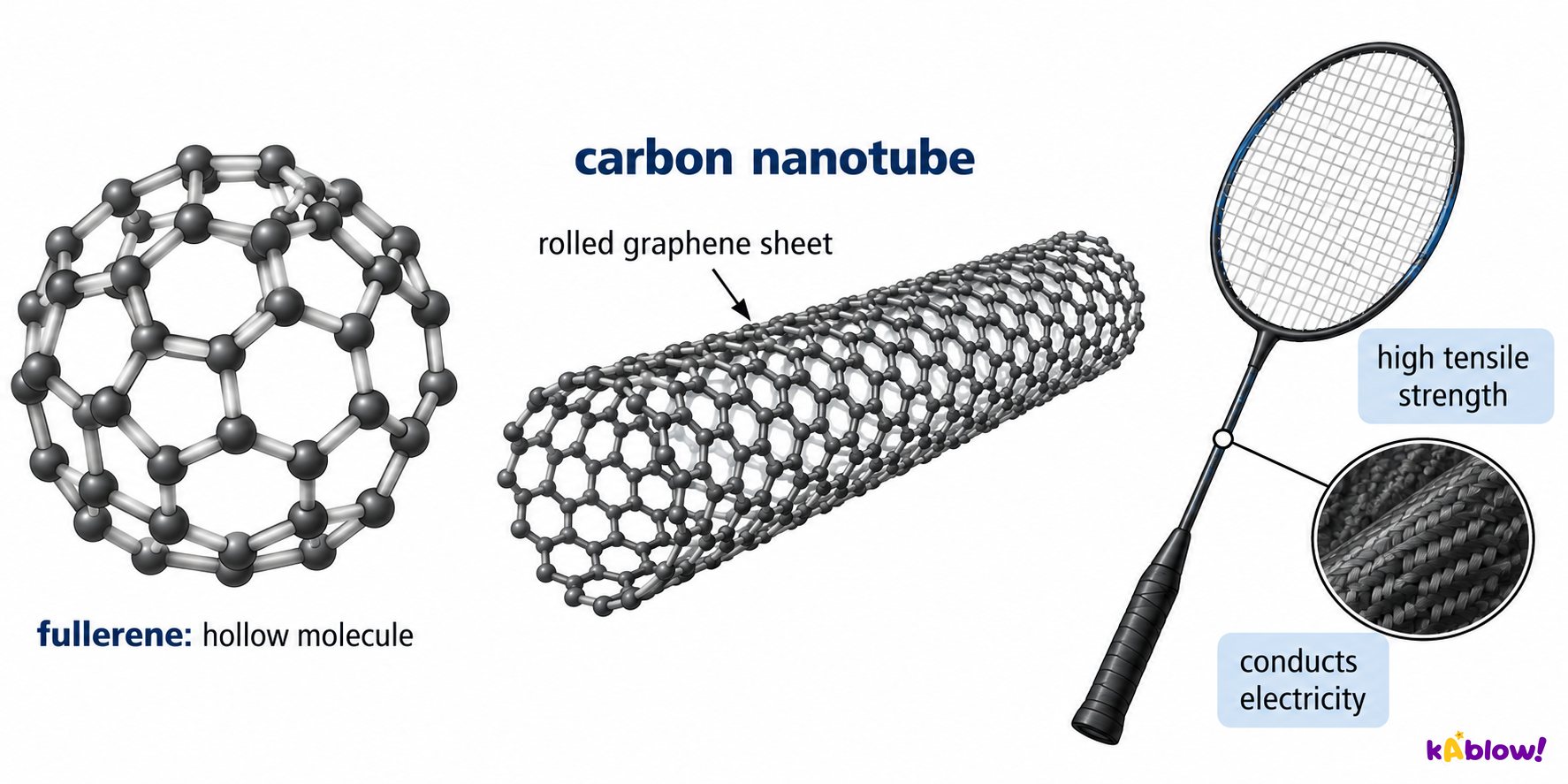
Carbon Nanotubes
- Carbon nanotubes are cylindrical fullerenes made by rolling a sheet of graphene into a cylinder.
- They have very high length to diameter ratios and high tensile strength, resisting breaking or stretching.
- Like graphene, nanotubes can conduct electricity, making them useful in composites, specialised materials, electronics and nanotechnology.
- Their properties make them useful for nanotechnology, electronics and materials.
Carbon nanotubes
Comparing Diamond, Graphite and Graphene
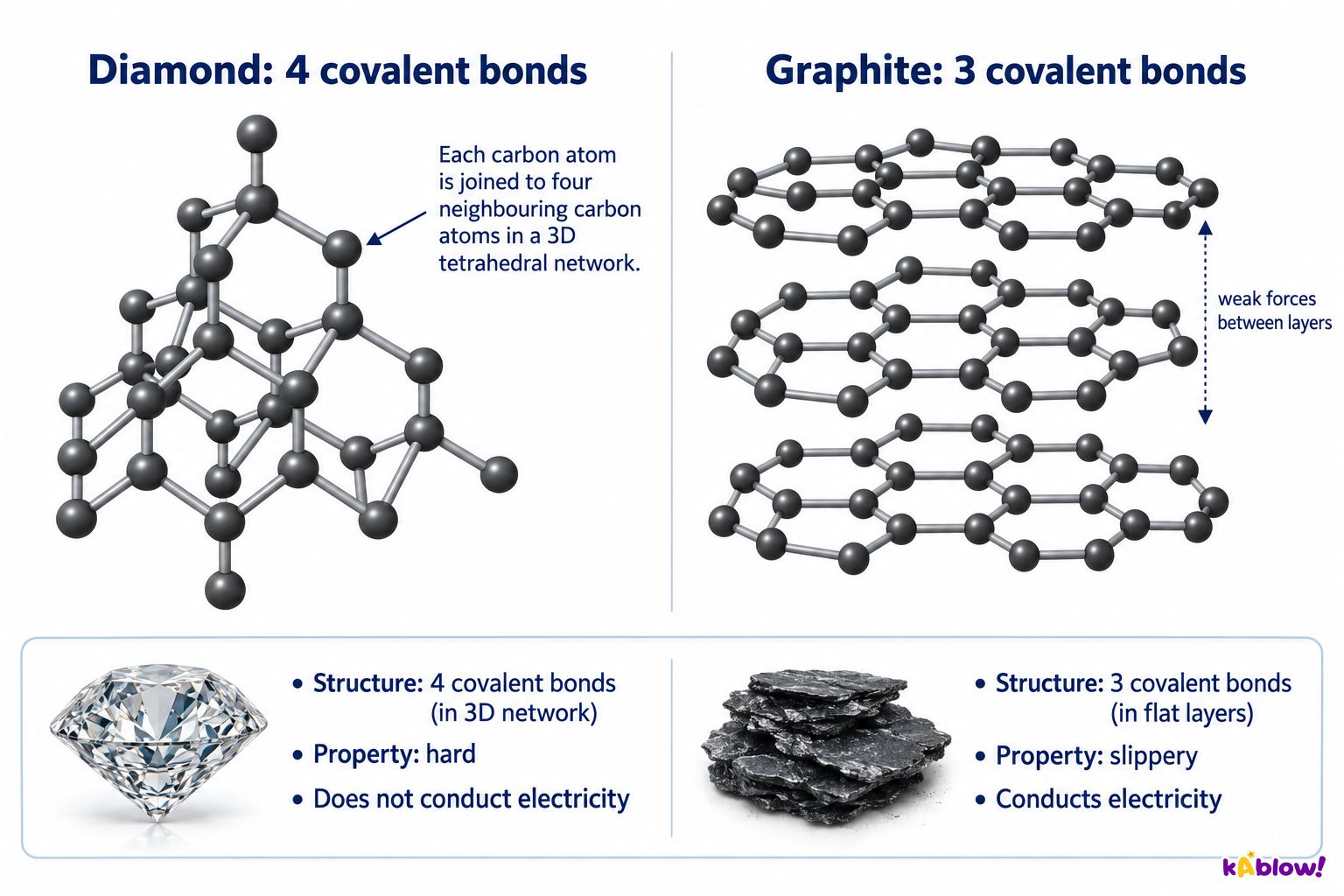
- Diamond is hard and does not conduct; graphite is soft, slippery and conducts; graphene is a single layer of graphite that is strong, flexible and conducts.
- Diamond has a giant covalent structure with each carbon bonded to four others; graphite has layers with each carbon bonded to three others.
- Graphite conducts because of delocalised electrons between layers; diamond does not because all outer electrons are held in covalent bonds.
- Graphite is soft because its layers slide over each other (weak intermolecular forces); diamond is hard because its rigid covalent network prevents movement.
- Graphene is similar to graphite in that it is a layer of hexagonal carbon rings, but different because it is only one atom thick.
- Both diamond and graphite have high melting points due to strong covalent bonds needing lots of energy to break.
Carbon allotropes: diamond and graphite
Common Misconceptions to Avoid
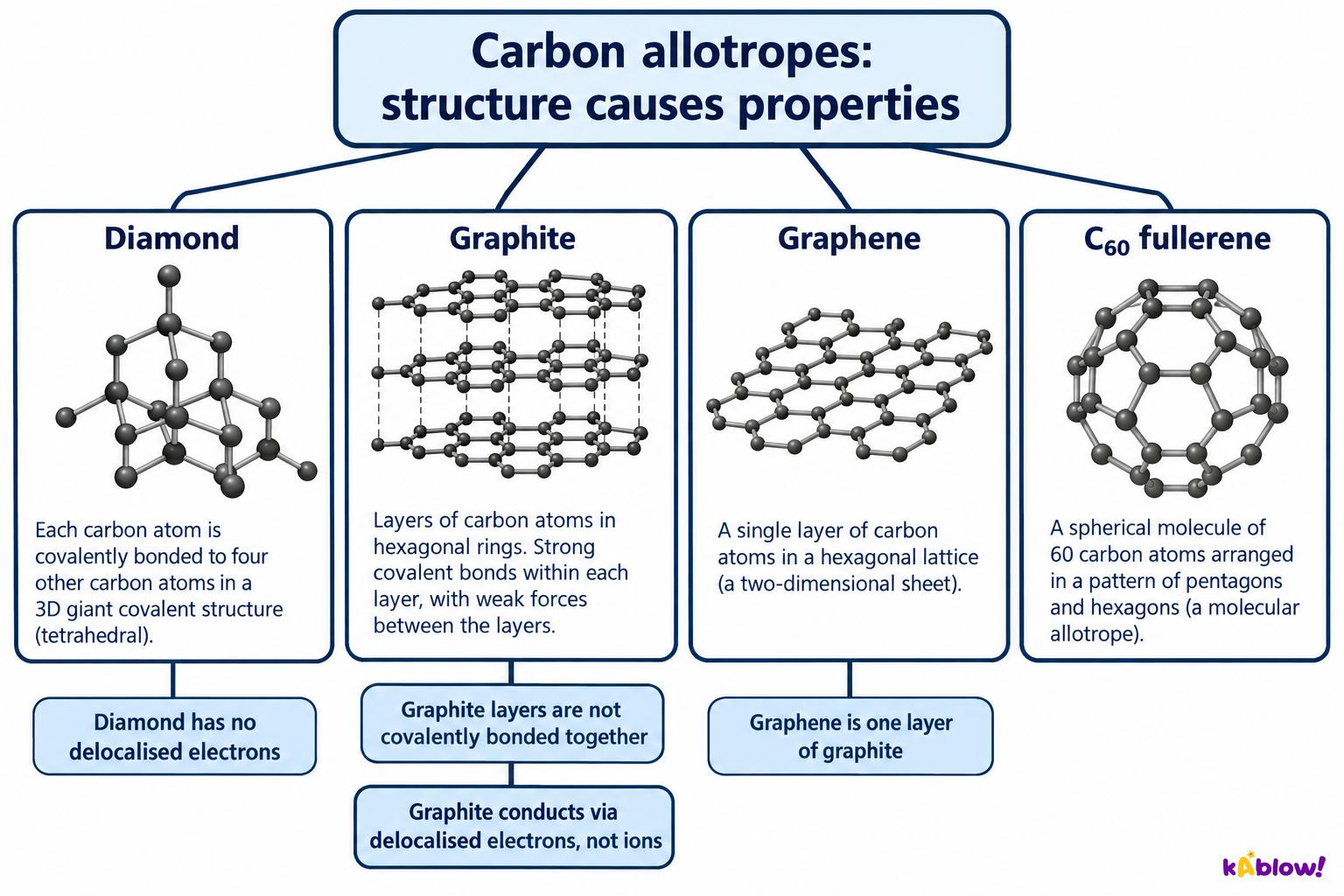
- Graphite does not conduct because of free ions; it conducts because of delocalised electrons.
- Each carbon atom in graphite forms three bonds, not four.
- Graphene is a single layer of graphite, not the same as bulk graphite.
- Diamond does not conduct electricity even though it is a giant structure.
- The layers in graphite are not held together by covalent bonds; they are held by weak intermolecular forces.
Carbon allotropes: common misconceptions
슬라이드
연습 문제
무료 미리 보기 — 63개 중 8개 문제. 가입하면 전부 볼 수 있어요.
1.Which bonding is found in diamond, graphite and fullerenes?
Easy- AIonic
- BCovalent
- CMetallic
- DCoordinate
2.Which substance cannot conduct electricity?
Easy- ADiamond
- BBuckminsterfullerene
- CGraphite
- DNanotubes
3.In graphite, each carbon atom is bonded to how many other carbon atoms?
Medium- ATwo
- BThree
- CFour
- DFive
4.Why can graphite conduct electricity?
Medium- AGraphite has delocalised electrons
- BGraphite has layers of atoms that can slide over each other
- CGraphite has a giant structure
- DGraphite has strong covalent bonds
5.Which statement about diamond is correct?
Medium- AIt is a hard substance with a low melting point
- BEach carbon atom is bonded to three others with strong covalent bonds
- CIt has a giant structure and conducts electricity
- DIt has a high melting point with each carbon bonded to four others
6.Which of the following is not a property of carbon nanotubes?
Medium- AHigh tensile strength
- BHigh melting point
- CPoor conductor of electricity
- DStrong covalent bonds
7.Which of the following are properties of Buckminsterfullerene? (select all that apply)
Medium- AStrong metallic bonds
- BA hollow shape
- CEach carbon is bonded to four other carbon atoms
- DHigh melting point
- EStrong covalent bonds
- FPoor conductor of electricity
8.Graphite is slippery because it has weak covalent bonds between its layers.
EasyTrue or false?
기출 문제
이 주제의 기출 문제 연습이 곧 나와요.
곧 출시