Use of amount of substance in relation to masses of pure substances
플레이하며 배우기
이 문제들을 풀어 에너지를 얻은 뒤 낚시하고 탐험하세요. 계정이 필요 없어요.
수업 노트
The Mole and Avogadro's Constant
- Chemical amounts are measured in moles; the unit symbol is mol.
- One mole of any substance contains the same number of stated particles (atoms, molecules, ions or formula units) as one mole of any other substance.
- The number of particles in one mole is the Avogadro constant, which is 6.02 × 10²³ per mole.
- For example, one mole of sodium contains 6.02 × 10²³ sodium atoms, and one mole of hydrogen molecules contains 6.02 × 10²³ hydrogen molecules.
- The mole applies to atoms, molecules, ions, electrons, formulae and equations.
- One mole of carbon contains the same number of atoms as there are molecules in one mole of carbon dioxide.
Molar Mass and Relative Formula Mass
- The relative formula mass (Mr) of a substance is the sum of the relative atomic masses of all the atoms in its formula.
- The mass of one mole of a substance in grams is numerically equal to its relative formula mass; this is called the molar mass.
- For an element, one mole is equal to the relative atomic mass in grams; for a compound, it is the relative formula mass in grams.
- For example, one mole of water has a mass of (2 × 1) + 16 = 18 g.
- The term relative molecular mass can be used for molecular substances, but relative formula mass is used for all compounds, including ionic ones.
Calculating Moles from Mass and Vice Versa
- Use the equation: moles = mass ÷ relative formula mass (or molar mass).
- To find mass from moles, rearrange to: mass = moles × relative formula mass.
- Example: 16.1 g of ethanol (Mr = 46) gives 16.1 ÷ 46 = 0.35 moles.
- Example: 9.6 g of magnesium (Ar = 24) gives 9.6 ÷ 24 = 0.4 moles.
- Example: 0.25 moles of sodium hydrogen carbonate (Mr = 84) has a mass of 0.25 × 84 = 21 g.
- Always show your working; you may still gain credit if the final answer is wrong.
Moles, mass and molar mass
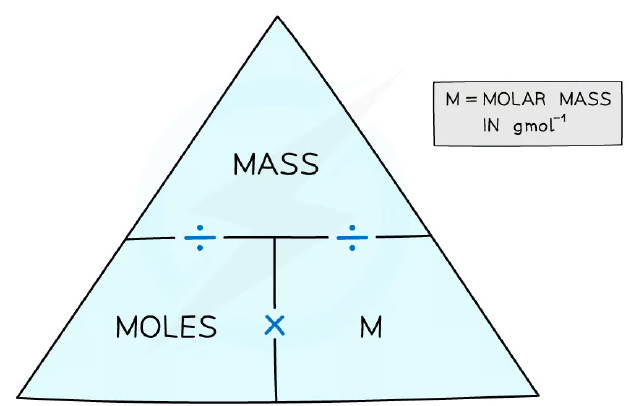
Amounts of Substances in Equations
- Balanced symbol equations show the ratio of moles of reactants and products.
- For example, Mg + 2HCl → MgCl₂ + H₂ shows that 1 mole of magnesium reacts with 2 moles of hydrochloric acid to produce 1 mole of magnesium chloride and 1 mole of hydrogen gas.
- The coefficients in an equation tell you the number of moles of each substance involved.
- To calculate masses from equations: write the balanced equation, calculate moles of the known substance, use the ratio to find moles of the unknown, then convert to mass.
- Example: 2Mg + O₂ → 2MgO. 0.4 moles of Mg produces 0.4 moles of MgO, which has a mass of 0.4 × 40 = 16 g.
- The masses of reactants and products can be calculated from the balanced equation and the mass of a given reactant or product.
Using Moles to Balance Equations
- The balancing numbers in a symbol equation can be found from the masses of reactants and products.
- Convert the masses in grams to amounts in moles by dividing by the relative formula mass.
- Convert the numbers of moles to a simple whole number ratio.
- Example: 15.9 g CuO (Mr = 79.5) = 0.2 mol; 1.2 g C (Ar = 12) = 0.1 mol; 12.7 g Cu (Ar = 63.5) = 0.2 mol; 4.4 g CO₂ (Mr = 44) = 0.1 mol. Ratio 0.2 : 0.1 : 0.2 : 0.1 simplifies to 2 : 1 : 2 : 1, giving 2CuO + C → 2Cu + CO₂.
- If the ratio is not exact, round to the nearest whole number.
Limiting Reactants
- In a reaction with two reactants, one is often in excess to ensure the other is completely used up.
- The reactant that is completely used up first is the limiting reactant; it limits the amount of product formed.
- The amount of product is directly proportional to the amount of limiting reactant.
- To identify the limiting reactant: write the balanced equation, calculate moles of each reactant, then compare the mole ratio.
- An easy method is to divide the moles of each reactant by its coefficient in the equation; the smallest result is the limiting reactant.
- Example: 9.2 g Na (0.4 mol) and 8.0 g S (0.25 mol) react as 2Na + S → Na₂S. 0.4 mol Na needs 0.2 mol S, so S is in excess and Na is limiting.
- When calculating the maximum product, always use the limiting reactant.
Concentration of Solutions
- Concentration is the amount of solute dissolved in a given volume of solvent.
- Concentration can be measured in grams per cubic decimetre (g/dm³) or in moles per cubic decimetre (mol/dm³).
- 1 dm³ = 1000 cm³, and 1 dm³ is the same as 1 litre.
- To convert cm³ to dm³, divide by 1000; to convert dm³ to cm³, multiply by 1000.
- To go from g/dm³ to mol/dm³, divide by the molar mass; to go from mol/dm³ to g/dm³, multiply by the molar mass.
- The formula triangle for concentration, moles and volume can be used: concentration = moles ÷ volume (in dm³).
- Example: 10 g NaOH dissolved in 2 dm³ gives a concentration of 10 ÷ 2 = 5 g/dm³.
- Example: 0.25 moles of NaHCO₃ (Mr = 84) has a mass of 21 g; if dissolved in 1 dm³, the concentration is 21 g/dm³.
Conservation of Mass
- The Law of Conservation of Mass states that no matter is lost or gained during a chemical reaction.
- The total mass of reactants equals the total mass of products, which is why equations must be balanced.
- In a closed system, the total mass before and after a reaction remains constant.
- If a reaction flask is open and a gas escapes, the total mass decreases.
- If the mass of a reaction flask increases, it may be because a gaseous reactant from the air has been used and all products are solids or liquids.
- Example: CaCl₂(aq) + Na₂SO₄(aq) → CaSO₄(s) + 2NaCl(aq) shows conservation of mass in a precipitation reaction.
Empirical Formula and Reacting Masses
- The empirical formula gives the simplest whole number ratio of atoms of each element in a compound.
- To find empirical formula from masses: divide each mass by the relative atomic mass, then divide by the smallest result to get the simplest ratio.
- Example: 10 g H and 80 g O gives 10 mol H and 5 mol O, ratio 2:1, so empirical formula is H₂O.
- The molecular formula is a multiple of the empirical formula; to find it, divide the relative formula mass by the empirical formula mass.
- Reacting mass calculations use the balanced equation to find the mass ratio between substances.
- Example: 2Mg + O₂ → 2MgO. 6.0 g Mg produces 6.0 × (80/48) = 10.0 g MgO.
슬라이드
연습 문제
무료 미리 보기 — 65개 중 8개 문제. 가입하면 전부 볼 수 있어요.
1.What is the symbol for the unit of amount of substance, the mole?
Easy- Amol
- BM
- Cg
- Dmol/dm³
2.One mole of any substance contains the same number of stated particles as one mole of any other substance.
EasyTrue or false?
3.What is the value of the Avogadro constant?
Easy- A6.02 × 10²³ per mole
- B6.02 × 10⁻²³ per mole
- C6.02 × 10²⁴ per mole
- D6.02 × 10²² per mole
4.Which of the following statements about the limiting reactant is NOT correct?
Medium- AThe limiting reactant is in excess.
- BThe limiting reactant is used up first.
- CThe limiting reactant controls the amount of product formed.
- DDoubling the amount of limiting reactant doubles the amount of product formed.
5.Which are the correct units for concentration when expressed as mass of solute per volume of solution?
Medium- Ag/dm³
- Bdm³/g
- Cmol/dm³
- Dg/mol
6.The empirical formula gives the simplest whole number ratio of atoms of each element in a compound.
EasyTrue or false?
7.Which of the following statements about the mole and Avogadro's constant are correct? (select all that apply)
Medium- AOne mole of carbon contains 6.02 × 10²³ atoms.
- BOne mole of oxygen molecules contains 6.02 × 10²³ atoms.
- COne mole of sodium chloride contains 6.02 × 10²³ formula units.
- DThe Avogadro constant is 6.02 × 10²⁴ per mole.
- EOne mole of hydrogen molecules contains 6.02 × 10²³ molecules.
8.Match each term about amounts of substance to its correct meaning.
Easy- Molar mass
- Limiting reactant
- Avogadro constant
- The mass of one mole of a substance in grams
- The reactant that is used up first and limits the amount of product
- The number of particles in one mole, 6.02 x 10²³