Using concentrations of solutions in mol/dm3
플레이하며 배우기
이 문제들을 풀어 에너지를 얻은 뒤 낚시하고 탐험하세요. 계정이 필요 없어요.
수업 노트
Concentration in mol/dm³
- Concentration can be measured in mol/dm³ (also written as mol/dm³ or mol/dm³).
- It is often more useful to express concentration in moles per unit volume rather than mass per unit volume.
- The formula is: concentration (mol/dm³) = number of moles of solute (mol) ÷ volume of solution (dm³).
- The units in the answer can be written as mol dm⁻³ or mol / dm³.
- You may need to convert between g/dm³ and mol/dm³ depending on the question.
Concentration, moles and volume formula triangle
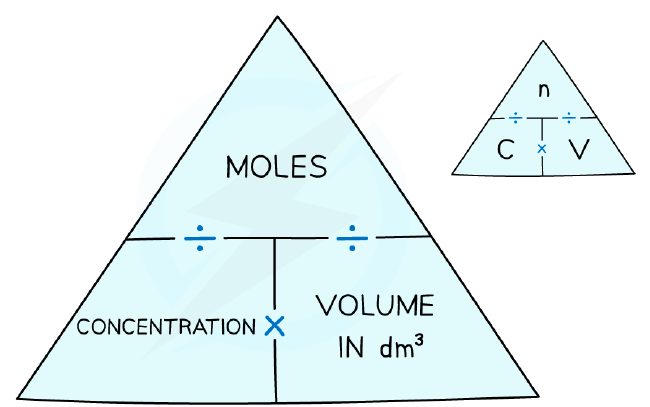
Converting between cm³ and dm³
- To go from cm³ to dm³, divide by 1000.
- To go from dm³ to cm³, multiply by 1000.
- For example, 500 cm³ ÷ 1000 = 0.5 dm³.
- A common mistake is forgetting to convert units, which gives an answer a thousand times out.
Calculating moles from concentration and volume
- Rearrange the formula to find moles: moles = concentration × volume.
- Make sure the volume is in dm³ before substituting into the equation.
- A formula triangle can help you rearrange the relationship between concentration, moles and volume.
- You are not given the formula triangle in exams, so you must learn it.
- It is a good idea to write the formula down before starting a problem.
Worked example: moles from concentration
- Calculate the moles in 2.5 dm³ of a solution of concentration 0.2 mol/dm³.
- Moles = concentration × volume = 0.2 × 2.5.
- The answer is 0.5 mol.
Worked example: concentration from mass
- Calculate the concentration of sodium hydroxide, NaOH, when 80 g is dissolved in 500 cm³ of water (Na = 23, H = 1, O = 16).
- First find the relative formula mass: Mᵣ(NaOH) = 23 + 16 + 1 = 40.
- So 40 g NaOH = 1 mole, and 80 g NaOH = 2 moles.
- Convert volume: 500 cm³ ÷ 1000 = 0.5 dm³.
- Concentration = moles ÷ volume = 2 ÷ 0.5 = 4 mol/dm³.
Titration calculations
- If the concentration of one reactant is known, the exact volumes from a titration and the balanced equation can be used to find the concentration of the other reactant.
- Use the equation for the reaction to find the mole ratio between the acid and the base.
- Calculate moles of the known solution using moles = (volume ÷ 1000) × concentration.
- Use the mole ratio to deduce the moles of the unknown solution.
- Finally, calculate concentration using concentration = moles ÷ volume (dm³).
Worked example: titration calculation
- 25.0 cm³ of hydrochloric acid was titrated against 0.100 mol/dm³ NaOH; 12.1 cm³ of NaOH was required.
- Equation: HCl (aq) + NaOH (aq) → NaCl (aq) + H₂O (l).
- Moles of NaOH = 0.012 dm³ × 0.100 mol/dm³ = 1.21 × 10⁻³ mol.
- The acid reacts in a 1:1 ratio, so moles of HCl = 1.21 × 10⁻³ mol.
- This is present in 25.0 cm³ = 0.025 dm³.
- Concentration of HCl = 1.21 × 10⁻³ ÷ 0.025 = 0.0484 mol/dm³.
Key terminology and practical skills
- Titration is used to determine the concentration of a strong acid or alkali.
- A pipette is used to measure a precise volume of one solution into a conical flask.
- A burette is used to add the other solution until the end-point is reached.
- A standard solution is one whose concentration is accurately known.
- Concordant results are titres within a small range (e.g. 0.10 cm³) of each other; only these should be averaged.
- Neutralisation occurs when an acid and alkali react completely.
Common misconceptions and errors
- Failing to convert cm³ to dm³ gives answers a thousand times out.
- Do not confuse g/dm³ with mol/dm³ — they are different units.
- Do not average non-concordant titres; only use concordant results.
- A more concentrated solution is not necessarily a stronger acid.
- When reading a burette, read from the correct end of the scale (top to bottom).
슬라이드
연습 문제
무료 미리 보기 — 66개 중 8개 문제. 가입하면 전부 볼 수 있어요.
1.Which equation correctly gives concentration in mol/dm³?
Easy- Aconcentration = moles of solute ÷ volume of solution in dm³
- Bconcentration = volume of solution in dm³ ÷ moles of solute
- Cconcentration = moles of solute × volume of solution in dm³
- Dconcentration = moles of solute ÷ volume of solution in cm³
2.A solution of sulfuric acid, H₂SO₄, contains 9.8 g of the acid in 250 cm³ of solution. What is the concentration in mol/dm³? (Ar: H = 1, S = 32, O = 16)
Medium- A0.10 mol/dm³
- B0.20 mol/dm³
- C0.40 mol/dm³
- D0.80 mol/dm³
3.Which of the following statements about concentration and titration are correct? (select all that apply)
Medium- AConcentration can be expressed in mol/dm³ or in g/dm³.
- BA more concentrated acid is always a stronger acid.
- CConcordant titres are within 0.10 cm³ of each other.
- DA burette is read from the top of the scale downwards.
- EThe pipette is used to deliver the solution of unknown concentration into the conical flask.
4.The concentration of a solution in mol/dm³ is the number of moles of solute dissolved in 1 dm³ of solution.
EasyTrue or false?
5.Match each piece of titration apparatus or term with its correct description.
Medium- pipette
- burette
- conical flask
- concordant results
- delivers a fixed volume of solution accurately
- delivers variable volumes and is read from the bottom of the meniscus
- used to hold the solution during titration and swirled
- titres that are within 0.10 cm³ of each other
6.Place the steps of a titration in the correct order.
Medium- Pipette a known volume of the solution into a conical flask.
- Add a few drops of indicator to the conical flask.
- Fill the burette with the other solution and record the initial reading.
- Add the solution from the burette until the indicator changes colour.
- Record the final burette reading and repeat until concordant results are obtained.
7.How many moles of solute are present in 2 dm³ of a 0.5 mol/dm³ solution of potassium iodide?
Medium- A0.5 mol
- B1.0 mol
- C2.0 mol
- D10 mol
8.In a titration, 25.00 cm³ of 0.20 mol/dm³ sodium hydroxide reacted with 26.50 cm³ of hydrochloric acid. What is the concentration of the acid? (HCl + NaOH → NaCl + H₂O)
Medium- A0.19 mol/dm³
- B0.23 mol/dm³
- C0.55 mol/dm³
- D0.82 mol/dm³