Atoms and nuclear radiation
플레이하며 배우기
이 문제들을 풀어 에너지를 얻은 뒤 낚시하고 탐험하세요. 계정이 필요 없어요.
교육자를 위해: Atoms and nuclear radiation(Science, Physics)을(를) 위한 바로 쓸 수 있는 수업 슬라이드, 복습 노트 — 수업에 사용하거나, 학습자들이 실시간 게임으로 즐기는 인터랙티브 클래스 활동으로 진행하세요.
수업 노트
Unstable Nuclei and Radioactive Decay
- Some atomic nuclei are unstable because of an imbalance in the forces within the nucleus.
- Isotopes can be unstable because of their large size or because they have too many or too few neutrons.
- For example, carbon-14 is unstable because it has two extra neutrons compared to stable carbon-12.
- Unstable nuclei emit radiation to become more stable; radiation can be a high-energy particle or wave.
- As radiation moves away from the nucleus, it transfers energy away, reducing the overall energy of the nucleus and making it more stable.
- The process of emitting radiation is called radioactive decay.
- Radioactive decay is a random process: it is not possible to know exactly when a particular nucleus will decay.
Types of Radiation
- α (α) particles are the same as a helium nucleus: 2 protons and 2 neutrons, with a charge of +2.
- β-minus (β⁻) particles are fast-moving electrons emitted from the nucleus, with a charge of -1.
- β-plus (β⁺) particles are fast-moving positrons (positive electrons), with a charge of +1.
- Gamma (γ) rays are electromagnetic waves with no charge and the highest energy of all EM waves.
- Neutrons (n) are neutral particles (no charge) that can also be emitted from unstable nuclei.
- α and β particles can be affected by an electric field because they have a charge; gamma rays and neutrons are unaffected.
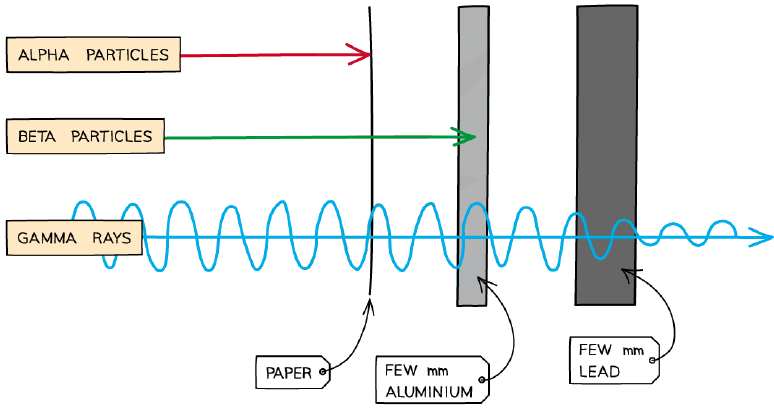
Penetrating power of alpha, beta, and gamma radiation through different materials
Properties of Radiation
- Penetrating power: α is stopped by paper, β by a few mm of aluminium, gamma is reduced by several cm of lead or metres of concrete.
- Ionising power: α is the most ionising, gamma is the least ionising.
- Range in air: α travels a few cm, β a few tens of cm, gamma has an infinite range (but intensity decreases with distance).
- The more ionising the radiation, the shorter its range in air because it reacts with air particles sooner.
- β particles are only stopped by aluminium if it is a few mm thick; thinner aluminium may not stop them.
Background Radiation
- Background radiation is the radiation that exists around us all the time.
- Natural sources include: radon gas from rocks and soil, cosmic rays from space, carbon-14 in biological material, and radioactive material in food and drink.
- Man-made sources include: medical sources (X-rays, CT scans, tracers, therapy), nuclear waste, fallout from nuclear weapons, and nuclear accidents (e.g. Chernobyl).
- Radon gas is an α emitter and is particularly dangerous if inhaled in large quantities.
- To find the corrected count rate, subtract the background count rate from the measured count rate.
Detecting Radiation
- Photographic film darkens when it absorbs radiation; film badges are worn by radiation workers to monitor exposure.
- A Geiger-Müller (GM) tube is the most common radiation detector; it produces an electrical pulse for each radiation absorbed, giving a count rate.
- The count rate is the number of decays detected per second; the closer the tube to the source, the higher the count rate.
- The dose of radiation received is measured in sieverts (Sv); people normally receive about 3 mSv per year from background radiation.
Beta Decay
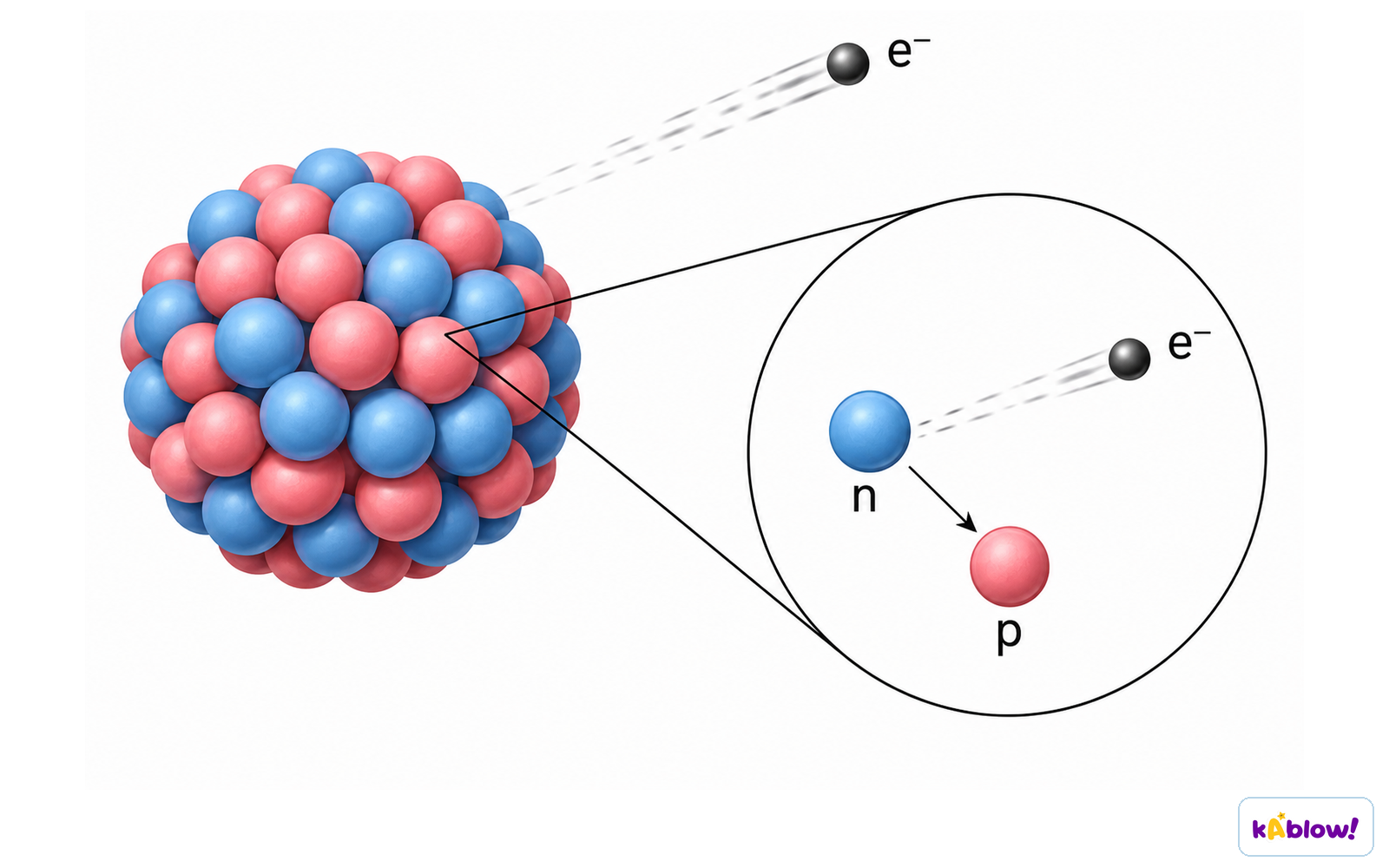
- β-minus decay: a neutron changes into a proton and an electron; the electron is emitted.
- In β-minus decay, the mass number stays the same and the atomic number increases by 1.
- β-plus decay: a proton changes into a neutron and a positron; the positron is emitted.
- In β-plus decay, the mass number stays the same and the atomic number decreases by 1.
- β decay forms a new element because the atomic number changes.
Beta decay
Nuclear Transformations and Equations
- α emission: the nucleus loses 2 protons and 2 neutrons, so the mass number decreases by 4 and the atomic number decreases by 2.
- β-minus emission: the mass number is unchanged and the atomic number increases by 1.
- β-plus emission: the mass number is unchanged and the atomic number decreases by 1.
- Gamma emission: no change to mass or atomic number; the nucleus loses excess energy.
- Neutron emission: the mass number decreases by 1 and the atomic number is unchanged.
- In nuclear equations, the sum of mass numbers and the sum of atomic numbers must balance on both sides.
Activity and Half-Life
- Activity is the rate at which unstable nuclei decay, measured in becquerels (Bq); 1 Bq = 1 decay per second.
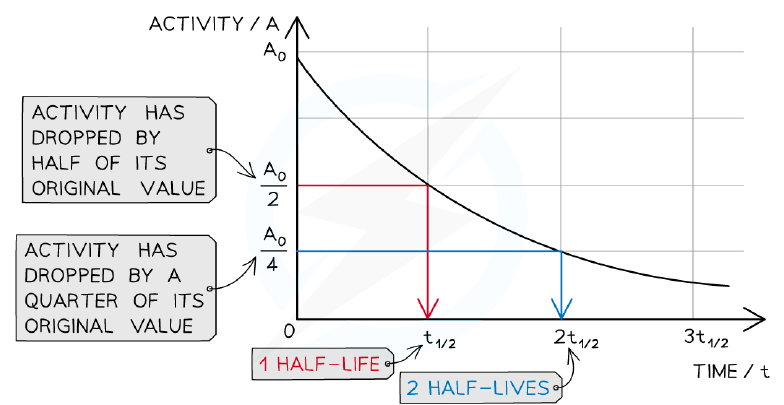
- Half-life is the time taken for half the undecayed nuclei to decay, or for the activity to halve.
- Half-life is constant for a particular isotope and can range from fractions of a second to billions of years.
- After one half-life, 50% remains; after two, 25%; after three, 12.5%, and so on.
- The number of undecayed nuclei never quite reaches zero because decay is random.
- To find half-life from a graph, find the time for the activity to fall to half its initial value.
A half-life graph showing activity falling from A0 to A0/2 to A0/4
Random Nature of Decay
- Radioactive decay is random: there is an equal probability of any nucleus decaying, and it cannot be predicted which or when.
- The rate of decay is unaffected by surrounding conditions (e.g. temperature, pressure).
- The dice analogy helps: you cannot predict a single roll, but you can predict probabilities over many rolls.
- Count rate from a GM tube fluctuates irregularly, providing evidence for the randomness of decay.
슬라이드
연습 문제
무료 미리 보기 — 64개 중 8개 문제. 가입하면 전부 볼 수 있어요.
1.When carbon-14 decays it emits a β-minus particle. A β-minus particle is
Easy- Aan electron
- Ba neutron
- Ca positron
- Da proton
2.Which type of radiation is the most ionising?
Easy- Aα
- Bβ
- CGamma
- DNeutron
3.Which type of radiation can penetrate a few millimetres of aluminium?
Easy- Aα
- Bβ
- CGamma
- DAll of the above
4.Which type of radiation is a type of electromagnetic radiation?
Easy- Aα
- Bβ
- CGamma
- DNeutron
5.Which type of radiation has a negative charge?
Easy- Aα
- Bβ-minus
- CGamma
- DNeutron
6.Cobalt-60 decays to nickel-60 through the process of radioactive decay: 60/27 Co → 60/28 Ni + X. What is particle X?
Medium- Aα particle
- Bβ-minus particle
- CGamma ray
- DNeutron
7.Match each type of radiation with its correct penetrating power.
Medium- α
- β
- Gamma
- Stopped by paper
- Stopped by a few mm of aluminium
- Reduced by several cm of lead
8.Radioactive decay is a random process.
EasyTrue or false?
기출 문제
이 주제의 기출 문제 연습이 곧 나와요.
곧 출시