Forces and elasticity
플레이하며 배우기
이 문제들을 풀어 에너지를 얻은 뒤 낚시하고 탐험하세요. 계정이 필요 없어요.
수업 노트
Changing Shape
- To change the shape of a stationary object, more than one force must be applied.
- Objects can be stretched, bent, or compressed, or a combination of these.
- Stretching: forces act in opposite directions, away from the object (e.g., weight of a mass and tension in a spring).
- Compression: forces act in opposite directions, towards the object (e.g., weight of a mass on a spring and reaction force from the surface).
- Bending: forces act in opposing directions at different points on the object (e.g., weight of a swimmer and reaction force from the block on a diving board).
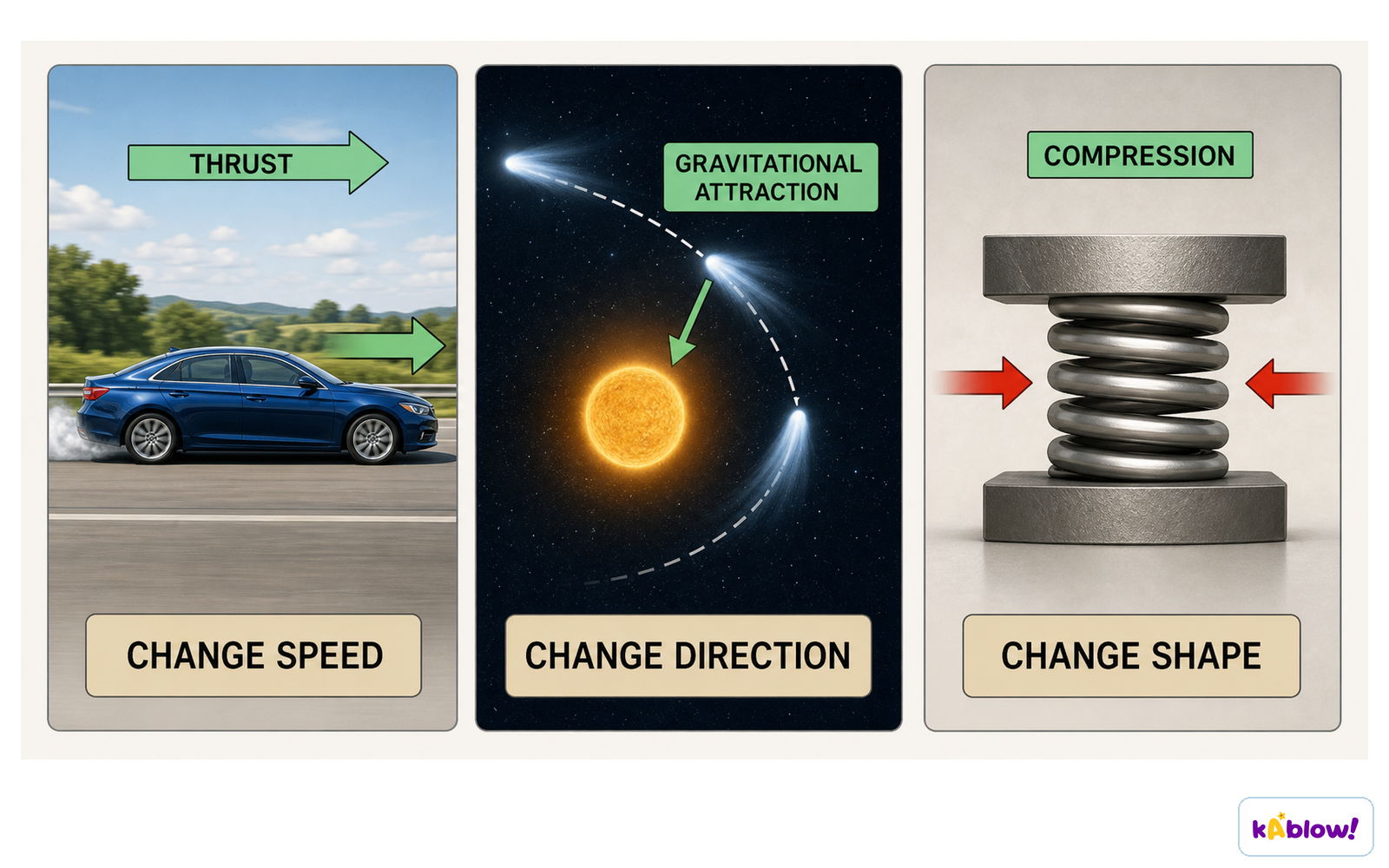
A thrust force can cause a car to speed up, a gravitational force can cause a comet to change direction, compression forces can cause a spring to change shape.
Elastic and Inelastic Deformation
- Elastic deformation: the object returns to its original shape and length when the deforming force is removed.
- Examples of elastic materials: rubber bands, fabrics, steel springs.
- Inelastic deformation: the object does not return completely to its original shape when the force is removed (permanent distortion).
- Examples of inelastic materials: plastic, clay, glass.
- In an exam, always state what happens when the force is removed to distinguish between elastic and inelastic.
Hooke's Law
- Hooke's Law: the extension of an elastic object is directly proportional to the force applied, provided the limit of proportionality is not exceeded.
- Directly proportional means if force doubles, extension doubles; if force halves, extension halves.
- The limit of proportionality is the point beyond which force and extension are no longer directly proportional.
- Equation: F = k × e (or F = k × x), where F = force (N), k = spring constant (N/m), e = extension (m).
- The spring constant k is a measure of stiffness; a higher k means a stiffer spring.
- Extension = final length – original length. Compression is treated similarly, with e representing compression.
Force–Extension Graphs
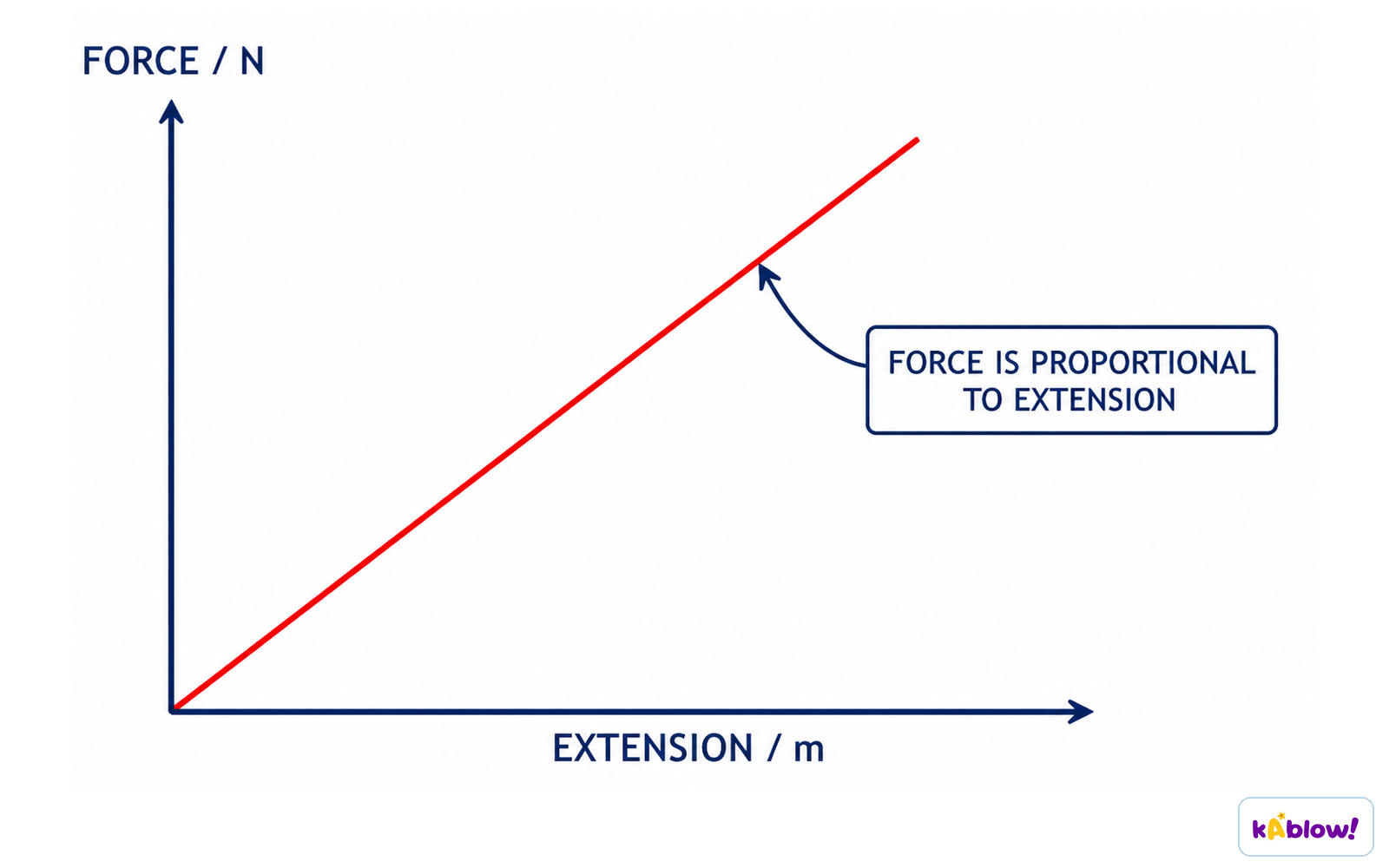
- A straight line through the origin shows a linear relationship (Hooke's law obeyed).
- A curve shows a non-linear relationship (limit of proportionality exceeded).
- The spring constant is the gradient of the straight-line region if force is on the y-axis and extension on the x-axis.
- If extension is on the y-axis and force on the x-axis, the spring constant is 1 ÷ gradient.
- A steeper straight line means a larger spring constant when force is on the y-axis; but if axes are reversed, a steeper line means a smaller spring constant.
- Always check which variable is on which axis before interpreting the gradient.
Force-extension graph for a spring
Work Done and Elastic Potential Energy
- When a spring is stretched or compressed, work is done and energy is transferred to its elastic potential energy store.
- Provided the limit of proportionality is not exceeded, work done on the spring equals the elastic potential energy stored.
- Equation: Ee = ½ × k × e² (or E = ½ k x²), where Ee = elastic potential energy (J), k = spring constant (N/m), e = extension (m).
- The extension is squared, so doubling the extension quadruples the work done (since 2² = 4).
- This equation is only valid for springs that have not been stretched beyond their limit of proportionality.
Required Practical: Investigating Force and Extension
- Aim: investigate the relationship between force and extension for a spring.
- Independent variable: force (weight of masses); dependent variable: extension; control variable: spring constant (same spring used).
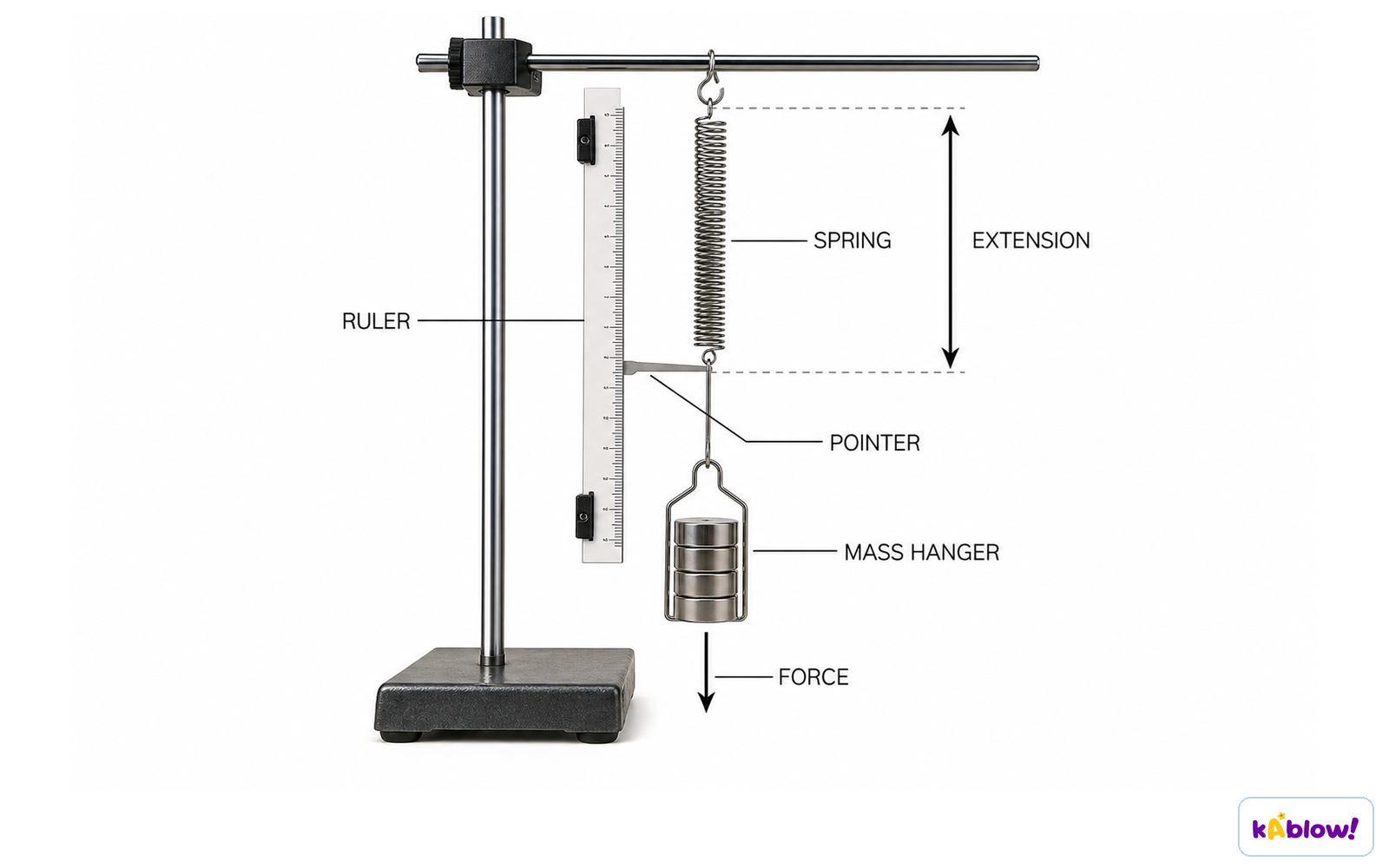
- Equipment: spring, ruler, mass hanger, 100 g masses, clamp stand, G clamp, fiducial marker.
- Method: measure original length; add masses one at a time; record new length; repeat for each mass; remove masses and repeat to get averages.
- Calculate force using W = mg (take g = 10 N/kg); calculate extension as final length – original length.
- Plot a graph of force against extension; a straight line through the origin shows Hooke's law is obeyed.
- Improve accuracy: use a fiducial marker, take readings at eye level to avoid parallax, wait for spring to stop moving before reading.
- Safety: wear goggles, secure clamp stand with G clamp, place a mat below masses, stand up and keep feet clear.
Equipment for investigating the extension of a spring
Common Misconceptions and Exam Tips
- Do not confuse extension with total length: extension = final length – original length.
- The limit of proportionality is not the same as the breaking point.
- A stiffer spring has a larger spring constant, not smaller.
- Not all deformation is elastic; some materials deform inelastically.
- When using F = k e or E = ½ k e², ensure extension is in metres (convert from cm by ÷ 100).
- The unit of spring constant is N/m; do not forget it in answers.
슬라이드
연습 문제
무료 미리 보기 — 64개 중 8개 문제. 가입하면 전부 볼 수 있어요.
1.Which of the following statements is correct about inelastic distortion?
Easy- AThe object returns to its original length when the force is removed
- BThe object does not return to its original shape when the force is removed
- CThe object requires only one force to be distorted
- DThe object returns to its original shape but not its original length
2.What is the correct unit for the force applied to a spring which makes it elastically distort?
Easy- Am
- BN m
- CN / m
- DN
3.Which of the following options is the correct equation linking force (F), spring constant (k) and extension (x)?
Easy- AF = kx²
- BF = ½ kx
- CF = kx
- DF = 2kx
4.A spring has a spring constant k. The force exerted on the spring is increased so that the extension doubles. How does this affect the work done on the spring?
Medium- AWork done doubles
- BWork done halves
- CWork done increases by a factor of 4
- DWork done decreases by a factor of 4
5.A single force is enough to change the shape of a stationary object.
EasyTrue or false?
6.A stiffer spring has a smaller spring constant.
EasyTrue or false?
7.The limit of proportionality is the same as the breaking point of a spring.
MediumTrue or false?
8.Which of the following statements about elastic deformation are correct? (Select all that apply.)
Medium- AThe object returns to its original shape when the deforming force is removed
- BThe object remains permanently stretched when the force is removed
- CA steel spring can undergo elastic deformation
- DA plastic bag can undergo elastic deformation
- EA rubber band can undergo elastic deformation