Photosynthesis and limiting factors
플레이하며 배우기
이 문제들을 풀어 에너지를 얻은 뒤 낚시하고 탐험하세요. 계정이 필요 없어요.
교육자를 위해: Photosynthesis and limiting factors(MYP Biology, Year 5)을(를) 위한 바로 쓸 수 있는 수업 슬라이드, 복습 노트 — 수업에 사용하거나, 학습자들이 실시간 게임으로 즐기는 인터랙티브 클래스 활동으로 진행하세요.
수업 노트
Big idea: how plants capture energy, and what limits them
- Big idea (key concept): Change. The rate of photosynthesis changes as conditions change. In this topic you will explain how and why, and use data to prove it.
- Related concept: Energy. Photosynthesis transfers light energy into chemical energy stored in glucose. Almost every food chain starts here.
- Global context: Globalization and sustainability. Growing enough food for a growing world means understanding what limits crop growth, and deciding when extra heat, light or carbon dioxide is worth its cost.
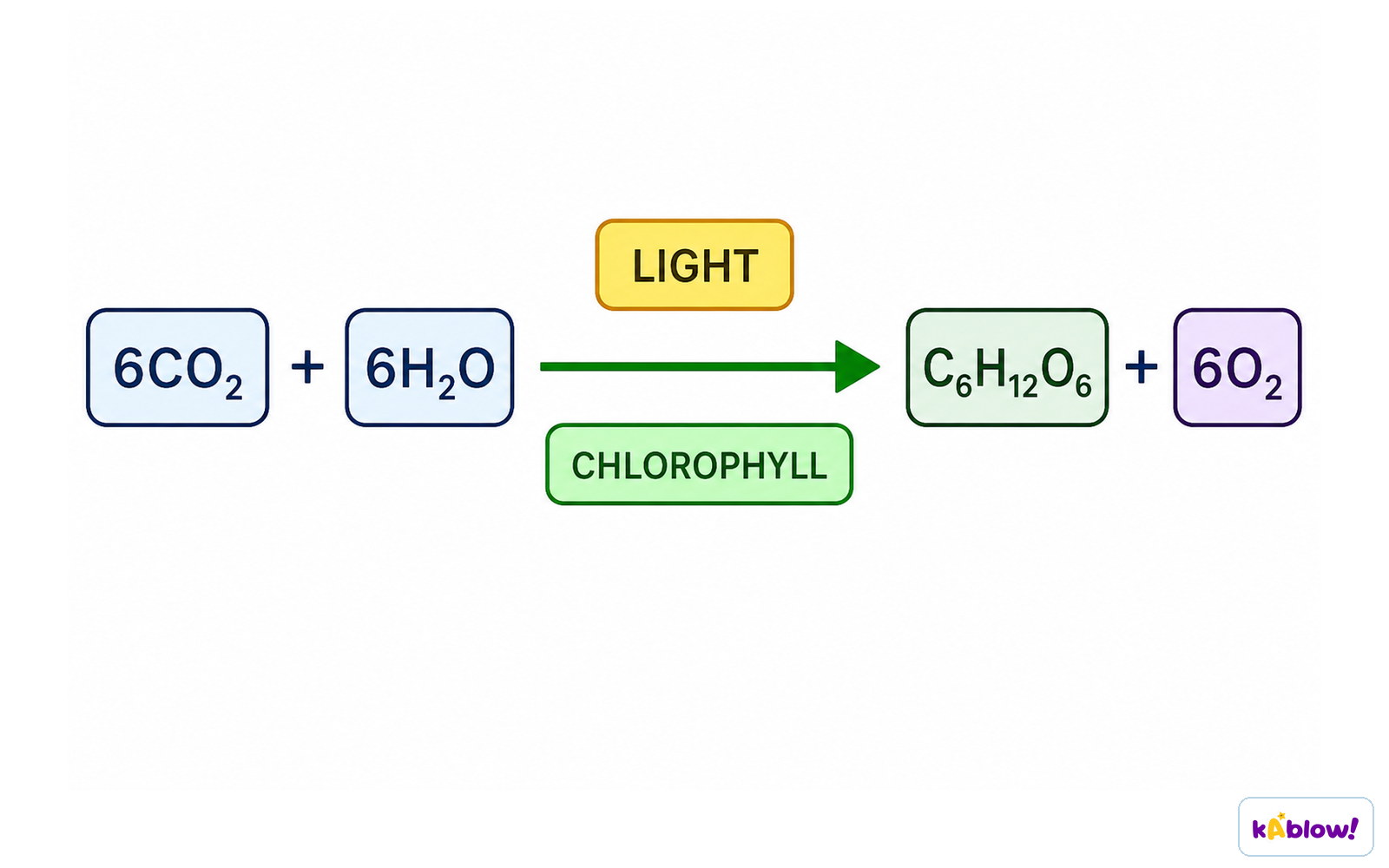
- The reaction. Carbon dioxide + water → glucose + oxygen. In symbols: 6CO2 + 6H2O → C6H12O6 + 6O2. Light energy is absorbed by chlorophyll in the chloroplasts. It is an endothermic reaction because energy is taken in.
- Glucose is used in four main ways: in respiration to release energy; stored as starch (insoluble, so it does not affect osmosis); built into cellulose for cell walls; and combined with nitrate ions from the soil to make amino acids for proteins. Fats and oils are also made from glucose.
- Chlorophyll needs magnesium. A plant short of magnesium has yellow leaves and photosynthesises less, because less light is absorbed.
The photosynthesis equation
The leaf: structure linked to function
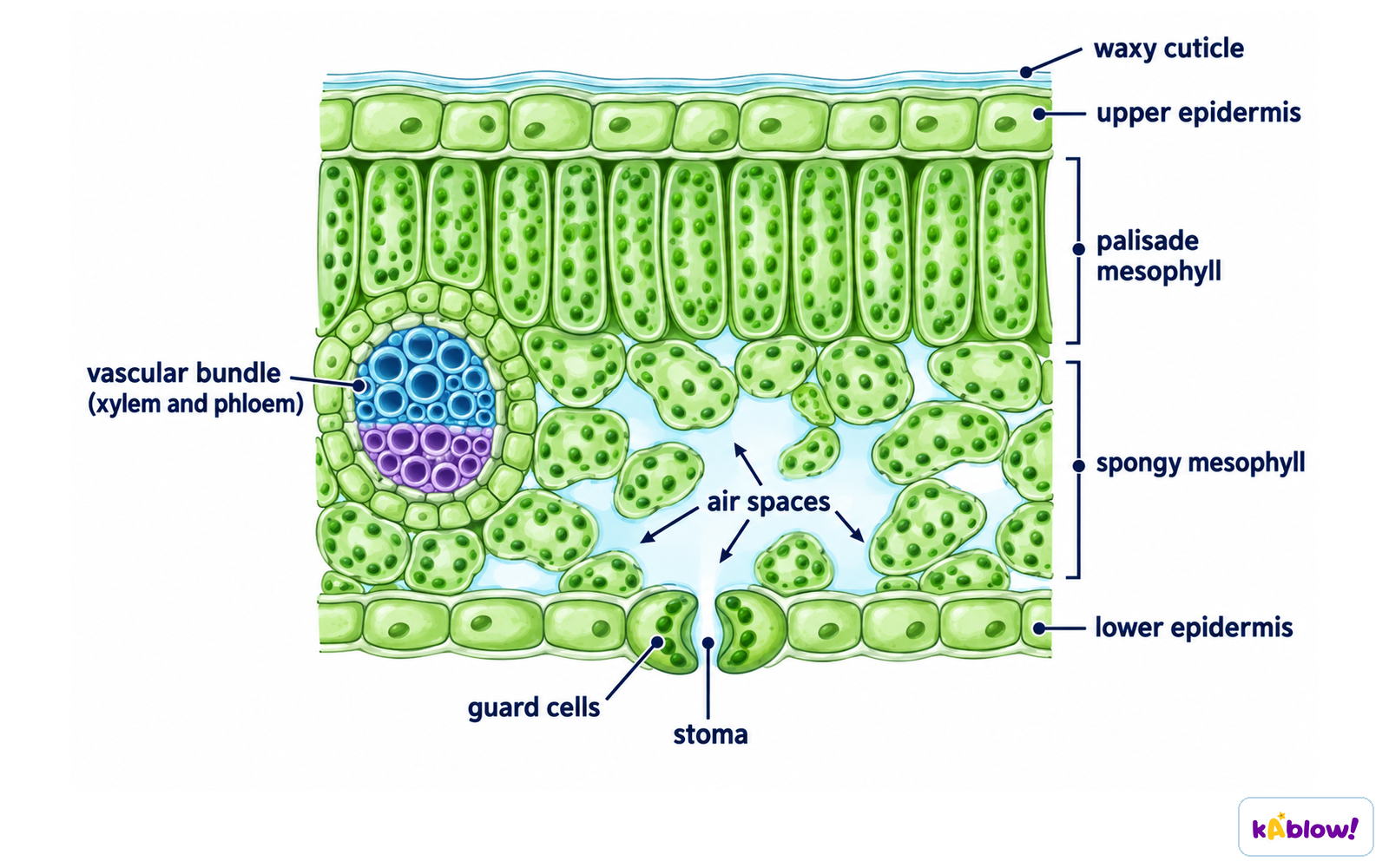
- The upper epidermis is thin and transparent, covered by a waxy cuticle that reduces water loss. Light passes through it to the cells beneath.
- Palisade mesophyll cells are tall, tightly packed and contain the most chloroplasts. Being near the top they absorb the most light.
- Spongy mesophyll cells are loosely arranged with air spaces between them, so carbon dioxide can diffuse to every photosynthesising cell, and oxygen can diffuse out.
- The lower epidermis contains stomata. Guard cells open and close each stoma. Carbon dioxide diffuses in through open stomata and oxygen diffuses out. When water is short, the guard cells close the stomata.
- Vascular bundles (xylem and phloem) bring water to the leaf and carry sugars away. A thin, flat leaf gives a large surface area for light and a short diffusion path for gases.
- Link to limiting factors. If the stomata close on a hot, dry day, carbon dioxide cannot enter, so carbon dioxide becomes the limiting factor even in bright light.
Inside a leaf: layers, air spaces and stomata
Limiting factors: light, carbon dioxide and temperature
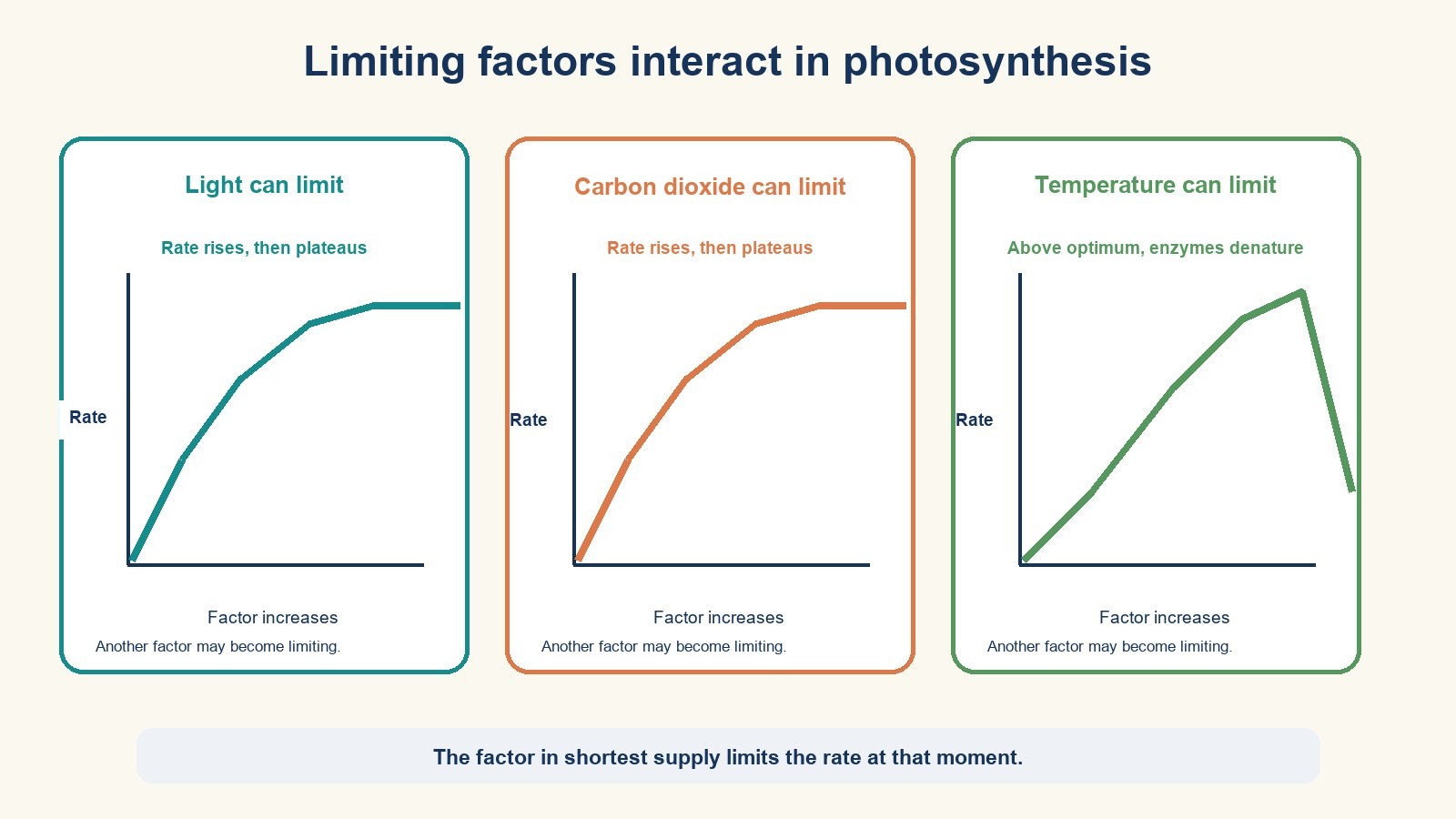
- A limiting factor is the factor in shortest supply at that moment. Raising it increases the rate; raising any other factor does not.
- Light intensity: at low light, rate rises in proportion to light. At higher light, the rate levels off in a plateau. Light is no longer limiting, so carbon dioxide or temperature is.
- Carbon dioxide concentration: the same shape. The air has only about 0.04% carbon dioxide, so it often limits the rate on a bright, warm day.
- Temperature: the rate rises with temperature because the enzymes and substrate particles collide more often with more energy. Above the optimum (often around 25 to 40 °C, depending on the plant), the enzymes begin to denature: the shape of the active site changes and the rate falls steeply.
- Water can also limit photosynthesis if the plant is short of it, and so can a lack of chlorophyll (for example from magnesium deficiency).
- Reading two factors at once: if the rate stops rising when carbon dioxide is increased at low light, light is limiting. Raise the light and the rate climbs again until another factor takes over.
Three limiting factors and the shapes of their graphs
Rate graphs, data and the inverse square law
- Reading a graph or table. Describe the pattern with numbers: the rate rises from 12 to 36 cm3 per hour between 10 and 30 units of light, then stays at 42. Then explain with the limiting factor.
- Percentage increase = change / original x 100. For example, a rise from 12 to 24 cm3 per hour is (24 - 12) / 12 x 100 = 100%.
- Rate = amount of product / time. 4.5 cm3 of oxygen in 3 minutes is 1.5 cm3 per minute.
- Means and anomalies. Counts of 31, 29, 45 and 30 bubbles per minute: if the 45 was a counting error, the mean of the other three is 30. State why you left it out.
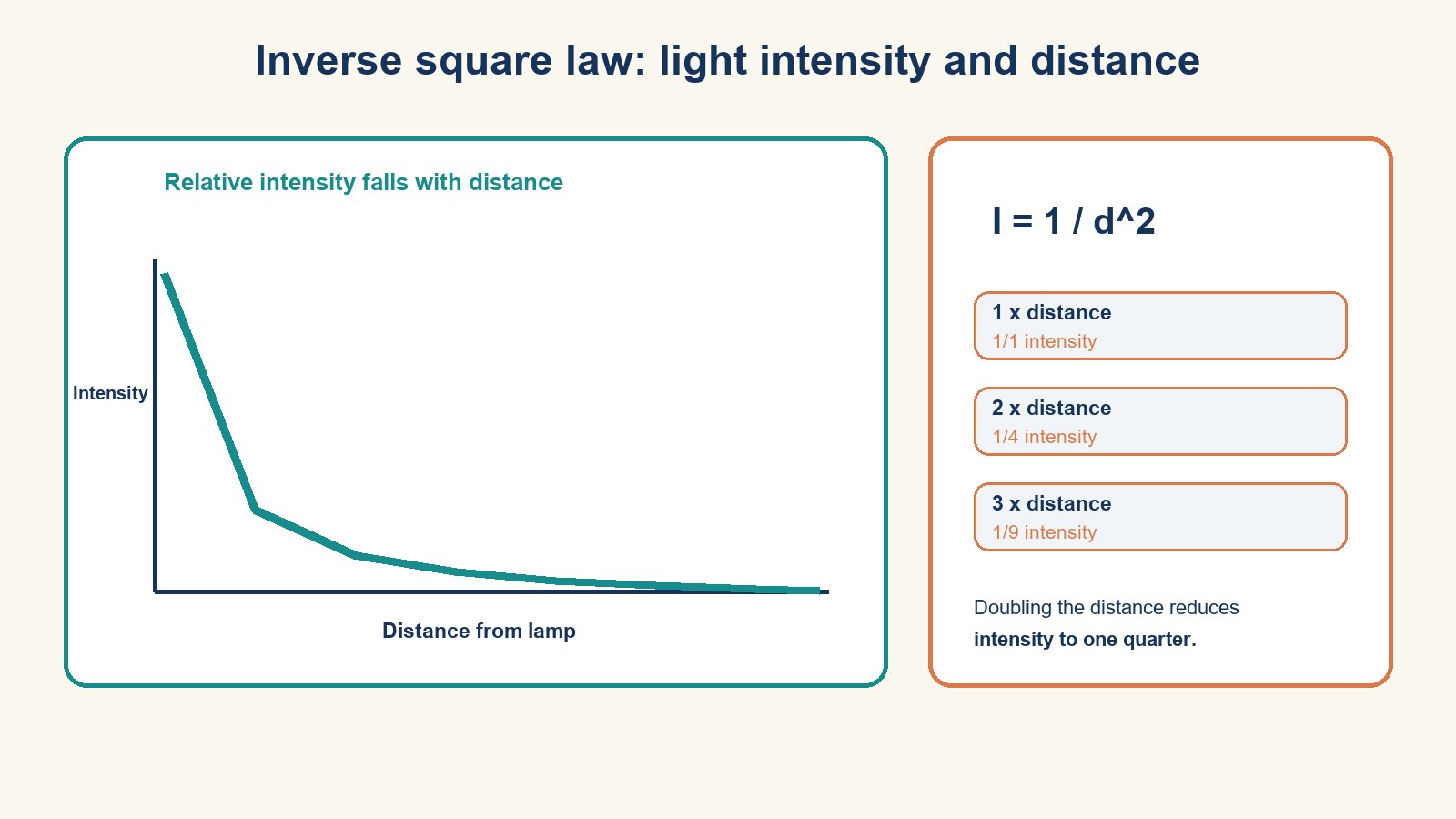
- Light and distance. Light intensity from a lamp follows the inverse square law: intensity is proportional to 1 / distance squared. Moving the lamp from 10 cm to 20 cm cuts the intensity to one quarter, and to 30 cm cuts it to one ninth.
- Careful with conclusions. If the intensity falls to one quarter but the rate falls by much less, light was not the only limiting factor at the start.
Light intensity falls quickly as distance from the lamp grows
Using limiting factors: greenhouses and economics
- Growers in greenhouses can control light (lamps), temperature (heaters) and carbon dioxide (adding the gas, or burning fuel that releases it) to remove limiting factors and raise yield.
- The yield rises quickly at first, but then levels off because another factor becomes limiting. Each extra step costs more energy, fuel or gas.
- Profit = income from the crop - running cost. Compare the extra income from each step with the extra cost of that step. Stop at the level where the extra cost is bigger than the extra income.
- Worked example (invented data). Raising carbon dioxide from 600 to 800 ppm adds 12 kg of tomatoes per 10 m2 (£18 at £1.50 per kg) for an extra cost of £12, so it is worth it. From 800 to 1000 ppm it adds 3 kg (£4.50) for £12, so it is not.
- Wider issues. Heating and lighting use energy and may add to greenhouse gas emissions. Growers must balance yield, cost and the environment, and consider whether energy comes from renewable sources.
Think like a scientist: investigating light and photosynthesis
- Question: how does light intensity affect the rate of photosynthesis in pondweed? A piece of pondweed in water with dissolved sodium hydrogencarbonate is placed at different distances from a lamp.
- The independent variable is the distance of the lamp (for example 10, 20, 30, 40 and 50 cm). The dependent variable is the number of oxygen bubbles per minute, or the volume of oxygen collected in a syringe per minute.
- Control variables: temperature (use a heat shield or a water bath), carbon dioxide concentration (same solution), the same piece of pondweed, the counting time and the room lighting.
- Reliability and accuracy: repeat each distance at least three times and calculate a mean; identify any anomaly. Counting bubbles is not very precise because the bubbles vary in size, so collecting the gas in a syringe is better.
- Safety: keep the lamp and its wires away from water and dry your hands before touching the plug.
- Inquiry task 1: write a plan with a results table that includes a column for the mean. Inquiry task 2: a student says "the rate fell by a quarter when the distance doubled, so light intensity is the only factor that matters". Use the inverse square law to evaluate this, and suggest what to test next.
슬라이드
연습 문제
무료 미리 보기 — 54개 중 8개 문제. 가입하면 전부 볼 수 있어요.
1.Which word equation summarises photosynthesis?
Easy- Aglucose + oxygen → carbon dioxide + water
- Bcarbon dioxide + oxygen → glucose + water
- Ccarbon dioxide + water → glucose + oxygen
- Dglucose + water → carbon dioxide + oxygen
2.What is the energy source for photosynthesis, and which substance absorbs it?
Easy- ALight, absorbed by chlorophyll
- BHeat, absorbed by the cell wall
- CGlucose, absorbed by the vacuole
- DOxygen, absorbed by the nucleus
3.Photosynthesis takes in energy from the surroundings, so it is an endothermic reaction.
EasyTrue or false?
4.The balanced equation is 6CO2 + 6H2O → C6H12O6 + 6O2. How many oxygen molecules are made for each glucose molecule?
Easy- A1
- B12
- C2
- D6
5.Match each use of glucose in a plant to its purpose.
Easy- Respiration
- Starch
- Cellulose
- Amino acids (made with nitrate ions)
- Makes proteins for growth and repair
- Makes strong cell walls
- Releases energy for the cell
- Stores glucose in an insoluble form
6.Complete the sentence.
EasyTo make amino acids, plants combine glucose with ____ ions absorbed by the roots.
7.Many plants store glucose as starch rather than as glucose. Which is the best reason?
Medium- AStarch is a smaller molecule that can leave the cell more easily
- BStarch is insoluble, so it does not draw water into cells
- CStarch can be used in respiration but glucose cannot
- DStarch dissolves so that it can be carried to every cell at once
8.Which of these are uses of glucose in a plant? (select all that apply)
Medium- AAbsorbing light energy at the chloroplast
- BMaking cellulose for cell walls
- CReleasing energy by respiration
- DMaking oxygen gas for the leaf
- EBeing stored as starch
기출 문제
이 주제의 기출 문제 연습이 곧 나와요.
곧 출시