Rates of reaction and collision theory
플레이하며 배우기
이 문제들을 풀어 에너지를 얻은 뒤 낚시하고 탐험하세요. 계정이 필요 없어요.
수업 노트
Big idea: rates of reaction and collision theory
- Key concept: Change. Successful collisions need sufficient energy. Concentration increases collision frequency, while temperature also changes the fraction of collisions with enough energy.
- Related concepts: Models and evidence. Use a scientific explanation to make predictions, then test it against observations.
- Global context: Scientific and technical innovation. Controlling reaction rate helps manufacturing produce materials efficiently.
Physical & Chemical Changes
- Physical changes do not produce new substances; they are often easy to reverse (e.g., melting, dissolving).
- Chemical changes form new substances with different properties; signs include colour change, temperature change, effervescence.
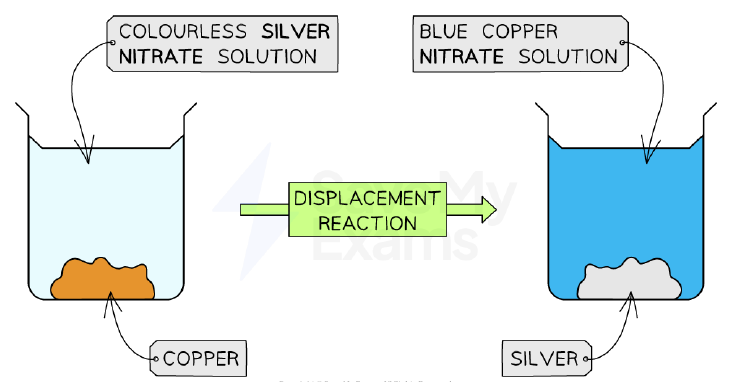
- Example of colour change: copper (orange-brown) + silver nitrate → silver solid + blue solution.
- Temperature changes: exothermic reactions release heat (e.g., CaO + water); endothermic reactions absorb heat (e.g., dissolving ammonium chloride).
- Effervescence (fizzing) indicates gas production, e.g., alkali metals + water produce hydrogen.
The metal displacement reaction of silver and copper
Rates of Reaction Factors
- Rate of reaction is affected by: concentration (or pressure for gases), surface area of solids, temperature, and catalysts.
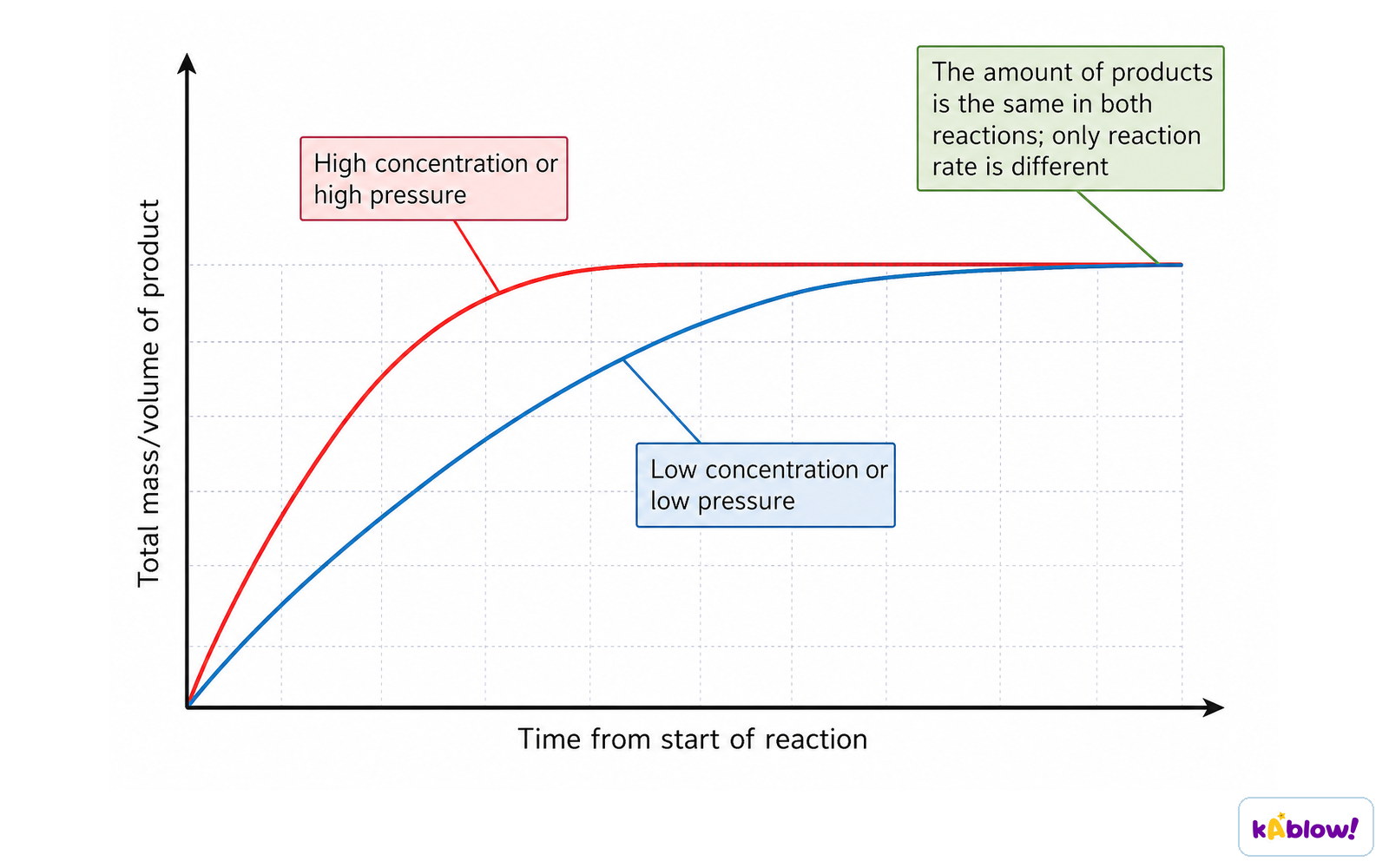
- Higher concentration/pressure → more particles per volume → steeper initial gradient, same final product amount.
- Higher surface area (e.g., powder vs lumps) → more exposed particles → steeper initial gradient, same final product.
- Higher temperature → particles have more kinetic energy → steeper initial gradient, same final product.
- Catalysts speed up reaction without being consumed; they provide an alternative pathway with lower activation energy.
Graph showing the effect of concentration on rate of reaction
Collision Theory
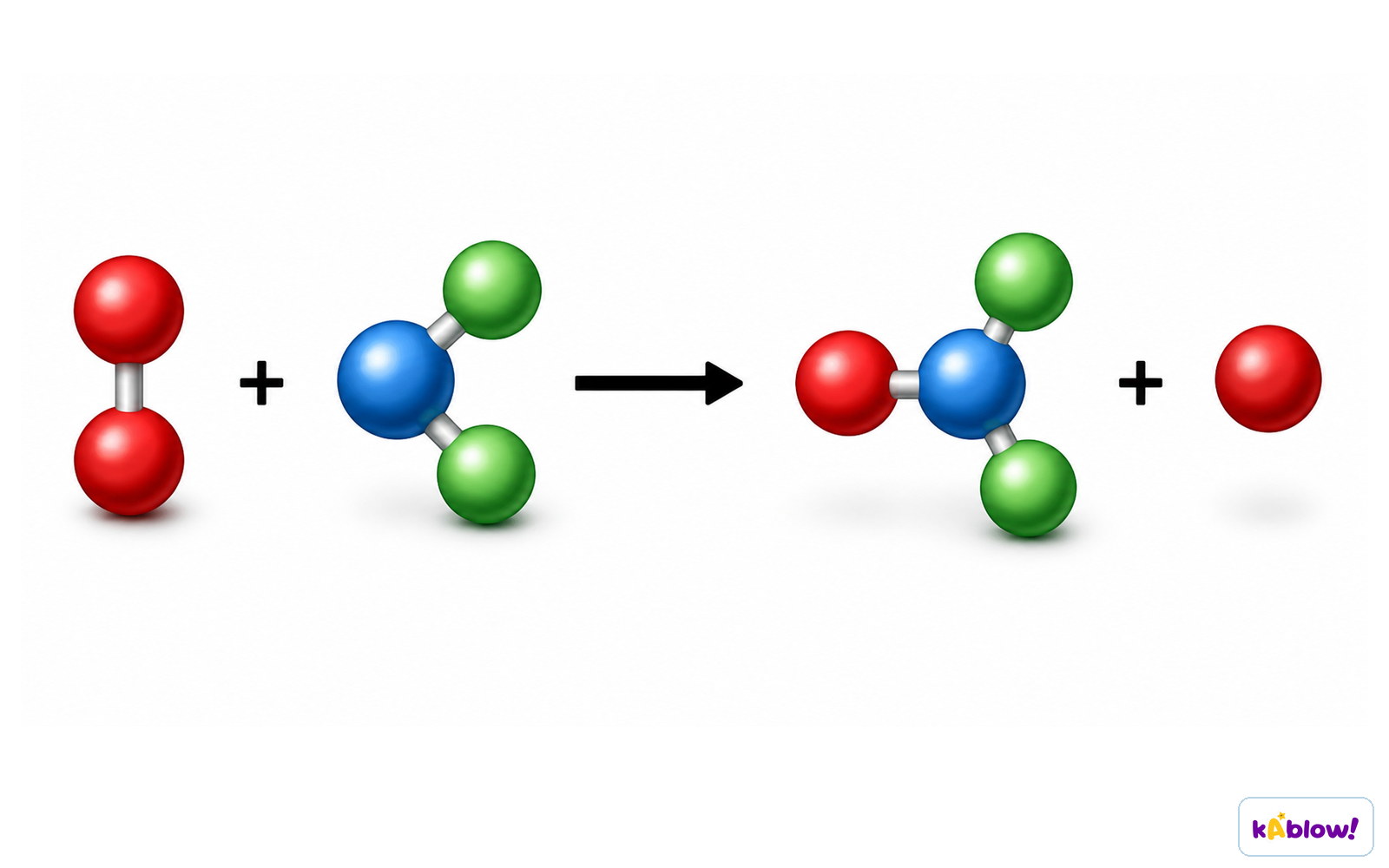
- For a reaction to occur, particles must collide with sufficient energy (≥ activation energy) and correct orientation.
- Successful collisions lead to product formation; unsuccessful collisions result in particles bouncing off unchanged.
- Rate depends on: number of particles per unit volume, collision frequency, kinetic energy of particles, and activation energy.
- Increasing any factor that raises collision frequency or energy increases the number of successful collisions per second.
A successful collision
Explaining Rates Using Collision Theory
- Concentration: more particles per volume → more collisions per second → higher rate.
- Pressure (gases): same particles in smaller volume → more collisions per second → higher rate.
- Surface area: more exposed particles → more collisions per second → higher rate.
- Temperature: particles gain kinetic energy → more collisions and a greater proportion exceed activation energy → rate increases sharply (≈ doubles per 10 °C).
- Catalysts: lower activation energy → more collisions have sufficient energy → higher rate.
Investigating the Rate of a Reaction
- Common methods: mass loss on a balance, gas volume (downward displacement or gas syringe), disappearing cross (precipitate formation).
- Disappearing cross: measure time for a cross to become obscured by sulfur precipitate from sodium thiosulfate + HCl.
- Gas collection: e.g., magnesium + acid → hydrogen; measure volume over time.
- Catalyst investigation: e.g., hydrogen peroxide decomposition with MnO₂ catalyst; compare gas volumes.
- Advantages/disadvantages: mass loss is simple but unsuitable for low‑mass gases; gas syringes are accurate but fragile.
Interpreting Data
- Rate is fastest at the start (steepest gradient) because reactant concentration is highest.
- As reaction proceeds, gradient decreases; when one reactant is used up, the line becomes horizontal (rate = 0).
- To find rate at a specific time, draw a tangent to the curve and calculate gradient = change in y / change in x.
- Comparing experiments: higher concentration, temperature, surface area, or catalyst gives a steeper initial curve and same final product amount (if limiting reactant unchanged).
- If the amount of limiting reactant is increased, the final product amount increases.
Think like a scientist
- A supervised class measures gas volume over time when equal masses of marble chips react with dilute acid at different concentrations.
- Comparison: the acid concentration. Outcome: gas volume produced in a fixed time.
- Control: keep the mass and surface area of marble chips constant. Explain why this makes the comparison fairer.
- Evidence: Use a consistent method, repeated observations where appropriate and a table with labelled quantities and units. Keep unexpected results and investigate their cause.
- Safety: Practical activities need teacher supervision and an appropriate risk assessment. Use the provided data or simulation where the investigation specifies it.
- Inquiry task: State a testable question, predict the outcome using the science, then explain how your observations would support or challenge the prediction.
Evaluate the science
- Controlling reaction rate helps manufacturing produce materials efficiently.
- A faster initial rate does not necessarily mean a larger final amount of product.
- Evaluation task: Link your conclusion to evidence, identify a limitation and suggest a specific improvement. Distinguish a measured result from an explanation of its cause.
슬라이드
연습 문제
무료 미리 보기 — 48개 중 8개 문제. 가입하면 전부 볼 수 있어요.
1.Which of the following processes represents a physical change?
Easy- AAcid base neutralisation
- BMetal displacement reactions
- CBoiling ethanol
- DCombustion of magnesium
2.Physical and chemical changes are different processes. Which of the following rows correctly identifies characteristics of each one?
Easy- Achemical change - no new substance formed; physical change - change of state
- Bchemical change - no new substance formed; physical change - involves electron transfer
- Cchemical change - new substance formed; physical change - involves electron transfer
- Dchemical change - new substance formed; physical change - change of state
3.Which process is a physical change?
Easy- Acracking of an alkane
- Bhydration of ethene
- Cfractional distillation of petroleum
- Dthermal decomposition of calcium carbonate
4.The rate of a reaction was monitored by recording the volume of gas produced every 5 seconds. What is the mean rate of reaction in the first 10 seconds of the reaction, in cm³/s? (Data: at 0 s, 0 cm³; at 5 s, 15 cm³; at 10 s, 35 cm³)
Easy- A2.9
- B3.0
- C3.5
- D2.5
5.A student investigates the rate of reaction between aqueous sodium thiosulphate and aqueous hydrochloric acid by measuring the time taken for a precipitate to obscure a cross underneath the beaker. Which statement is correct for the reaction?
Medium- AThe precipitate will be formed faster if ice is placed in contact with the beaker.
- BThe precipitate will be formed faster if 10.0 cm³ of water are added to the aqueous sodium thiosulphate.
- CThe precipitate will be formed slower if a catalyst is added to the reaction mixture.
- DThe precipitate will be formed faster if drops of concentrated hydrochloric acid are added to the reaction mixture.
6.Magnesium metal reacts with an excess of hydrochloric acid solution to form magnesium chloride and hydrogen: Mg (s) + 2HCl (aq) → MgCl₂ (aq) + H₂ (g). Which of the following will not increase the rate of this reaction?
Medium- AIncrease the temperature of the acid
- BIncrease the surface area to volume ratio of the pieces of magnesium
- CIncrease the concentration of the hydrochloric acid
- DIncrease the volume of hydrochloric acid solution used
7.Catalysts are often used in chemical reactions. Which letter represents two correct features of catalysts?
Medium- AFeature 1 - Lower activation energy for the reaction; Feature 2 - More products made in total
- BFeature 1 - Alternative pathway for the reaction is provided; Feature 2 - Not used up over the course of the reaction
- CFeature 1 - Makes industrial processes cheaper; Feature 2 - Metal catalysts are cheap to buy
- DFeature 1 - Reduce the overall energy change of the reaction; Feature 2 - Can be present in biological systems as enzymes
8.Which of the following statements explains how increasing temperature increases the rate of a reaction?
Hard- AIncreasing the temperature increases the kinetic energy of the particles so there are a smaller number of successful collisions.
- BIncreasing the temperature increases the kinetic energy of the particles so there are a larger number of unsuccessful collisions.
- CIncreasing the temperature decreases the kinetic energy of the particles so there are a larger number of successful collisions.
- DIncreasing the temperature increases the kinetic energy of the particles so there are a larger number of successful collisions.