Sound
플레이하며 배우기
이 문제들을 풀어 에너지를 얻은 뒤 낚시하고 탐험하세요. 계정이 필요 없어요.
교육자를 위해: Sound(MYP Physics, Year 1)을(를) 위한 바로 쓸 수 있는 수업 슬라이드, 복습 노트 — 수업에 사용하거나, 학습자들이 실시간 게임으로 즐기는 인터랙티브 클래스 활동으로 진행하세요.
수업 노트
Big idea: sound is a vibration that travels
- Big idea. Key concept: Systems. Sound is a system: a source that vibrates, a material that carries the vibration, and a detector such as your ear.
- Related concept: Interaction. A vibrating object pushes on the particles next to it, and they push on the next ones.
- Global context: Identities and relationships. Hearing lets us talk, listen to music and warn each other of danger.
- Every sound is made by something vibrating: a guitar string, a drum skin, a loudspeaker, your own vocal cords.
- A vibration is a very fast movement backwards and forwards. You can feel it by touching your throat while you hum.
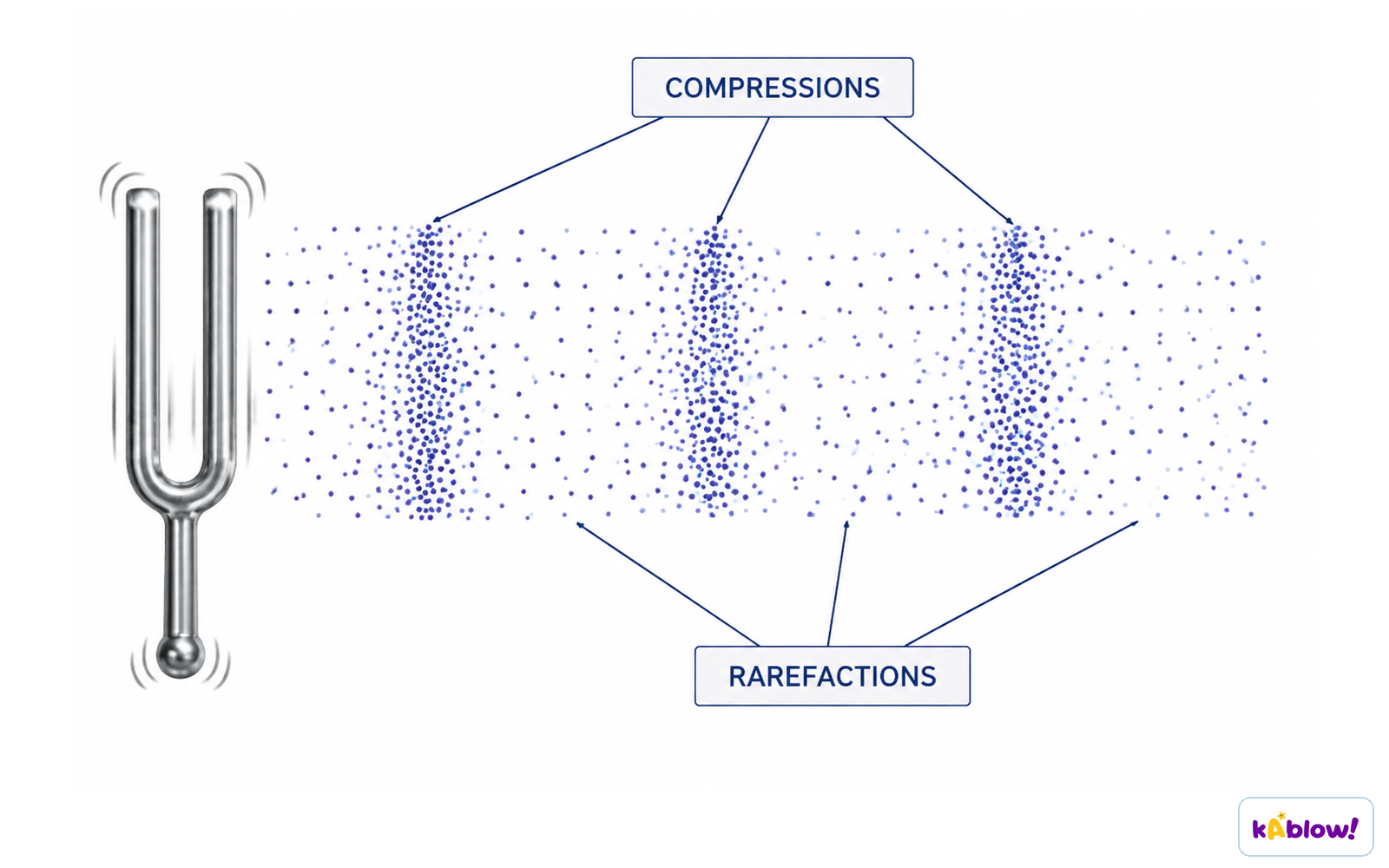
- The vibrating object pushes the air next to it. This makes regions where the particles are squashed together, called compressions, and regions where they are spread out, called rarefactions. These travel outwards as a sound wave.
A tuning fork sending compressions and rarefactions through air
How sound travels
- Sound needs a medium, which is a material made of particles. It can travel through solids, liquids and gases.
- Sound cannot travel through a vacuum (empty space) because there are no particles to pass the vibration on. This is why space is silent.
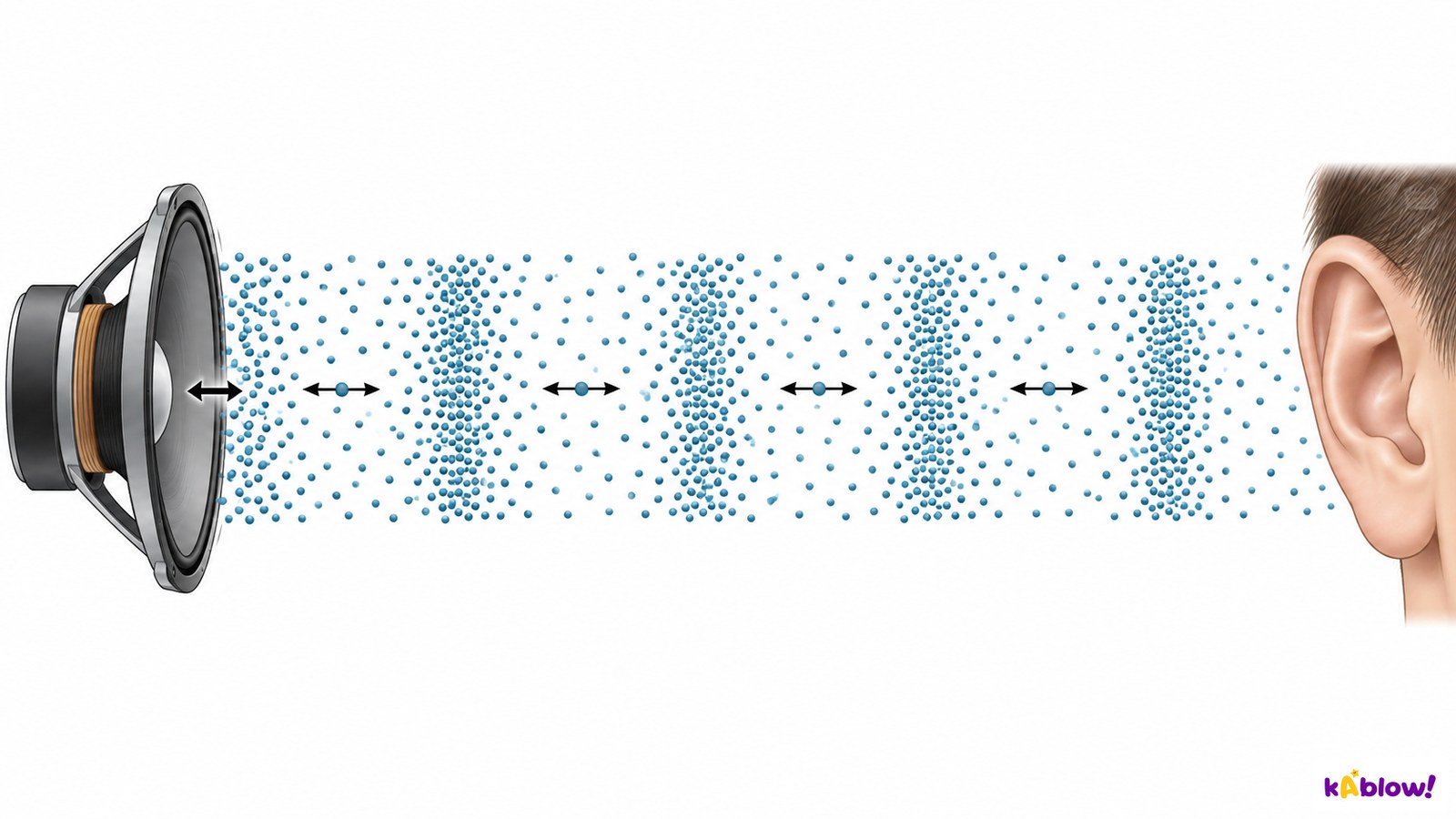
- The particles do not travel along with the sound. Each particle only moves a little to and fro and bumps its neighbour. The energy is what travels.
- Sound travels fastest in solids, slower in liquids and slowest in gases, because the particles are closer together in solids and pass the vibration on more quickly.
- Approximate speeds: about 340 m/s in air, about 1500 m/s in water and about 5000 m/s in steel.
- Light is far faster than sound, at about 300 000 000 m/s. This is why you see lightning before you hear the thunder.
Sound travelling from a loudspeaker to an ear
Loudness and pitch
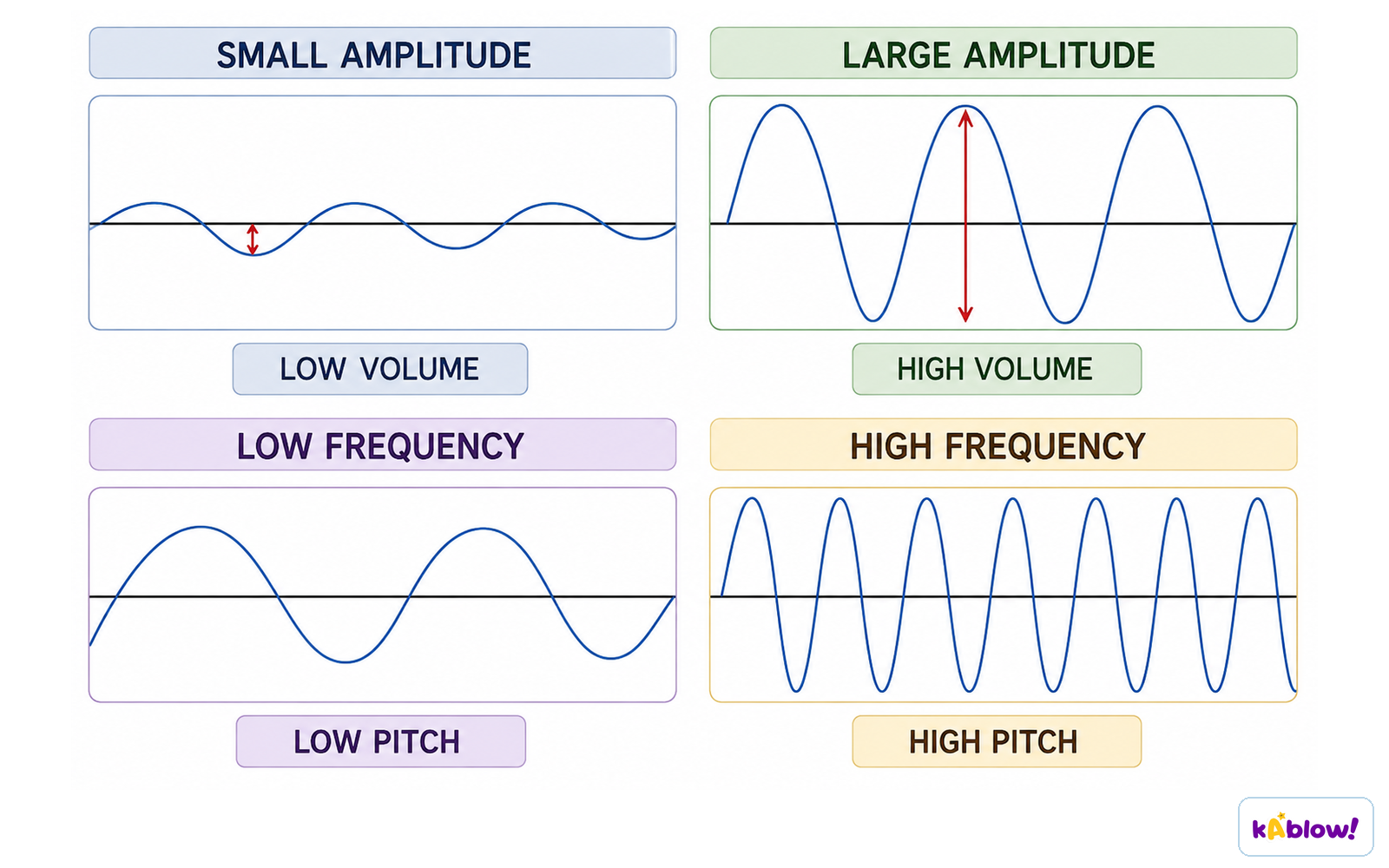
- Amplitude is how far the particles move from their rest position. A bigger vibration has a bigger amplitude.
- Loudness depends on amplitude. A bigger amplitude gives a louder sound. Hitting a drum harder makes a louder sound.
- Frequency is the number of vibrations (or waves) every second. It is measured in hertz (Hz). 1 Hz is one vibration per second.
- Pitch is how high or low a note sounds. A higher frequency gives a higher pitch. A whistle has a high pitch and a rumble of thunder has a low pitch.
- Changing the loudness does not change the pitch. A quiet high note and a loud high note have the same frequency.
- A shorter, thinner or tighter string vibrates faster and makes a higher note. A longer, thicker or looser string makes a lower note.
Amplitude and loudness, frequency and pitch
Hearing, ultrasound and keeping your ears safe
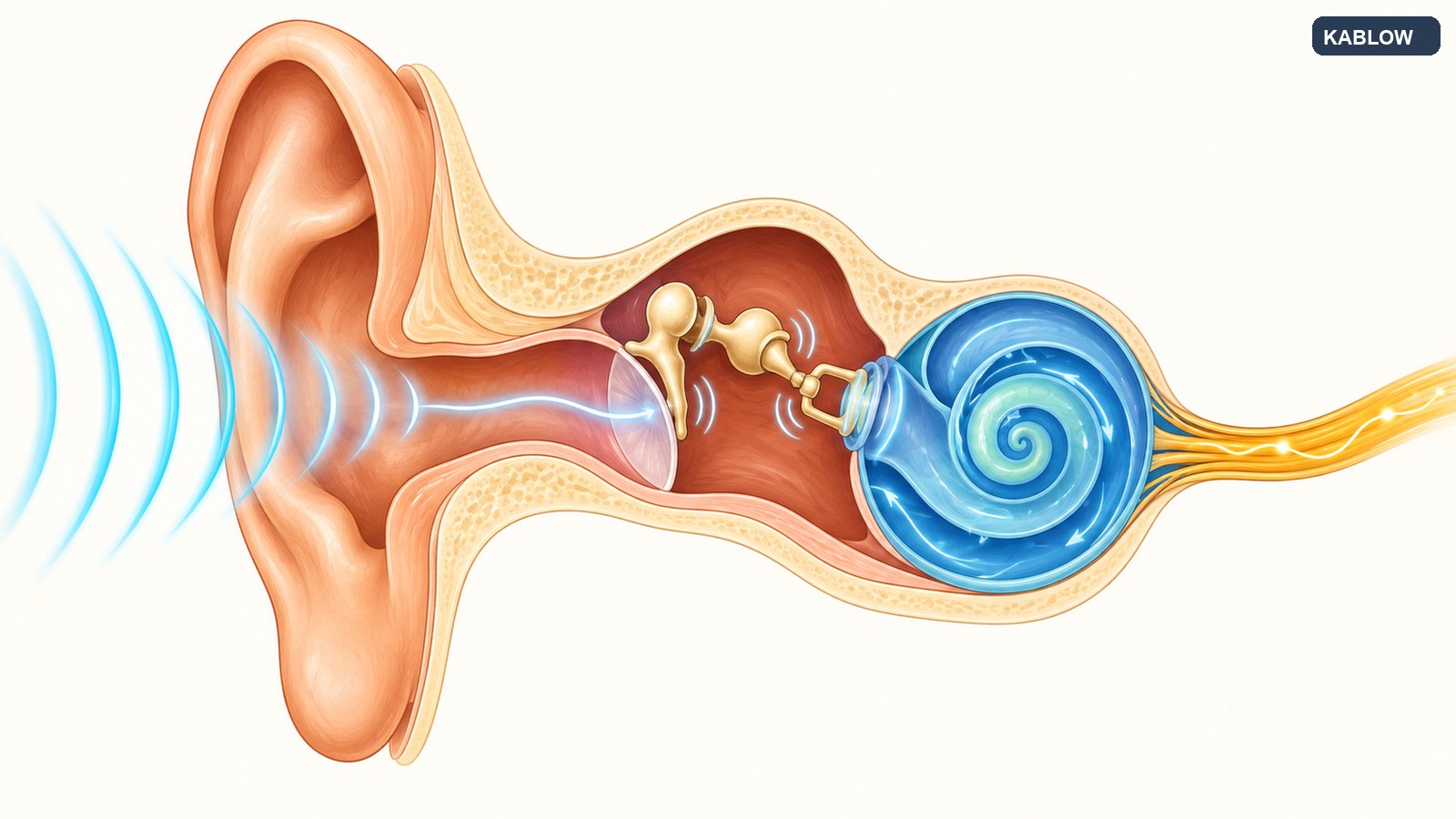
- Sound waves enter the ear canal and make the eardrum vibrate. Three tiny bones pass the vibrations on to the cochlea.
- The cochlea is filled with liquid and lined with sensitive cells. They turn the vibrations into electrical signals, which a nerve carries to the brain.
- Young people can hear frequencies from about 20 Hz to 20 000 Hz. The range gets smaller as we get older.
- Sound below 20 Hz is infrasound. Sound above 20 000 Hz is ultrasound. We cannot hear either, but some animals can: dogs hear some ultrasound and bats use it to find insects.
- Doctors use ultrasound to make pictures of the inside of the body. Boats use ultrasound in sonar to measure how deep the water is.
- Very loud sounds can damage the cochlea and the damage cannot be repaired. Keep music at a sensible level and wear ear protection near loud machines.
Sound waves travelling through the human ear
Speed of sound and echoes
- Speed, distance and time are linked by the equation distance = speed × time. This can be rearranged to speed = distance ÷ time and time = distance ÷ speed.
- In air, sound travels about 340 m every second. In 3 s it travels 340 × 3 = 1020 m. Always give the unit with your answer.
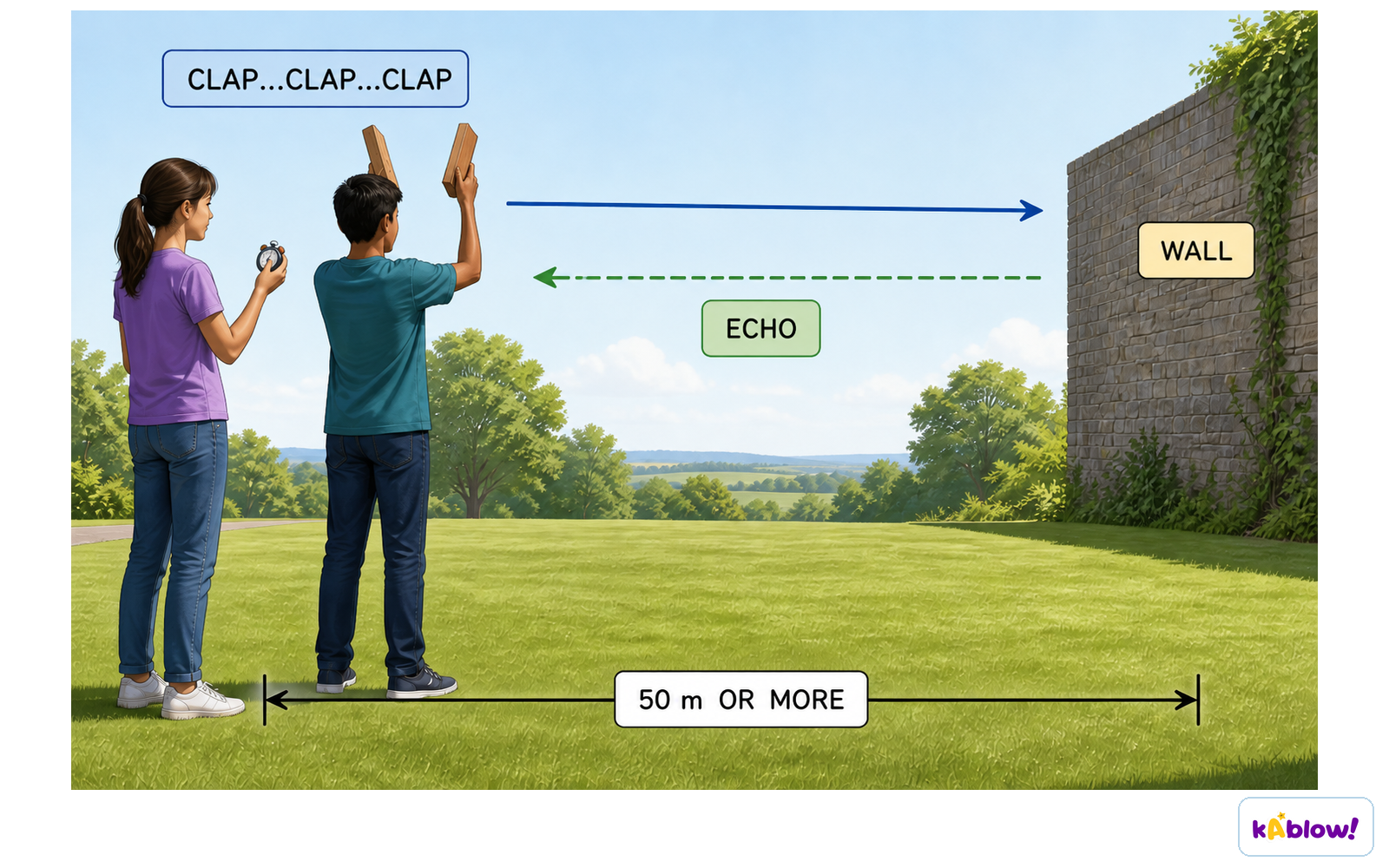
- An echo is sound that has been reflected from a surface. Hard, smooth surfaces such as stone walls reflect sound well. Soft, rough surfaces such as curtains and carpet absorb it, so there is little echo.
- For an echo, the sound travels to the wall and back. The distance it travels is twice the distance to the wall.
- So the distance to the wall = speed × time ÷ 2. An echo that comes back after 0.5 s means the wall is 340 × 0.5 ÷ 2 = 85 m away.
- Bats, dolphins and ships use echoes to find objects and measure distances. This is called echolocation in animals and sonar in ships.
A clap reflected from a wall as an echo
Think like a scientist: what changes the pitch of a note?
- Question: does the length of a ruler that overhangs a desk edge change the pitch of the note it makes when you twang it?
- The independent variable is the length of ruler that overhangs. The dependent variable is the pitch, which you can compare by ear, or measure with a free frequency app on a tablet.
- Control variables include the same ruler, the same way of twanging it and the same size of twang, so the loudness stays about the same.
- Try at least five lengths. Repeat each length three times and take a mean, because one reading could be a mistake.
- To evaluate, ask what could be wrong. Was it hard to judge the pitch by ear? Did the ruler slip? Did background noise confuse the app?
- Inquiry task: plan a fair test to find out whether the thickness of an elastic band changes its pitch when it is plucked. List your independent, dependent and control variables, say how you will measure the pitch and explain how you will make your results reliable.
슬라이드
연습 문제
무료 미리 보기 — 54개 중 8개 문제. 가입하면 전부 볼 수 있어요.
1.What produces every sound?
Easy- ASomething that is vibrating
- BSomething that is getting hot
- CSomething that is giving out light
- DSomething that is standing still
2.A guitar string is plucked and a note is heard. What is the string doing?
Easy- AMoving slowly in one direction only
- BMoving quickly backwards and forwards
- CGiving out tiny pieces of sound
- DStaying completely still all the time
3.Through which of these can sound NOT travel?
Easy- ALiquid water in a swimming pool
- BA long steel railway track
- CAir in a classroom
- DA vacuum such as outer space
4.Which part of the ear vibrates first when a sound wave arrives?
Easy- AThe eardrum
- BThe cochlea
- CThe auditory nerve
- DThe outer ear flap
5.What is the unit of frequency?
Easy- AMetres per second (m/s)
- BNewtons (N)
- CHertz (Hz)
- DSeconds (s)
6.What is an echo?
Easy- ASound that is too high for people to hear
- BSound that has bounced off a surface and is heard again
- CSound that travels through a solid only
- DSound that is made louder by a loudspeaker
7.Ultrasound is sound with a frequency...
Easy- Aabove 20 000 Hz, higher than humans can hear
- Bbelow 20 Hz, lower than humans can hear
- Cbetween 20 Hz and 20 000 Hz
- Dthat is exactly the same as the speed of sound
8.In which of these does sound travel fastest?
Easy- AA steel bar
- BAir
- CWater
- DA vacuum
기출 문제
이 주제의 기출 문제 연습이 곧 나와요.
곧 출시