Density
플레이하며 배우기
이 문제들을 풀어 에너지를 얻은 뒤 낚시하고 탐험하세요. 계정이 필요 없어요.
교육자를 위해: Density(MYP Physics, Year 2)을(를) 위한 바로 쓸 수 있는 수업 슬라이드, 복습 노트 — 수업에 사용하거나, 학습자들이 실시간 게임으로 즐기는 인터랙티브 클래스 활동으로 진행하세요.
수업 노트
Big idea: how much matter is packed into a space
- Big idea (key concept): Relationships. Density links two measurements, mass and volume, into one number that describes a material.
- Related concept: Patterns. Every pure material has its own density, so density helps us recognise materials and predict what will float or sink.
- Global context: Scientific and technical innovation. Engineers choose materials by density: light alloys for aircraft, dense concrete for foundations, buoyant materials for life jackets.
- Density tells you how much mass a material has in each unit of volume. A brick is denser than a sponge of the same size because it has more mass packed into the same space.
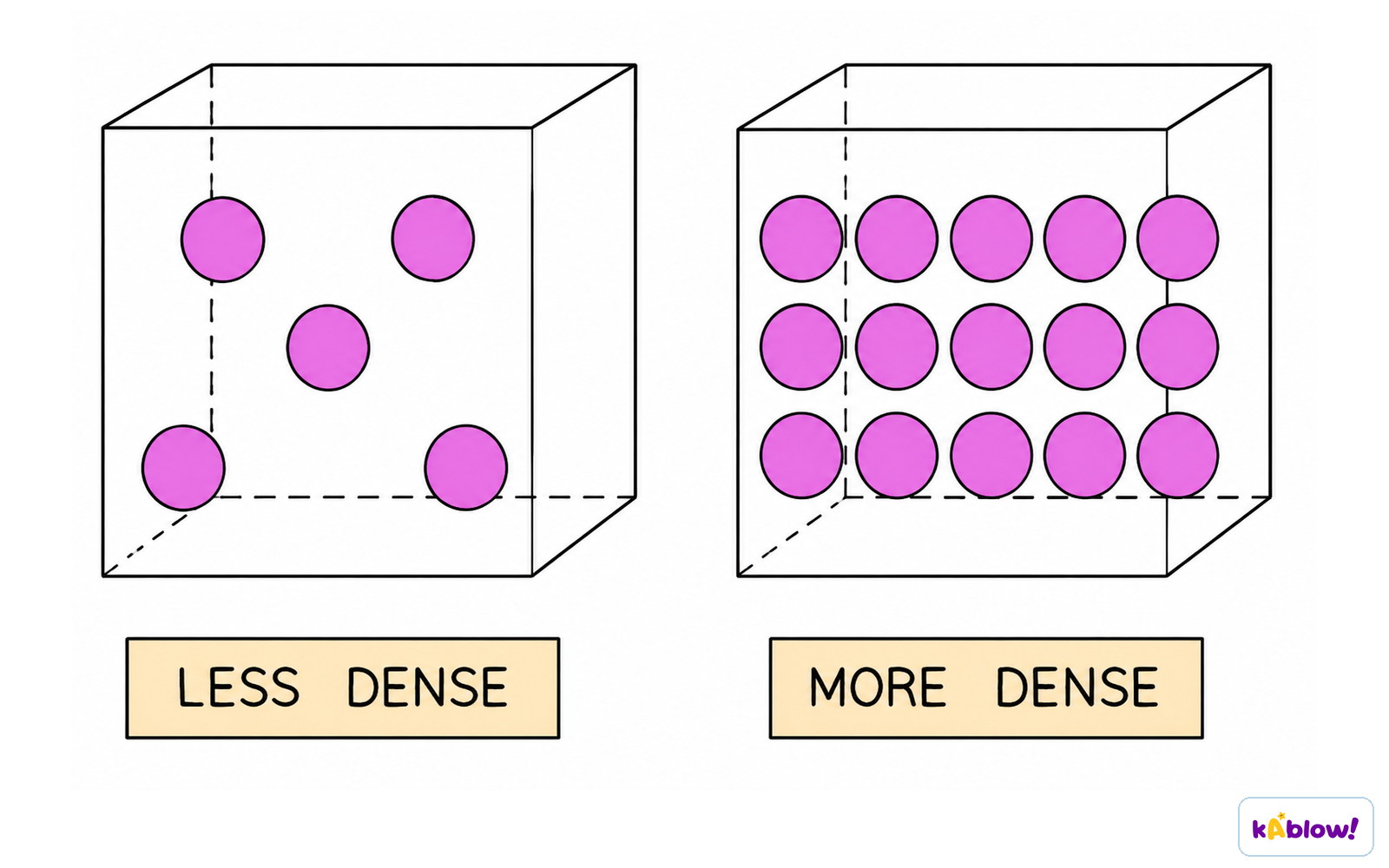
- In a dense material the particles are packed closely together, or the particles themselves are heavy. In a less dense material there is more empty space between lighter particles.
- Density is a property of the material, not the size of the piece. A tiny nail and a huge iron girder have the same density.
Particles packed less closely and more closely in equal volumes
Calculating density
- The equation in words: density = mass / volume. In symbols, \rho = m / V , where the Greek letter rho ( \rho ) stands for density.
- Common units: mass in grams (g) and volume in cm³ give density in g/cm³. Mass in kilograms (kg) and volume in m³ give density in kg/m³.
- To change units: 1 g/cm³ = 1000 kg/m³. Water is 1 g/cm³, which is 1000 kg/m³.
- Worked example: a block has a mass of 240 g and a volume of 80 cm³. Density = 240 g / 80 cm³ = 3 g/cm³.
- The equation can be rearranged. mass = density x volume and volume = mass / density.
- Worked example (rearranging): aluminium has a density of 2.7 g/cm³. A piece of volume 50 cm³ has mass = 2.7 g/cm³ x 50 cm³ = 135 g.
- Always write the unit. A density of '3' means nothing; '3 g/cm³' does.
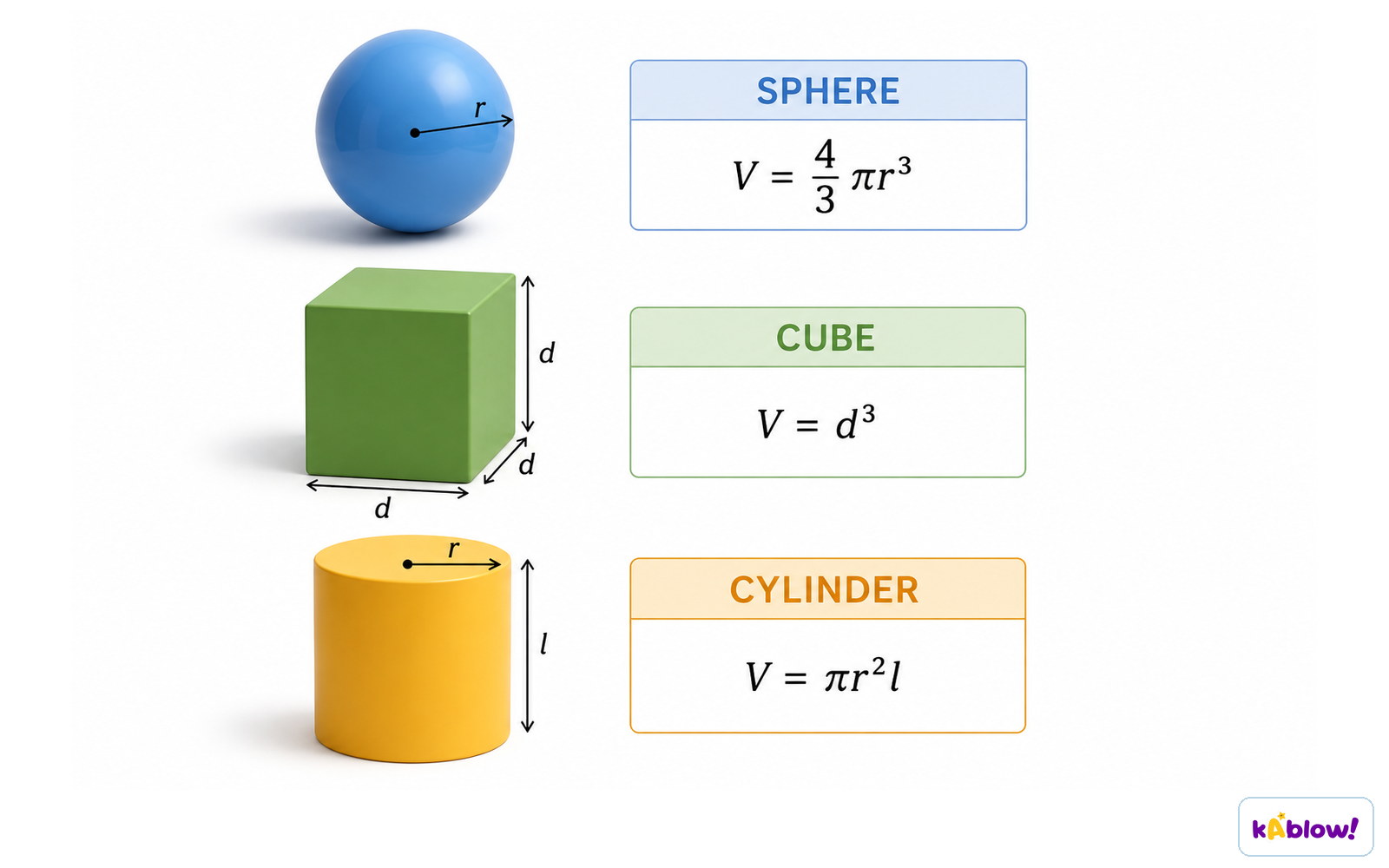
Volume formulas for a sphere, a cube and a cylinder
Measuring density in the laboratory
- You always need two measurements: the mass and the volume.
- Mass: put the object on a balance. For a liquid, weigh the empty container, add the liquid, weigh again and subtract. The difference is the mass of the liquid.
- Volume of a regular solid (such as a cuboid): measure length, width and height with a ruler and use volume = length x width x height.
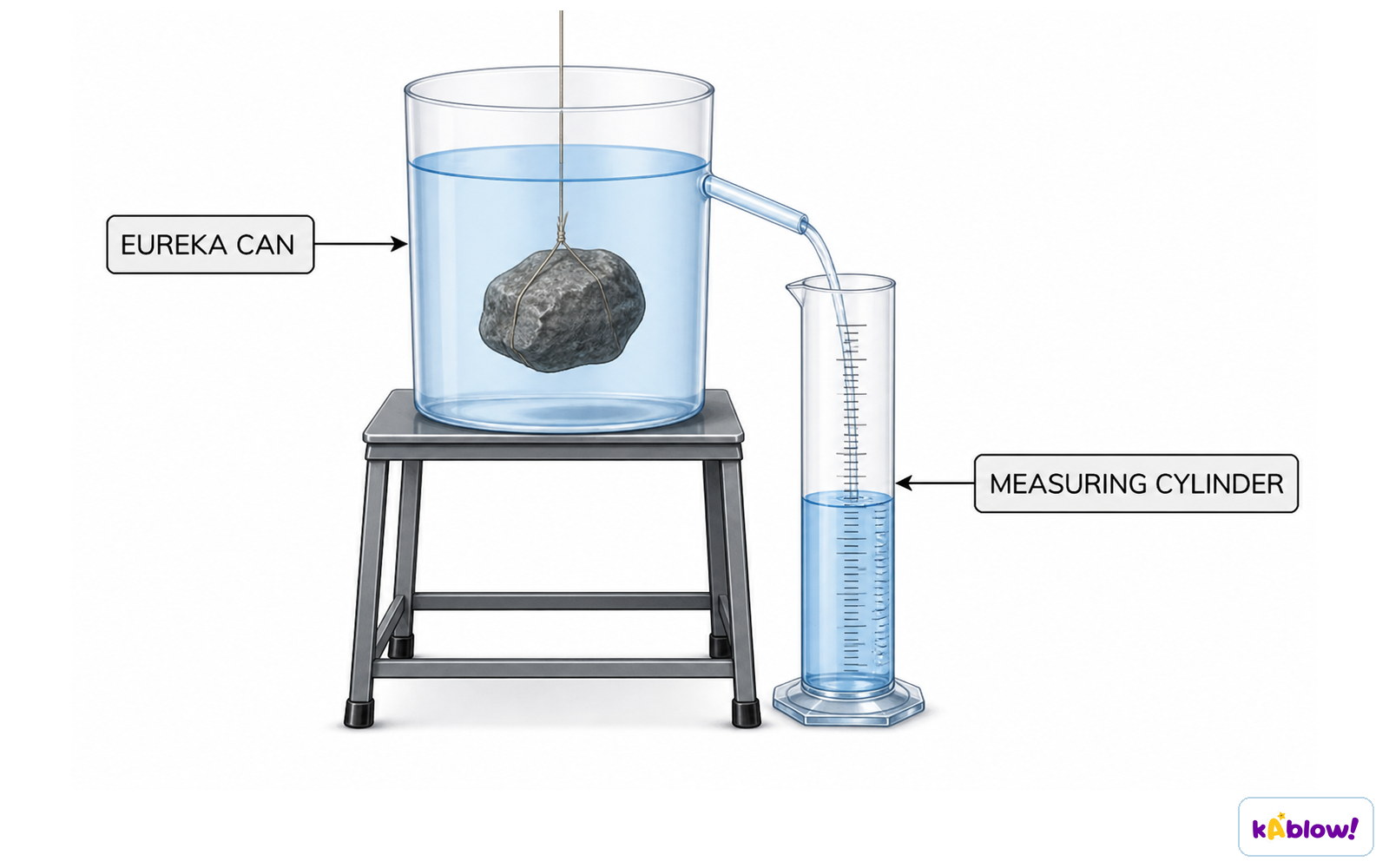
- Volume of an irregular solid (such as a stone): use displacement. Lower it into a eureka can or into water in a measuring cylinder and measure the volume of water pushed out of the way. That volume equals the volume of the stone.
- Volume of a liquid: pour it into a measuring cylinder and read the scale at the bottom of the curved surface, with your eye level with the liquid.
- Safety: wipe up spills at once so nobody slips, lower objects in gently so water does not splash, and wear eye protection if your teacher asks you to.
Finding the volume of a stone by displacement
Floating and sinking
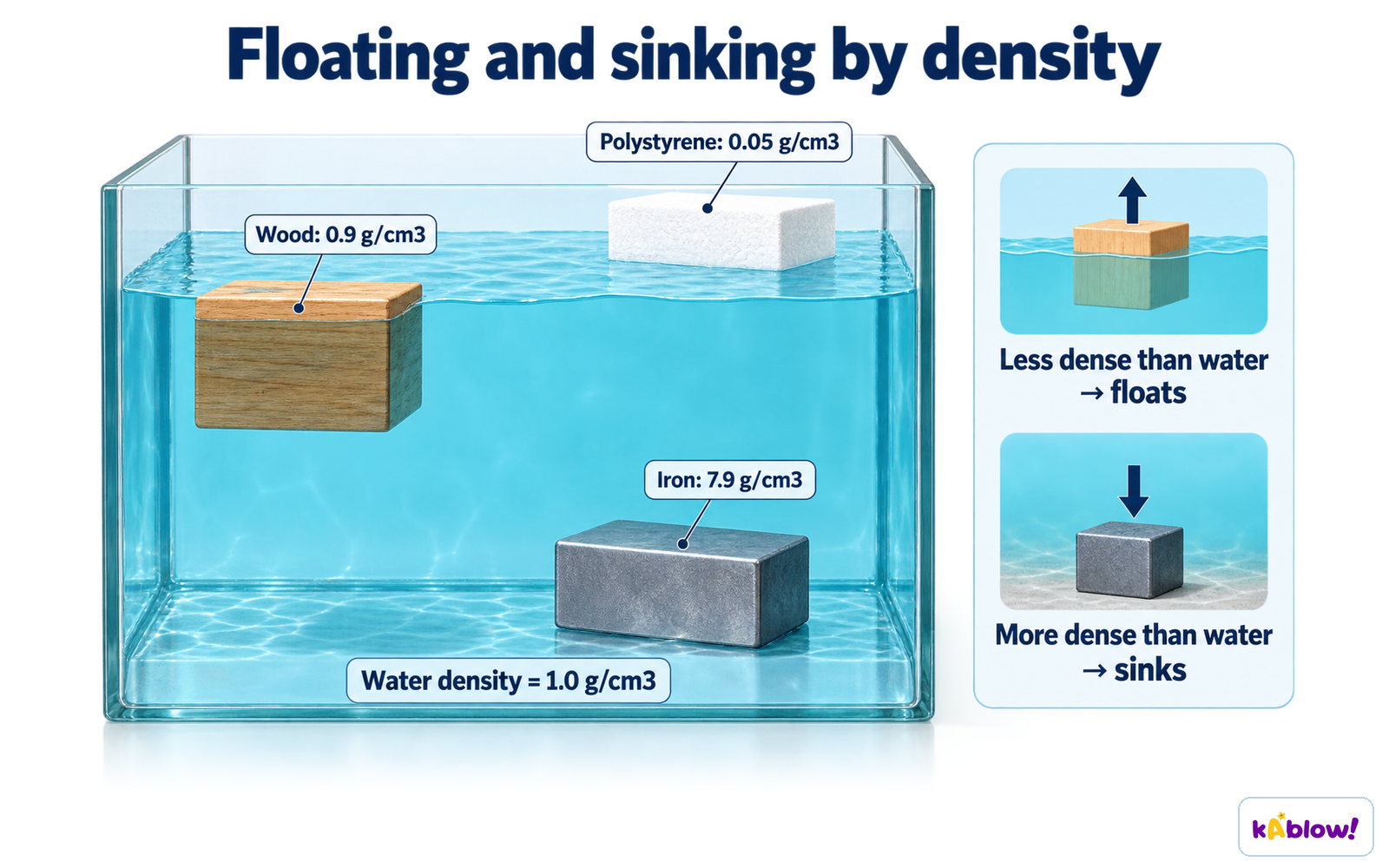
- Water has a density of 1.0 g/cm³. An object floats in water if its density is less than 1.0 g/cm³, and sinks if its density is greater.
- Some examples: polystyrene is about 0.05 g/cm³ and floats very high; wood in the picture is 0.9 g/cm³ and floats low; iron is 7.9 g/cm³ and sinks.
- The same rule works in any liquid: compare the object's density with the liquid's density.
- A steel ship floats even though steel is denser than water. A ship is a hollow shape full of air, so its average density (total mass divided by total volume) is less than water.
- Worked example: an object has a mass of 50 g and a volume of 40 cm³. Density = 50 / 40 = 1.25 g/cm³. This is greater than 1.0 g/cm³, so it sinks in water.
Polystyrene and wood float in water while iron sinks
Liquids, gases and layers
- Gases are far less dense than liquids and solids because their particles are very far apart. Air is only about 1.2 kg/m³, roughly a thousand times less dense than water.
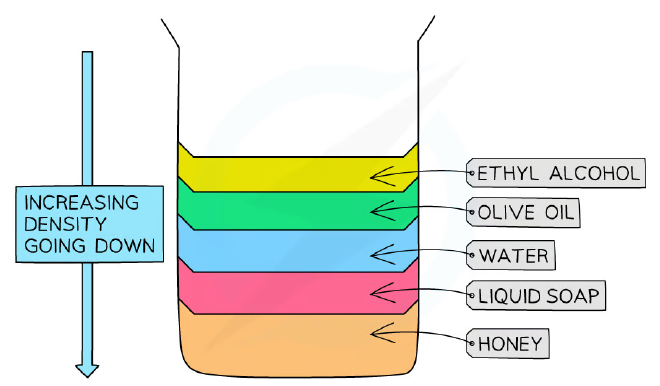
- Liquids that do not mix form layers with the densest at the bottom. In the picture, honey is the densest and ethyl alcohol the least dense.
- When a gas is squashed into a smaller volume its mass stays the same, so its density increases. When a gas is heated and expands, its density decreases, which is why hot air rises.
- Most solids are denser than their liquids, because particles are closer together in the solid. Water is unusual: ice is less dense than liquid water (about 0.92 g/cm³), so ice floats.
Five liquids layered by density in a beaker
Think like a scientist: does salt change what floats?
- A student wants to find out whether dissolving salt in water changes how well an egg floats. This tests whether a denser liquid pushes objects up better.
- The independent variable (what you change) is the mass of salt dissolved in the water. The dependent variable (what you measure) can be the fraction of the egg that sits above the surface, or whether it floats or sinks.
- Control variables (keep the same): the same egg, the same volume of water, the same temperature, the same container.
- Mass and volume of each salt solution can be measured to calculate its density. Repeat each test at least 3 times so one odd result does not mislead you.
- Inquiry task: plan the investigation with 5 different masses of salt. Say how you would treat one result that looks very different from the rest (an anomaly), and how you would present the density of each solution in a table and graph.
슬라이드
연습 문제
무료 미리 보기 — 53개 중 8개 문제. 가입하면 전부 볼 수 있어요.
1.What does the density of a material tell you?
Easy- AHow big a piece of it is
- BHow hot it is compared with water
- CHow much mass it has in each unit of volume
- DHow strongly gravity pulls on one gram of it
2.Which equation gives density?
Easy- Adensity = mass / volume
- Bdensity = volume / mass
- Cdensity = mass x volume
- Ddensity = mass + volume
3.Which of these is a unit of density?
Easy- Acm³
- Bg/cm³
- Cg
- DN/kg
4.A material has a density of 0.8 g/cm³. Water has a density of 1.0 g/cm³. What happens when a block of the material is placed in water?
Easy- AIt sinks
- BIt dissolves
- CIt floats only if it is hollow
- DIt floats
5.A piece of iron and a piece of wood are exactly the same size. Why is the iron heavier?
Easy- AIron has more mass packed into the same volume
- BIron has less mass in the same volume
- CIron takes up more volume than wood
- DGravity is stronger for iron than for wood
6.Which method can you use to find the volume of an irregular stone?
Easy- AMeasure its length with a ruler only
- BMeasure how much water it displaces
- CWeigh it on a balance
- DMultiply its mass by 10
7.Which of these is usually the least dense?
Easy- AWater
- BIron
- COlive oil
- DAir
8.Water has a density of 1 g/cm³. What is this in kg/m³?
Easy- A1 kg/m³
- B1000 kg/m³
- C100 kg/m³
- D10 000 kg/m³
기출 문제
이 주제의 기출 문제 연습이 곧 나와요.
곧 출시