Refraction, lenses and optical evidence
플레이하며 배우기
이 문제들을 풀어 에너지를 얻은 뒤 낚시하고 탐험하세요. 계정이 필요 없어요.
수업 노트
Big idea: refraction, lenses and optical evidence
- Key concept: Systems. Light changes speed when it crosses into another medium. At oblique incidence this changes direction; lenses use refraction to form images.
- Related concepts: Models and evidence. Use a scientific explanation to make predictions, then test it against observations.
- Global context: Scientific and technical innovation. Lenses are used in cameras and instruments to form useful images.
Reflection of Light
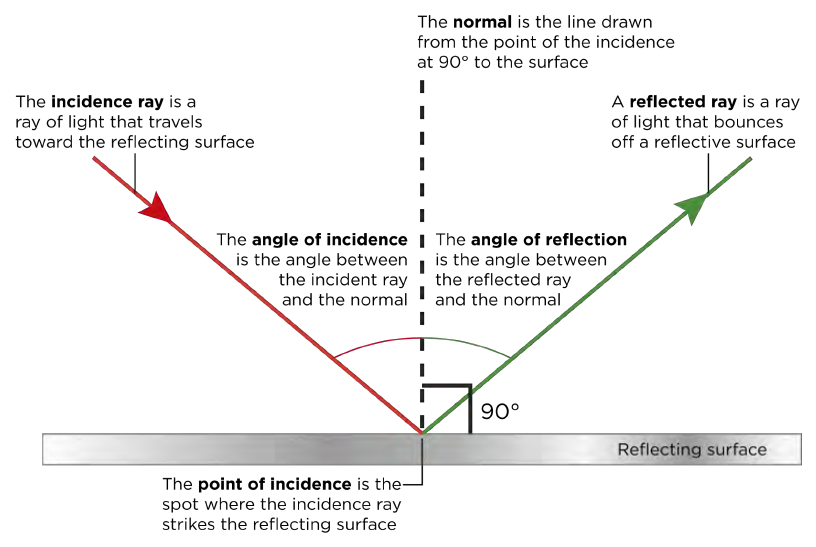
- A normal is drawn at right angles to the boundary between two media.
- Angles are measured between the ray and the normal: angle of incidence (i) and angle of reflection (r).
- Law of reflection: angle of incidence = angle of reflection (i = r).
- In a plane mirror, the image is virtual, same size, same distance behind the mirror as the object is in front, and laterally inverted.
- Ray diagrams show incident and reflected rays with arrows indicating direction.
Reflection of light
Investigating Reflection
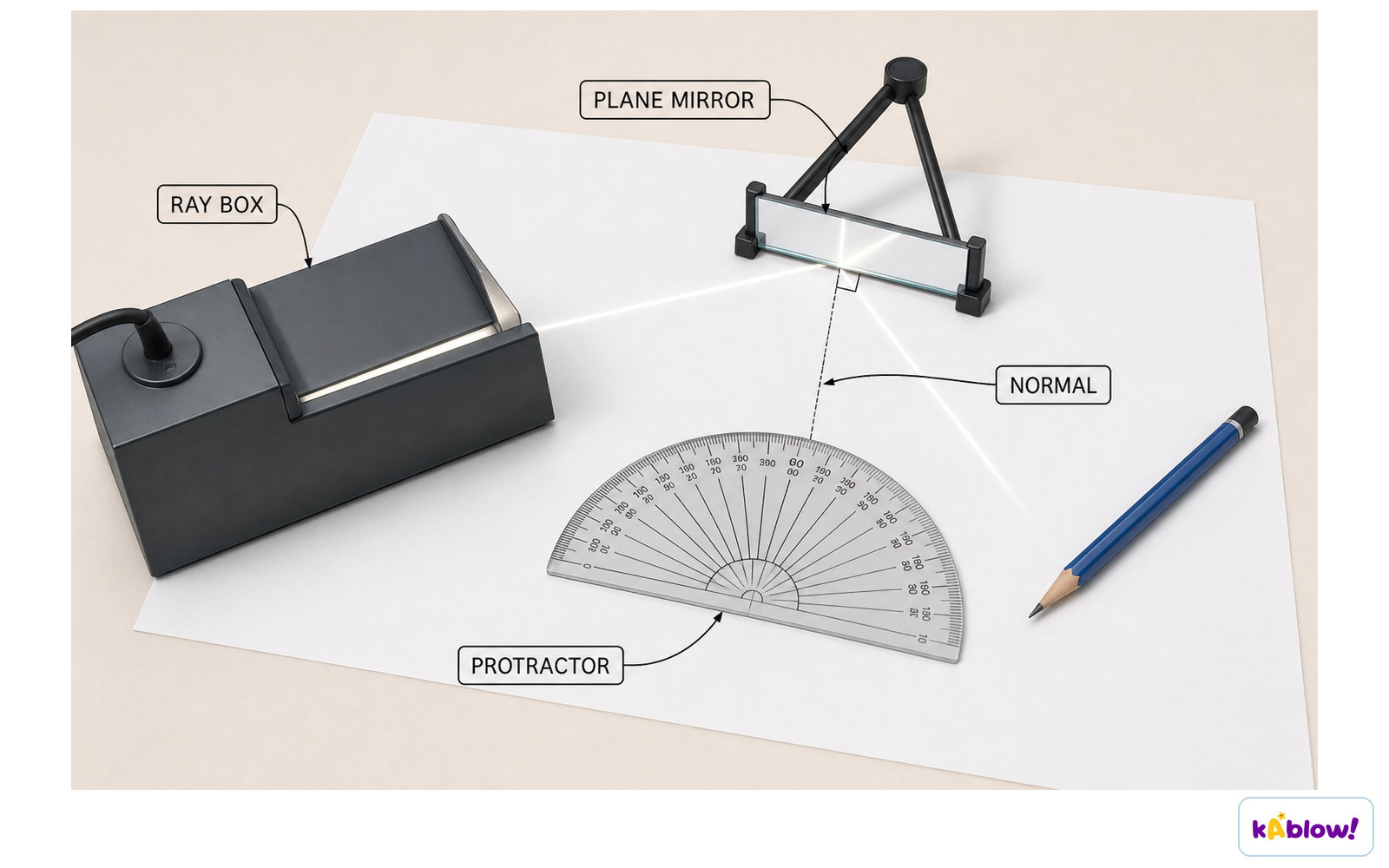
- Aim: To investigate reflection by a plane mirror.
- Independent variable: angle of incidence; dependent variable: angle of reflection.
- Use a ray box, protractor, paper, pencil, ruler, and plane mirror.
- Mark incident and reflected ray positions, then measure angles with a protractor.
- Repeat for different angles of incidence to verify i = r.
Apparatus for investigating the reflection of light
Refraction of Light
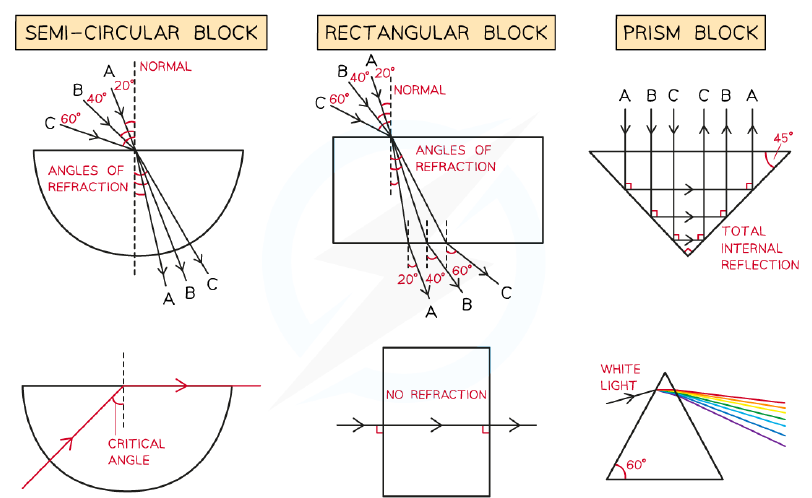
- Refraction occurs when light passes between two transparent media of different optical density.
- From less dense to more dense (e.g., air to glass): light bends towards the normal.
- From more dense to less dense (e.g., glass to air): light bends away from the normal.
- If light travels along the normal, it does not bend.
- Frequency remains constant; speed and wavelength change.
Refraction of light through different shapes of perspex blocks (semi-circular, rectangular, prism)
Refractive Index
- Refractive index n = speed of light in vacuum / speed of light in material.
- Also n = sin i / sin r (Snell's law).
- Refractive index has no unit. For the ordinary transparent materials studied here, such as glass and water, it is greater than 1 relative to a vacuum.
- Higher n means more optically dense (e.g., diamond n ≈ 2.4, glass n ≈ 1.5).
Total Internal Reflection
- Total internal reflection (TIR) occurs when light travels from a denser to a less dense medium and the angle of incidence exceeds the critical angle (c).
- Critical angle: angle of incidence for which angle of refraction = 90°.
- Relationship: sin c = 1/n.
- Higher n gives smaller critical angle.
- Uses: optical fibres (communications, endoscopes), prisms in periscopes, binoculars.
Ray Diagrams for Lenses
- Converging (convex) lens: brings parallel rays to a focus at the principal focus (f).
- Diverging (concave) lens: makes parallel rays diverge; virtual focus on same side as incoming light.
- Focal length: distance from lens centre to principal focus.
- Three key rays: through optical centre (undeviated), parallel to axis (through focus), through focus (emerges parallel).
Real & Virtual Images
- Real image: formed where rays converge and can be projected on a screen. A single converging lens forms an inverted real image of a real object outside its focal length.
- Virtual image: rays appear to diverge from its position; it cannot be projected directly on a screen. The single-lens examples studied here produce upright virtual images of real objects.
- Converging lens can produce real or virtual images depending on object position.
- Diverging lens always produces a virtual, upright, diminished image.
Correcting Sight & Dispersion
- Long-sightedness: image forms behind retina; corrected with converging (convex) lens.
- Short-sightedness: image forms in front of retina; corrected with diverging (concave) lens.
- Dispersion: white light splits into colours when refracted by a prism; violet bends most, red least.
- Visible spectrum: red, orange, yellow, green, blue, indigo, violet (longest to shortest wavelength).
- Monochromatic light: single frequency/colour (e.g., laser).
Think like a scientist
- Use a school ray box to compare angles of incidence and refraction as light enters a glass block; never direct it towards eyes.
- Comparison: the angle of incidence. Outcome: the angle of refraction measured from the normal.
- Control: use the same glass block and light source. Explain why this makes the comparison fairer.
- Evidence: Use a consistent method, repeated observations where appropriate and a table with labelled quantities and units. Keep unexpected results and investigate their cause.
- Safety: Practical activities need teacher supervision and an appropriate risk assessment. Use the provided data or simulation where the investigation specifies it.
- Inquiry task: State a testable question, predict the outcome using the science, then explain how your observations would support or challenge the prediction.
Evaluate the science
- Lenses are used in cameras and instruments to form useful images.
- The ray model predicts paths but does not describe every wave effect or correct for all lens distortions.
- Evaluation task: Link your conclusion to evidence, identify a limitation and suggest a specific improvement. Distinguish a measured result from an explanation of its cause.
슬라이드
연습 문제
무료 미리 보기 — 50개 중 8개 문제. 가입하면 전부 볼 수 있어요.
1.What is the law of reflection?
Easy- AAngle of incidence equals angle of reflection
- BAngle of incidence equals angle of refraction
- CAngle of reflection is twice the angle of incidence
- DAngle of incidence is greater than angle of reflection
2.Which type of image cannot be projected onto a screen?
Easy- AReal image
- BVirtual image
- CInverted image
- DMagnified image
3.When light passes from air into glass, it bends towards the normal. What happens to the speed of light?
Easy- AIt increases
- BIt decreases
- CIt stays the same
- DIt becomes zero
4.A ray of light enters a glass block of refractive index 1.5 at an angle of incidence of 30°. What is the angle of refraction? (sin 30° = 0.5)
Medium- A19.5°
- B30°
- C45°
- D9.7°
5.What is the critical angle for a material with refractive index 1.5?
Medium- A41.8°
- B25°
- C90°
- D30°
6.Which of the following is a condition for total internal reflection to occur?
Easy- ALight travels from a less dense to a more dense medium
- BThe angle of incidence is less than the critical angle
- CLight travels from a more dense to a less dense medium and the angle of incidence is greater than the critical angle
- DThe angle of incidence equals the angle of refraction
7.A student measures the angle of incidence as 40° and the angle of refraction as 25°. What is the refractive index of the medium? (sin 40° = 0.643, sin 25° = 0.423)
Medium- A1.52
- B0.66
- C1.0
- D2.0
8.Which colour of light is refracted the most when white light passes through a prism?
Easy- ARed
- BGreen
- CBlue
- DViolet