Magnetic fields and material applications
플레이하며 배우기
이 문제들을 풀어 에너지를 얻은 뒤 낚시하고 탐험하세요. 계정이 필요 없어요.
교육자를 위해: Magnetic fields and material applications(MYP Physics, Year 5)을(를) 위한 바로 쓸 수 있는 수업 슬라이드, 복습 노트 — 수업에 사용하거나, 학습자들이 실시간 게임으로 즐기는 인터랙티브 클래스 활동으로 진행하세요.
수업 노트
Big idea: magnetic fields and material applications
- Key concept: Systems. A magnetic field describes the force effects around a magnet. Field lines point from north to south outside a magnet; induced magnetism depends on the material.
- Related concepts: Models and evidence. Use a scientific explanation to make predictions, then test it against observations.
- Global context: Scientific and technical innovation. Magnetic materials are used in compasses, motors and electromagnets.
Magnetism
- Magnets have two poles: north and south.
- Magnetic forces are strongest at the poles.
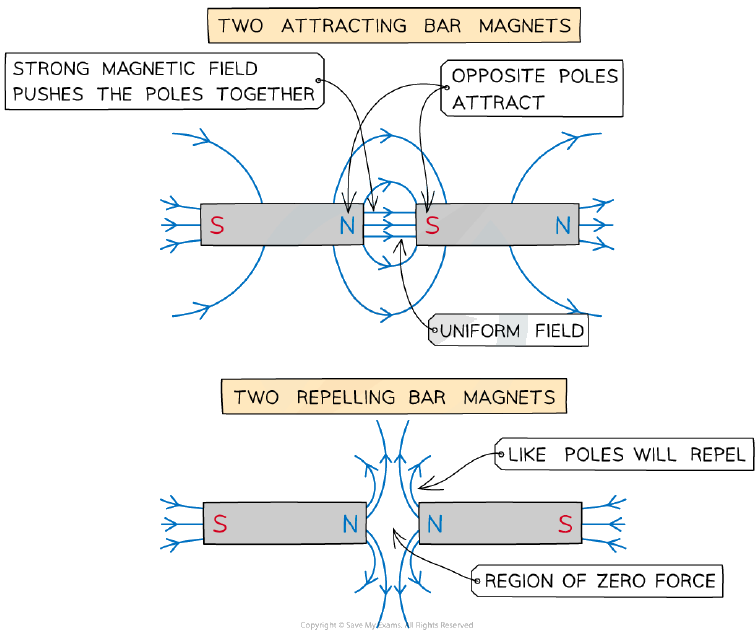
- Like poles repel (N–N or S–S).
- Opposite poles attract (N–S).
- Attraction/repulsion between magnetic poles is a non-contact force.
Magnetic field lines showing attraction and repulsion between bar magnets.
Magnetic Materials
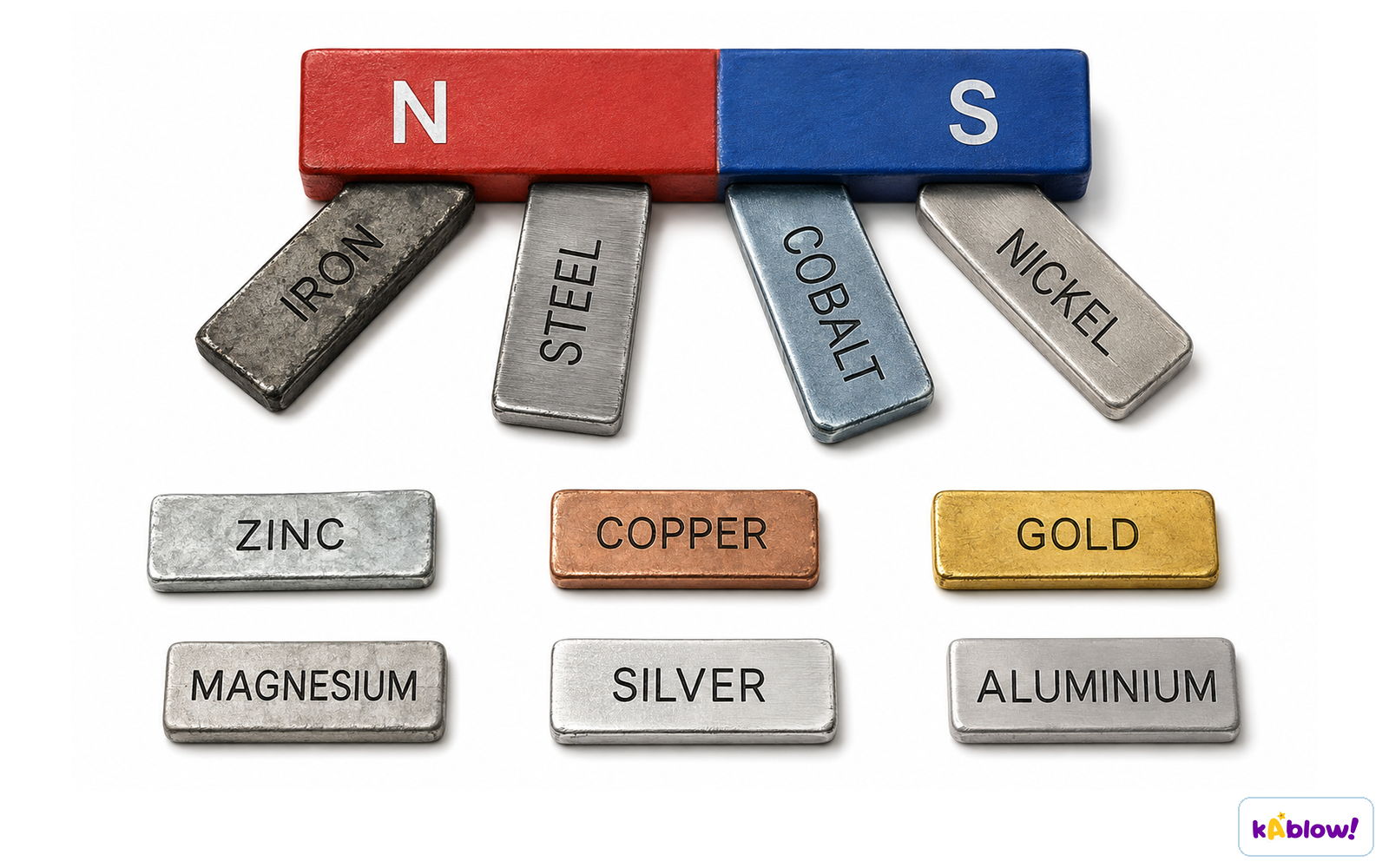
- Only a few metals are magnetic: iron, cobalt, nickel.
- Steel (an alloy containing iron) is also magnetic.
- Magnetic materials are attracted to both poles of a magnet.
- Non-magnetic materials (e.g., aluminium, plastic) are not affected by a magnet.
- A material is a magnet if it repels a known magnet; it is magnetic if it attracts; non-magnetic if neither.
Magnetic materials are attracted to a magnet; non-magnetic materials are not
Permanent Magnets
- Made from hard magnetic materials such as steel.
- Produces its own magnetic field.
- Does not lose its magnetism easily.
- Used in: compasses, school lab magnets, toys, fridge magnets.
Compasses and toy trains are examples of the use of permanent magnets

Induced (Temporary) Magnets
- Made from soft magnetic materials such as soft iron.
- Becomes magnetised only when placed in a magnetic field.
- The end closest to the magnet gains the opposite pole.
- Loses magnetism quickly when removed from the field.
- Used in: electromagnets, transformers.
Magnetic Fields
- A magnetic field is a region where a magnetic pole experiences a force.
- Field lines go from north pole to south pole.
- Arrows show direction of force on a north pole.
- Field is strongest at the poles (lines are closer together).
- Field weakens with distance (lines spread apart).
Plotting Magnetic Fields
- Iron filings method: Place paper over magnet, sprinkle filings, tap gently to reveal field pattern.
- Plotting compass method: Place compass near magnet, mark needle ends, move compass step by step to trace field lines.
- Compass needle points from north to south (north arrow points to south pole of magnet).
Uses of Electromagnets
- MRI scanners in hospitals use powerful electromagnets for imaging.
- Speakers and earphones use electromagnets to produce sound.
- Recycling: Electromagnets separate steel from other scrap.
- Mag-Lev trains use repulsion between electromagnets to hover and reduce friction.
Think like a scientist
- Map the direction of a bar magnet's field using a small plotting compass at different positions.
- Comparison: the compass position around the magnet. Outcome: the compass direction.
- Control: keep the magnet position and orientation constant. Explain why this makes the comparison fairer.
- Evidence: Use a consistent method, repeated observations where appropriate and a table with labelled quantities and units. Keep unexpected results and investigate their cause.
- Safety: Practical activities need teacher supervision and an appropriate risk assessment. Use the provided data or simulation where the investigation specifies it.
- Inquiry task: State a testable question, predict the outcome using the science, then explain how your observations would support or challenge the prediction.
Evaluate the science
- Magnetic materials are used in compasses, motors and electromagnets.
- Field lines are a model rather than physical threads; nearby magnetic materials and fields can distort the observations.
- Evaluation task: Link your conclusion to evidence, identify a limitation and suggest a specific improvement. Distinguish a measured result from an explanation of its cause.
슬라이드
연습 문제
무료 미리 보기 — 50개 중 8개 문제. 가입하면 전부 볼 수 있어요.
1.Which of the following lists of metals contains only metals that are non-ferrous?
Easy- AIron, steel, nickel
- BCobalt, copper, steel
- CAluminium, brass, copper
- DIron, tin, aluminium
2.Which metal is suitable for use as a permanent magnet?
Easy- ASteel
- BSoft iron
- CCopper
- DAluminium
3.Which of the following lists contains only ferrous metals?
Easy- AAluminium and iron
- BSteel and iron
- CSteel and lead
- DTin and iron
4.Which statement about a permanent bar magnet is incorrect?
Easy- AThe S-pole attracts the N-pole of another magnet
- BThe S-pole repels the S-pole of another magnet
- CIt cannot repel a non-magnetic material
- DIt is made from a soft magnetic material (such as soft iron)
5.Which magnet has the strongest magnetic field?
Easy- AA bar magnet with widely spaced field lines
- BA bar magnet with closely spaced field lines
- CA bar magnet with no field lines
- DA bar magnet with field lines that cross
6.What material can a temporary magnet be made from?
Easy- APlastic
- BSoft iron
- CSteel
- DWood
7.Which compass correctly shows the direction of the magnetic field due to a bar magnet?
Easy- AA compass with its north pole pointing towards the magnet's south pole
- BA compass with its north pole pointing towards the magnet's north pole
- CA compass with its south pole pointing towards the magnet's south pole
- DA compass with its needle aligned perpendicular to the magnet
8.Which of the following statements about a permanent bar magnet is true?
Medium- AThe north pole of a permanent bar magnet will repel the north pole of another magnet.
- BA permanent bar magnet must be made from a soft magnetic material.
- CA permanent bar magnet can repel a magnetic material.
- DThe field lines of a permanent bar magnet cross each other where the field is strongest.
기출 문제
이 주제의 기출 문제 연습이 곧 나와요.
곧 출시