Cell Specialisation
플레이하며 배우기
이 문제들을 풀어 에너지를 얻은 뒤 낚시하고 탐험하세요. 계정이 필요 없어요.
수업 노트
Stem Cells: Core Properties
- A stem cell is a cell that can divide by mitosis an unlimited number of times.
- Each new cell produced when a stem cell divides can either remain a stem cell or develop into a specialised cell by differentiation.
- The two key properties of stem cells are self-renewal (capacity to divide) and the ability to differentiate.
- After differentiation, a cell is no longer considered a stem cell.
- Some stem cells remain in specific locations in the body called stem cell niches, giving tissues the capacity to regenerate and repair.
- A niche environment must be able to maintain stem cells in an inactive state and also stimulate their proliferation and differentiation.
Stem Cell Niches in the Body
- Bone marrow provides a niche for stem cells used to replace red blood cells, white blood cells and platelets, which are required indefinitely.
- The hair follicle niche is located at the root of the hair where it anchors into the skin; stem cells here promote continual hair growth.
- Stem cells in bone marrow can only produce cells that differentiate into the different types of blood cells, as adult stem cells have already partially differentiated.
Stem Cell Potency
- Potency is the ability of stem cells to differentiate into more specialised cell types.
- Totipotent stem cells can differentiate into any cell type found in an embryo, as well as extra-embryonic cells such as the placenta.
- The zygote formed when a sperm cell fertilises an egg cell is totipotent, as are embryonic cells up to the 16-cell stage of human embryo development.
- Pluripotent stem cells are embryonic stem cells that can differentiate into any cell type found in an embryo but not into extra-embryonic cells.
- Multipotent stem cells are adult stem cells that can differentiate into closely related cell types, e.g. bone marrow stem cells differentiating into different blood cells.
- Unipotent stem cells are adult cells that can only differentiate into their own lineage, e.g. heart muscle cells (cardiomyocytes) generating new cardiomyocytes; most cells in animal bodies are unipotent.
- Totipotent cells have the highest potency and unipotent cells the lowest.
Cell Specialisation and Differentiation
- In complex multicellular organisms, eukaryotic cells become specialised for specific functions; this is also called the division of labour.
- Specialisation occurs after fertilisation to allow development of different tissues within the embryo.
- Specialised cells develop specific adaptations for their role, enabling tissues to function more efficiently.
- Structural adaptations include the shape of the cell and the organelles the cell contains or does not contain.
- For example, cells that make large amounts of proteins contain many ribosomes, the organelle responsible for protein production.
- During differentiation, cell sizes can vary drastically; size is a feature of adaptation, so cells require different dimensions to carry out their jobs efficiently.
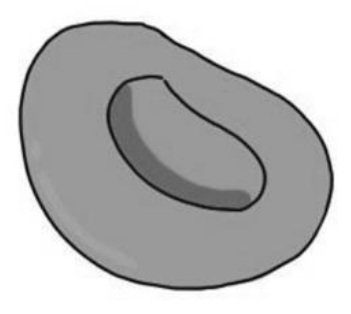
A red blood cell
How Differentiation Adapts Cells to Their Function
- Red blood cells are small to allow movement through narrow capillaries.
- Active white blood cells are larger than inactive ones to allow space for rER and Golgi apparatus for protein (antibody) synthesis.
- Sperm cells are long for movement towards the egg cell and have narrow streamlined heads to reduce resistance.
- An egg cell body has the largest volume of all cells to allow for stored food reserves.
- A nerve cell has a large cell body to allow protein synthesis to maintain the structure of the long axon, required for rapid delivery of impulses.
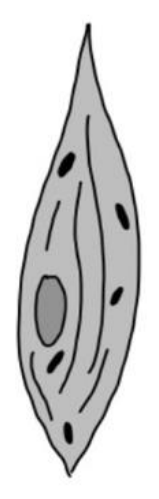
- Muscle cells are larger than normal cells; their length and diameter are designed to exert force during muscle contraction.
Surface Area to Volume Ratio and Cell Size
- For cells to survive, metabolic reactions must occur; these rely on materials being constantly exchanged across the plasma membrane at the cell's surface.
- The metabolic requirements of a cell vary with the volume or mass of cytoplasm, where the reactions take place.
- As cells increase in size, their surface area to volume ratio (SA:V) decreases.
- An increase in volume raises metabolic requirements, but the ability to exchange with the environment does not increase at the same rate.
- Single-celled organisms have a high SA:V ratio, so they can survive by simple diffusion at the cell surface; their metabolic requirements are relatively low and the diffusion distance to all organelles is short.
- For larger cells, the SA:V ratio is too small for survival using only diffusion: metabolic requirements are higher, surface area is not large enough for sufficient exchange, and the diffusion distance to the centre of the cell is too long.
- Once the SA:V ratio becomes too small, growth must stop and cells must divide, giving rise to multicellular organisms.
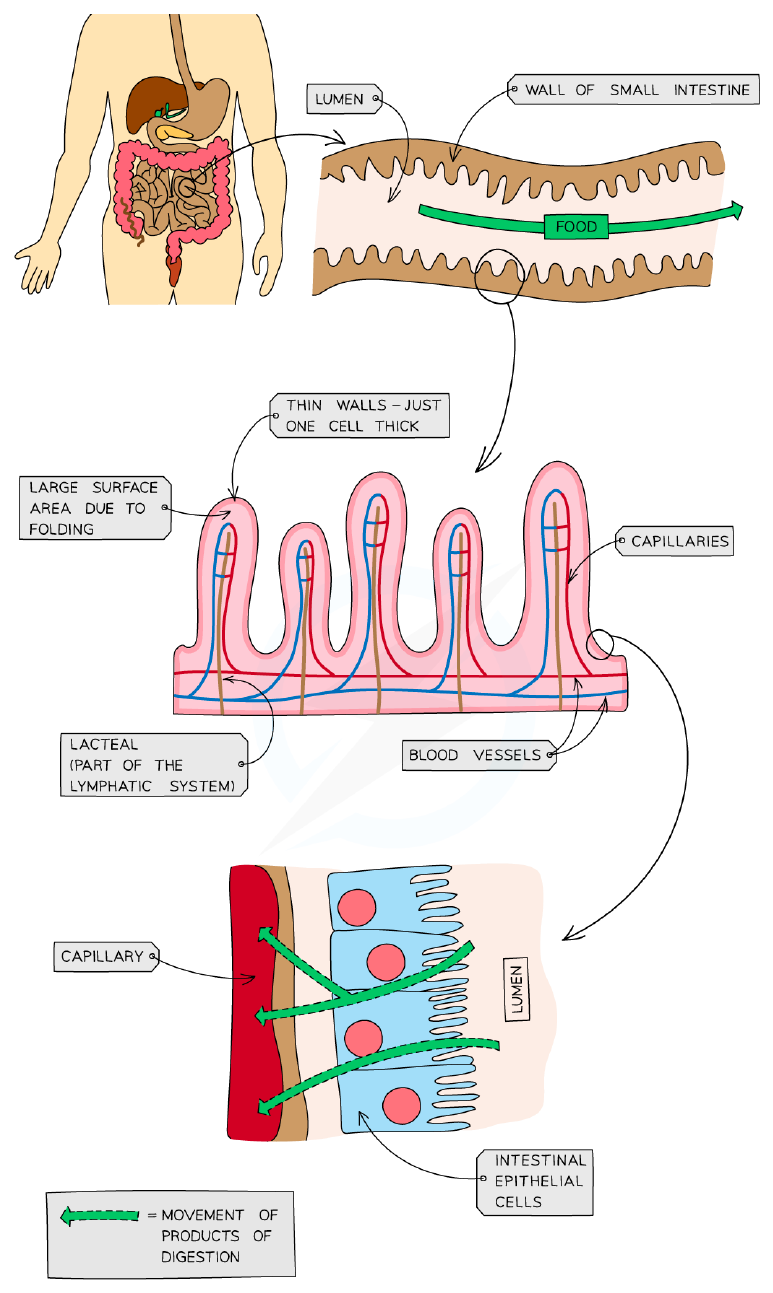
- Multicellular organisms have evolved adaptations such as gas exchange systems, digestive systems and circulatory systems to facilitate exchange and transport.
Adaptations of the small intestine
Investigating Surface Area to Volume Ratio
- Scientists use models as simplified versions of complex systems to test predictions and develop explanations.
- Agar cubes can model the effect of changing surface area to volume ratio on the rate of ion diffusion.
- Coloured agar is cut into cubes of different dimensions (e.g. 0.5 cm, 1 cm and 2 cm cubes); purple agar can be made using dilute sodium hydroxide and Universal Indicator.
- The surface area, volume and SA:V ratio of the cubes are calculated and recorded.
- Cubes are placed into boiling tubes containing the same volume of dilute hydrochloric acid, which has a higher molarity than the sodium hydroxide so diffusion can be monitored by colour change.
- Measurements can be the time taken for the acid to completely change the indicator colour, or the distance travelled into the block in a given time.
- Times can be converted to rates, and a graph drawn of rate of diffusion against SA:V ratio.
Specialised Cells: Maximising Surface Area
- Maximising surface area to volume ratio is crucial in cells that require movement of substances across the membrane.
- The larger the surface area compared to the volume, the faster the rate of substance movement.
- Red blood cells (erythrocytes) deliver oxygen from the lungs to respiring cells.
- They are flattened and biconcave in shape to maximise surface area and minimise volume, so oxygen diffuses in more quickly in the lungs and out at respiring tissues.
- Proximal convoluted tubule cells are tiny tubes in the outer region of the kidney responsible for reabsorption of vital substances such as glucose and mineral ions from the glomerular filtrate.
- These cells have microvilli in the apical membrane and invaginations (infoldings) in the basal membrane to maximise surface area.
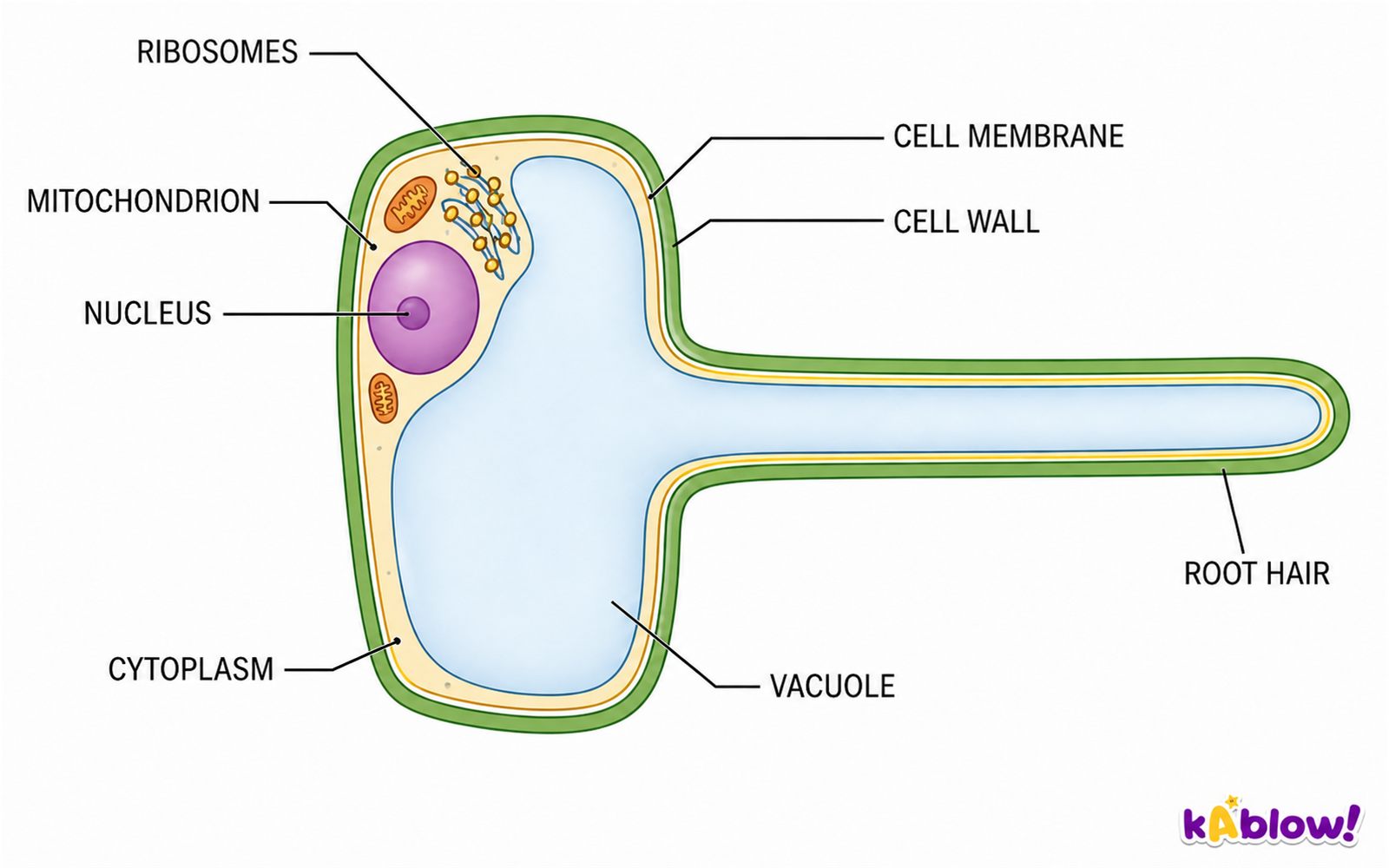
A root hair cell: its long extension increases the surface area for absorbing water.
Specialised Cells: Pneumocytes
- Millions of alveoli in the lungs collectively provide maximum surface area for gas exchange by diffusion.
- The alveolar walls (alveolar epithelium) are only one cell thick, providing a short diffusion distance.
- Type I pneumocytes are extremely thin cells making up the majority of the alveolar epithelium, adapted to maximise gas exchange by providing a short diffusion distance.
- Capillary walls are also only one cell thick, so there is usually less than 0.5 μm between the air in the alveoli and the blood.
- Type II pneumocytes are rounded cells with many secretory vesicles (lamellar bodies) that secrete a solution coating the alveolar epithelium; they occupy around 5% of the epithelium.
- The solution contains pulmonary surfactant, whose molecules have hydrophobic tails and hydrophilic heads and form a monolayer with the tails facing the alveolar air.
- Pulmonary surfactant reduces surface tension, maintaining alveolar shape, preventing alveoli sticking together and preventing the lungs from collapsing.
- The moisture layer allows oxygen to dissolve before diffusing into the blood, and carbon dioxide diffuses from the moist surface before removal in exhalation.
Specialised Cells: Muscle
- Skeletal muscle is attached to the skeleton and aids movement; cardiac muscle is found in the heart; smooth muscle is found in blood vessels and organs.
- Skeletal muscle is striated, appearing stripy under a microscope; striated muscle cells are bundled into fibres surrounded by a single plasma membrane called the sarcolemma.
- Muscle fibres are cell-like units: each contains an organised arrangement of contractile proteins, many nuclei, specialised endoplasmic reticulum called sarcoplasmic reticulum (SR) that stores calcium, and specialised cytoplasm called sarcoplasm.
- The sarcoplasm contains mitochondria, which carry out aerobic respiration to generate ATP for contraction, and myofibrils, bundles of actin and myosin filaments that slide past each other during contraction.
- The sarcolemma has deep tube-like projections called T-tubules that run close to the SR.
- Cardiac muscle is myogenic, meaning it contracts without external stimulation via nerves or hormones, allowing the heart to beat at its own regular intervals.
- Cardiac muscle does not tire or fatigue, so it can contract continuously throughout life.
- Cardiac muscle fibres form a network through the walls of the atria and ventricles and are connected by branched intercalated discs, allowing contraction to spread quickly; they contain many mitochondria and contractile myofibrils.
A muscle cell
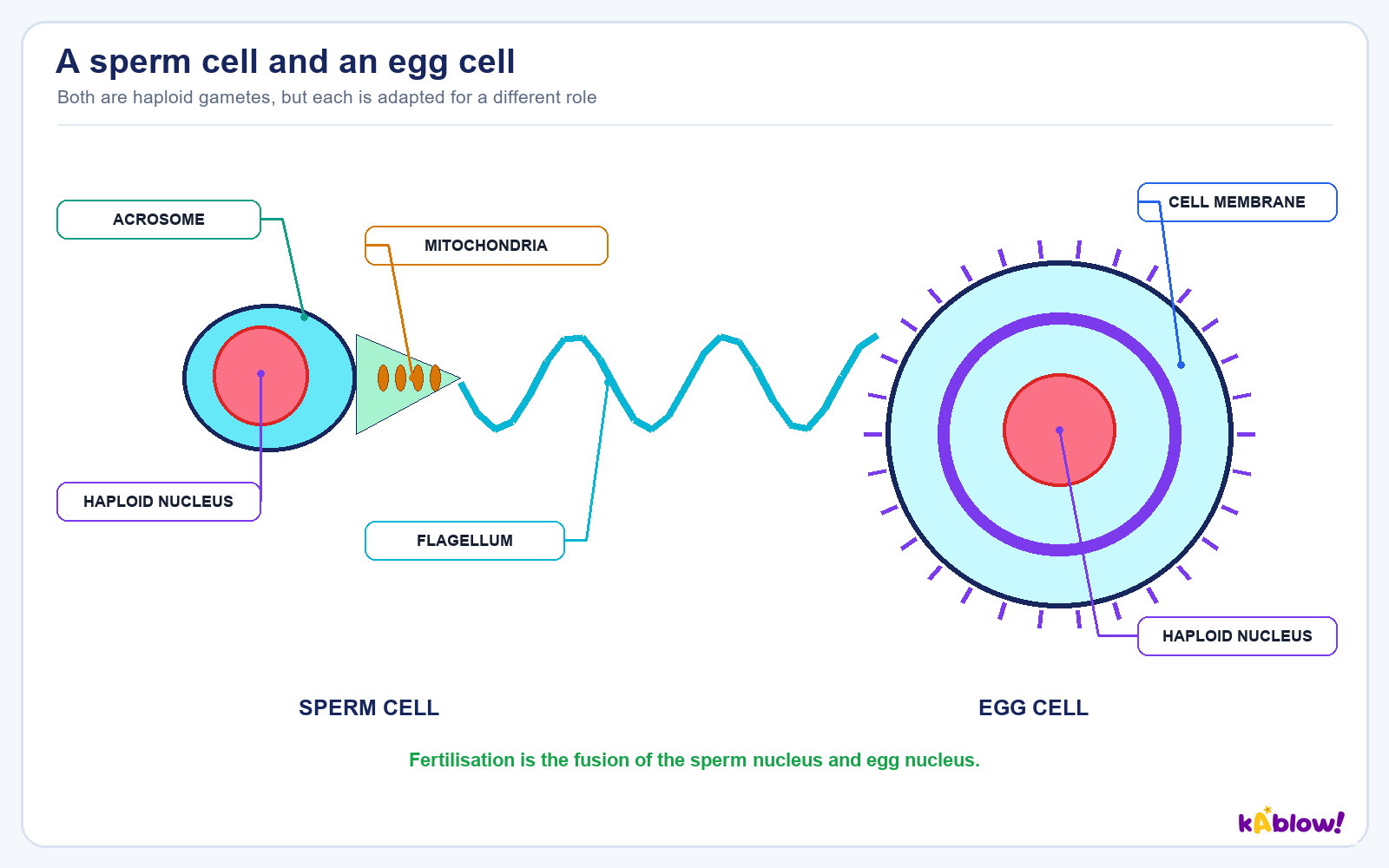
Specialised Cells: Gametes
- Sperm and ova are specialised cells whose structure aids their function.
- Sperm cells have a haploid nucleus contained within a streamlined head that can fuse with an ovum nucleus to form a diploid zygote.
- The acrosome contains digestive (hydrolytic) enzymes to aid entry into the ovum through the zona pellucida.
- Many mitochondria in the middle piece release energy to aid movement, and a flagellum made of protein microtubules aids movement.
- Egg cells (ova) have a haploid nucleus that can fuse with a sperm cell nucleus to form a diploid zygote; the final stage of meiosis is only completed after fertilisation.
- A surrounding jelly layer, the zona pellucida, can harden to prevent polyspermy (penetration by more than one sperm, which can affect embryo development).
- Follicle cells nourish and protect the ovum, and cortical granules contain digestive enzymes released into the zona pellucida to prevent polyspermy.
- The ovum cytoplasm is rich in nutrients for the developing embryo after fertilisation.
A sperm cell and an egg cell
슬라이드
연습 문제
무료 미리 보기 — 63개 중 8개 문제. 가입하면 전부 볼 수 있어요.
1.Which of the following is not a source of stem cells?
Easy- AUmbilical cord blood
- BBone marrow
- CAn embryo
- DBlood plasma
2.What happens to the surface area to volume ratio of a cell as the cell grows and increases in size?
Easy- AIt does not change
- BIt increases
- CIt decreases
- DIt doubles as the cell doubles in size
3.Which of the following is true of stem cells? I. Cells in early-stage animal embryos are totipotent. II. Stem cells in adult tissue are multipotent. III. Pluripotent stem cells are formed in adult tissue.
Medium- AI and II only
- BII and III only
- CI and III only
- DII only
4.Which property of stem cells makes them suitable for use in medicine?
Medium- AThey can differentiate into specialised cells
- BThey can produce chemicals that destroy viruses
- CThey can form gametes when they divide by mitosis
- DThey have chromosomes that are suitable for gene transfer
5.The cube below has sides that measure 2 cm in length. Which of the following represents the correct surface area : volume ratio of this cube?
Medium- A1:1
- B6:1
- C3:1
- D2:1
6.The proximal convoluted tubule cells in the nephron are adapted by having microvilli and invaginations. What is the purpose of these adaptations?
Medium- ATo provide a large surface area to volume ratio.
- BTo allow reabsorption of glucose due to a short diffusion pathway.
- CTo provide a large volume to surface area ratio.
- DTo provide a steep concentration gradient for reabsorption of glucose.
7.Current research is making great advances in the therapeutic use of stem cells. Embryonic stem cells are delivering promising results in treating diseases such as Stargardt’s disease due to their unique characteristics. Which of the following are not characteristics of embryonic stem cells?
Hard- AThey have the potential to develop into any type of tissue if taken within the first few days after fertilisation
- BThey can be stimulated in a laboratory setting to develop into any specialised cell type
- CA small number remain in many tissues of the body, such as bone marrow, skin and the liver to replace damaged or dead cells
- DThey can divide an unlimited number of times to produce a large number of cells that can become specialised
8.The cells of bacteria are on average 1-5 μm long, whereas human cells are on average 100 μm in diameter. What is the main limiting factor preventing the bacterial cells from growing to the same size as human cells?
Hard- AThe rate of cell division would be too slow to allow colonisation of new areas
- BThe structure of bacterial cell walls limits the size of the cell
- CA larger size would limit cell motility
- DThe rate of diffusion at the cell surface does not increase quickly enough