Natural Selection
플레이하며 배우기
이 문제들을 풀어 에너지를 얻은 뒤 낚시하고 탐험하세요. 계정이 필요 없어요.
수업 노트
Natural Selection & Evolution
- Evolution is defined as changes in the heritable characteristics of organisms over generations.
- Natural selection is the process by which organisms better adapted to their environment survive, reproduce, and pass on their advantageous alleles, causing advantageous characteristics to increase in frequency within a population.
- Charles Darwin proposed the theory of evolution by natural selection after a five-year expedition; he published×On the Origin of Species×in 1859.
- Darwin's theory replaced Lamarckism, the idea that organisms could pass on physical characteristics acquired during their lifetime to their offspring.
- Darwin's theory caused a paradigm shift because it contradicted previous assumptions; nearly 200 years of genetic research supports it.
- Example: in a rabbit population, brown fur provides better camouflage against predators, so brown rabbits are more likely to survive and reproduce, increasing the frequency of brown fur alleles over generations.
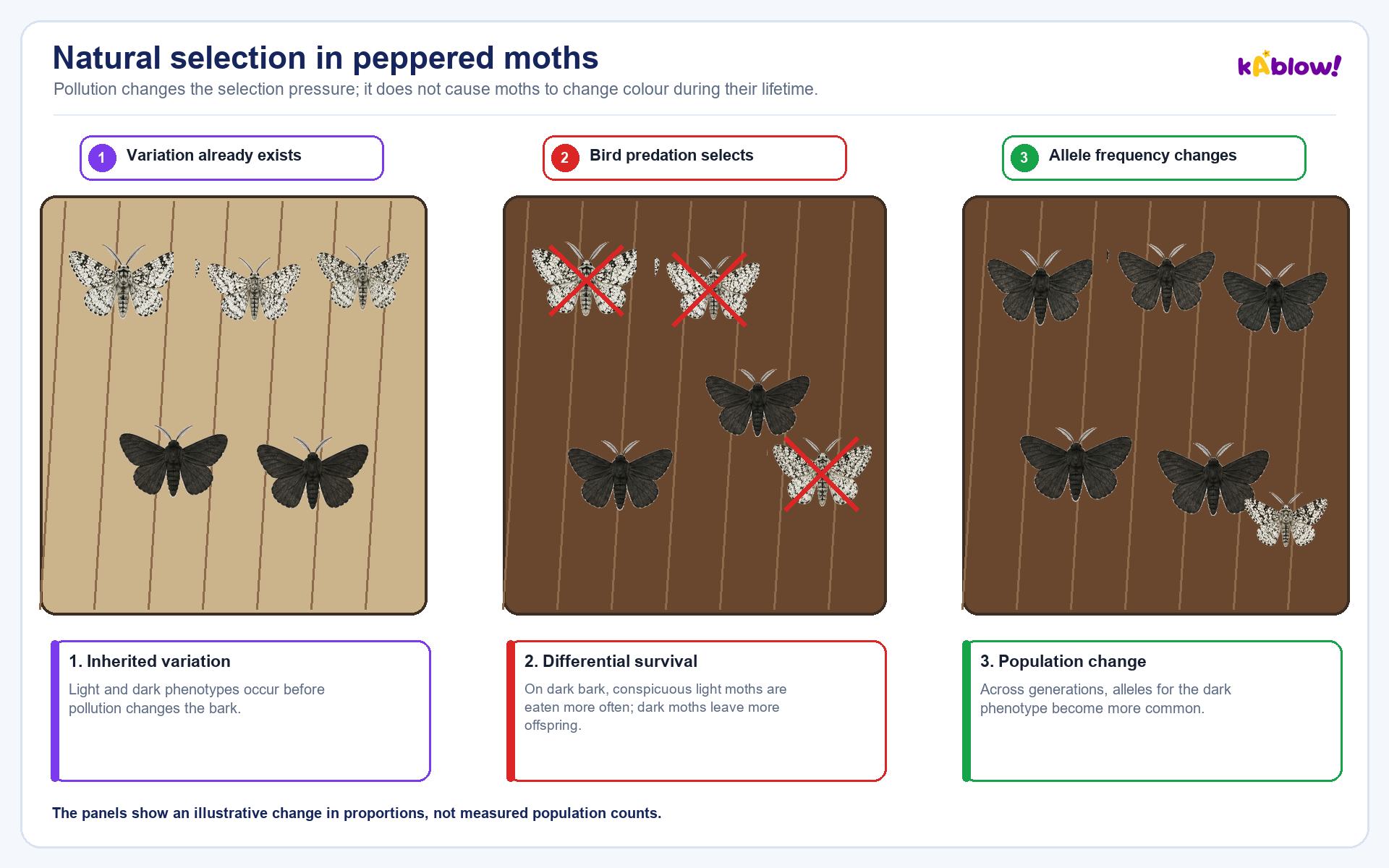
Natural selection in peppered moths
Generating Genetic Variation
- Variation exists between organisms of the same species and is essential for natural selection; without variation, no individual is favoured and the population cannot adapt.
- Variation results from small differences in DNA base sequences between individuals.
- Mutation is the original source of genetic variation; it is a change in the DNA base sequence resulting from a copying error during DNA replication, generating new alleles.
- Mutations in sex organs can be passed to gametes; a mutation in a somatic (body) cell is not passed on and has no impact on natural selection.
- Meiosis generates variation through crossing over (exchange of alleles between homologous chromosomes) and random orientation (independent assortment of homologous pairs during metaphase I).
- Random fertilisation during sexual reproduction creates genetic variation because any male gamete can fuse with any female gamete, producing a unique combination of alleles.
- The number of possible chromosome combinations from random orientation is 2n, where n is the haploid number; in humans this is 223 = 8,324,608 combinations.
Overproduction, Competition, and Heritable Traits
- Darwin noted the overproduction of offspring: more offspring are produced than can be supported by the environment.
- Overproduction leads to competition for limited resources such as food, space, and light, which limits the carrying capacity of a population.
- Intraspecific competition (between individuals of the same species) plays a greater role in evolution because individuals share the same niche and are affected by the same abiotic and biotic factors.
- Individuals with characteristics better adapted for survival are more likely to survive into adulthood, find a mate, and reproduce, passing on their advantageous alleles.
- Heritable characteristics are determined by alleles and can be physical (e.g. giraffe neck length) or behavioural (e.g. woodlouse moving towards dark).
- Non-heritable characteristics (e.g. weight gained during lifetime or injuries) are not passed on to offspring.
- Better-adapted organisms are more likely to survive and reproduce, not guaranteed; less-suited organisms may still survive and reproduce but with lower probability.
Selection Pressures
- Abiotic factors are non-living factors in an ecosystem (e.g. temperature, rainfall) that can act as selection pressures, causing population size to fluctuate.
- Sexual selection is a form of selection that occurs due to the preference of one sex for certain characteristics in individuals of the other sex.
- Sexual selection requires variation within the population; traits visible to the opposite sex can indicate overall fitness and affect mating success.
- Sexual selection can cause reproductive isolation (changes preventing successful breeding with others) and sexual dimorphism (distinct differences in size or appearance between sexes).
- Example: male Birds of Paradise are brightly coloured and perform courtship displays, while females have grey/brown plumage.
- Natural selection occurs due to competition for resources, whereas sexual selection occurs due to competition for mates.
- Sexual selection can produce traits that reduce survival (e.g. peacock's long tail makes it more prone to predation) but increase mating success.
Selection Pressures: Skills (Endler's Guppy Experiments)
- Guppies in Trinidad and Tobago show variation in colour and pattern; males are brightly coloured and females are dull (sexual dimorphism).
- Spot colouration provides camouflage by mimicking the gravel of streambeds; some streambeds are finer and sandier, others coarser and more pebble-like.
- John Endler hypothesized that when predators are present, substrate type affects survival and spot brightness; low predation increases spot brightness due to sexual selection; high predation decreases spot brightness.
- In Endler's laboratory experiment, guppies were placed in ponds with coarse or fine gravel and exposed to no, weak, or dangerous predators.
- Results: high predation decreased mean number of spots; low predation increased spot number; coarse gravel favoured larger spots and fine gravel favoured smaller spots (mimicking gravel size).
- In ponds with no predation, the opposite was observed: fine gravel favoured large spots and coarse gravel favoured small spots, possibly because not matching the background makes males more conspicuous to females.
- In the field experiment, dull male guppies transferred from high to low predation areas developed more colourful patterning over 15 generations, likely due to sexual selection.
- Endler concluded that guppy evolution is a dynamic trade-off between natural selection (predator avoidance) and sexual selection (attracting mates).
Gene Pools and Allele Frequencies
- A gene pool consists of all the genes and their different alleles present in an interbreeding population.
- Multiple gene pools can exist for a species if populations are geographically isolated.
- A stable gene pool occurs when the population is large, all individuals have an equal chance of mating, matings are random, and there are no selection pressures acting on phenotype; a stable gene pool means the population is not evolving.
- Allele frequency is the relative frequency of an allele at a particular gene locus; if more than one allele exists, their frequencies must add up to 1.
- Changes in allele frequency occur due to natural selection, sexual selection, and genetic drift.
- Modern understanding of evolution integrates genetics with Darwin's theory, often called neo-Darwinism.
- Comparing allele frequencies can help identify genetic associations with diseases, estimate disease susceptibility or drug resistance, and perform evolutionary and anthropological studies.
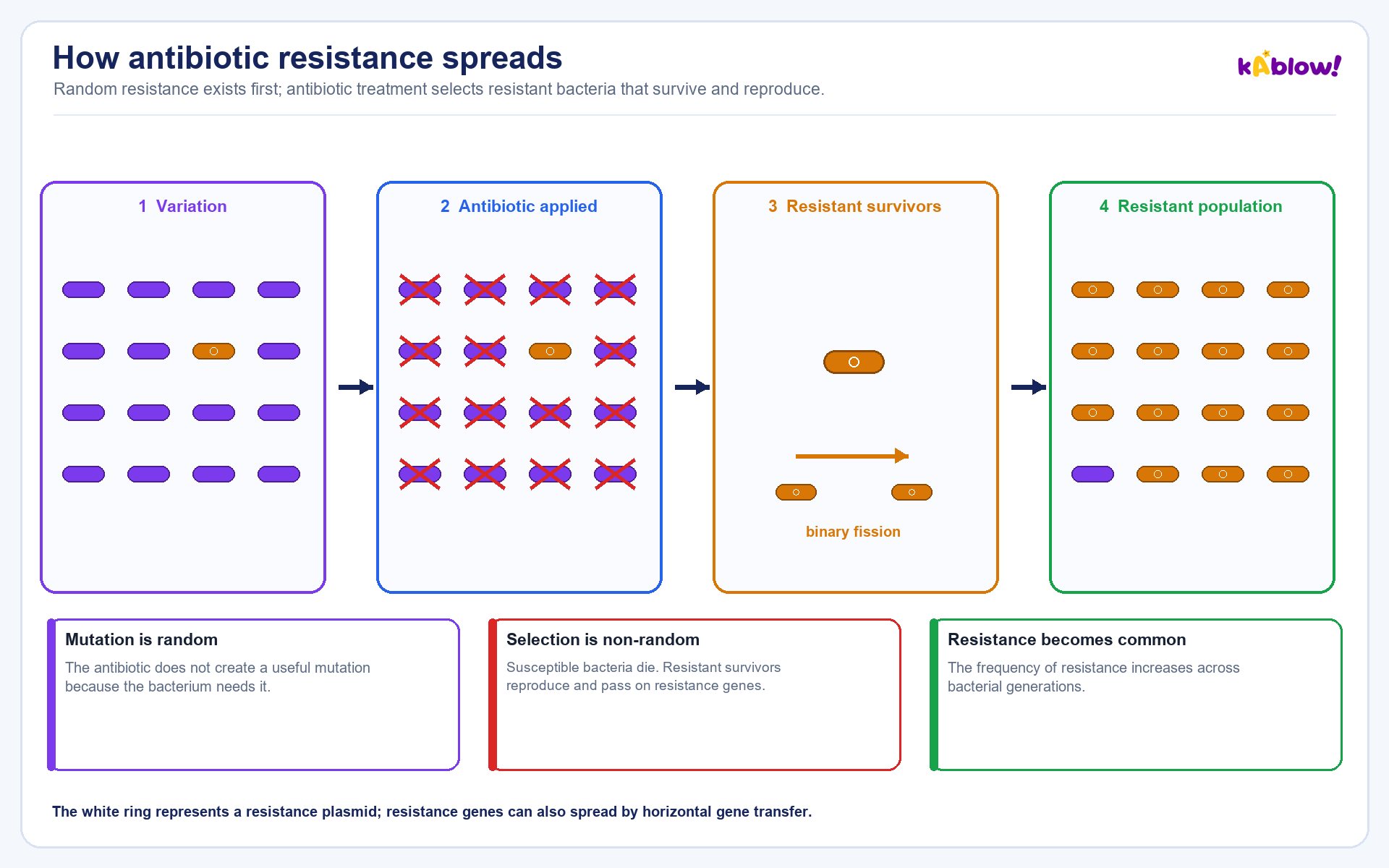
Natural selection in bacteria
Allele Frequencies: Skills
- For any gene locus, each individual carries two alleles (one from each parent), except for alleles on X or Y chromosomes.
- In a population, there are twice as many total alleles as there are individuals.
- Homozygous individuals contribute two of the same allele to the total; heterozygous individuals contribute one of each allele.
- Allele frequencies can be calculated from phenotype frequencies using the Hardy-Weinberg formula: p + q = 1, where p is the dominant allele frequency and q is the recessive allele frequency.
- For a recessive phenotype, the phenotype frequency equals q²; thus q is the square root of the recessive phenotype frequency.
- Worked example: if 4/13 lizards are white (yy), then q² = 0.3077, q = 0.5547, and p = 1 - 0.5547 = 0.4453.
- Geographic isolation can cause differences in allele frequencies between populations; human allele frequencies vary by geography and ethnicity, but truly isolated populations are rare due to travel and interbreeding.
Types of Natural Selection
- Directional selection changes the population towards one extreme of a range of variation; it tends to occur when environmental conditions change.
- Example of directional selection: a fall in average temperature selects for frost-resistant plants if an allele provides frost protection; fish body size decreases with warming ocean temperatures.
- Stabilising selection favours the average individual and occurs when environmental conditions are stable; it is the most common form of natural selection.
- Stabilising selection discards extreme phenotypes, decreases diversity, works mostly on polygenic traits, and is characterised by a normal distribution (bell-shaped curve).
- Examples of stabilising selection: coat colour in mice (brown fur camouflaged against forest floor) and human birth mass (too low or too high reduces survival).
- Disruptive selection selects against the average individual and is the rarest form; it occurs when habitats or resources change and can lead to speciation (diversifying selection).
- Example of disruptive selection: Darwin's finches in the Galápagos, where different beak types adapted to different food sources, allowing species to occupy different niches.
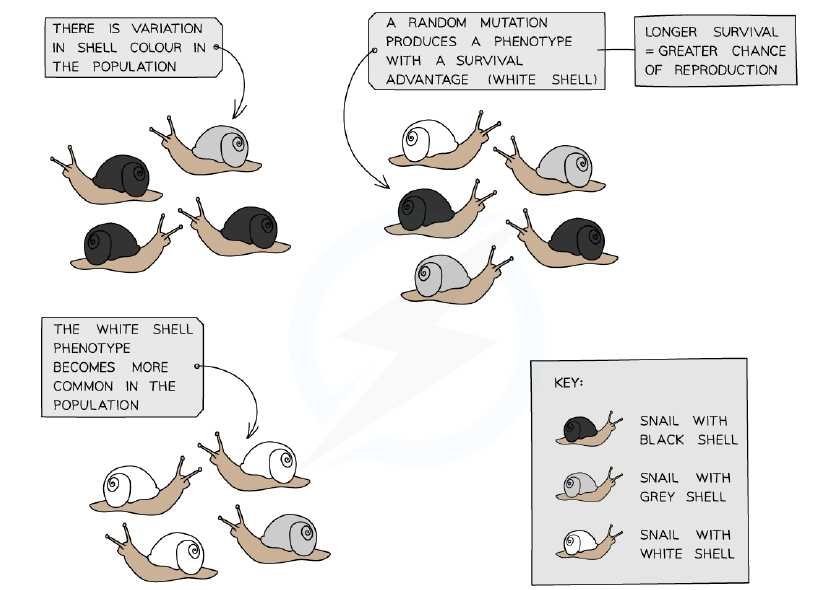
Natural selection in snail shell colour
Hardy-Weinberg Principle
- The Hardy-Weinberg principle states that if certain conditions are met, allele frequencies in a population will not change from one generation to the next.
- The Hardy-Weinberg equation allows calculation of allele and genotype frequencies: p + q = 1 and p² + 2pq + q² = 1.
- p represents the frequency of the dominant allele, q the recessive allele; p² is the frequency of homozygous dominant, 2pq of heterozygous, and q² of homozygous recessive genotypes.
- Conditions for Hardy-Weinberg equilibrium: organisms are diploid, reproduce sexually, no overlap between generations, random mating, large population, no migration, mutation, or selection, and allele frequencies equal in both sexes.
- If genotype frequencies do not fit the Hardy-Weinberg equation, one or more conditions are not being met.
- The principle is useful for building models and making predictions, but its assumptions are rarely all present in nature.
- When solving problems, start by determining the proportion of individuals with the recessive phenotype, as this is the only phenotype that directly gives the genotype (homozygous recessive).
Artificial Selection
- Artificial selection (selective breeding) is the process by which humans choose organisms with desirable traits and breed them together to enhance those traits over many generations.
- Humans have practiced selective breeding for thousands of years; individuals are selected by phenotype, not genotype, so knowledge of alleles is not required.
- Breeders can accidentally enhance other traits genetically linked to the desired trait, sometimes negatively affecting health.
- Steps: population shows phenotypic variation; breeder selects two individuals with desired phenotype (not closely related); they are bred; offspring are tested and the best are selected for further breeding; process continues for many generations.
- Animals are selectively bred for traits such as higher milk or meat yield, large eggs, gentle nature, quality wool, and speed; all domestic dog breeds descend from wolves.
- Plants are selectively bred for disease resistance, increased yield, hardiness, better taste, and large or unusual flowers; wild brassica has given rise to cauliflower, cabbage, broccoli, Brussels sprouts, kale, and kohlrabi.
- Difference from natural selection: artificial selection involves deliberate choice by humans, whereas natural selection does not; artificial selection can result in animals poorly suited to their environment, while natural selection results in better adaptation.
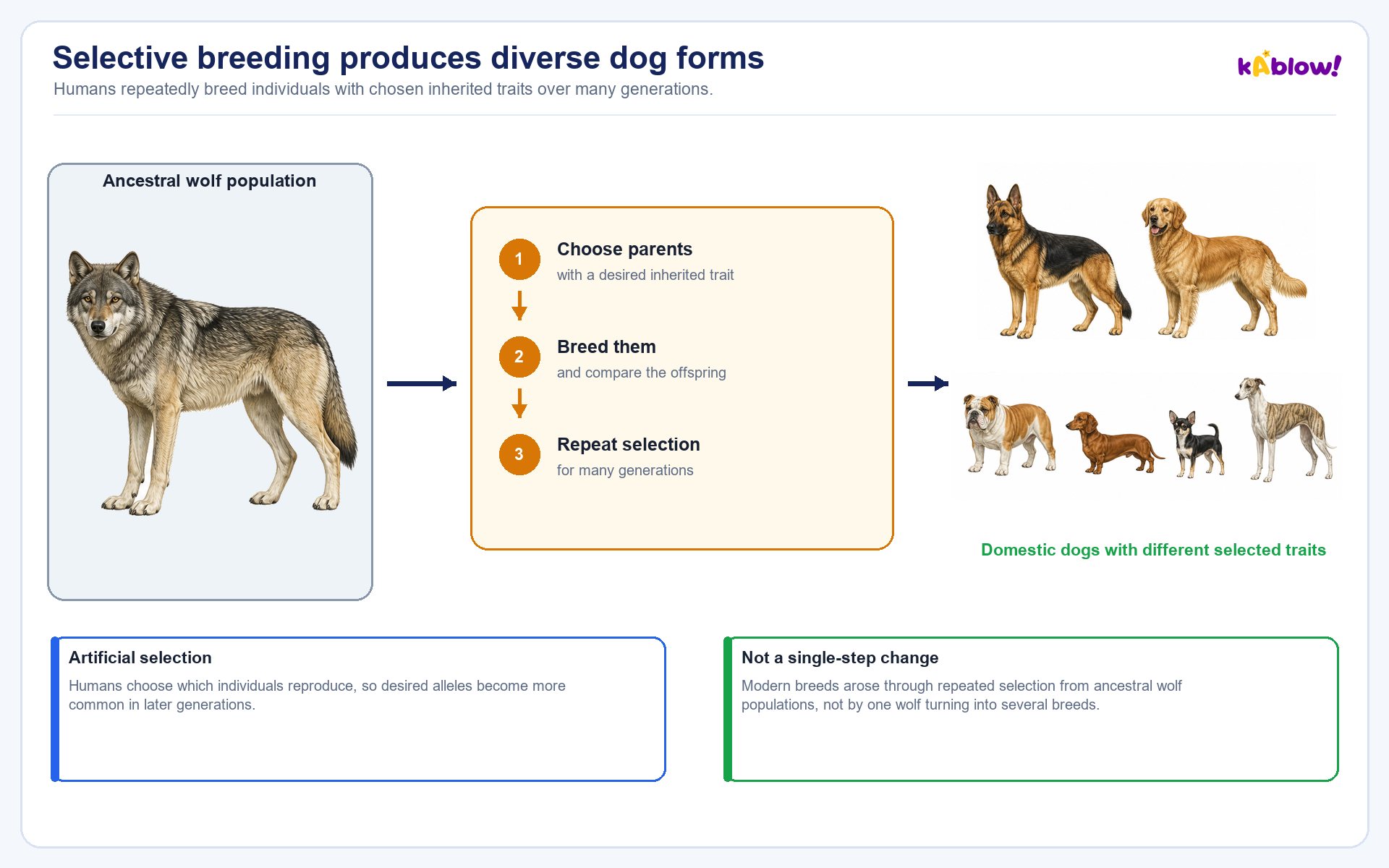
Selective breeding in dogs
슬라이드
연습 문제
무료 미리 보기 — 63개 중 8개 문제. 가입하면 전부 볼 수 있어요.
1.What is the definition of the term 'gene pool'?
Easy- AAll of the genes and their different alleles that exist within a single population
- BAll of the genes that exist within a population
- CAll of the genes and their different alleles that exist within a species
- DThe different alleles that exist for one gene within a species
2.An example of a trait that evolved by natural selection is body size in fish, which has declined with warming ocean temperatures. State the type of selection that this change represents.
Easy- ADirectional
- BStabilizing
- CDisruptive
- DAllopatric
3.Which process does not generate heritable variation in a population?
Easy- AMitosis
- BMutation
- CMetaphase I of meiosis
- DFertilisation
4.Which of the following statements correctly explains the process of natural selection? I. Some species produce small numbers of young and provide higher levels of parental care II. Advantageous alleles increase an individual's chance of surviving and reproducing III. Individuals that change to suit their environment pass their alleles on to offspring IV. Advantageous alleles increase in frequency in the population
Medium- AII and IV only
- BI and II only
- CI, II, III, and IV
- DII, III, and IV only
5.A game farm in South Africa has a population of about 5 000 large antelope called Kudu. Kudu bulls have large, spiralled horns which draw the attention of trophy hunters that frequently visit the game farm. The antelope are all kept in a large, fenced-off area consisting of open grassland habitat. Could this be considered an example of a stable gene pool?
Medium- ANo, since there will be a selective pressure for antelope with smaller horns
- BNo, since there will be a selective pressure to increase the allele frequency for antelope with large horns
- CYes, it is a large population of antelope with an equal chance to mate with each other
- DYes, it is a large population located in a habitat that enables random matings between antelope of different phenotypes
6.Which of the following applies to the process of evolution by natural selection? I. Changes in the phenotype of organisms in a population II. Selection pressures favouring certain alleles within a population III. Individuals with a certain genetic makeup will not pass on their genes IV. Changes in the allele frequencies within a population over time
Medium- AII and IV only
- BII only
- CI, II and III
- DI, II, III and IV
7.What would be the most accurate description of the following graphs? I: A graph showing a shift in the distribution of giraffe neck lengths towards longer necks. II: A graph showing a bimodal distribution of turtle size with both larger and smaller turtles favoured. III: A graph showing a narrow distribution of cactus spine density with medium spine density favoured.
Hard- ADirectional selection as giraffes with longer necks are selected for; Disruptive selection as larger and smaller turtles are selected for; Stabilising selection as cacti with a medium spine density are selected for
- BStabilising selection as giraffes with longer necks are selected for; Directional selection as larger and smaller turtles are selected for; Disruptive selection as cacti with a medium spine density are selected for
- CStabilising selection as giraffes with medium neck lengths are selected for; Disruptive selection as larger and smaller turtles are selected against; Directional selection as cacti with medium spine density are selected for
- DDirectional selection as giraffes with medium neck lengths are selected for; Stabilising selection as larger and smaller turtles are selected against; Disruptive selection as cacti with medium spine density are selected for
8.Which of the following examples would be a useful application of comparing allele frequencies between populations? I. Estimating the number of individuals in a population that may be susceptible to certain diseases II. Studying the evolutionary history of populations within a specific species III. Investigating the effect of environmental factors on the phenotype within different populations
Medium- AI and II only
- BI only
- CIII only
- DI and III only