Counting Particles By Mass: The Mole
플레이하며 배우기
이 문제들을 풀어 에너지를 얻은 뒤 낚시하고 탐험하세요. 계정이 필요 없어요.
교육자를 위해: Counting Particles By Mass: The Mole(Chemistry, HL)을(를) 위한 바로 쓸 수 있는 수업 슬라이드, 복습 노트 — 수업에 사용하거나, 학습자들이 실시간 게임으로 즐기는 인터랙티브 클래스 활동으로 진행하세요.
수업 노트
The Mole and Avogadro's Constant
- The mole is the amount of substance that contains the same number of fundamental units as there are atoms in exactly 12.00 g of carbon-12.
- The Avogadro constant (NA or L) is the number of particles equivalent to the relative atomic mass (Ar) or relative molecular mass (Mr) of a substance in grams.
- The value of the Avogadro constant is 6.02 × 10²³ mol-1.
- The Avogadro constant applies to atoms, molecules and ions.
- One mole of any substance contains 6.02 × 10²³ fundamental units.
- The mass of a substance with this number of particles is called the molar mass.
Relative Atomic and Molecular Mass
- The relative atomic mass (Ar) of an element is the weighted average mass of one atom compared to one twelfth the mass of a carbon-12 atom.
- Ar is determined using the weighted average mass of the isotopes of the element.
- Ar has no units because it is a ratio and the units cancel.
- Relative molecular mass (Mr) is the sum of the relative atomic masses of the atoms in a molecule.
- For compounds containing ions, the term relative formula mass (Mr) is used and is calculated in the same way.
- Example: Mr of H2O = (2 × 1.01) + 16.00 = 18.02.
Moles and Mass Calculations
- The number of moles can be calculated using: moles = mass (g) ÷ molar mass (g mol-1).
- The molar mass of a substance is its relative atomic mass (Ar) or relative formula mass (Mr) expressed in grams.
- Molar mass is given in units of g mol-1.
- To find the mass of a substance: mass = moles × molar mass.
- Always show your workings in calculations to check for errors and possibly gain credit.
Moles, mass and molar mass
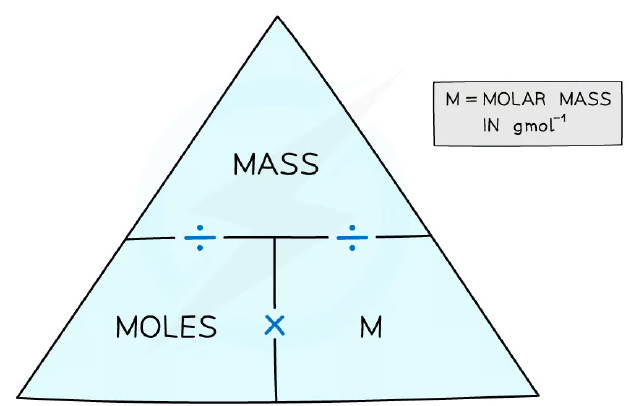
Moles and Particles
- The number of particles can be calculated using: number of particles = moles × Avogadro constant.
- To find the number of moles from particles: moles = number of particles ÷ Avogadro constant.
- When calculating the number of atoms in a molecule, multiply the number of moles of molecules by the number of atoms in one molecule.
- Example: 0.010 moles of CH3CHO contains 0.040 moles of H atoms, which is 2.4 × 10²² H atoms.
Empirical Formula
- The empirical formula gives the simplest whole-number ratio of atoms of each element in a compound.
- The molecular formula shows the actual number and type of atoms in a molecule.
- The empirical formula can be determined from percentage composition by mass data.
- To find the empirical formula: divide the mass or percentage of each element by its atomic mass, then divide by the smallest value to get the simplest ratio.
- The formula of an ionic compound is always written as an empirical formula.
- Organic compounds often have different empirical and molecular formulae.
Molecular Formula
- To determine the molecular formula from the empirical formula: divide the relative molecular mass (Mr) by the relative mass of the empirical formula.
- This gives a whole number multiplier.
- Multiply the empirical formula by this number to get the molecular formula.
- Example: If empirical formula is C4H10S and Mr = 180.42, the multiplier is 2, so molecular formula is C8H20S2.
Molar Concentration
- Concentration tells us how much solute is dissolved in a solvent to make a solution.
- It is usually measured as the amount of solute in 1 dm3 of solution.
- The solute is the substance being dissolved; the solvent is the liquid that does the dissolving.
- Concentration can be expressed as moles per unit volume (mol dm-3), mass per unit volume (g dm-3), or parts per million (ppm).
- Formula: concentration (mol dm-3) = moles of solute (mol) ÷ volume of solution (dm3).
- To convert cm3 to dm3, divide by 1000.
- To convert from mol dm-3 to g dm-3, multiply the molar concentration by the molar mass.
- To convert from g dm-3 to mol dm-3, divide the mass concentration by the molar mass.
Concentration, moles and volume
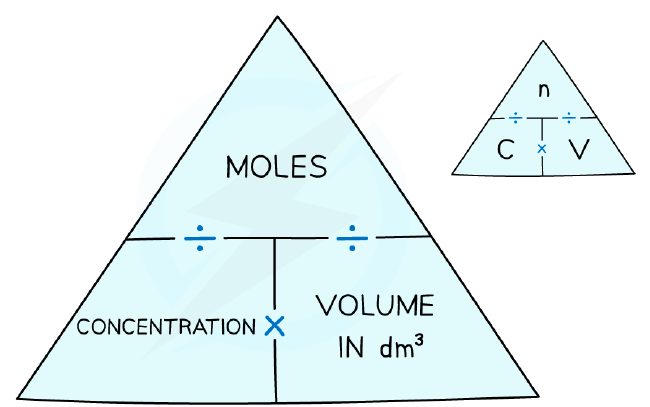
Parts Per Million (ppm)
- ppm is used for very low concentrations, such as pollutants in water or air.
- 1 ppm is defined as 1 mg of solute dissolved in 1 dm3 of water.
- Since 1 dm3 of water weighs 1 kg, 1 ppm is also 1 mg dissolved in 1 kg of water.
- This is equivalent to 10-3 g in 103 g, or a concentration of 1 in 106.
Avogadro's Law and Gas Volumes
- Avogadro's Law states that equal volumes of gases under the same conditions of temperature and pressure contain the same number of molecules.
- At standard temperature and pressure (STP), one mole of any gas occupies 22.7 dm3.
- STP conditions are defined as 0 °C (273 K) and 100 kPa pressure.
- The volume ratio of gaseous reactants and products in a balanced equation is the same as the mole ratio.
- Example: In C3H8(g) + 5O2(g) → 3CO2(g) + 4H2O(l), 50 cm3 of propane requires 250 cm3 of O2 and produces 150 cm3 of CO2.
- Gas volume relationships are only valid if all gases are measured under the same conditions of temperature and pressure.
- If gases are not in the same ratio as the balanced equation, use limiting reactant principles to determine the actual amount of product formed.
슬라이드
연습 문제
무료 미리 보기 — 66개 중 8개 문제. 가입하면 전부 볼 수 있어요.
1.Which statement defines the mole?
Easy- AThe amount of substance that contains 6.02 × 10²³ elementary entities.
- BThe mass of one atom of carbon-12.
- CThe volume occupied by one gram of any gas at room temperature.
- DThe number of particles in one gram of any substance.
2.What is the value of the Avogadro constant?
Easy- A6.02 × 10²³ mol⁻¹
- B6.02 × 10⁻²³ mol⁻¹
- C12.00 g mol⁻¹
- D22.7 dm³ mol⁻¹
3.Which statement about relative atomic mass (Ar) is correct?
Easy- AIt is the weighted average mass of an atom compared to one-twelfth the mass of a carbon-12 atom.
- BIt is the mass of one mole of an element in grams.
- CIt is the number of atoms in one mole of an element.
- DIt is the mass of one atom of an element in kilograms.
4.Which of the following is the relative formula mass (Mr) of ammonium sulfate, (NH₄)₂SO₄? (Ar: N=14.01, H=1.01, S=32.07, O=16.00)
Easy- A132.17
- B114.11
- C68.14
- D100.17
5.The empirical formula of a compound gives the simplest whole-number ratio of atoms of each element in the compound.
EasyTrue or false?
6.How many moles are present in 2.64 g of sucrose, C₁₂H₂₂O₁₁ (Mr = 342.3)?
Medium- A7.71 × 10⁻³ mol
- B7.71 × 10⁻² mol
- C0.771 mol
- D1.30 × 10² mol
7.Which of the following statements about concentration are correct? (select all that apply)
Medium- AConcentration in mol dm⁻³ is calculated as moles of solute divided by volume of solution in dm³.
- B1 ppm is equivalent to 1 mg of solute dissolved in 1 dm³ of water.
- CTo convert cm³ to dm³, divide by 1000.
- DA concentrated solution contains a small amount of solute per unit volume.
- EThe units of concentration can be mol dm⁻³, g dm⁻³ or ppm.
8.Match each term with its correct description.
Medium- Mole
- Molar mass
- Empirical formula
- Avogadro's Law
- The amount of substance containing 6.02 × 10²³ particles
- The mass of one mole of a substance in grams
- The simplest whole-number ratio of atoms in a compound
- Equal volumes of gases at the same temperature and pressure contain the same number of molecules
기출 문제
이 주제의 기출 문제 연습이 곧 나와요.
곧 출시