The Metallic Model
플레이하며 배우기
이 문제들을 풀어 에너지를 얻은 뒤 낚시하고 탐험하세요. 계정이 필요 없어요.
수업 노트
Metallic Bonding
- Metal atoms are tightly packed in lattice structures.
- Outer shell electrons become delocalised and are free to move throughout the structure.
- Metal atoms become positively charged when they lose their outer electrons.
- The positive charges repel each other and keep the neatly arranged lattice in place.
- Metallic bonding is the strong electrostatic attraction between positive metal centres and the 'sea' of delocalised electrons.
Metallic bonding and malleability
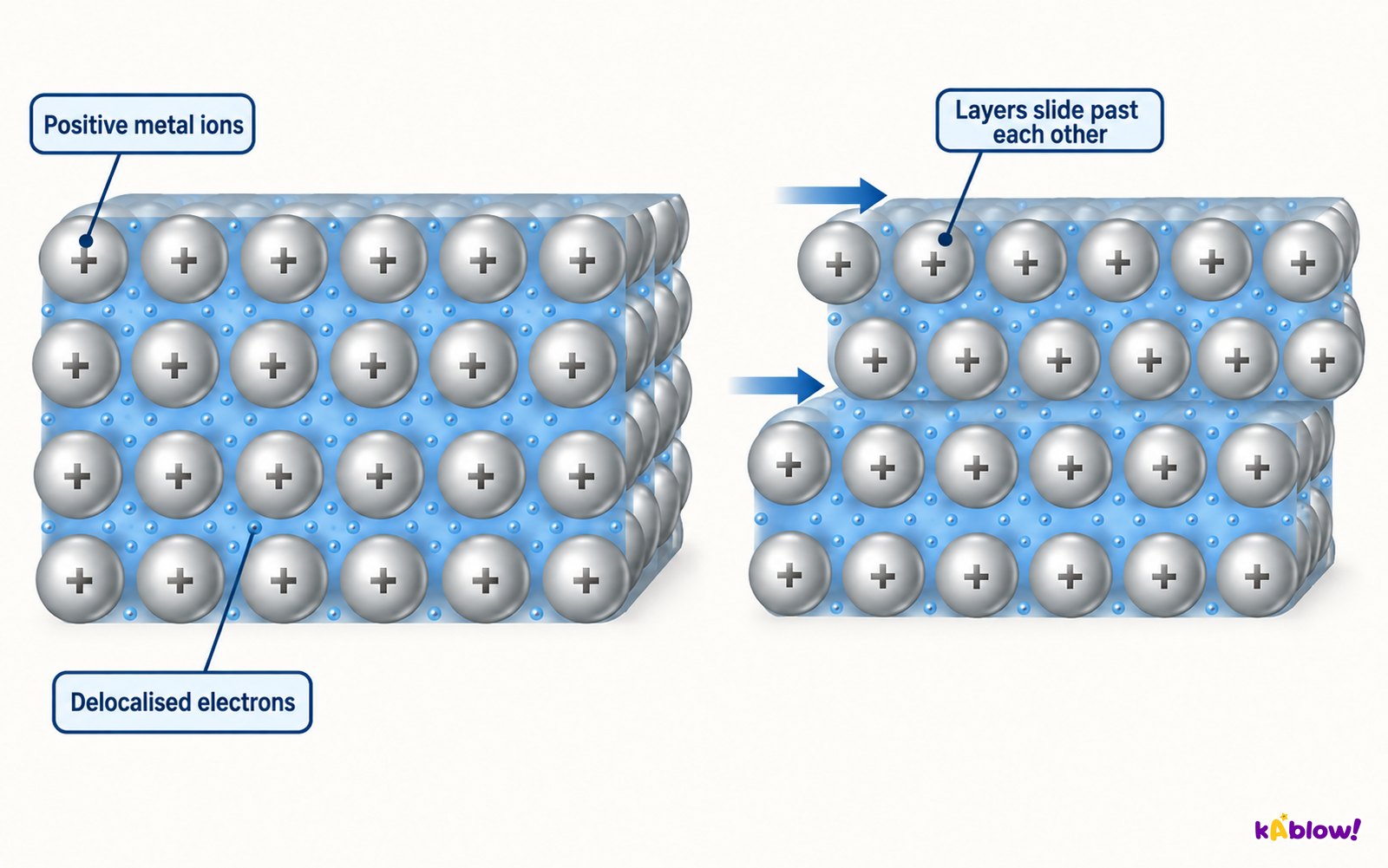
Properties of Metals
- Metals are malleable (can be hammered into sheets) and ductile (can be drawn into wires).
- Layers of metal ions can slide over each other when a force is applied, while delocalised electrons allow the metal to retain its structure without breaking bonds.
- Metals are typically strong and hard due to strong electrostatic attraction between cations and electrons and the closely packed structure of metal ions.
- Metals conduct electricity in both solid and liquid states because mobile electrons can freely move.
- When a potential difference is applied, delocalised electrons move towards the positive terminal.
- Metals are good thermal conductors: vibrating cations transfer kinetic energy to delocalised electrons, which rapidly carry it through the metal.
- Metals have high melting and boiling points because strong electrostatic forces between cations and delocalised electrons require large amounts of energy to overcome.
Trends in Metallic Bond Strength
- The strength of a metallic bond depends on the charge of the metal ion, the radius of the metal ion, and the number of delocalised electrons.
- Greater charge on the metal ion means more delocalised electrons and a greater charge difference, leading to stronger electrostatic attraction.
- Smaller ionic radius means the metal ion exerts a greater attraction on the sea of delocalised electrons, strengthening the metallic bond.
- Increasing the number of delocalised electrons per atom, increasing positive charge, and decreasing ionic size all increase the strength of metallic bonding.
Melting Points Across a Period
- Across Period 3, the number of valence electrons increases: Na (1), Mg (2), Al (3).
- Aluminium ions are also smaller than magnesium or sodium ions.
- These factors lead to stronger metallic bonding from Na to Al.
- Stronger metallic bonding requires more energy to break the lattice, so melting points increase across the period.
- Melting point data: Na = 371 K, Mg = 922 K, Al = 933 K.
Melting Points Down a Group
- Down a group, the size of the cation increases.
- This decreases the attraction between the outer electrons and the metallic lattice.
- Therefore, the melting point decreases down the group.
- Melting point data for Group 1: Na = 371 K, K = 337 K, Rb = 312 K.
Uses of Metals
- The choice of metal for a job depends on properties such as malleability/ductility, melting/boiling point, density, reactivity, electrical conductivity, strength, toxicity, lustre, thermal conductivity, strength-to-weight ratio, corrosion resistance, and sonority.
- Aluminium is used in food cans because it is non-toxic and resistant to corrosion and acidic food stuffs.
- Copper is used in electrical wiring because it is a good electrical conductor and malleable/ductile.
- Stainless steel is used for cutlery as it is strong and resistant to corrosion.
Transition Metals: Definition and Location
- A transition metal is an element with an incomplete d-subshell or an element that can form at least one stable cation with an incomplete d-subshell.
- Scandium and zinc are d-block elements but not transition metals: Sc only forms Sc³⁺ ([Ar] 3d⁰) and Zn only forms Zn²⁺ ([Ar] 3d¹⁰).
- The first transition series is Ti to Cu.
- Transition metals are located in the d-block: Period 4 from Ti to Cu, Period 5 from Zr to Ag.
- Periods 6 and 7 are complicated by the presence of the f-block lanthanides and actinides.
Physical Properties of Transition Metals
- Transition metals have a metallic lattice structure: layers of positive ions in a sea of delocalised electrons.
- The 3d and 4s subshells are close in energy, so transition metals can delocalise d-electrons to form metallic bonds.
- Transition metals form metallic bonds involving both s- and d-electrons, giving more delocalised electrons and stronger electrostatic attraction.
- This results in high melting points and high electrical conductivity.
- Period 4 transition metals have higher melting points than Group 1 and Group 2 metals (exception: Be has a melting point of 1,287 °C due to its small size).
- The three most conductive metals are Ag > Cu > Au; copper is most used in electrical cables due to cost and conductivity.
슬라이드
연습 문제
무료 미리 보기 — 61개 중 8개 문제. 가입하면 전부 볼 수 있어요.
1.Which of the following types of bonds does the statement 'electrostatic attraction between cations and delocalised electrons' best describe?
Easy- Ametallic
- Bionic
- Chydrogen
- Ddipole-dipole
2.Which of the following materials only contains one type of bonding?
Easy- Abrass
- Bgraphite
- Cice
- Diodine crystals
3.Substance L melts at 660 °C and conducts electricity when solid and when molten. What is the likely identity of substance L?
Medium- AAl
- Bgraphite
- CLi₂O
- DNaCl
4.What is the correct order of decreasing melting points for the Group 1 metals Na, K, Rb and Cs?
Medium- ANa > K > Rb > Cs
- BNa > K > Cs > Rb
- CCs > Rb > K > Na
- DK > Na > Rb > Cs
5.Which of the following Period 3 metals would have the highest melting point?
Medium- AAl
- BMg
- CNa
- DK
6.Which of the following species has the highest melting point?
Medium- A1s² 2s² 2p⁶ 3s² 3p²
- B1s² 2s² 2p⁶ 3s²
- C1s² 2s² 2p⁶ 3s¹
- D1s² 2s² 2p⁶ 3s² 3p¹
7.Which statement about metals is correct?
Medium- AThe melting point of vanadium is higher than that of calcium
- BScandium is a transition metal
- CTransition metals are good conductors of electricity due to the incomplete d-subshell
- DThe electronic configuration of Zn²⁺ is 1s² 2s² 2p⁶ 3s² 3p⁶ 4s² 3d¹⁰
8.Which of the following metals will have the greatest ability to conduct electricity?
Hard- AAl
- BMg
- CNa
- DLi