The Periodic Table: Classification Of Elements
플레이하며 배우기
이 문제들을 풀어 에너지를 얻은 뒤 낚시하고 탐험하세요. 계정이 필요 없어요.
수업 노트
The Periodic Table: Structure and Organisation
- The Periodic Table lists all known elements in order of increasing atomic number (1 to 118).
- Elements are arranged so that atoms with the same number of shells are placed together, and atoms with similar outer-shell electronic configurations are grouped together.
- Periods are rows; each period corresponds to the number of electron shells occupied (e.g. Period 2 elements Li to Ne have 2 shells).
- Groups are columns; each group contains elements with the same number of valence electrons, giving similar chemical properties.
- Group numbers can be shown as 1–18 (IUPAC format).
- Hydrogen is placed in its own group because its properties do not match any one group closely.
- Helium is placed in Group 18 because it shares the unreactive nature of the noble gases, despite having only 2 electrons.
The Periodic Table
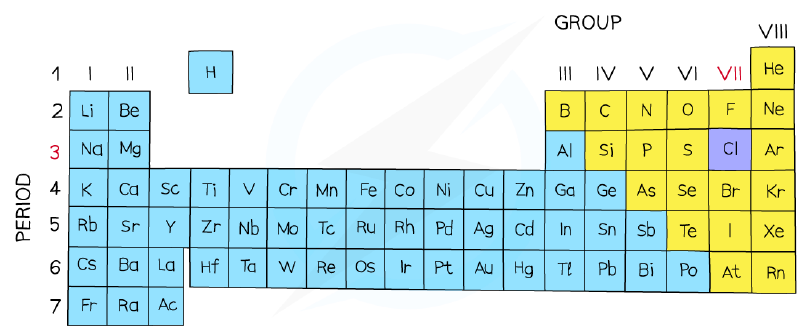
Metals, Non-Metals and Metalloids
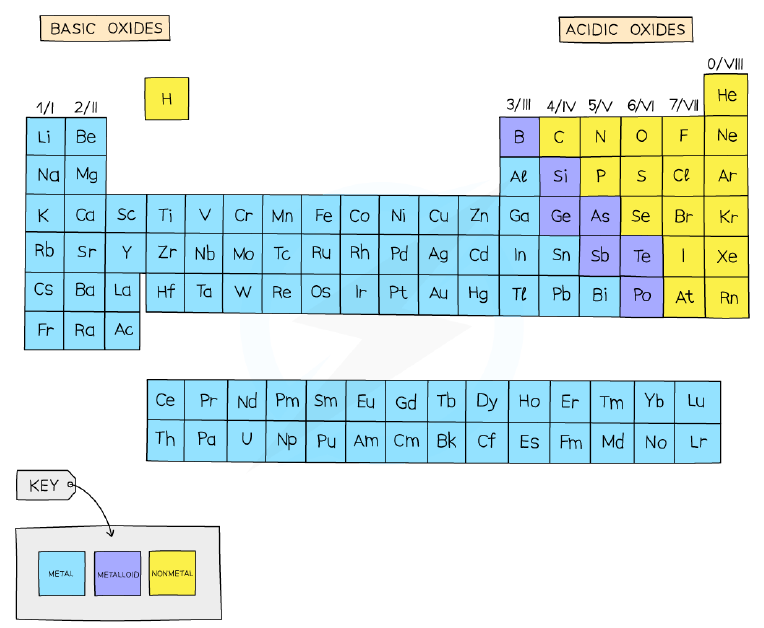
- Metals are found on the left and centre of the table (s- and d-blocks, and part of the p-block); they are good conductors of heat and electricity, and are malleable/ductile.
- Non-metals are found on the right-hand side (p-block); they are poor conductors, brittle when solid, and often form acidic oxides.
- Metalloids are found along a diagonal boundary between metals and non-metals and exhibit properties of both.
- Metalloids include elements like boron, silicon, arsenic, antimony.
Metals and non-metals in the Periodic Table
Blocks of the Periodic Table
- s-block: Groups 1 and 2 plus helium; outer electrons are in s orbitals.
- p-block: Groups 13 to 18; outer electrons are in p orbitals.
- d-block: Transition metals (Groups 3 to 12); outer electrons are in d orbitals.
- f-block: Lanthanides and actinides; outer electrons are in f orbitals.
- These blocks are useful for predicting reactivity, oxidation states, and typical bonding behaviour.
- The Periodic Table in the IB Chemistry Data Booklet does not label groups, blocks, or element types, so you must be able to locate periods, groups, and block positions yourself.
Electron Configurations and the Periodic Table
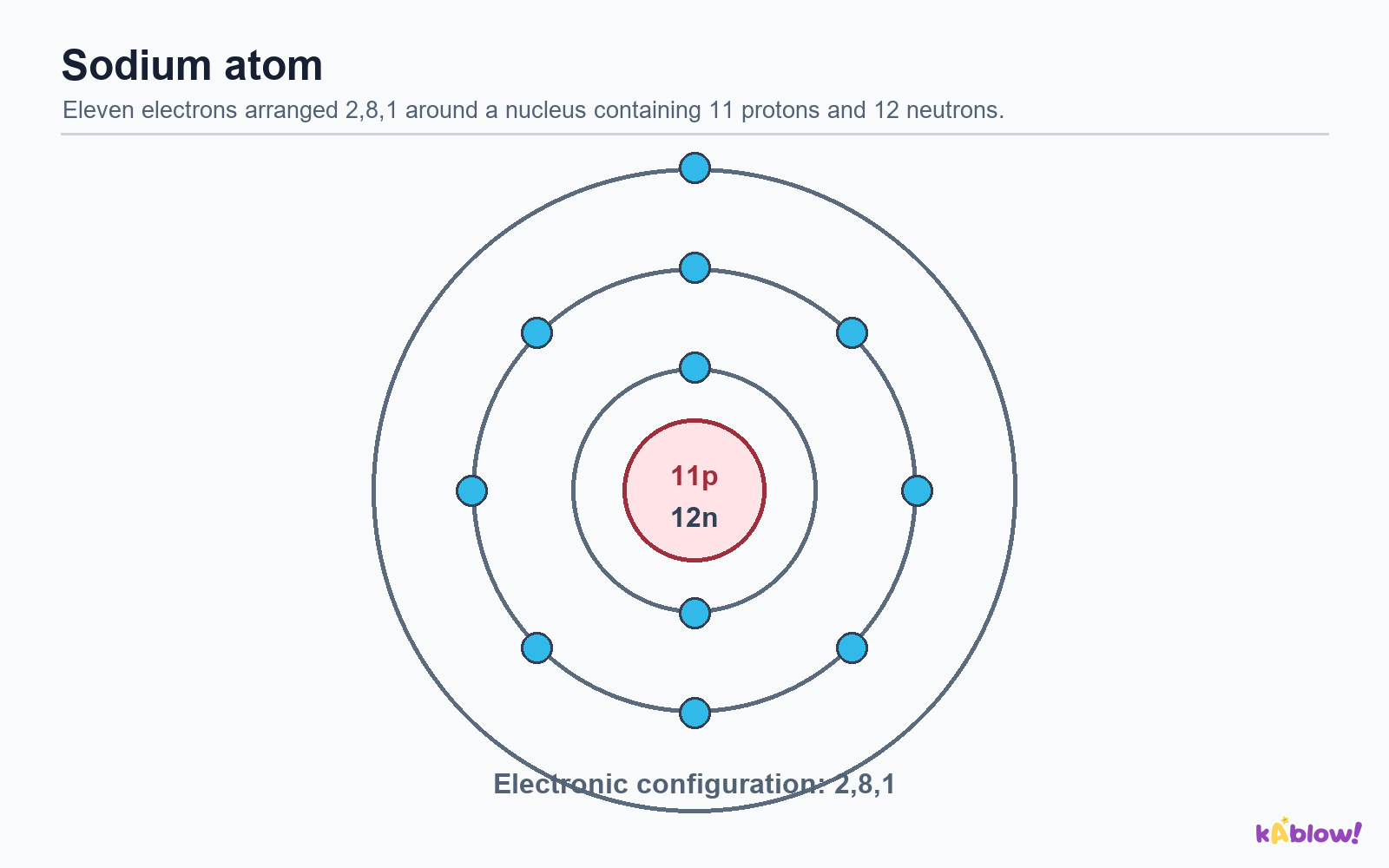
- The period number indicates the main energy level (shell) the valence electrons occupy and how many occupied energy levels the atom has.
- The group number indicates the number of valence electrons (e.g. Group 4 means 4 valence electrons).
- The block (s, p, d, f) is determined by the type of orbital the last electrons occupy.
- In the p-block, the element’s position from left to right tells you how many electrons are in the p subshell (e.g. the 2nd element in the p-block has 2 electrons in the p-subshell).
- The 4s orbital is lower in energy than the 3d subshell, so it is filled first (e.g. potassium: 1s² 2s² 2p⁶ 3s² 3p⁶ 4s¹, shorthand [Ar] 4s¹).
- When writing full electron configurations, they are often written in numerical order, so 3d is written before 4s (e.g. gallium: 1s² 2s² 2p⁶ 3s² 3p⁶ 3d¹⁰ 4s² 4p¹, shorthand [Ar] 3d¹⁰ 4s² 4p¹).
- For ions, electrons are lost from the outermost shell first (e.g. Mg²⁺: 1s² 2s² 2p⁶, shorthand [Ne]).
Electron shells and the Periodic Table
Periodic Trends: Atomic and Ionic Radius
- Atomic radius is the distance from the nucleus to the outermost electron shell; it is often taken as half the mean distance between two adjacent atoms.
- Across a period, atomic radius generally decreases: nuclear charge increases, electrons are added to the same shell, shielding is roughly constant, so outer electrons are pulled closer.
- Down a group, atomic radius generally increases: more principal quantum shells are added, outer electrons are further from the nucleus, and shielding increases.
- There is a sharp increase in atomic radius between a noble gas and the next alkali metal because the alkali metal has one extra principal quantum shell.
- Cations are smaller than their parent atoms because electrons are lost (often an outer shell), reducing electron–electron repulsion and allowing the nucleus to pull remaining electrons closer.
- Anions are larger than their parent atoms because extra electrons increase electron–electron repulsion, spreading the electron cloud out further.
- Ionic radius across a period: for cations it decreases; after anions form it increases sharply due to added electron repulsion, then decreases again as nuclear charge increases.
- Ionic radius down a group increases because more electron shells are added, increasing shielding and distance from the nucleus.
Periodic Trends: Ionisation Energy, Electron Affinity and Electronegativity
- First ionisation energy is the energy required to remove one mole of electrons from one mole of gaseous atoms to form one mole of gaseous ions (e.g. Ca(g) → Ca⁺(g) + e⁻, ΔH = +590 kJ mol⁻¹).
- Across a period, ionisation energy generally increases: nuclear charge increases, shielding is roughly constant, so outer electrons are more strongly attracted.
- Down a group, ionisation energy generally decreases: outer electrons are further from the nucleus and experience increased shielding.
- There is a rapid decrease in ionisation energy between the last element of one period and the first of the next due to increased distance and shielding.
- Electron affinity is the energy released when one mole of electrons is gained by one mole of gaseous atoms to form one mole of gaseous ions (e.g. Cl(g) + e⁻ → Cl⁻(g), ΔH = –349 kJ mol⁻¹).
- First electron affinity is usually exothermic for non-metals, but some elements (e.g. Group 2, Group 12, Group 15) have positive (endothermic) first electron affinities due to extra repulsion when adding an electron to a stable or half-filled subshell.
- Electron affinity across a period becomes more negative/exothermic; down a group it becomes less negative/exothermic.
- Electronegativity is the ability of an atom to attract a pair of electrons towards itself in a covalent bond; it increases across a period and decreases down a group.
Group 1 Metals with Water
- Group 1 metals are called alkali metals because they form alkaline solutions with high pH when reacted with water.
- They are soft and easy to cut (getting softer and denser down the group), have shiny silvery surfaces when freshly cut, conduct heat and electricity, and have low melting points and low densities.
- Melting point decreases down the group as atomic radius increases and metallic bonding gets weaker.
- Group 1 metals react vigorously with water to form an alkaline metal hydroxide solution and hydrogen gas: group 1 metal + water → group 1 metal hydroxide + hydrogen.
- Lithium floats and reacts slowly, releasing bubbles of hydrogen and forming a clear, colourless solution of lithium hydroxide.
- Sodium reacts more vigorously, melting into a small silvery ball that moves on the surface, producing hydrogen and a clear, colourless solution of sodium hydroxide.
- Potassium reacts more violently, melting into a shiny ball that dashes around, and the heat produced ignites the hydrogen with a lilac flame, forming potassium hydroxide.
- Reactivity increases down Group 1 because the outer electron is further from the nucleus and more shielded, so it is more easily lost.
Group 17 Elements with Halide Ions
- The halogens are the Group 17 non-metals: fluorine, chlorine, bromine, iodine and astatine; they are poisonous and exist as diatomic molecules (X₂).
- All halogens have seven electrons in their outer shell (ns² np⁵) and form halide ions by gaining one electron to complete their outer shell.
- Colours and states at room temperature: fluorine is a yellow gas, chlorine a pale green gas, bromine an orange-brown liquid (readily evaporates to a brown gas), iodine a grey-black solid (sublimes to a purple vapour).
- Melting and boiling points increase down the group due to increasing molecular mass and stronger van der Waals forces between molecules; the halogens also get darker in colour down the group.
- Reactivity decreases down Group 17 because atomic radius and shielding increase, and electron affinity becomes less negative, so the attraction for an incoming electron is weaker.
- A more reactive halogen will displace a less reactive halogen from an aqueous solution of its halide; the order of reactivity is chlorine > bromine > iodine.
- Example: chlorine displaces bromine from potassium bromide solution (Cl₂ + 2KBr → 2KCl + Br₂), turning the solution orange.
- Example: bromine displaces iodine from sodium iodide solution (Br₂ + 2NaI → 2NaBr + I₂), turning the solution brown.
Metallic and Non-Metallic Oxides
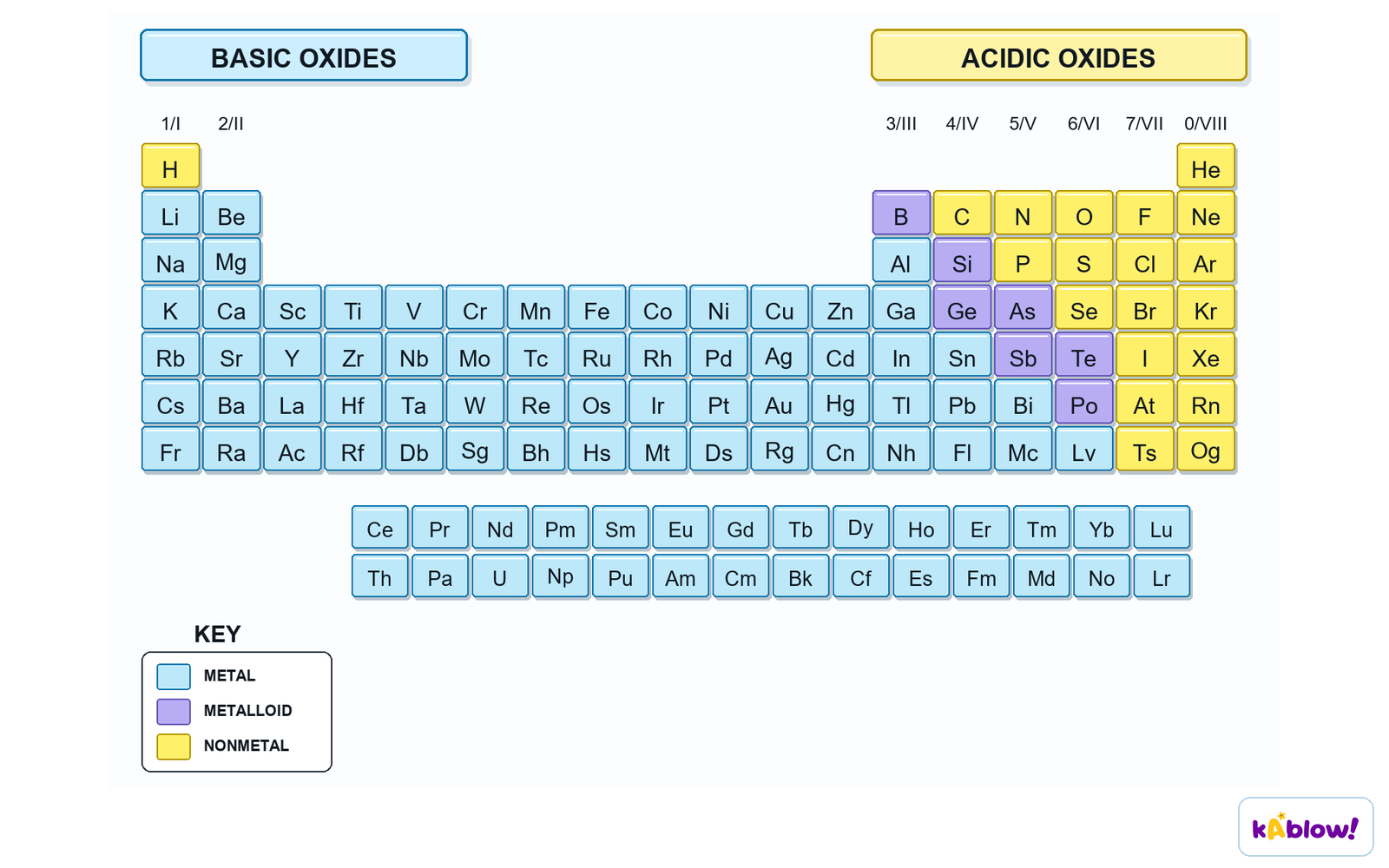
- Across a period, oxides change from basic through amphoteric to acidic.
- Amphoteric means a substance can act as both an acid and a base; aluminium oxide is amphoteric and reacts with both HCl and NaOH.
- Oxides on the left of Period 3 (Na₂O, MgO) are basic; Al₂O₃ is amphoteric; oxides on the right (SiO₂, P₄O₁₀, SO₂, SO₃) are acidic.
- Basic oxides (Group 1 and 2 metals) form hydroxides in water, giving alkaline solutions: Na₂O + H₂O → 2NaOH (pH ≈ 14); MgO + H₂O → Mg(OH)₂ (pH ≈ 10).
- Acidic oxides (non-metals) form oxoacids in water, giving acidic solutions: P₄O₁₀ + 6H₂O → 4H₃PO₄ (pH ≈ 2); SO₂ + H₂O → H₂SO₃ (pH ≈ 1); SO₃ + H₂O → H₂SO₄ (pH ≈ 1).
- The trend from basic to acidic oxides is explained by bonding and electronegativity: large electronegativity differences between oxygen and metals on the left give ionic oxides; smaller differences give covalent oxides.
- Environmental links: non-metal oxides dissolving in atmospheric water cause acid rain (e.g. SO₂ + H₂O → H₂SO₃; 2NO₂ + H₂O → HNO₃ + HNO₂); CO₂ dissolving in seawater causes ocean acidification (CO₂ + H₂O ⇌ H₂CO₃).
Metals form basic oxides, non-metals form acidic oxides
Oxidation States
- Oxidation can be defined as addition of oxygen, loss of hydrogen, or loss of electrons; reduction as loss of oxygen, gain of hydrogen, or gain of electrons.
- The oxidation number (or state) of an atom is the charge it would have if all bonding were completely ionic.
- Oxidation numbers are used to tell if oxidation or reduction has taken place, identify what has been oxidised/reduced, and construct half-equations and balance redox equations.
- Oxidation numbers are always written with the sign before the number (e.g. +1, –2).
- For simple ions, the oxidation number equals the charge on the ion (e.g. Na⁺ = +1, Mg²⁺ = +2, Cl⁻ = –1, O²⁻ = –2).
- In a neutral molecule or compound, the sum of oxidation numbers is zero (e.g. in H₂O, H = +1 and O = –2; in CO₂, C = +4 and O = –2).
- In a polyatomic ion, the sum of oxidation numbers equals the ion’s charge (e.g. in SO₄²⁻, S = +6 and O = –2).
- In compounds/ions, the more electronegative element is assigned the negative oxidation number (e.g. in F₂O, F = –1 and O = +2).
슬라이드
연습 문제
무료 미리 보기 — 55개 중 8개 문제. 가입하면 전부 볼 수 있어요.
1.Which of the following statements describes first ionisation energy?
Easy- AThe energy required to remove one mole of electrons from one mole of gaseous atoms
- BThe energy required to remove the outermost electron from each atom in one mole of gaseous atoms
- CThe energy required to remove the outermost electron from each atom in one mole of atoms
- DThe energy required to produce one mole of ions from one mole of gaseous atoms
2.Sodium sulfide, Na2S, is a reactive yellow solid, produced when sodium and sulfur react together. How do the ionic radius and atomic radius of sodium compare with those of sulfur?
Easy- Aionic radius: sodium < sulfur; atomic radius: sodium < sulfur
- Bionic radius: sodium < sulfur; atomic radius: sodium > sulfur
- Cionic radius: sodium > sulfur; atomic radius: sodium > sulfur
- Dionic radius: sodium > sulfur; atomic radius: sodium < sulfur
3.Which property below decreases generally across the second period?
Easy- AAtomic number
- BAtomic radius
- CElectronegativity
- DIonisation energy
4.The trends in three physical properties of the elements of Period 3 are shown in graphs. Which physical property is not illustrated?
Medium- AElectrical conductivity
- BAtomic radius
- CMelting point
- DFirst ionisation energy
5.This question refers to isolated gaseous species. The species O2−, Ne and Mg2+ are isoelectronic. In which order do their radii increase?
Medium- AMg2+ < Ne < O2−
- BNe < O2− < Mg2+
- CMg2+ < O2− < Ne
- DO2− < Ne < Mg2+
6.Which graph correctly shows the electronegativity of the elements Na, Mg, Al and Si, from Period 3, plotted against their first ionisation energies?
Medium- AA graph showing a positive correlation: as ionisation energy increases, electronegativity increases.
- BA graph showing a negative correlation: as ionisation energy increases, electronegativity decreases.
- CA graph showing no correlation.
- DA graph showing a random scatter.
7.Which period 3 element from sodium to silicon has the largest atomic radius?
Easy- AMagnesium
- BSodium
- CSilicon
- DAluminium
8.What is the correct classification for the element zirconium, Zr?
Easy- As block
- Bd block
- Cf block
- Dp block