Counting Particles By Mass: The Mole
플레이하며 배우기
이 문제들을 풀어 에너지를 얻은 뒤 낚시하고 탐험하세요. 계정이 필요 없어요.
수업 노트
The Mole and Avogadro's Constant
- The Avogadro constant (NA or L) is the number of particles equivalent to the relative atomic mass (Ar) or molecular mass (Mr) of a substance in grams.
- The value of the Avogadro constant is 6.02 × 10²³ mol⁻¹.
- One mole of a substance contains the same number of fundamental units as there are atoms in exactly 12.00 g of carbon-12.
- 6.02 × 10²³ atoms of carbon-12 have a mass of exactly 12.00 g.
- The Avogadro constant applies to atoms, molecules and ions.
- The mass of a substance with this number of particles is called the molar mass.
Relative Atomic and Formula Mass
- The relative atomic mass (Ar) of an element is the weighted average mass of one atom compared to one twelfth the mass of a carbon-12 atom.
- The relative atomic mass is determined by using the weighted average mass of the isotopes of a particular element.
- Ar has no units as it is a ratio and the units cancel out.
- The relative formula mass (Mr) is used for compounds containing ions and is calculated in the same way as relative molecular mass.
- Mr is the sum of the relative atomic masses of all atoms in the formula unit.
Molar Mass and Calculations
- The molar mass of a substance is its relative atomic mass (Ar) or relative formula mass (Mr) expressed in grams.
- Molar mass is given in units of g mol⁻¹.
- The number of moles can be found using the formula: moles = mass (g) ÷ molar mass (g mol⁻¹).
- The number of particles can be calculated using: number of particles = amount in moles × Avogadro constant.
- To find the mass of a substance: mass = moles × molar mass.
- Always show your workings in calculations as it is easier to check for errors and you may pick up credit if you get the final answer wrong.
Empirical and Molecular Formulas
- The molecular formula shows the actual number and type of atoms in a molecule (e.g. ethanoic acid is C₂H₄O₂).
- The empirical formula gives the simplest whole-number ratio of atoms of each element in a compound (e.g. ethanoic acid is CH₂O).
- The empirical formula can be determined from percentage composition by mass data.
- Organic compounds often have different empirical and molecular formulae.
- The formula of an ionic compound is always written as an empirical formula.
- To determine the molecular formula: divide the compound's relative molecular mass (Mr) by the relative mass of the empirical formula, then multiply the empirical formula by this whole number.
Molar Concentration
- Concentration tells us how much solute is dissolved in a solvent to make a solution.
- It is usually measured as the amount of solute in 1 dm³ of solution.
- The solute is the substance being dissolved; the solvent is the liquid that does the dissolving.
- A concentrated solution contains a large amount of solute per unit volume; a dilute solution contains a small amount.
- Concentration can be expressed as moles per unit volume (mol dm⁻³), often written using square brackets, e.g. [NaCl] = 0.25 mol dm⁻³.
- Concentration can also be expressed as mass per unit volume (g dm⁻³) or parts per million (ppm) for very low concentrations.
- The formula for concentration in mol dm⁻³ is: concentration = moles of solute ÷ volume of solution (dm³).
- You must convert cm³ to dm³ by dividing by 1000.
Concentration, moles and volume
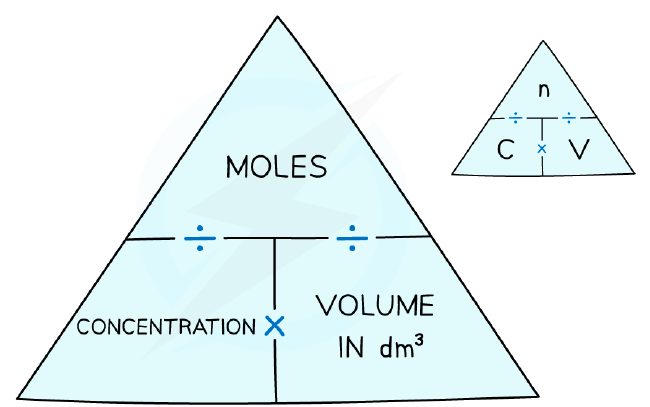
Mass Concentration and ppm
- The formula for mass concentration is: concentration (g dm⁻³) = mass of solute (g) ÷ volume of solution (dm³).
- To convert from mol dm⁻³ to g dm⁻³: multiply the molar concentration by the molar mass.
- To convert from g dm⁻³ to mol dm⁻³: divide the mass concentration by the molar mass.
- Parts per million (ppm) is useful for expressing extremely low concentrations, such as pollutants in water or air.
- 1 ppm is defined as a mass of 1 mg dissolved in 1 dm³ of water (which weighs 1 kg), or 10⁻⁶ g in 10⁻³ g.
- For concentration calculations, always check units: use g mol⁻¹ for molar mass, g for mass, and dm³ (not cm³) for volume.
Avogadro's Law and Gas Volumes
- Avogadro's Law states that equal volumes of gases (under the same conditions of temperature and pressure) contain the same number of molecules.
- This allows us to determine mole ratios from the volumes of reacting gases.
- At standard temperature and pressure (STP), one mole of any gas occupies 22.7 dm³ (units: dm³ mol⁻¹).
- STP conditions are defined as 0 °C (273 K) and 100 kPa pressure.
- The volume ratio of gaseous reactants and products in a balanced chemical equation is the same as the mole ratio.
- These gas volume relationships are only valid if all gases are measured under the same conditions of temperature and pressure.
Stoichiometry and Limiting Reactants in Gases
- In a balanced equation, the coefficients give the mole ratio, which can be directly applied to gas volumes.
- Example: C₃H₈(g) + 5O₂(g) → 3CO₂(g) + 4H₂O(l). If 50 cm³ of propane is burned, volume of O₂ needed = 5 × 50 = 250 cm³, and volume of CO₂ formed = 3 × 50 = 150 cm³.
- If gases are not in the same ratio as the balanced equation, use limiting reactant principles to determine the actual amount of product formed.
- To identify the limiting reactant, divide the volumes of the gases by their coefficients; the lowest number indicates the limiting reactant.
- In limiting reactant problems involving gas volumes, use the 'lowest is limiting' technique.
- For example, in the reaction 4NH₃(g) + 5O₂(g) → 4NO(g) + 6H₂O(l), if 70 cm³ NH₃ and 50 cm³ O₂ are used, O₂ is limiting because 50/5 = 10 is lower than 70/4 = 17.5.
슬라이드
연습 문제
무료 미리 보기 — 65개 중 8개 문제. 가입하면 전부 볼 수 있어요.
1.Which of the following is the value of the Avogadro constant?
Easy- A6.02 × 10²³ mol⁻¹
- B6.02 × 10²² mol⁻¹
- C6.02 × 10²⁴ mol⁻¹
- D6.02 × 10⁻²³ mol⁻¹
2.Which of the following is the standard reference used for the relative atomic mass scale?
Easy- Athe mass of an electron
- B1/12 the mass of a carbon-12 atom
- Cthe mass of a hydrogen-1 atom
- Dthe mass of a proton
3.Which of the following shows the relative formula mass of ammonium sulfate, (NH₄)₂SO₄?
Easy- A70.00
- B132.17
- C114.09
- D132.00
4.Shown below are four molecular formulas. Which one is also an empirical formula?
Medium- APCl₅
- BCH₃COOH
- CH₂O₂
- DC₆H₁₂O₆
5.Ethane has the formula C₂H₆. What is the mass in grams of one molecule of ethane?
Medium- A1.8 × 10²⁵
- B3.0 × 10⁻²³
- C30.0
- D5.0 × 10⁻²³
6.A compound has an empirical formula of C₂H₆O and a molar mass of 92.16 g mol⁻¹. What is the molecular formula of this compound?
Medium- AC₂H₆O
- BC₄H₁₂O₂
- CC₆H₁₈O₃
- DC₈H₂₄O₄
7.Which amount of the following substances contains the smallest quantity of ions?
Medium- A2 mol of KOH
- B1 mol of NH₄Br
- C2 mol of MgCl₂
- D1 mol of Fe₂O₃
8.A sample of hydrated calcium sulfate, CaSO₄·xH₂O, has a relative formula mass of 172.19. What is the value of x?
Medium- A1
- B2
- C3
- D4