Energy Cycles In Reactions
플레이하며 배우기
이 문제들을 풀어 에너지를 얻은 뒤 낚시하고 탐험하세요. 계정이 필요 없어요.
수업 노트
Bond Enthalpy Basics
- A chemical bond is a force of attraction between two atoms.
- Breaking a bond requires energy input, so it is an endothermic process.
- Forming a bond releases energy, so it is an exothermic process.
- The energy required to break a particular bond is called the bond dissociation enthalpy, often shortened to bond enthalpy or bond energy.
- The energy released when a bond forms has the same magnitude as the energy taken in to break it, but with opposite sign.
Overall Enthalpy Changes
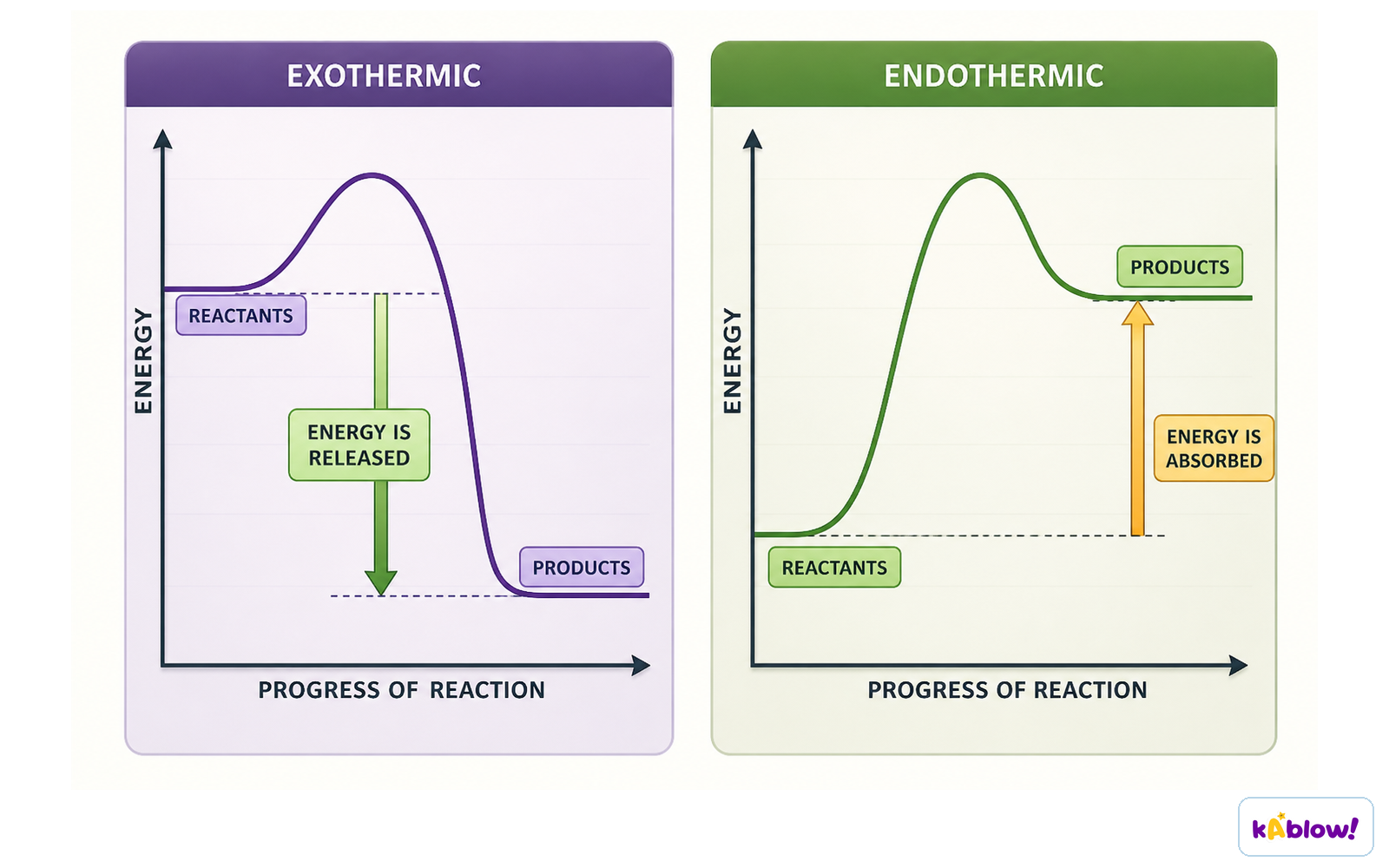
- If more energy is released when new bonds form than is required to break bonds, the reaction is exothermic.
- In an exothermic reaction, the products are more stable than the reactants.
- If more energy is required to break bonds than is released when new bonds form, the reaction is endothermic.
- In an endothermic reaction, the products are less stable than the reactants.
Exothermic and endothermic reactions
Average Bond Enthalpy
- Bond energies are affected by other atoms in the molecule (the environment).
- An average bond enthalpy is defined as the energy needed to break one mole of bonds in a gaseous molecule, averaged over similar compounds.
- For example, the average C–H bond enthalpy is found by taking the bond dissociation enthalpy for the whole molecule and dividing by the number of C–H bonds.
- The first C–H bond is easier to break than the second because the remaining hydrogens are pulled more closely to the carbon.
- Since it is impossible to measure the energy of each individual C–H bond, an average is taken and compared with similar compounds to obtain an accepted value.
Bond Enthalpy Calculations
- Bond energies are used to find the ΔH of a reaction when it cannot be done experimentally.
- The process is a step-by-step summation of the bond enthalpies of all molecules present.
- The formula is: ΔH = enthalpy change for bonds broken + enthalpy change for bonds formed.
- Values for bonds broken are positive (endothermic) and values for bonds formed are negative (exothermic).
- Always draw out full displayed structures to account for every bond present.
- Watch out for coefficients in balanced equations; multiply bond enthalpies by the coefficients.
- Show your steps because bond enthalpy calculations often carry marks for workings.
Hess's Law
- In 1840, Russian chemist Germain Hess formulated Hess's Law.
- Hess's Law states: 'The total enthalpy change in a chemical reaction is independent of the route by which the chemical reaction takes place as long as the initial and final conditions are the same.'
- This means whether a reaction takes place in one or two steps, the total enthalpy change is the same.
- Hess's Law is used to calculate enthalpy changes that cannot be found experimentally using calorimetry.
- For example, ΔHf of propane cannot be found experimentally as hydrogen and carbon don't react under standard conditions.
- Hess's Law is based on the Law of Conservation of Energy: energy cannot be created or destroyed, only changed in form.
Calculating ΔH from ΔHf using Hess's Law Energy Cycles
- According to Hess's Law, the total enthalpy change is the same regardless of the pathway taken, because energy is conserved.
- Two possible routes to form products from elements: direct formation (one-step) and indirect formation (two-step via reactants).
- Direct route: Elements → Products, enthalpy change = ΔH₂.
- Indirect route: Elements → Reactants → Products, enthalpy change = ΔH₁ + ΔHr.
- By Hess's Law: ΔH₂ = ΔH₁ + ΔHr.
- Rearranged to solve for enthalpy change of reaction: ΔHr = ΔH₂ − ΔH₁.
Hess's Law Calculations Using Cycles
- There are two common methods to solve Hess's Law problems: using cycles and using equations.
- To use cycles, follow a step-by-step plan: write the target enthalpy change at the top, write the alternative route at the bottom, connect with arrows, and add enthalpy data adjusting for molar amounts.
- Two important rules: if you follow the direction of the arrow, ADD the quantity; if you go against the arrow, SUBTRACT the quantity.
- Example: Calculate ΔH for 2N₂(g) + 6H₂(g) → 4NH₃(g) given 4NH₃(g) + 3O₂(g) → 2N₂(g) + 6H₂O(l) ΔH = -1530 kJ mol⁻¹ and H₂(g) + ½O₂(g) → H₂O(l) ΔH = -288 kJ mol⁻¹.
- Solution: ΔH = +6ΔH₂ – ΔH₁ = +(-288 × 6) - (-1530) = -198 kJ.
Hess's Law Calculations Using Equations
- When using equations, identify which given equation contains the desired product and reactant.
- Adjust equations if necessary: if you reverse an equation, reverse the sign of ΔH; if you multiply an equation, multiply ΔH by the same factor.
- Add the equations together and cancel common items on both sides.
- Add the ΔH values together to get the final enthalpy change.
- Example: Given N₂(g) + O₂(g) → 2NO(g) ΔH = +180 kJ and 2NO(g) → 2NO₂(g) + O₂(g) ΔH = +112 kJ, find ΔH for N₂(g) + 2O₂(g) → 2NO₂(g).
- Reverse the second equation: 2NO₂(g) + O₂(g) → 2NO(g) ΔH = -112 kJ. Add to first: N₂(g) + O₂(g) + 2NO₂(g) + O₂(g) → 2NO(g) + 2NO₂(g). Cancel: N₂(g) + 2O₂(g) → 2NO₂(g) ΔH = +180 - 112 = +68 kJ.
Examiner Tips and Tricks
- You do not need to learn Hess's Law word for word, but you must understand the principle as it provides the foundation for problem solving in Chemical Energetics.
- When using cycles, always put brackets around values and add the mathematical operator in front to avoid confusing signs with operations.
- It doesn't matter whether you use equations or cycles to solve Hess's Law problems, but you should be familiar with both methods and sometimes one is easier than another.
슬라이드
연습 문제
무료 미리 보기 — 61개 중 8개 문제. 가입하면 전부 볼 수 있어요.
1.Which statement best describes what is meant by the average HI bond enthalpy?
Easy- AThe energy stored in a covalent bond.
- BThe energy required to break one covalent bond in the gas phase.
- CThe energy required to break one mole of the HI bonds in the gas phase.
- DThe energy released when two atoms form a covalent bond.
2.Which is the correct definition of mean bond enthalpy?
Easy- AThe amount of energy required to break a specific covalent bond in the gas phase
- BThe energy required to break one mole of a specific covalent bond with all chemicals in their standard states
- CThe amount of energy required to break a specific covalent bond with all chemicals in their standard states
- DThe energy required to break one mole of a specific covalent bond in the gas phase
3.A basic definition of Hess’s Law states that the overall enthalpy change for a reaction is the same independent of the route taken. Which of the following statements make the definition of Hess’s Law more complete? (select all that apply)
Medium- AProviding that the reactants are the same
- BProviding that the products are the same
- CProviding that the conditions at the start and the end of the reaction are the same
- DProviding that the reaction is exothermic
- EProviding that the reaction goes to completion
4.Which equation shows the correct application of Hess’s law to calculate the enthalpy change for the conversion of graphite to diamond, given the enthalpy changes of formation of graphite (ΔH₁) and diamond (ΔH₂) from their elements?
Medium- AΔH = ΔH₁ + ΔH₂
- BΔH = ΔH₁ - ΔH₂
- CΔH = ΔH₂ - ΔH₁
- DΔH = ΔH₁ × ΔH₂
5.A student drew a Hess cycle to calculate the enthalpy of reaction to produce ethane from ethene and hydrogen. The student used the following enthalpy of combustion data: C₂H₄(g) ΔHc = -1411 kJ mol⁻¹, H₂(g) ΔHc = -286 kJ mol⁻¹, C₂H₆(g) ΔHc = -1560 kJ mol⁻¹. What are the correct labels for the arrows for the student’s Hess cycle?
Medium- AArrow 1: ΔHr, Arrow 2: -1411, Arrow 3: -286, Arrow 4: -1560
- BArrow 1: ΔHr, Arrow 2: -1411, Arrow 3: +286, Arrow 4: -1560
- CArrow 1: ΔHr, Arrow 2: +1411, Arrow 3: -286, Arrow 4: +1560
- DArrow 1: ΔHr, Arrow 2: -1411, Arrow 3: -286, Arrow 4: +1560
6.The diagram shows two possible reaction pathways for the reaction of A → D. Which of the following statements are correct? I. A → D ΔH = +45 kJ II. C → D ΔH = -25 kJ III. D → C ΔH = -65 kJ
Medium- AI and II only
- BI and III only
- CII and III only
- DI, II and III
7.The thermal decomposition of calcium carbonate is very slow and requires a high temperature. The enthalpy change can be determined by two reactions with dilute hydrochloric acid. Which set of chemicals correctly completes the Hess cycle diagram?
Medium- ACaCO₃ + CaO + HCl
- BCaCl₂ + H₂O + CO₂
- CCaCl₂ + H₂O
- DCaCl₂ + H₂O + CO₂ + HCl
8.The hydration enthalpy of anhydrous copper(II) sulfate cannot be measured directly. It can be found indirectly by determining the solution enthalpies of anhydrous and hydrated copper(II) sulfate. Which are the correct labels for the enthalpies shown in the Hess cycle?
Medium- A1: ΔHsol, 2: ΔHhyd, 3: ΔHhyd
- B1: ΔHr, 2: ΔHhyd, 3: ΔHhyd
- C1: ΔHhyd, 2: ΔHsol, 3: ΔHhyd
- D1: ΔHr, 2: ΔHsol, 3: ΔHsol