Energy From Fuels
플레이하며 배우기
이 문제들을 풀어 에너지를 얻은 뒤 낚시하고 탐험하세요. 계정이 필요 없어요.
교육자를 위해: Energy From Fuels(Chemistry, SL)을(를) 위한 바로 쓸 수 있는 수업 슬라이드, 복습 노트 — 수업에 사용하거나, 학습자들이 실시간 게임으로 즐기는 인터랙티브 클래스 활동으로 진행하세요.
수업 노트
Combustion Reactions
- Combustion is a rapid, exothermic reaction involving a fuel, oxygen, and an ignition source, commonly called burning.
- It produces heat and light, so it is exothermic.
- Complete combustion occurs with sufficient oxygen, while incomplete combustion occurs with limited oxygen.
- Metals can combust to form metal oxides; reactive metals like magnesium burn with a bright white flame: 2Mg(s) + O₂(g) → 2MgO(s).
- Non-metals such as sulfur burn to form covalent oxides like sulfur dioxide: S(s) + O₂(g) → SO₂(g).
- Organic fuels include hydrocarbons (especially alkanes) and alcohols; they release large amounts of energy when combusted.
- Complete combustion of organic compounds produces carbon dioxide and water: fuel + oxygen → carbon dioxide + water.
- For example, methane: CH₄(g) + 2O₂(g) → CO₂(g) + 2H₂O(l); ethanol: C₂H₅OH(l) + 3O₂(g) → 2CO₂(g) + 3H₂O(l).
Incomplete Combustion
- Incomplete combustion occurs when oxygen is limited; it still produces water but forms carbon monoxide (CO) or carbon (C) instead of carbon dioxide.
- In a Bunsen burner, complete combustion gives a blue, non-luminous flame; incomplete combustion gives a yellow, luminous flame.
- Carbon monoxide is colourless and odourless, making it hard to detect without a sensor.
- CO is toxic because it binds irreversibly to haemoglobin, preventing oxygen transport; this can cause dizziness, loss of consciousness, and death.
- With very limited oxygen, carbon (soot) is produced; a yellow, sooty flame indicates incomplete combustion.
- Hydrocarbons with higher carbon content are more likely to produce soot; for example, naphthalene (94% C) produces more soot than nitrobenzene (59% C).
- Incomplete combustion never produces hydrogen; hydrogen is always preferentially oxidised by any available oxygen.
- Example: incomplete combustion of propane to carbon: C₃H₈(l) + 2O₂(g) → 3C(s) + 4H₂O(l).
Fossil Fuels: Advantages and Disadvantages
- Fossil fuels include coal, oil, and natural gas; they are made of hydrocarbons formed from buried dead plants and animals.
- They are non-renewable (finite) and cannot be replaced quickly once used.
- Coal is cheap, widely available, long-lasting, and safe to store; by-products like ash can be used in road construction.
- Oil is easy to store and transport, has high energy density, and can be separated by fractional distillation and cracking.
- Natural gas is the cheapest fossil fuel, easy to transport in pipelines, and burns with a blue flame producing minimal harmful emissions.
- Combustion of fossil fuels releases carbon dioxide (global warming), sulfur dioxide (acid rain), and particulates (global dimming).
- Coal mining causes habitat destruction, noise pollution, and health risks; oil spills harm habitats; natural gas is expensive to extract and store under pressure.
Amount of Carbon Dioxide Produced When Fuels Burn
- Specific energy is a measure of the energy stored in a substance; different fuels release different amounts of energy when combusted.
- As the hydrocarbon chain length increases, carbon content increases, so more carbon dioxide and carbon monoxide/carbon are produced.
- Longer chains have stronger London dispersion forces, making the hydrocarbon less volatile.
- Longer chains release less energy per unit mass of fuel; methane releases the most energy per unit mass.
- As chain length increases, incomplete combustion becomes more likely.
- To calculate CO₂ produced, use the balanced equation and mole ratios; for example, 1.00 g butane produces 3.03 g CO₂.
Carbon Dioxide Levels & the Greenhouse Effect
- Atmospheric carbon dioxide is rising due to human activities: combustion of fossil fuels (electricity, transport, construction), deforestation, and livestock farming.
- The main driver is combustion of fossil fuels, which releases carbon stored for millions of years.
- Greenhouse gases include carbon dioxide (CO₂), methane (CH₄), nitrous oxides (NOₓ), and water vapour (H₂O).
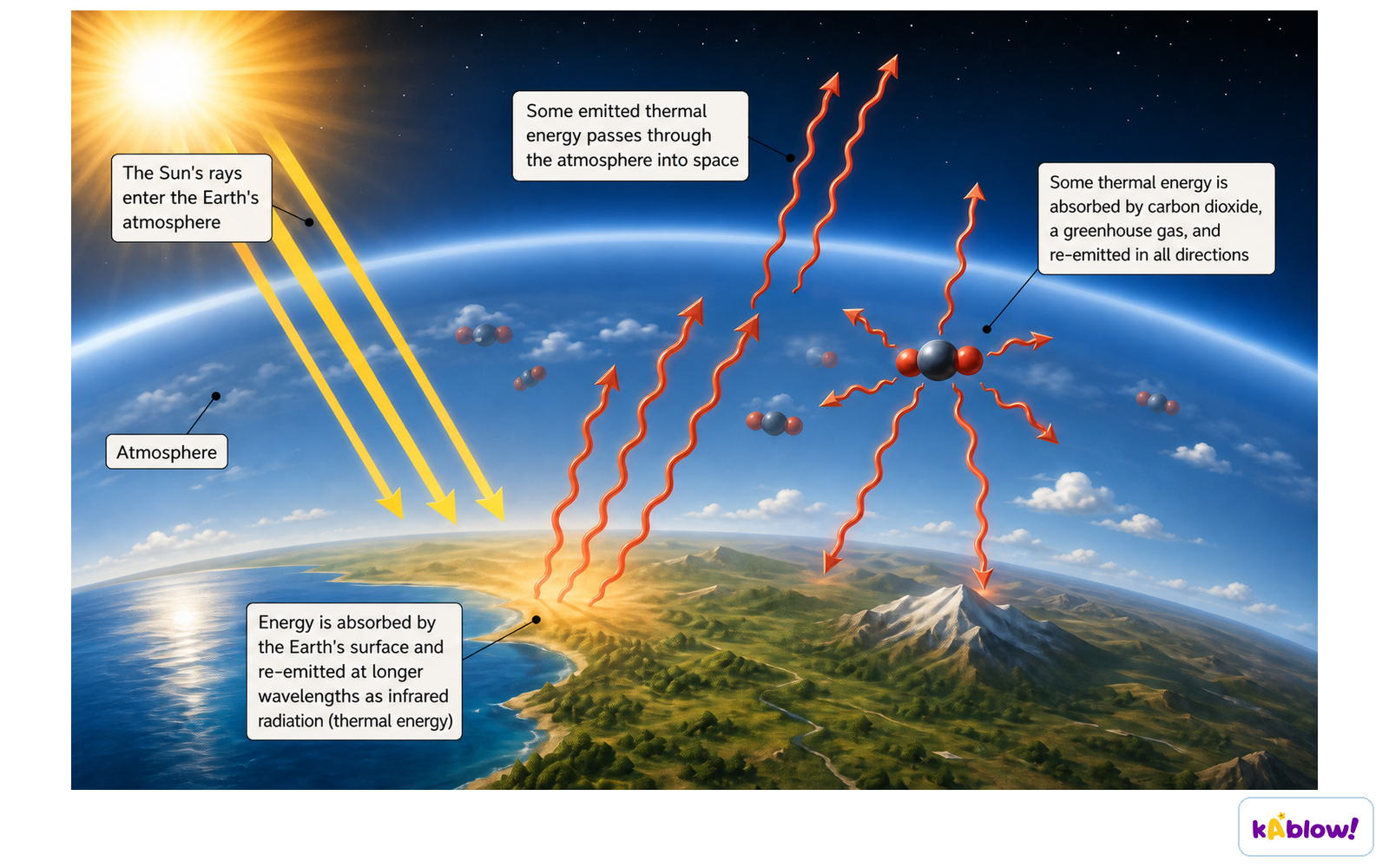
- The greenhouse effect keeps Earth warm: shortwave radiation from the sun is absorbed and re-emitted as longwave infrared radiation, which is absorbed by greenhouse gases and re-radiated in all directions.
- Human activities increase greenhouse gas levels, leading to the enhanced greenhouse effect and global warming.
- Mauna Loa Observatory has recorded CO₂ data since 1958 and methane data since 1984; the graph shows annual fluctuations due to seasonal photosynthesis.
- Photosynthesis removes CO₂ from the atmosphere, causing seasonal changes in CO₂ levels.
The greenhouse effect
Biofuels
- Renewable resources will not run out in the foreseeable future and are sustainable; non-renewable resources are finite and will run out.
- The three main biofuels are bioethanol, biodiesel, and biogas; they are made from organic compounds produced by biological carbon fixation.
- Bioethanol is ethanol made from a biological source; plants absorb CO₂ via photosynthesis: 6CO₂(g) + 6H₂O(l) → C₆H₁₂O₆(aq) + 6O₂(g), then glucose is fermented to ethanol.
- Bioethanol can be carbon neutral if the CO₂ absorbed during photosynthesis equals the CO₂ released when burned.
- Biodiesel is made from renewable vegetable oils via transesterification with methanol, catalysed by acid or alkali (e.g. NaOH or KOH); excess methanol shifts equilibrium to products, yield up to 98%.
- Biogas is made when organic matter is broken down by microorganisms in anaerobic conditions; it is mainly methane and carbon dioxide.
- Advantages of biofuels: carbon neutral, renewable, reduce greenhouse gases and landfill waste, generate income and jobs.
- Disadvantages of biofuels: high costs, land use conflict with food crops, deforestation, soil nutrient depletion, and lower specific energy than fossil fuels.
Fuel Cells
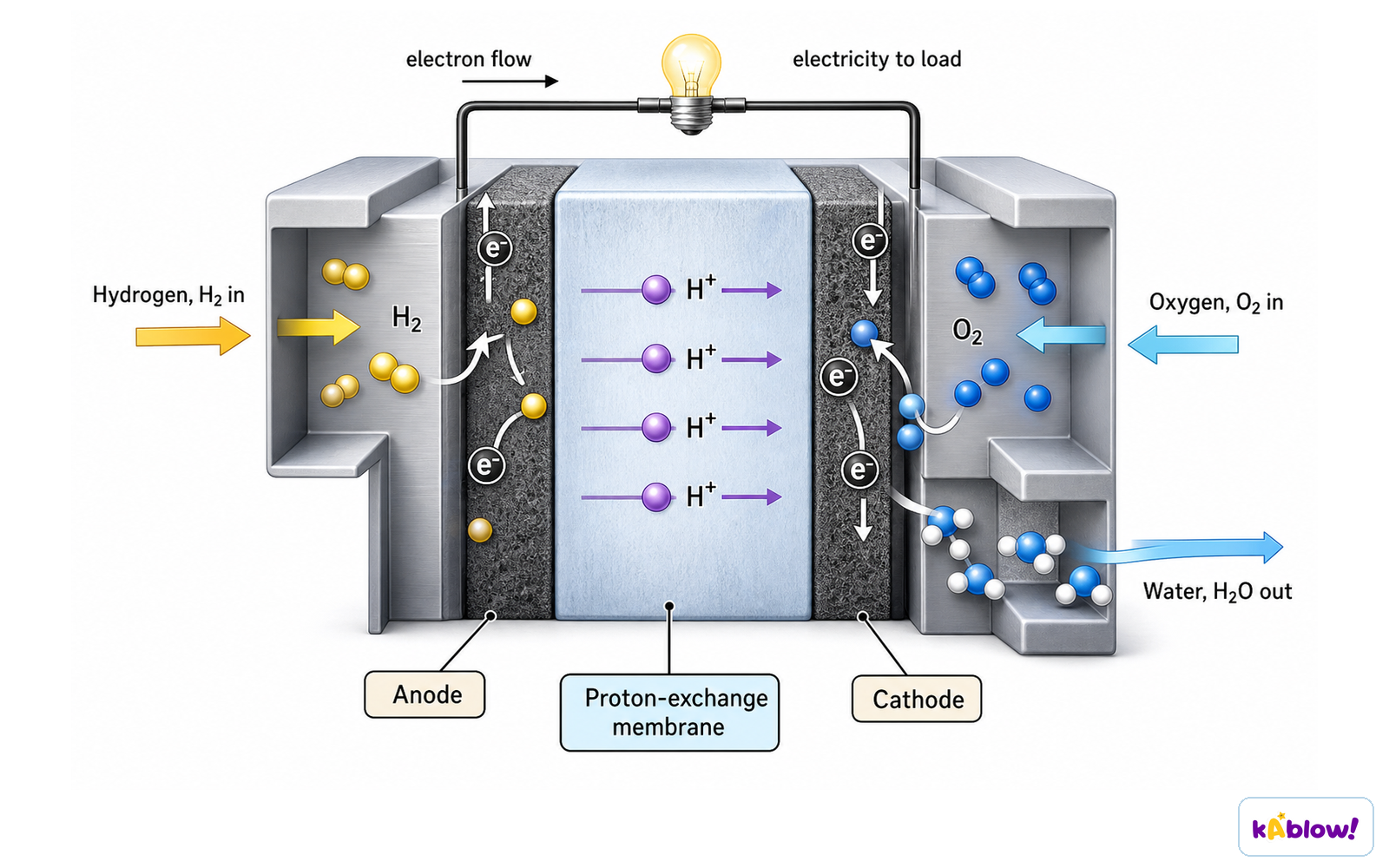
- A fuel cell is an electrochemical cell where a fuel donates electrons at one electrode and oxygen gains electrons at the other, generating a voltage.
- In a hydrogen-oxygen fuel cell, the electrolyte is aqueous sodium hydroxide; half-equations: 2H₂(g) + 4OH⁻(aq) → 4H₂O(l) + 4e⁻ and O₂(g) + 2H₂O + 4e⁻ → 4OH⁻(aq); overall: 2H₂(g) + O₂(g) → 2H₂O(l) Eθ = +1.23 V.
- The only product is water, so hydrogen fuel cells are environmentally friendly with no harmful emissions; they operate at room temperature and avoid combustion.
- Hydrogen fuel cells produce no nitrogen oxides (NOₓ) unlike high-temperature combustion; they have been used on spacecraft where product water can be drunk by astronauts.
- Disadvantages of hydrogen fuel cells: hydrogen is highly flammable, requires heavy storage tanks, and is mostly sourced from fossil fuels; low energy density by volume means larger containers.
- In a methanol fuel cell, methanol is the source of hydrogen ions; half-equations: CH₃OH(aq) + H₂O(l) → CO₂(g) + 6H⁺(aq) + 6e⁻ and O₂(g) + 4H⁺(aq) + 4e⁻ → 2H₂O(l); overall: CH₃OH(aq) + 1.5O₂(g) → CO₂(g) + 2H₂O(l).
- Advantages of methanol over hydrogen fuel cells: easier to store and transport, operates at low pressure and temperature, higher energy density, can be made from renewable resources.
- Disadvantages of methanol fuel cells: toxic and flammable, commonly made from fossil fuels, lower voltage and power output, low efficiency due to methanol crossover, requires expensive catalysts, and produces CO₂.
A hydrogen–oxygen fuel cell
슬라이드
연습 문제
무료 미리 보기 — 62개 중 8개 문제. 가입하면 전부 볼 수 있어요.
1.Which of the following is NOT required for combustion to occur?
Easy- AA fuel
- BOxygen
- CAn ignition source
- DA catalyst
2.What are the products of the complete combustion of a hydrocarbon?
Easy- ACarbon monoxide and water
- BCarbon dioxide and water
- CCarbon and water
- DCarbon dioxide and hydrogen
3.Which flame colour indicates complete combustion in a Bunsen burner?
Easy- AYellow, luminous
- BBlue, non-luminous
- COrange, sooty
- DGreen, non-luminous
4.Which of the following are greenhouse gases? (select all that apply)
Medium- ACarbon dioxide (CO2)
- BMethane (CH4)
- CNitrogen (N2)
- DWater vapour (H2O)
- ENitrous oxides (NOx)
5.The incomplete combustion of organic compounds can produce hydrogen gas.
EasyTrue or false?
6.Which of the following is the main product of the incomplete combustion of a hydrocarbon when oxygen is very limited?
Medium- ACarbon dioxide
- BCarbon monoxide
- CCarbon (soot)
- DHydrogen
7.Why is carbon monoxide dangerous to inhale?
Medium- AIt is a greenhouse gas
- BIt binds irreversibly to haemoglobin, preventing oxygen transport
- CIt is highly flammable
- DIt reacts with water to form an acid
8.Which of the following is a biofuel?
Easy- APetrol
- BDiesel
- CBioethanol
- DNatural gas
기출 문제
이 주제의 기출 문제 연습이 곧 나와요.
곧 출시